
Aberdeen Proving Ground and the QSPR Genesis
In late 1969, planning officers for the 101st Airborne Division faced an unyielding operational clock. Field commanders preparing for Operation Texas Star along the fringes of the A Shau Valley received explicit directives. They needed to interdict North Vietnamese supply hubs within six months. Procurement delays were unacceptable. Theater intelligence confirmed that enemy regiments had converted the ridgelines around Hill 927 into fortified subterranean bunker complexes. Standard weapons failed inside these narrow clay passages. Combat engineers required a silent close-quarters weapon immediately. This requirement compressed an experimental development schedule that normally demanded three full years into fewer than two hundred days.
Aberdeen Proving Ground had six months to deliver an operational weapon.
Archival evidence shows that weapon designers at the US Army Land Warfare Laboratory in Maryland partnered with engineers from the AAI Corporation. They had to confront a physical barrier. Discharging a standard .45 ACP Colt M1911A1 inside a four-foot-high unlined dirt tunnel generated blast overpressures well beyond 165 decibels. The rapid air displacement within enclosed earthworks created extreme acoustic shock waves. These waves shattered tympanic membranes and cracked sinus walls. Muzzle flash completely blinded soldiers in total darkness for up to ten minutes. Trapped propellant fumes displaced breathable air with carbon monoxide. Fitting traditional cylindrical baffles onto handguns used in confined crawl spaces was a physical impossibility. AAI engineers abandoned conventional sound suppressors entirely. Their technical team focused instead on isolating explosive blast forces directly at the point of ignition.
The platform chosen to anchor this mechanism was the most powerful production handgun in the American commercial inventory.
A close review of operational logs indicates that project coordinators selected the carbon steel Smith and Wesson Model 29 revolver. This weapon was originally built on the heavy N-frame. Standard military service revolvers lacked the tensile strength needed to withstand experimental internal pressure spikes. Machinists at Cockeysville stripped the commercial blued wheelguns down to the bare frame. They discarded the standard six-inch rifled barrels. Technicians fitted a miniature smoothbore steel sleeve measuring exactly 1.375 inches in their place. This sleeve extended just past the forward edge of the frame to allow clearance for holstering. The six-shot cylinder required complete internal machining. AAI workers enlarged the chambers to clear proprietary non-tapered cartridge walls. They faced the cylinder front down to an exact tolerance of several thousandths of an inch. That precise clearance eliminated frame-gap gas venting. All mechanical stress was forced directly into the steel cylinder walls and frame crane.
The lethal core of the Quiet Special Purpose Revolver resided inside its ammunition.
AAI designed a proprietary rimmed aluminum cartridge case containing an internal captive-piston assembly. When the hammer struck the percussion cap, a small charge of fast-burning propellant ignited behind a machined aluminum piston head. That piston drove forward down the internal bore of the casing. It transferred kinetic energy directly into a payload of fifteen tungsten-alloy pellets. As the piston reached the cartridge mouth, it slammed into a narrowed internal shoulder. It locked into place and sealed superheated gases and burning powder completely inside the aluminum hull. Zero combustible gas escaped into the atmosphere. The fifteen tungsten pellets departed the smoothbore muzzle at a subsonic velocity of 730 feet per second. Sound meters recorded the discharge at 110 decibels. Ground tests confirmed that the heavy tungsten shot spread into a ten-inch circle at an engagement range of twenty-five feet. The weapon deposited kinetic energy without generating muzzle flash or concussive overpressure.
Captive Piston Mechanics and Metallurgical Deficiencies
Archival evidence shows that during firing evaluations conducted at Range 8, ballistics technicians tracked peak acoustic output using calibrated blast-pressure transducers. The core engineering concept relied on an internal captive piston design. This mechanism captured expanding propellant gases directly inside the cartridge casing at the instant of detonation. Rapid deflagration of the sealed powder charge drove a machined aluminum piston forward along the interior wall of the casing. This mechanical stroke pushed the sabot and its fifteen tungsten pellets out through the cylinder throat. The piston slammed into an internal shoulder machined into the forward lip of the hull before exiting the cartridge mouth. This locked the piston head in place and suppressed the acoustic signature below 110 decibels. Pressure sensors positioned three feet from the cylinder recorded output peaks between 108 and 110 decibels.
Trapping violent propellant gases created immediate mechanical failures inside the revolver cylinder.
A close review of operational logs from the Land Warfare Laboratory indicates that the captive piston generated severe internal pressure spikes. These spikes overwhelmed the structural limits of the aluminum ammunition. The violent deceleration of the piston against the cartridge shoulder produced internal chamber pressures exceeding 30,000 pounds per square inch. Without a forward barrel vent to bleed off expanding gases, thermal energy and explosive force radiated outward against the proprietary aluminum hull. High chamber pressure spikes caused severe cartridge case expansion. The soft aluminum walls expanded plastically against the steel cylinder chambers of the modified Model 29 frame. This mechanical deformation created extreme extraction binding in field tests. Standard star extractor rods jammed completely. They were unable to dislodge the swollen metal hulls from the chambers. Field testers operating in humid test trenches at Fort Belvoir had to pound empty cartridge cases out with brass cleaning rods and wooden mallets. Immediate cylinder reloads under fire were impossible.
Standard rifling could not survive the abrasive friction of the tungsten payload.
When examining the historical record of metallurgical revisions completed before deployment to northern I Corps, designers attempted to mitigate bore destruction by re-engineering the forward assembly. Prototype barrels equipped with standard rifling lands accumulated heavy lead fouling and plastic sabot debris after firing fewer than twenty rounds. Friction from multi-ball ammunition stripped lead alloy from the pellets. This clogged the grooves and raised bore pressures to hazardous levels. AAI machinists addressed the problem through the installation of smoothbore barrel inserts. These inserts prevented lead fouling across extended firing cycles. Workers bored out the standard steel barrel and pressed a 1.375-inch unrifled sleeve into the receiver. This presented a completely frictionless exit path for the tungsten shot. This modification eliminated bore maintenance issues in damp underground combat. The lack of rotational spin caused the shot cluster to bloom erratically the instant it cleared the muzzle. Terminal ballistics data confirmed that this severe dispersion reduced effective range to ten meters. Lethal employment was restricted exclusively to point-blank subterranean ambushes.
PAVN Sap Trenching Around Firebase Ripcord
Archival evidence shows that by early July 1970, the tactical perimeter on Hill 927 had degraded into an isolated kill zone. Tactical radio intercepts monitored by the 101st Airborne Division confirmed that the 2nd Battalion 506th Infantry Regiment was cut off from ground reinforcement. Operating under the command of Lieutenant Colonel Andre Lucas, the American battalion numbered fewer than five hundred infantrymen across the forward firebase and its peripheral outposts. Four full infantry regiments from the PAVN 324B Division had established interlocking combat rings around the ridgeline. These included the 803rd, 9th, and 812th Regiments. An estimated five thousand North Vietnamese regulars controlled every draw and crest line. They were equipped with 120mm heavy mortars, 75mm recoilless rifles, and quad 12.7mm anti-aircraft batteries. Flight logs from the 158th Aviation Battalion record that forty-five helicopters took direct anti-aircraft hits during a single ten-day resupply window. Downed airframes littered the battered staging pads. Garrison crews had to push burning wreckage down the ravines with entrenching tools.
Lucas was outnumbered ten to one.
A close review of operational logs indicates that PAVN combat engineers bypassed American artillery superiority through classical subterranean siege techniques. Sappers began digging continuous approach saps into the red clay slopes of Hill 927 during the heavy cloud cover of the monsoon season. North Vietnamese work crews excavated zigzagging trenches twenty to thirty inches wide and five feet deep. They moved tons of laterite earth by hand. They dumped the loose spoil down blind ravines. Sappers drove horizontal shafts directly underground when these surface ditches reached the outer defensive wire. Excavators cut two-foot-wide galleries beneath the ground surface. They tunneled right under the tripwires, seismic sensors, and claymore minefields laid by American infantrymen. These subterranean galleries terminated in concealed firing steps directly beneath the forward berms of Firebase Ripcord. Delta Company outposts reported distinct scraping sounds vibrating up through their sandbagged bunker floors between midnight and dawn. Hand grenades tossed down exploratory boreholes detonated harmlessly against the dense red clay. They were unable to collapse the reinforced timber framing supporting the enemy galleries.
The hill was being hollowed out.
When examining the historical record of emergency ordnance requests, division logistics officers recognized that standard weapons could not clear these unventilated underground passages. Discharging an M16 rifle or an M1911A1 pistol inside a forty-inch dirt tunnel caused instant acoustic trauma. It also produced concussive disorientation and blinding clouds of stagnant powder smoke. The Land Warfare Laboratory responded by pulling ten pre-production Quiet Special Purpose Revolvers directly from technical staging areas at Aberdeen Proving Ground. Packed inside zinc-lined wooden shipping crates, the weapons traveled on high-priority military transports across the Pacific to the ordnance depot at Camp Evans. A single UH-1H from the 101st Aviation Battalion touched down on Hill 927 amid incoming 82mm mortar rounds. The crew kicked the wooden containers into the dirt. Ordnance specialists delivered the modified N-frame revolvers alongside four hundred rounds of experimental tungsten-loaded captive cartridges directly to the battalion command bunker. Reconnaissance scouts from the battalion cracked the packing seals while mortar fragments shredded the surrounding revetments.
Subterranean Combat Deployments in Ripcord Saps
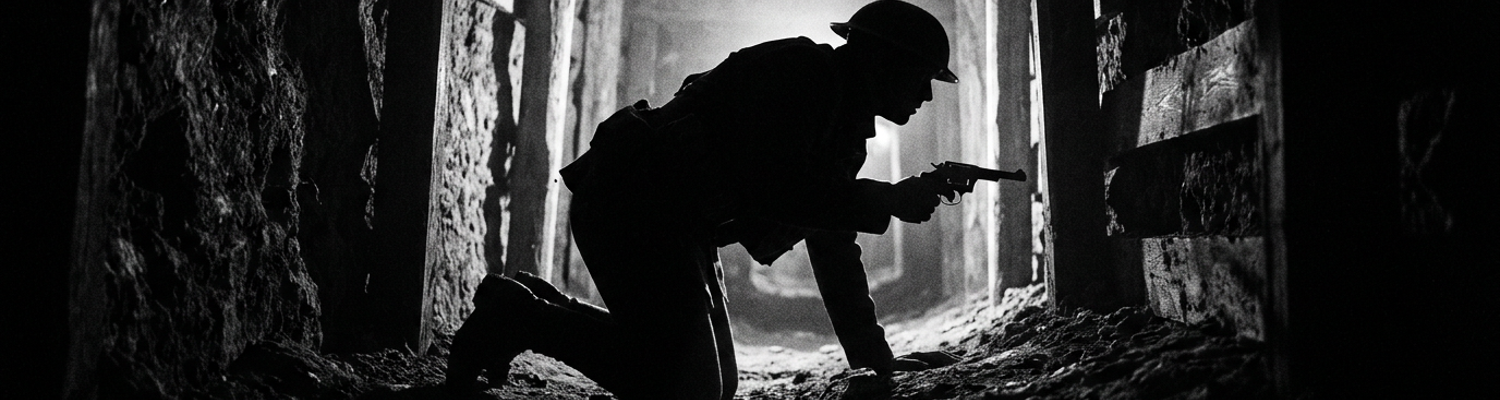
A close review of operational logs indicates that combat employment of the QSPR fell directly on two-man teams drawn from the 326th Engineer Battalion. They operated alongside perimeter security detachments from the 2nd Battalion 506th Infantry. North Vietnamese trench networks converged to within fifteen meters of the perimeter berm on the eastern saddle facing Hill 805 between July 10 and July 18. PAVN sappers from the 803rd Regiment had driven continuous subterranean approach saps beneath the tactical wire. They were preparing deep blast chambers intended for command-detonated satchel charges. Combat engineers crawled headfirst into these unmapped openings without body armor or helmets. They carried only a wire-pull demolition block, a utility knife, and a single QSPR loaded with six rounds. Standard clearing procedures required sliding prone on elbows through damp red laterite clay. Operators traced enemy timber shoring in total blackness to intercept active digging parties. Close-range engagements occurred in tubes measuring barely twenty-six inches wide. Swinging an M16 carbine barrel proved physically impossible in these confines. An ordinary service automatic would shatter an operator's tympanic membranes with trapped concussive overpressure.
The engineers entered these galleries blind.
When examining the historical record of close-quarter underground combat on Hill 927, the optical performance of the captive-piston cartridge determined survival. Discharging a conventional .45 ACP in an unlighted gallery unleashed an incandescent fireball. This bleached retinal rhodopsin and blinded the shooter for up to ten minutes. It also provided enemy soldiers an unmistakable point of aim. The QSPR eliminated that hazard entirely. The internal aluminum piston sealed both the deflagrating powder charge and the burning combustion gases inside the hull itself. Zero flame escaped the muzzle sleeve. Subterranean ambushes occurred at distances of three to six feet. An engineer could smell damp canvas footwraps or detect the scrape of an entrenching spade against packed earth. Squeezing the double-action trigger produced an acoustic signature of 110 decibels. This matched the sound of a wooden crate dropping on packed earth. It was accompanied by zero flash. Operators maintained complete natural night-vision adaptation in zero-illumination galleries. They tracked secondary targets immediately after the initial discharge sent fifteen high-density tungsten pellets into an adversary.
Thermal retention inside the aluminum cases caused an immediate mechanical breakdown.
Archival evidence shows that weapon performance deteriorated rapidly once captive combustion trapped 30,000 pounds per square inch of heat and pressure inside the cylinder. The proprietary aluminum hulls absorbed all thermal energy with nowhere to vent. The metal walls expanded plastically against the steel chambers. This locked the cylinder shut against the frame crane. Star extractors sheared directly through soft cartridge rims when operators struck the ejection rod by hand. Armorers from Company E carried out immediate field modifications inside the maintenance bunker on the southern apron of Ripcord. Mechanics dismantled the modified Smith and Wesson N-frames under intermittent mortar bombardment. They utilized hand-held chamber reamers and silicon-carbide emery cloth to ream out each cylinder chamber by an additional one-thousandth of an inch. Armorers ground down the factory cylinder stop pins. Mechanics fabricated lengthened center-pin ejector extensions from scrap helicopter airframe bolts. Engineers were issued three-inch steel drift punches tethered to their wrists with nylon parachute cord. They used these to pound out ruptured aluminum casings between firing sequences. Tactical teams cleared seven individual approach saps before the garrison received final evacuation orders on July 23.
Environmental Fouling and Subterranean Auditory Isolation
Archival evidence shows that inside the unventilated earthen galleries cut beneath Hill 927, environmental contamination degraded the QSPR mechanism within minutes of entry. Relative humidity inside the subterranean saps hovered near one hundred percent. Heavy condensation pooled across the blued carbon steel frames. Loose red laterite clay turned into an abrasive slurry. This viscous mud penetrated the micro-tolerances between the cylinder face and the flush-cut smoothbore sleeve. AAI machinists had maintained clearances of barely three thousandths of an inch to limit flash venting. Fine grit packed directly into the exposed star extractor ratchets. This bound the cylinder hand and prevented the cylinder from rotating into lockup during double-action trigger pulls. Scouts pushed the revolvers ahead of them through wet soil without holsters. This forced particulate matter into the open rebound slide springs and hammer recesses. Minor traces of clay grit caused the internal cylinder stop bolt to seize in its recess. The cylinder was left spinning freely on its crane without indexing behind the bore sleeve. Moisture also softened the cardboard retaining wads holding the tungsten payload inside the aluminum casings. This produced misfires when damp propellant failed to ignite.
Grit inside the lockwork rendered the experimental revolvers completely inoperable.
A close review of operational logs indicates that the subterranean environment combined with suppressed weapon mechanics produced severe psychological trauma among tunnel-clearing personnel. Ambient sound dropped to absolute zero inside the deadened dirt shafts. This stripped scouts of ordinary spatial orientation and sensory feedback. The dense laterite absorbed sound waves completely. Operators were trapped with only their own rapid respiration, vascular pulses in their temples, and the faint scraping of North Vietnamese spades biting into hard clay ten feet ahead. Discharging the QSPR produced an acoustic report of only 110 decibels. This entirely eliminated the concussive tactile crack that infantrymen relied on to register a successful round discharge. The weapon yielded only a hollow mechanical clack that sounded identical to a hammer falling on an empty chamber. This total absence of auditory confirmation triggered acute panic reactions. Absolute darkness and the smell of stagnant oxygen-depleted air compounded the vestibular disorientation and severe claustrophobic dissociation among the combat engineers of the 326th. Men pulled from the saps shook uncontrollably. They were unable to speak or maintain balance after thirty minutes in the silent earth.
Sensory deprivation broke scouts faster than incoming artillery.
When examining the historical record of 2nd Battalion 506th Infantry operations, the failure of subterranean interdiction directly precipitated the tactical collapse of the firebase. PAVN sappers from the 812th and 803rd Regiments had pushed continuous underground galleries directly beneath the sandbag revetments of Battery B by July 20. Engineers unable to cycle their fouled QSPR revolvers could no longer enter the deep branch saps to neutralize active digging faces with satchel charges. North Vietnamese excavation teams drove horizontal tunnels directly beneath the battalion tactical operations center. They packed dead-end galleries with hundreds of pounds of Chinese-manufactured TNT blocks and Soviet plastic explosives. Lieutenant Colonel Lucas recognized that the base sat atop an untamable grid of command-detonated mine galleries. These could detonate the hill from beneath the 105mm artillery pads. The complete breakdown of tunnel denial operations eliminated the garrison's final defensive redoubt. The 101st Airborne Division executed an emergency helicopter extraction under intense mortar fire on July 23. Downed Hueys and abandoned heavy equipment burned across the helicopter pads. The final elements of Company B lifted off into the cloud base.
Material Audits and Program Cancellation in 1972
A close review of operational logs indicates that technical evaluations conducted at the Camp Evans forward support depot in August 1970 reached grim conclusions regarding weapon reliability. Division ordnance personnel inspected the surviving QSPR handguns retrieved from Firebase Ripcord after the July evacuation. They documented mechanical failures across all recovered cylinders. Technicians test-fired the modified Smith and Wesson Model 29 frames under simulated field conditions. They recorded cartridge casing seizure rates exceeding thirty percent. Captive-piston ignition trapped expanding propellant gases inside the hull without a forward vent. Thermal energy forced the proprietary aluminum cases to expand outward against the steel cylinder walls. Ambient heat averaging ninety-five degrees Fahrenheit and continuous relative humidity above ninety percent prevented convective metal cooling between firing cycles. Striking the ejector rod repeatedly sheared the steel star extractor teeth directly through the softened aluminum rims. This permanently bound the cylinder against the frame crane. Depot armorers had to drive deformed casings out from the front of the cylinder using steel drift punches and mallets. This warped ejector rods and bent cylinder cranes during field maintenance.
Casing extraction required a hammer and drift punch after every volley.
When examining the historical record of subsequent supply audits, procurement specialists discovered that ammunition manufacturing expenses made broad tactical fielding impossible. Each proprietary captive-piston round produced by the AAI Corporation required separate lathe turning. Tight-tolerance internal piston matching and manual assembly at Cockeysville drove individual unit costs above twenty-two dollars per cartridge in 1971 currency. Standard military issue .38 Special and .45 ACP ammunition cost the Department of Defense less than seven cents per round. Depot inspection reports compiled across technical holding areas in South Vietnam simultaneously revealed rapid chemical decay within forward ammunition lots. Synthetic rubber O-rings and internal elastomeric seals designed to bottle high-pressure combustion gases decomposed in hot damp storage bunkers. Jungle moisture penetrated the degraded seal gaps. This contaminated propellant charges and destabilized internal percussion caps. Ballistic testing on stored ammunition batches confirmed that forty percent of forward inventory suffered from pressure leakage. Erratic pellet velocity or complete ignition failure occurred after six months in theater.
A single six-round cylinder reload cost more than an entire wooden crate of standard service ammunition.
Archival evidence shows that the US Army Land Warfare Laboratory formally terminated the Quiet Special Purpose Revolver development program in late 1972. Technical Report LWL-CR-02P70 concluded that the experimental captive-piston system offered zero practical utility outside subterranean bunker interdiction. American combat brigades were withdrawing from the Republic of Vietnam under the troop drawdowns of Operation Keystone. Ground doctrine shifted away from specialized jungle fighting to armored warfare against mechanized forces in Central Europe. Army ordnance managers recalled the remaining field evaluation assets from overseas depots. They received twenty-five modified revolvers and twelve hundred unfired captive-piston cartridges back at Aberdeen Proving Ground. AAI Corporation contract options for full-scale production were canceled without authorization for replacement parts or follow-on acquisitions. Technicians packed the recovered revolvers into cosmoline-coated shipping containers. They logged the serial numbers under obsolete experimental property codes. The wooden crates were slid into inactive storage aisles at Aberdeen.