
Navy Department Inquests on Salerno Fire Direction
Between September 9 and September 18 of 1943, Allied forces sustained 8,924 casualties inside the Salerno bridgehead. The United States 36th Infantry Division lost 1,600 men in five days of sustained German counterattacks. Following the near-collapse of the beachhead at the junction of the British X Corps and United States VI Corps, the Navy Department convened formal inquiries in Washington. Investigating officers systematically pulled after-action reports from Admiral H. Kent Hewitt and his Western Task Force. They reviewed transcripts from Army artillery commanders. Archival evidence shows that what had been planned as an integrated air-sea-land defensive umbrella dissolved almost immediately into uncoordinated radio panic once the 16th Panzer Division pushed into the Sele River corridor.
Waterproofing compounds failed the moment landing craft dropped their ramps.
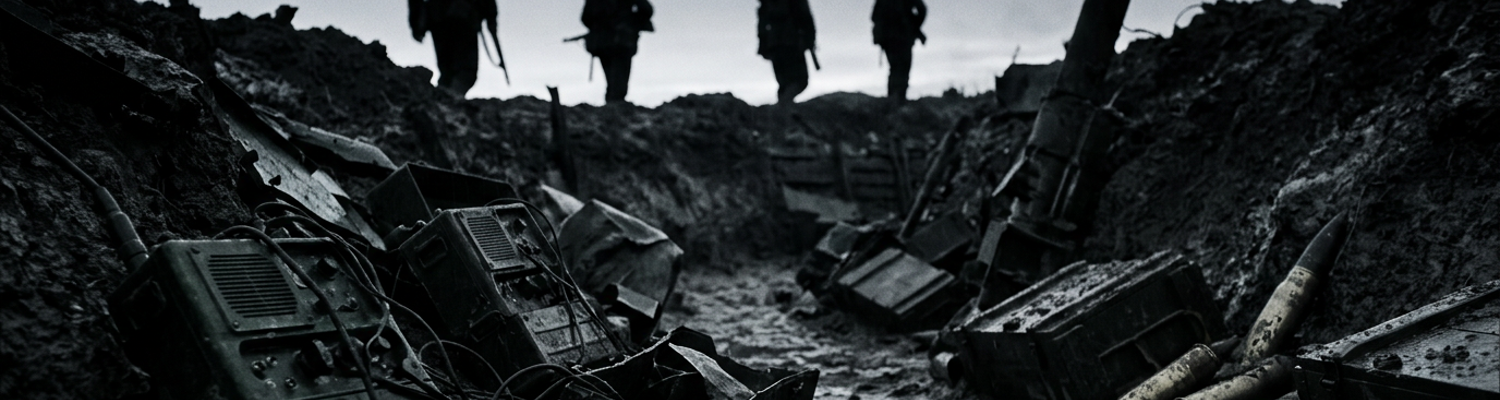
When examining the historical record of the 36th Division sector, investigators isolated catastrophic equipment and procedural failures within the naval gunfire liaison teams. Shore fire control parties dragged SCR-284 radio sets through four feet of breaking surf onto Red Beach. This soaked the internal tuning coils and rendered battery packs dead on contact. Out of thirty-two liaison radio nets scheduled to open on D-Day morning, three managed to establish two-way communication with fire support destroyers standing offshore. Forward observers who did maintain functional gear discovered severe frequency congestion across the high-frequency spectrum. Tank battalion command nets bled directly into naval target-designation channels. Severe map coordinate discrepancies compounded the communications void.
Army spotters called in targets using the British Modified Grid system mapped to 1:50,000 tactical sheets.
Shipboard plotters on the light cruisers worked off polyconic charts gridded in latitude and longitude. This required manual arithmetic conversions under fire that routinely introduced errors of three hundred to five hundred yards. Liaison officers isolated near the Persano tobacco factory found themselves completely cut off. They watched German panzers roll past their positions while unable to transmit firing coordinates to cruisers floating four miles out at sea.
Navy Department records confirmed eleven separate friendly-fire incidents within the Sele-Calore pocket.
A close review of operational logs indicates that the crisis shifted from message transmission to raw terminal ballistics once ships began firing without positive target verification. Analysts at the Bureau of Ordnance focused their post-action review on the six-inch 47-caliber Mark 16 guns mounted in triple turrets aboard the light cruisers USS Boise and USS Philadelphia. Firing up to ten rounds per barrel each minute, these batteries delivered sustained high-explosive bombardments directly into the gaps where German infantry was overrunning American positions. Bureau ballistic specialists discovered that rapid continuous fire drove barrel temperatures beyond metallurgical design limits. This stripped rifling lands and accelerated copper fouling within the gun tubes.
Thermal expansion and bore wear rapidly destroyed ballistic accuracy.
Bureau of Ordnance gunnery tables demonstrated that after five hundred rounds of continuous service, the dispersion pattern of a six-inch high-capacity shell expanded wildly. At ranges between ten thousand and fourteen thousand yards, the standard range dispersion ellipse doubled from one hundred and fifty yards to over three hundred and twenty yards. Lateral deflection shifted unpredictably up to two hundred yards from the aiming point. The hundred-and-five-pound Mark 34 projectile possessed a lethal fragmentation radius exceeding seventy yards against exposed infantry. Forward commanders in the Sele pocket had authorized missions within two hundred yards of