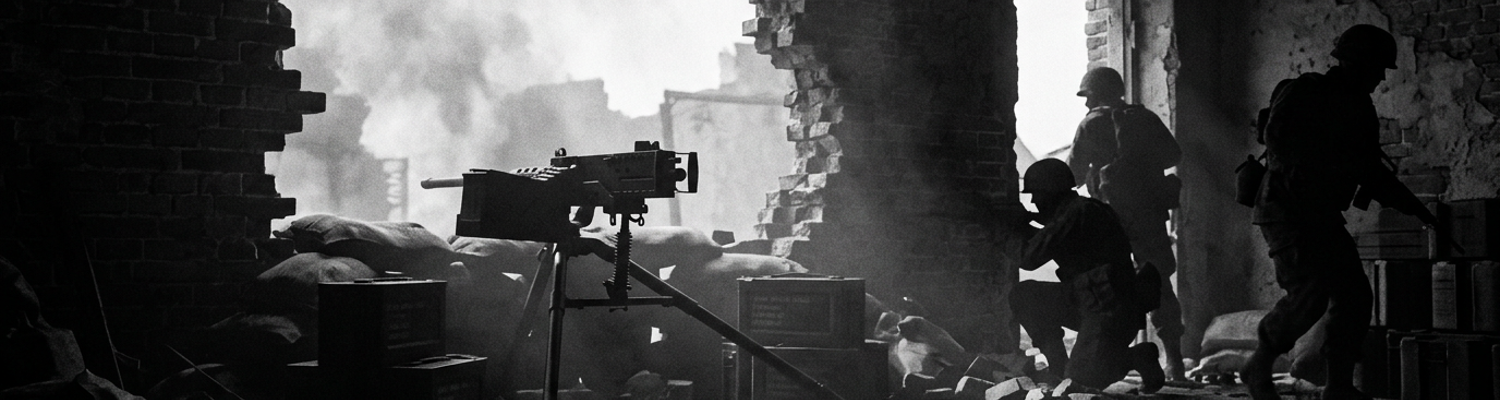

Heliborne Insertion at St. George Compound
Down-wash from the main rotors bent the estate hedges. Anti-aircraft fire cut through the morning fog over St. George harbor. The element of surprise vanished immediately.
A close review of operational logs indicates the communications network for the raid failed long before the first helicopter skid cleared the tree line. Two nights prior. A covert water drop off the southern tip of Grenada near Point Salines. High winds and heavy ocean swells claimed four operators along with the assault element primary satellite communication gear. The AN/PSC-3 tactical satellite transceiver package sank. This unit was weighted down with lithium battery blocks and cryptographic speech equipment (NSN 5820-01-145-9871). It slipped beneath the waves during the maritime extraction attempt from a C-130 Hercules. Losing this hardware eliminated direct voice links between the assault team and the command deck of the amphibious assault ship USS Guam (LPH-9). Ground operators carried only lightweight MX-300 handheld radios and VHF survival sets. These small transmitters lacked the wattage to push signals through the volcanic ridges encircling the capital.
Direct radio connection to offshore naval air support vanished before the assault force reached the objective.
Archival evidence shows that at approximately 0530 hours on October 25, 1983, two MH-60A Black Hawk helicopters assigned to the 160th Aviation Battalion flared over the manicured grounds of the Government House compound. Down-wash peeled clay tiles from the Victorian roof. Twenty-two operators from SEAL Team Six kicked thick braided fast-ropes through the open cabin doors. They slid fifty feet into the hillside estate overlooking St. George harbor. Descending through small-arms fire from nearby high ground. The commandos dropped into the manicured gardens, bounded past exterior retaining walls, and established defensive sectors along the outer gates. Below the hill, merchant vessels and civilian fishing trawlers drifted in plain view across the bay. Gunners at nearby Fort Frederick immediately targeted the open elevation of the mansion with heavy 12.7mm machine-gun fire.
Both transport helicopters took multiple fuselage hits before lifting clear of the estate trees.
When examining the historical record, breaching the brick residence exposed the explosive diplomatic stakes driving the entire military incursion. Assault teams pushed through the ground-floor entryways. They cleared room by room until locating British Crown representative Governor-General Sir Paul Scoon and his wife sheltered inside an interior room. Scoon held the sole legal authority recognized by neighboring Caribbean democracies to sanction external military intervention. The government of Prime Prime Margaret Thatcher in London had received no advance consultation regarding the American troop deployment. Grenadian police constables stationed at the home surrendered their weapons to the assault force without firing a shot. American commandos ushered the Governor-General, his spouse, and several domestic staff members into a reinforced room. They established defensive firing positions behind heavy mahogany furniture as Grenadian People Revolutionary Army forces organized an immediate counterattack.
Soviet-built BTR-60 armored personnel carriers were already grinding into gear along the main approach road from the harbor.
Mechanized Encirclement by Grenadian Revolutionary Forces
The brick walls offered no shelter against heavy armor.
Archival evidence shows mechanized units of the Grenadian People Revolutionary Army deployed three Soviet-manufactured BTR-60PB armored personnel carriers from the garrison at Fort Frederick. This deployment occurred within thirty minutes of the helicopter insertion. Rumbling down the steep tarmac of Richmond Hill toward the capital basin. These eight-wheeled amphibious transports maneuvered into blocking positions along the main gate, the eastern service driveway, and the lower gardens. The fourteen-ton vehicles utilized their dual GAZ-49B six-cylinder engines to crash through the compound perimeter obstacles. Motorized infantry detachments under the direct command of Revolutionary Military Council leadership operated the carriers. They established uninterrupted fields of fire across the courtyard. Grenadian infantry squads dismounted under vehicle cover. They occupied adjacent stone outbuildings and set up secondary cordons along the perimeter fences. SEAL operators posted at ground-floor windows found themselves staring directly down the barrels of armored turrets positioned less than seventy yards away. Driver crews throttled the engines to idle. They held position just beyond the effective range of shoulder-fired weapons.
Light small-arms fire suddenly gave way to heavy vehicular cannons.
When examining the historical record, the ballistic disparity between the opposing forces altered the engagement inside minutes. Gunners inside the conical turrets of the BTR-60PBs opened fire with 14.5mm KPVT heavy machine guns. They unleashed steel-cored B-32 armor-piercing incendiary rounds directly into the residence facade. Exiting the muzzle at roughly 1,000 meters per second. These heavy projectiles pulverized nineteenth-century Victorian brickwork. They shattered load-bearing wooden support beams. They punched completely through multiple interior partition walls without losing trajectory. Standard exterior masonry fractured into clouds of high-velocity stone fragments. SEALs returned fire with 5.56mm CAR-15 carbines and 7.62mm M60 machine guns. Standard small-arms fire simply ricocheted off the sloped armor plate of the Soviet hulls. The BTR-60PB featured welded steel armor ranging from seven to nine millimeters in thickness. This was sufficient to deflect NATO standard 5.56mm ball ammunition at any range. An operator fired a 66mm M72 LAW anti-tank rocket from an upper-floor window. The munition glanced off the front glacis plate of the lead carrier without penetrating the crew compartment. Commandos pulled the Governor-General, his wife, and domestic staff into a reinforced interior hallway on the lower level. They stacked antique mahogany tables to create makeshift blast baffles as powdered plaster blinded the defenders. Spall and heavy machine-gun slugs chewed through interior furniture, wounding two commandos with stone fragments.
Planned evacuation corridors ceased to exist.
A close review of operational logs indicates the original assault plan designated an emergency helicopter extraction via Marine CH-46 Sea Knights from the amphibious assault ship USS Guam within two hours of securing the building. That window closed before 0800 hours. Anti-aircraft crews stationed at Fort Frederick and Fort Rupert had locked down the surrounding airspace. They directed twin-barrel 23mm ZU-23 autocannons and truck-mounted DShK heavy machine guns across the estate sloping front lawn. PRA motorized squads simultaneously threw reinforced roadblocks across Lucas Street. This severed the sole downhill escape corridor toward the commercial harbor docks and precluded any overland breakout on foot. Incoming transport helicopters attempting to flare over the lawn faced interlocking crossfires from elevated ridgeline batteries that overlooked the compound. Trapped alongside non-combatant VIPs, the twenty-two SEALs depleted their remaining 5.56mm ammunition to single magazines while dealing with weapon stoppages caused by concrete debris. The detachment had no usable escape route to the coastline, no operational landing zone, and zero physical link to offshore naval forces. Every planned line of retreat dissolved under heavy automatic fire.
Field Expedient Communications and Armor Defense
Survival inside the perimeter depended entirely on improvisation with whatever hardware remained functional inside the residence.
Archival evidence shows communications specialists realized standard line-of-sight whip antennas could not clear the volcanic rim of Mount Maitland. Radioman operators stripped insulated wiring from shattered floor lamps, wall sconces, and ceiling fans across the formal dining room. They used pocket multitools to shave the plastic jackets down to raw copper strands. Splice by splice. Two commandos twisted the exposed metal into a makeshift sixty-foot dipole array. They bound one terminal directly into the RF output connector of an AN/PRC-117 tactical radio set. Running the line through an upstairs sash window. An operator crawled under intermittent machine-gun fire across the clay shingles to loop the end around an iron lightning rod on the east chimney. This jury-rigged assembly converted the building metal rain gutters and rooftop ironwork into an amplified resonant antenna ground plane. Testing the setup at 0915 hours. Operators registered an immediate spike in transmit wattage. The signal threw radio frequencies straight up into the lower ionosphere to circumvent the terrain shielding the St. George basin.
Soviet armor still controlled the driveway.
When examining the historical record, standard shoulder-firing techniques against the BTR-60PB vehicles proved suicidal given the continuous 14.5mm suppression sweeping the upper window frames. Team members gathered four remaining single-shot 66mm M72 LAW tubes. They stripped their damaged rubberized safety covers and detached the factory pop-up sights. Operators used field wire, duct tape, and scrap lumber from broken dining tables to construct rigid reinforced firing brackets. These brackets were anchored directly against the stone interior sills of the second-story study. This mechanical mount stabilized the disposable launch tubes at a steep downward forty-five-degree angle toward the blind spots of the armored hulls twenty yards below. Commandos rigged lanyard cords to the trigger levers. This enabled gunners to ignite the rocket motors from prone shielded positions behind reinforced brick piers. When the lead eight-wheeled vehicle rolled past the servant quarters at point-blank range, a triggered LAW warhead struck the top deck plate directly above the GAZ-49B engine bay at a ninety-degree angle of incidence. The high-explosive shaped charge pierced the thin seven-millimeter horizontal armor. It ignited the fuel tanks and detonated onboard ammunition drums.
That direct strike disabled the lead hull.
A close review of operational logs indicates the ad-hoc antenna array broke through military frequency channels at roughly 0945 hours. It picked up the callsign of an Air Force AC-130H Spectre gunship orbiting beyond radar coverage to the north. Operators on the second floor authenticated call codes using signal operating instructions scavenged from a soaked vest. They immediately patched their frequency into the joint fire support net. This improvised voice circuit also connected Government House with the bridge of the destroyer USS Caron (DD-970). The destroyer was steaming eight miles off Grand Mal Bay. SEAL spotters laid grease pencils across tourist maps of St. George. They relayed eight-digit grid coordinates for PRA anti-aircraft positions, troop concentrations, and the surviving two armored vehicles encircling the gates. Orbiting above the cloud deck, the AC-130 leveled into a left-hand pylon turn. The aircraft walked 40mm Bofors shells and 105mm high-explosive rounds within fifty yards of the mansion outer brick fence. Simultaneously, five-inch naval artillery rounds from USS Caron hammered the heavy mortars and ZU-23 emplacements on Richmond Hill. This stripped away the supporting infantry units that pinned the diplomatic compound.
Shrapnel from the offshore naval bombardment severed the PRA telephone trunk line to Fort Rupert at 1015 hours.
Interservice Radio Failures and Tactical Isolation
Interoperability between American military branches did not exist on the ground in Grenada.
Archival evidence shows the communications architectures of the Navy special warfare detachment and incoming conventional Army units operated on entirely distinct frequency bands. SEAL Team Six deployed with UHF and specialized VHF-FM transceivers pre-set to naval fleet satellite channels and naval gunfire support nets. Elements of the Army 82nd Airborne Division and the 75th Ranger Regiment landed miles to the south at Point Salines. Their forward air controllers and platoon leaders operated AN/PRC-77 radio sets tuned to tactical VHF-FM bands between 30.00 and 75.95 MHz. Cryptographic authentication tables and Signal Operating Instructions had never been exchanged between the branches before the operation commenced. Factory-set Navy radios lacked the capability to dial into the low-band Army tactical networks. Army company commanders advancing north had no hardware capable of receiving the higher-frequency UHF broadcasts emitted from Government House. Joint planners in Norfolk failed to publish an integrated communications plan. Tactical units remained isolated within their individual service frequencies despite operating within five miles of each other.
No radio signal bridged the five-mile gap between the estate and the airfield.
A close review of operational logs indicates the breakdown of tactical radio links forced ground personnel to depend on civilian infrastructure to contact American naval command ships offshore. Wandering through the smoke-filled administrative offices on the mansion ground floor. An operator discovered an intact British-style rotary telephone plugged into an active wall jack. Dial tones still hummed across the receiver because Grenadian telecom technicians had not cut the subterranean copper trunks connecting St. George to the international cable exchange. Lacking direct radio contact with the amphibious command ship USS Guam. The operator dialed an unclassified commercial phone number belonging to the Joint Special Operations Command headquarters at Fort Bragg, North Carolina. Operators in the besieged residence utilized a personal commercial telephone credit card to keep the transatlantic connection active across the Caribbean switchboards. Duty officers inside the operations center at Fort Bragg answered the incoming civilian call. They jotted down eight-digit map grid coordinates and manually teletyped the tactical data through high-priority military channels back out to Navy commanders aboard USS Guam. This multi-thousand-mile civilian relay loop routed every urgent request for naval gunfire, AC-130 gunship strikes, and perimeter ammunition resupply.
The voice link depended on an uninterrupted civilian telephone cable.
When examining the historical record, the absence of functional joint coordination stretched the mission into an unexpected twenty-four-hour siege. Planners originally scheduled conventional relief units to lift the encirclement within two to three hours of the initial morning airborne assault. The 2nd Battalion, 8th Marines faced heavy naval gunfire tasks and beach obstacles at Grand Mal Bay. The 82nd Airborne Division sat pinned down by entrenched anti-aircraft batteries and motorized infantry around Point Salines and the Richmond Hill ridgeline. Army assault columns lacked real-time situational reports regarding the status of the mansion. Their armored elements halted along southern roads rather than pushing aggressive spearheads through the mountain passes. Night fell over St. George with twenty-two commandos, the British Governor-General, and eleven foreign civilians still trapped behind makeshift barricades. Grenadian infantry probed the outer brick walls under darkness. Relief finally arrived at 0700 hours on October 26. Company G of the 2nd Battalion, 8th Marines pushed five amphibious assault vehicles and two M60A1 Patton tanks up the steep grade from Grand Mal.
Twenty-six hours had elapsed since the first Black Hawk cleared the tree line.
Anglo-American Diplomatic Fallout and Commonwealth Tensions
The transatlantic telephone cables between London and Washington carried heavy diplomatic traffic before the smoke cleared over St. George.
Archival evidence shows Prime Minister Margaret Thatcher received word of the military landings only after American transport helicopters were already descending on the island. Hours earlier on October 24. Foreign Secretary Sir Geoffrey Howe stood at the dispatch box in the House of Commons. He assured members of Parliament that the United States harbored no military designs against the Commonwealth territory. That assessment collapsed when American special operations forces stormed the private estate of Governor-General Sir Paul Scoon. Scoon acted as the direct constitutional stand-in for Queen Elizabeth II. Inside 10 Downing Street. Thatcher dictated sharp telex cables to the White House. She registered fierce official objections over the absence of prior consultation before initiating kinetic operations within a sovereign Commonwealth state. American planners bypassed British channels to prevent operational leaks. British cabinet ministers were left blindsided while the Royal Navy frigate HMS Antrim lingered fifty miles offshore without engagement orders. Thatcher informed President Ronald Reagan by secure voice link that unannounced armed incursions into allied territorial jurisdictions set a dangerous precedent for Western international relations. She specifically noted the physical encirclement of Her Majesty official representative inside an active firefight represented a grave diplomatic insult.
Downing Street learned of the helicopter assault from morning news wire feeds.
When examining the historical record, this political friction broke into the open at the United Nations headquarters in New York. The United Nations Security Council convened an emergency session on October 27, 1983. They debated draft resolution S/16077, sponsored jointly by Guyana, Nicaragua, and Zimbabwe. Draft terms formally censured the military action. The text labeled the armed intervention in Grenada a direct violation of international law and sovereign independence. United States Ambassador Jeane Kirkpatrick occupied the council seat to defend the operation. She argued the incursion represented an urgent evacuation mission to protect American medical students and restore civil order alongside the Organization of Eastern Caribbean States. Council members pushed the measure to a formal vote on October 28. Eleven nations voted in favor of condemnation, including key American treaty partners France and the Netherlands. Great Britain abstained from the vote alongside Togo and Zaire. Kirkpatrick dropped the lone American veto to kill the resolution. The measure promptly migrated to the General Assembly where member states passed Resolution 38/7 by a vote of 108 to 9. This censured the operation without veto interference.
Western unity fractured along the polished floorboards of the Security Council chamber.
A close review of operational logs and diplomatic traffic indicates the operation exposed deep strategic divisions between the Reagan administration and traditional North Atlantic Treaty Organization partners. European defense ministries in Paris, Bonn, and Rome viewed the unilateral deployment of carrier battle groups and airborne regiments to the Caribbean as evidence of unpredictable American foreign policy conduct. This unilateral stance alarmed European defense ministers. These officials were actively preparing domestic bases for the incoming deployment of American Pershing II intermediate-range ballistic missiles and BGM-109G ground-launched cruise missiles. Washington bypassed allied consultation over Commonwealth territory in Grenada. European leaders feared an unchecked American command could initiate unilateral strikes against Soviet-bloc targets from European soil. This would expose NATO members to retaliatory strikes without their consent. West German Chancellor Helmut Kohl faced mounting domestic pressure from anti-nuclear coalitions citing the Grenada invasion as proof of uncoordinated American adventurism. At NATO headquarters in Brussels. American liaison officers fielded tense inquiries from European delegations seeking written reassurances that dual-key consultative mechanisms over theater nuclear assets would remain inviolable.
Legislative Repercussions and Special Operations Structural Reform
Capitol Hill demanded immediate accountability once the commercial phone call from Government House became public knowledge.
Archival evidence shows closed-door hearings before the House and Senate Armed Services Committees centered directly on the systemic friction dividing service branches in St. George. Admiral Wesley McDonald directed Atlantic Command from Norfolk. He managed an operational structure where naval battle groups, Marine amphibious elements, and Army airborne units answered to separate service chiefs. These chiefs guarded their administrative turf. The siege exposed how service branch rivalries crippled tactical execution. Navy commanders aboard USS Guam refused to refuel Army helicopters. Army commanders advanced across the island without common maps or unified battle space boundaries. Representative Bill Nichols and Senator Barry Goldwater seized on these tactical breakdowns. They pushed investigative staff to draft comprehensive overhaul legislation despite ferocious opposition from the Joint Chiefs of Staff and Defense Secretary Caspar Weinberger. The resulting Goldwater-Nichols Department of Defense Reorganization Act of 1986 stripped the individual service secretaries of operational warfighting control. Power shifted directly to regional combatant commanders. The Chairman of the Joint Chiefs gained statutory designation as the principal military advisor to the National Command Authority.
Inter-service rivalry had paralyzed command on the ground.
A close review of operational logs indicates the operational isolation of SEAL Team Six at Government House convinced defense analysts that special operations forces required an autonomous administrative architecture. Army Rangers jumping onto Point Salines, Air Force combat controllers, and Navy special warfare operators entered the Grenada campaign under fractured commands. They relied on competing supply pipelines and zero shared doctrine. Senators Sam Nunn and William Cohen introduced legislation to amend the 1987 National Defense Authorization Act. They bypassed Pentagon resistance to establish the United States Special Operations Command at MacDill Air Force Base in Florida in April 1987. This legislative mandate created a unified four-star combatant command specifically dedicated to unconventional warfare across all branches. Congress simultaneously created Major Force Program 11. This ring-fenced funding line prevented conventional service chiefs from raiding budgets earmarked for commando equipment, weapons development, and specialized aviation assets. The creation of the civilian post of Assistant Secretary of Defense for Special Operations and Low-Intensity Conflict guaranteed direct oversight inside the Pentagon.
Tactical radios from different branches could not bridge a five-mile gap.
When examining the historical record, the spectacle of elite ground operators using an unencrypted civilian telephone landline and a personal credit card to call Fort Bragg forced an overhaul of Pentagon electronics procurement. Ground forces carried incompatible inventory. Army infantry platoons brought analog AN/PRC-77 VHF-FM radios. Navy SEAL teams brought AN/PSC-3 UHF satellite transceivers and high-band sets. Marine units operated on divergent tactical networks. The Office of the Secretary of Defense cancelled several branch-specific radio contracts. They ordered defense contractors to develop standardized frequency-agile systems capable of operating across low-band VHF, high-band VHF, and UHF spectrums. This institutional shift accelerated the acquisition of the Single Channel Ground and Airborne Radio System, known as SINCGARS. This platform incorporated integrated cryptographic modules and automated frequency-hopping to secure tactical voice traffic against interception. Defense procurement directives mandated that future radio acquisitions satisfy strict Joint Interoperability Certification standards. Ground-level equipment programs began transitioning toward multiband architectures. This directly shaped the engineering requirements that later produced the AN/PRC-148 Multiband Inter/Intra Team Radio and the AN/PRC-117F tactical terminal.
The Department of Defense formally decertified non-interoperable single-service tactical transceivers from frontline procurement schedules in late 1988.