
Logistical Bottlenecks on the Cotentin Peninsula
At 0412 hours, net control logged an unencrypted message from the forward observer near the approaches to Cherbourg. Dry cells were failing. The circuit broke on radio set SCR-300. Signal strength dropped to zero. Contact with battalion headquarters ceased. When examining the historical record, this frantic transmission exposed the collapse of front-line technical communications days before infantry assaulted the concrete outer works of Fort du Roule. Severe supply bottlenecks along the Cotentin Peninsula restricted the flow of basic operational equipment to the forward trace. Off the coast, a severe English Channel gale between June 19 and June 22 wrecked the temporary Mulberry harbor at Saint-Laurent. This weather event halted offshore lighterage operations. Seventh Corps quartermasters faced a backlog. Transport tonnage dropped from expected targets to mere trickles. Depot managers south of Sainte-Mere-Eglise prioritized heavy artillery shells and vehicle fuel. Basic signal hardware, dry cell batteries, and dry footwear sat in flooded beach dumps.
Wrecked supply vehicles blocked the single usable lane on Route Nationale 13.
A close review of operational logs indicates that First Army motor maintenance companies ran out of standard spare axles and universal joints for two-and-a-half-ton GMC trucks by June 20. Dirt roads across the Cotentin corridor dissolved into deep mud under continuous Allied convoy movements. Drive shafts snapped. Supply columns stalled south of Valognes (NARA Record Group 338). Divisional staff officers routed supply trains through narrow secondary lanes flanked by ancient stone hedgerows. This created gridlock. Division-level distribution stalled. Mechanics lacked vulcanized tire patches, carburetor gaskets, and replacement fuel pumps. Distribution points near Montebourg held pallets of grease and canned rations. Forward regiments could not obtain signal wire spools or fresh radio dry cells. Forward commanders sent quartermaster couriers on foot to retrieve items. Depot officers remained strictly bound by priority discharge orders. These orders forbade opening waterproof munitions crates without division authorization. Ordnance depots held crated radio sets fifty miles behind the lines at the beachhead. Line companies fought with depleted gear.
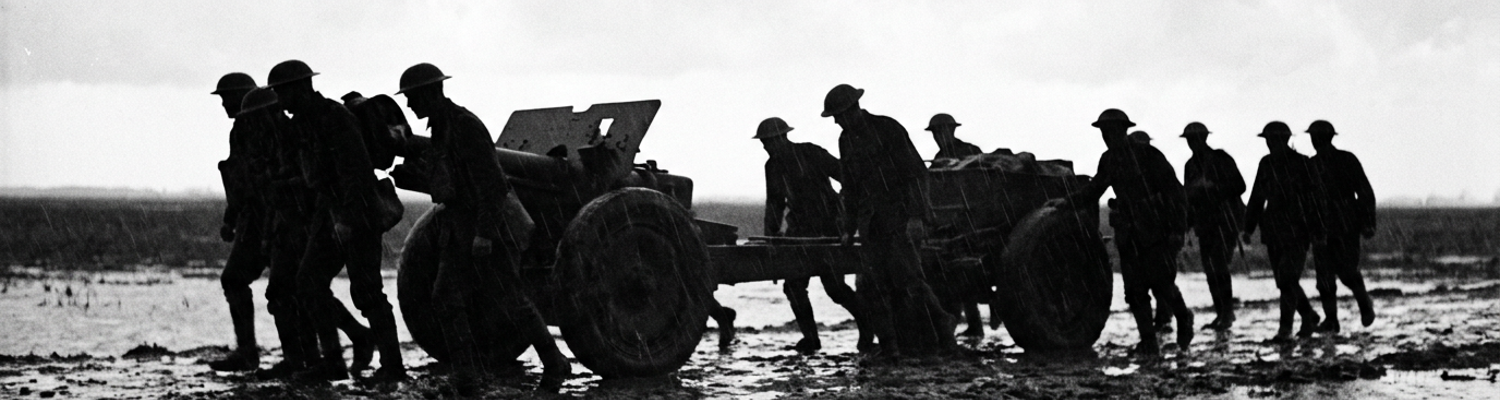
Archival evidence shows that the 314th Infantry Regiment of the 79th Infantry Division suffered the full brunt of this distribution failure during their advance toward Cherbourg. Elements of the regiment began an exhausting forced march on June 19. They moved north through drenching rain and deep mire toward the German defensive perimeter ringing the port. Soldiers sloshed through continuous downpours along the marshy edges of the Douve drainage basin. They averaged less than two miles per hour. Deep mud dragged down combat boots. Col. Warren A. Robinson ordered his battalions forward without pauses for hot rations or dry clothing. He needed to meet VII Corps attack deadlines. Riflemen stumbled through continuous squalls for seventy-two hours. They carried heavy entrenching tools, wet woolen overcoats, and combat loads through flooded sunken lanes. German rear-guard machine gun nests and mortar barrages near Delasse repeatedly forced companies off the dirt tracks. Men dove into waist-deep water in flooded drainage ditches. By June 22, the 314th reached the outer defense belt of Cherbourg. Riflemen suffered severe foot rot and physical exhaustion.
Packs absorbed rainwater until individual loads exceeded eighty pounds.
Prolonged exposure to damp conditions degraded sensitive battery supplies. Infantry packs across every forward company became saturated. Standard canvas M1928 haversacks lacked rubberized liners. Wool blankets, spare socks, and field rations absorbed gallons of moisture. Inside communications pouches, moisture penetrated the non-hermetic cardboard casings of standard zinc-carbon dry cells. The BA-70 batteries powering the SCR-300 backpack radios suffered rapid internal chemical decay. The smaller BA-38 batteries inside the SCR-536 hand-held units experienced the same failure. Water seeped through the terminal seals. This triggered galvanic corrosion. Electrical potential drained before operators ever switched the equipment to transmit. Terminal voltage in forward BA-70 packs fell from a nominal eighteen volts down to less than four volts. This starved the vacuum tubes of operating power. Signal officers attempted to run field tests on replacement batteries straight out of division supply crates. They found up to sixty percent of the cells dead from mold contamination and terminal crusting. Company signalmen stripped the cardboard sleeves. They discovered that moisture had dissolved the paper spacers between positive carbon rods and zinc cups. This caused direct short circuits. Line platoons entering the outer defense zone of Fort du Roule lacked functioning transceivers. They relied on single-strand field wire. This wire broke whenever vehicles crushed the muddy roadbeds.
Dry-Cell Battery Shortages Before the Fortress Assault
A close review of operational logs indicates that the 314th and 313th Infantry Regiments hit an absolute deficit of replacement dry-cell packs. They converged on the outer works of Cherbourg on June 23. Field units relied on two portable battery models to coordinate company and platoon maneuvers. The first was the BA-70 multi-cell block for the backpack SCR-300 FM transceiver. The second was the slender 103.5-volt BA-38 stack designed for the handheld SCR-536. Each SCR-300 transceiver consumed its BA-70 battery within twenty to twenty-four hours of intermittent operation. The small BA-38 depleted after roughly two to four hours of active voice transmission. Quartermaster supply depots around Sainte-Mere-Eglise flooded. Thousands of reserve batteries absorbed groundwater through their wax paper jackets. This initiated an uncontrolled internal discharge. Regimental signal officers attempted to requisition fresh stocks. They received fewer than ten percent of their scheduled allowances. Battery testing occurred at the 79th Infantry Division signal dump near Valognes. Out of two hundred inspected BA-70 packs, one hundred and forty-two registered zero volts on the B-battery high-tension circuit. Soldiers carried sixteen-pound radio sets without a single working cell to power their vacuum-tube filaments.
Every battalion signal depot across the northern Cotentin ran completely out of replacement dry cells by midday on June 23.
Archival evidence shows that VII Corps supply priority sheets directly caused this front-line electronic blackout. Priority red-line manifests issued by First Army logistics control mandated specific cargo loads. Every operational two-and-a-half-ton cargo truck coming up from Utah Beach had to carry Class V ordnance instead of Class II and IV technical supplies. Corps artillery battalions supporting the push on Cherbourg expended over twenty-five thousand rounds of 105-millimeter and 155-millimeter high-explosive shells every twenty-four hours. This demanded hundreds of daily truckloads to maintain firing rates against concrete German pillboxes. Quartermaster officers at the beachhead dumps stripped crates of signal wire, field phones, and radio batteries off outbound trucks. They made room for 4.2-inch chemical mortar shells and Bangalore torpedoes. These munitions were required to clear defensive barbed-wire belts. Convoys rolling up Route Nationale 13 carried pallets of artillery propellants and rifle clips. Communications officers waited at roadside transfer points with empty handcarts. Regimental requisitions for spare BA-38 batteries received a Class IV distribution freeze from division logistics officers. These officers categorized dry-cell power supplies as secondary combat equipment.
Artillery shells took up every square inch of cargo space on the northern roads.
When examining the historical record, this supply failure forced battalion and company radio operators to ration transmission time down to strict operational windows. They fought toward the rocky slopes beneath Fort du Roule. Signal officers ordered forward operators to keep transceivers switched off. They only powered up during prearranged three-minute contact windows scheduled once every two hours. Forward observers from the 311th Field Artillery Battalion advanced along the slopes of Hill 86. They could not call in defensive fire missions against German 88-millimeter guns. Keeping the SCR-300 receiver circuit open for fifteen continuous minutes drained the already corroded BA-70 packs below the 4.5-volt tube filament cutoff. Operators attempted to transmit voice messages. They held the press-to-talk switch down for no more than five seconds. They transmitted coordinates in compressed numerical code. Then they broke the circuit to prevent plate-voltage collapse. Rifle company commanders lost the ability to redirect flanking platoons. Handheld SCR-536 units fell completely silent. Their depleted BA-38 batteries failed to heat the 1S5 audio amplifier tubes. Contact between adjacent assault platoons disintegrated entirely during the final approach across the open anti-tank ditches fronting the southern fort fortifications.
Third battalion radio operators attempted to transmit from the drainage culverts at the western base of the fortress at 1600 hours on June 24.
They found their remaining BA-70 batteries delivering less than 1.1 volts on the low-voltage tap. The radio transmitters arrived dead at the rocky foot of Fort du Roule.
Physical Exhaustion of the 304th Engineer Combat Battalion
A close review of operational logs indicates that logistical transport broke down completely along the secondary access trails between La Glacerie and Cherbourg on June 24. Heavy downpours turned bypass tracks into bottomless clay beds. Two-and-a-half-ton GMC CCKW trucks and 3/4-ton Dodge weapons carriers sank up to their axles. Divisional staff could not advance motorized air compressors or vehicle-mounted pneumatic tools to clear path obstructions. Support teams had to hand-carry logistical gear across washed-out roads. These roads were inaccessible to standard transport vehicles. Pioneer platoons organized into relay lines to move Class IV construction stores, replacement entrenching picks, five-gallon water cans, and heavy spools of wire forward by hand. Runoff washed away primitive field bridges over local drainage ditches. This left steep muddy ditches. Soldiers waded waist-deep through swift currents. Crates of canned C-rations and replacement rifle ammunition shifted from stalled truck beds onto the shoulders of men. They marched over three miles through knee-deep slime to reach the forward assembly areas.
Wheeled vehicles could not advance past the ruptured culverts south of the fort.
Archival evidence shows that sappers belonging to Company A and Company B of the 304th Engineer Combat Battalion were physically spent. They hauled heavy demolition charges over waterlogged terrain. Each three-man demolition detachment transported over one hundred pounds of ordnance through saturated marshes and inundated cattle pastures below Hill 86. Soldiers slung M1 canvas satchel charges over heavy wool uniforms soaked through with rainwater. Each charge contained twenty pounds of dense Composition C-2. Pairs of men dragged five-foot segments of M1A1 Bangalore torpedoes across water-filled ditches. Submerged roots and mud repeatedly threw them off balance. Blasting cap boxes, spools of detonating cord, and friction igniters absorbed surface grime. This required constant manual cleaning by soldiers. Their fingers were stiffened by cold and dampness. Forty-eight hours of continuous foot movements without dry shelter caused acute trench foot, back spasms, and severe muscle fatigue throughout the battalion. These sappers arrived at the assembly points below the fortress bluffs near physical collapse. The sheer dead weight of their equipment broke them down.
Sappers dropped from physical depletion before a single fuse was cut.
When examining the historical record, this exhaustion compromised the pace of tactical deployment as units reached the rocky approaches to the fort. Steep limestone outcroppings and loose shale slopes fronting the southern face of Fort du Roule required agile climbing. The overburdened engineers could not execute these climbs. German defensive positions raked the bare stone approaches with grazing fire. These positions included interlocking MG-42 machine-gun nests and 20-millimeter Flak emplacements on the upper works. Riflemen from the 314th Infantry crawled forward under cover. The accompanying engineers lacked the strength to sprint between cover points. They were burdened by heavy satchels and Bangalore torpedoes. Sapper deployment fell ninety minutes behind the assault timetable established by 79th Division headquarters. Demolition teams could not scale the forty-degree rock ledges to reach the steel embrasures of the lower casemates. Infantrymen had to stop under fire to physically drag them up the bluffs. Shaking hands and physical tremors delayed the preparation of pole charges. Teams failed to insert charges into gun ports before German defenders swept the ledges with automatic fire. The initial engineer assault team finally set its first charge against the lower blast door at 0945 hours on June 25. This occurred forty minutes after the supporting infantry ran out of smoke grenades.
Subterranean Granite Architecture and Signal Attenuation
Solid rock blocked every tactical frequency the moment assault teams crossed the threshold of the mountain.
Archival evidence shows that the German fortress engineers of Organisation Todt burrowed deep into the Montagne du Roule. They encased pre-existing 19th-century French fortifications in massive interior revetments. An extensive subterranean network stretched across multiple tiers beneath the exposed upper redoubt. Narrow-gauge railway tunnels, vertical munitions hoist shafts, and carved granite galleries connected these tiers. The shafts sank over one hundred feet into the rock face. The granite itself possessed an electrical conductivity that acted as an impenetrable electromagnetic barrier. It was dense with quartz and mica deposits and saturated by ground seepage from days of relentless downpours. Radio frequency propagation inside these boreholes was physically impossible. The tunnel diameters fell far below the cutoff dimensions required for sub-gigahertz signal waveguiding. The 314th Infantry Regiment attempted to coordinate room-clearing actions between the lower coastal battery galleries and the upper observation cupolas. Radio waves decayed exponentially within feet of the rock surfaces. Electromagnetic energy dissipated directly into the damp stone walls. The wavefronts failed to travel beyond the first ninety-degree corner of the railway tracks.
No field set possessed the wattage to bridge stone barriers carved directly out of the mountain.
A close review of operational logs indicates that the handheld SCR-536 radio sets suffered total attenuation at the tunnel entrances. These sets were designed around low-power amplitude modulation within the high-frequency band of 3.5 to 6.0 megahertz. These five-and-a-half-pound transceivers carried the designation BC-611. They relied on a modest radio-frequency output of approximately 250 to 360 milliwatts and a fragile bottom-loaded telescoping antenna. Rifle squads from Company K of the 314th Infantry carried these units. They attempted to coordinate fire teams pushing toward the lower rail depot entrance along the northern cliff face. Lead scout teams stepped into the tunnel portals. The high-frequency carrier wave underwent complete dielectric absorption against the wet granite archways immediately. Signals did not degrade gradually. They collapsed within twelve feet of the entrance. Internal 1S5 detector and 3S4 power amplifier vacuum tubes continued to draw current from the dying BA-38 battery stacks. The receiver headphones emitted only dead static. Platoon leaders standing fifteen yards outside the entrance portal received zero sideband energy. This severed tactical command over the interior clearance teams.
When examining the historical record, the heavier SCR-300 backpack transceivers failed just as completely against the subterranean works. These eighteen-tube frequency-modulated sets operated in the very-high-frequency band between 40.0 and 48.0 megahertz. They required direct line-of-sight propagation. The fortress geography completely denied this requirement. Forward observers from the 311th Field Artillery Battalion and infantry communications teams struggled to advance with the thirty-eight-pound BC-1000 units strapped to their canvas harnesses. They attempted to establish radio nets between the subterranean passages and regimental command posts outside the fort. The fortress featured blast walls of steel-reinforced concrete measuring up to three meters thick. Gas-tight steel bulkhead doors supplemented these walls. They isolated each sector of the interior galleries. These reinforced concrete bulkheads acted as grounded Faraday shields. They were laced with dense steel rebar grids. The 0.3-watt output of the SCR-300 transmitter could not penetrate even the first reinforced bulkhead. Sixty feet of solid granite separated the subterranean ammunition galleries from the exterior slopes. The 3rd Battalion net control station at the southern ditch logged complete signal silence from all four assigned backpack radios operating within the lower gallery levels by 1115 hours on June 25.
Field Improvisations with Vehicle-Mounted SCR-508 Relays
Vehicles became stationary power stations at the threshold of the mountain.
Archival evidence shows that officers from the 304th Engineer Combat Battalion and the 314th Infantry directed an M3 half-track outfitted with an SCR-508 radio set straight toward the entrance of the lower railroad tunnel by 1300 hours on June 25. Mechanics reversed the vehicle into the concrete archway. They wedged the rear compartment against the wet stone framing. This shielded its open cabin from mortar airbursts. The SCR-508 set comprised a BC-604 transmitter and paired BC-603 receivers. It ran off a heavy 24-volt dynamotor power supply tied into the internal combustion engine of the vehicle. It offered a rated radio-frequency output of thirty watts across the 20.0 to 27.9 megahertz spectrum. This transmitter carried far more wattage than the depleted, water-damaged portable packs carried by forward rifle platoons. Drivers kept the White 160AX six-cylinder gasoline engine idling continuously. This kept the heavy dynamotor spinning. It filled the damp portal with carbon monoxide fumes and engine heat. Radiomen wedged the ten-foot whip antenna horizontally along the damp masonry lintel. They hoped the structural opening would direct the signal toward division headquarters three miles to the south.
A close review of operational logs indicates that the relay station created immediate technical friction. Tunnel mouth operators faced an irreconcilable technical barrier. The vehicular SCR-508 operated exclusively on frequency-modulated bands between 20.0 and 27.9 megahertz. This made direct cross-communication with the assault units impossible. The infantry squads clearing the interior galleries possessed only high-frequency SCR-536 amplitude-modulated transceivers or scattered SCR-300 units locked in the 40.0 to 48.0 megahertz band. Technicians could not cross-patch the incompatible frequencies. Every operational scrap of intelligence required a manual relay. Sapper couriers and wire-laying teams dragged spools of insulated W-130 assault wire out from the dark, gas-filled tunnel corridors. They connected remote EE-8 sound-powered field phones to a terminal strip propped on the running board of the vehicle. A technician sat crouched over the field phone handset in the roaring mouth of the tunnel. He scribbled casualty counts and bunker coordinates onto grease-stained message pads. He then manually keyed the BC-604 microphone to re-transmit the data to the 79th Division fire-direction center. Engine roar, dynamotor whine, and the constant crackle of adjacent artillery detonations frequently drowned out the voice transmissions. A twenty-word coordinates message turned into a fifteen-minute translation cycle.
Manual re-transmission cost the advancing assault platoons time.
When examining the historical record, this static placement transformed the relay vehicle into a target for German detachments holding the upper limestone cliffs above the tunnel. Defenders positioned in concealed firing pits along the upper ramparts of Fort du Roule rolled Model 24 stick grenades down the near-vertical rock face. They dropped concentrated explosive blocks directly toward the entrance. Heavy machine-gun crews fired MG-42 bursts from upper embrasures. Steel-jacketed 7.92-millimeter rounds ricocheted off the approach tracks and punctured the radiator core of the vehicle. The mass of fragmented limestone dislodged by German defensive mortaring and Allied counter-battery shells slamming into the upper bluff proved more destructive than small arms fire. Chunks of granite and fractured masonry weighing up to fifty pounds sheared away from the cliff parapets. They plummeted eighty feet onto the vehicle. Falling stones shattered the ceramic base insulators of the MP-48 antenna mount. They crushed the thin canvas cab roof of the vehicle. A boulder collapsed the starboard storage locker of the half-track at 1440 hours. This severed the electrical grounding strap. Operators had to extinguish a harness fire while pinned beneath the steel bulkheads.
Vulnerability of W-110-B Wire Communications
Copper and steel filaments became the final physical link between the subterranean assault teams and the outside world.
Archival evidence shows that wire teams from the 79th Signal Company and the 314th Infantry Regiment had no alternative but to hand-spool W-110-B field wire directly into the cavernous railway bores. W-110-B served as standard twin-conductor tactical field cable. It comprised three galvanized steel strands for tensile resistance twisted together with four tinned copper strands to carry electrical current. A vulcanized rubber jacket and an asphalt-saturated cotton braid wrapped the entire assembly. Linemen carried RL-39 chest reels and DR-8 spools on hand axles through the rail depot portal. They walked blind into the unlit tunnels. The heavy spools snagged against railway ties and jagged granite walls. Two-man teams had to manually feed the wire off the reels yard by yard to prevent snarling. Signal teams advanced alongside lead rifle squads of Company K. They ran the twin-conductor lines along the floor toward the lower gun casemates to establish contact using EE-8-A battery-operated field telephones. Soldiers dropped the wire directly onto the wet floor of the central gallery. They lacked vehicle-mounted payout reels or permanent wall anchors. Miles of loose, exposed cabling rested in drainage puddles and railway ballast.
Every foot of cable laid on the tunnel floor was immediately exposed to mechanical destruction.
A close review of operational logs indicates that the physical environment of the lower tunnels destroyed these open lines faster than signal crews could unroll replacement spools. Sappers placed twenty-pound M1 satchel charges against interior steel blast doors. Detonations produced violent overpressure waves. These waves ripped unanchored wire off tunnel ledges and shredded the outer cotton jackets. Concussions dislodged fractured granite slabs and limestone chunks from the tunnel ceilings. This crushed the inner core conductors against concrete curbs and shorted the copper strands against wet rock. Combat boots from trailing rifle companies, engineer carrying parties hauling heavy Bangalore torpedoes, and medical squads evacuating wounded men ground the cable directly into steel narrow-gauge rail tracks. The thin vulcanized rubber layer split under repeated trampling. Mineral-heavy water penetrated the twisted core. Galvanic action rapidly grounded the high-impedance telephone circuits. The voice signal dropped below audible thresholds hours before physical breaks severed the lines entirely.
Battery-operated field phones clicked and fell silent across the entire third battalion front.
When examining the historical record, this continuous line destruction forced Signal Corps wiremen to crawl backward through contested galleries under zero visibility to locate the ruptures. Linemen moved on hands and knees without flashlights. Any visible beam drew immediate machine-gun fire from German holdouts entrenched in side galleries and vertical ventilation shafts. Technicians guided themselves solely by running bare fingers along the greasy, mud-caked W-110-B wire. They searched for flattened insulation, jagged wire ends, or severed cores. Linemen working in the dark used TL-29 folding knives to strip the vulcanized rubber and scrape corrosion off the steel and copper strands. They twisted the wire pairs together with standard Western Union splices. They wrapped the raw metal with rubber tape. They sealed the joints with friction tape to keep out subterranean groundwater. German rear-guard snipers fired down the rail corridors whenever soldiers accidentally brushed against metal track switches or dropped their wire pliers. Repair crews patched twenty-two separate breaks along a six-hundred-yard stretch of tunnel by 1530 hours on June 25. They performed this work while lying flat in stagnant water contaminated with machine oil and battery acid.
Demolition Hazards and Corridor Combat Dynamics
Chemical smoke turned subterranean galleries into unbreathable tombs.
Archival evidence shows that assault teams from Company A of the 304th Engineer Combat Battalion and Company K of the 314th Infantry triggered severe respiratory hazards. They used standard breaching munitions inside the unventilated passages. Sappers advanced past the intermediate blast doors on June 25. They employed twenty-pound M1 satchel charges packed with Composition C-2 to crack interior reinforced masonry bulkheads. Lead riflemen hurled M15 white phosphorus smoke grenades into vertical ventilation shafts and elevator hoistways. They did this to suppress German defenders firing from upper mezzanine galleries. The Composition C-2 detonated inside confined stone chambers without natural airflow. This yielded high concentrations of toxic carbon monoxide and heavy particulate soot. Chemical oxidation from the burning phosphorus pellets produced dense clouds of phosphorus pentoxide vapor. This vapor had nowhere to vent. Standard issue M3 lightweight service gas masks carried by the infantry proved completely useless against this atmosphere. Charcoal and paper particulate filters inside the M10 canisters clogged within three minutes of exposure to the greasy chemical smoke. They provided zero protection against carbon monoxide displacement. Soldiers experienced violent coughing fits, corneal burns, and asphyxiation. Clearing parties had to crawl on their bellies along slimy drainage culverts. Pockets of cooler, unburned air lingered against the wet floor.
Thick soot extinguished every hand-held beam within seconds.
A close review of operational logs indicates that total darkness paralyzed interior assault maneuvers. The smoke cloud compounded the fortress electrical failure. German garrison engineers severed the fort diesel generator circuits prior to retreating into the lower gun galleries. This cut power to all interior bulkhead lighting. American assault squads carried standard TL-122-A right-angle flashlights. These tools failed systematically under subterranean combat conditions. Shockwaves from satchel charge detonations shattered the fragile double-contact incandescent bulbs inside their plastic housings. Bullets struck the non-yielding rock surfaces. The depleted BA-30 zinc-carbon dry cells outputted weak, orange filaments. These cells were already degraded by Cotentin dampness. The weak light could not pierce the dense carbon suspension hanging in the air. Visual contact between scattered engineer squads dissolved completely inside ninety-degree corridor junctions. Section leaders could not locate adjacent fire teams separated by less than fifteen feet of tunnel. Voice communication collapsed. Acoustic reverberations off bare granite walls turned shouted commands into unintelligible echoes. Squads lost directional orientation entirely. They blundered into dead-end munitions spurs and vertical drainage chutes. German snipers fired at the sound of scraping equipment.
When examining the historical record, the physical architecture of the tunnels transformed standard small-arms fire into an indiscriminate hazard. German defenders positioned behind sandbagged traverses swept the main corridors with 7.92-millimeter MG-42 machine guns. American clearing teams returned fire with .30-06 M1 Garand rifles and .45 ACP Thompson submachine guns. Riflemen fired into narrow galleries measuring less than seven feet wide. High-velocity rifle projectiles failed to seat in the dense granite masonry or concrete revetments. Bullets struck the non-yielding rock surfaces at shallow angles. This stripped their gilding-metal jackets. The rounds skipped along curved tunnel walls. These flattened, jagged lead cores ricocheted around corridor doglegs and deflected through steel partition doorways. They retained enough kinetic energy to shatter bone. Secondary fragments and razor-sharp rock spall dislodged by bullet impacts sprayed the tunnels indiscriminately. This debris struck soldiers prone behind steel bulkheads or sheltering within deep wall niches. Platoon commanders, company runners, and line privates suffered identical penetrating wounds from erratic secondary deflections. These deflections bypassed ballistic helmets and standard canvas field jackets. A single deflected 7.92-millimeter burst ricocheted off a concrete lintel near Gallery Four at 1620 hours. This wounded First Lieutenant Robert Vance and three sappers lying flat behind an armored steel bulkhead thirty yards from the German firing point.
Command Breakdown and Reliance on Foot Runners
Every wired and wireless communication channel inside the lower fortress complex went dead by 1645 hours on June 25.
A close review of operational logs indicates that the complete failure of EE-8 field phones and SCR-536 transceivers stripped 3rd Battalion command staff of all remote tactical control. Splices along the W-110-B wire lines shorted out in standing groundwater. Internal inductors inside the battery-powered handsets failed after continuous chemical exposure to burning phosphorus soot. Captain Arthur F. Gorham of Company L had to establish immediate contact with 314th Infantry headquarters situated at the southern rail cut. Company officers lacked operational field radios or telegraph keys. They ordered designated riflemen to act as foot runners. Men selected for messenger duty carried grease-pencil map coordinates and handwritten operational messages on torn cardboard ration boxes. They entered unlit subterranean galleries without operational flashlights. They kept their left hands pressed against wet granite walls to keep their balance while side-stepping raw sewage and unexploded ordnance. Moving through the subterranean darkness took twenty minutes to cover fifty yards. Soldiers walked into severed hanging electric cables. They tripped over steel narrow-gauge ties and bumped against jagged rock ledges.
Runners walked directly into German fields of fire.
Archival evidence shows that runner attrition crippled operational timing between infantry assault elements and supporting artillery battalions. German defenders maintained MG-42 interlocking fire lanes down the length of Gallery Three. This cut down messengers attempting to reach the upper redoubt stairs. Private First Class Donald R. Miller and two accompanying runners from Company K died instantly by 7.92-millimeter fire at the junction of the central munitions tunnel. Secondary structural collapses worsened these personnel losses. Heavy 155-millimeter shells fired by the 311th Field Artillery Battalion struck the upper parapet of Fort du Roule. This brought down twelve tons of granite masonry and crushed the main egress corridor of the intermediate gallery. Messengers dispatched to adjust gun elevations halted at solid walls of shattered stone. Detours through unmapped lower drainage aqueducts added forty to seventy minutes to every runner cycle. Planned rolling barrages moved ahead on paper schedules. Assault squads remained pinned inside lower casemate galleries. Written cancel orders finally arrived at the battalion command post outside the fortress. Forward rifle platoons had already taken hits by short rounds from their own supporting batteries.
Centralized tactical command ceased to exist across the subterranean sector.
When examining the historical record, the elimination of coherent messenger communication broke the assault into isolated squad actions. Regimental headquarters could not provide guidance. Junior sergeants and isolated fire teams made autonomous decisions on clearing individual bunker rooms. Lead elements of Company K ran critically low on .30-06 ammunition clips and possessed no fresh satchel charges. They resorted to jamming bayonets and steel pry bars into heavy German bulkhead latch mechanisms. Physical fatigue rapidly overtook soldiers who had spent thirty-six hours hauling demolition stores without sleep or dry rations. Muscle exhaustion left men trembling as they tried to aim M1 Garand rifles or prime fragmentation grenades in cold air thick with cordite residue. Squads cleared individual quarters only to find themselves trapped in dead-end ventilation rooms. Adjacent German garrisons reoccupied previously bypassed chambers. The rate of advance ground down from deliberate assault paces to sporadic, fifty-foot lunges. These lunges depended entirely on whatever small-arms munitions could be stripped from dead personnel on the stone floors. Staff Sergeant Harold A. Peterson halted his four surviving riflemen inside a munitions storage niche fifty yards short of Battery Four at 1810 hours. He expended his last rifle bandolier.