
The cannons on the Great Lakes fell silent in 1815. The frantic hammering of shipwrights at Sackets Harbor, New York, and Presque Isle, Pennsylvania, ceased. For two years, these inland shores had hosted a naval arms race of astonishing speed and scale, a contest of deforestation and naval architecture between the United States and Great Britain. Master builders like Henry Eckford and the brothers Adam and Noah Brown had transformed vast tracts of old-growth forest into powerful warships. Under the direction of Commodore Isaac Chauncey, the American naval commander on the lakes, a fleet materialized that could challenge the Royal Navy for control of North America's freshwater seas. With the signing of the Treaty of Ghent in late 1814, however, this powerful inland armada, some of its vessels larger than any flying the American flag on the high seas, became a profound strategic and logistical problem. The war was over, but a new, quieter conflict was about to begin. This was a war against physics, biology, and political neglect.
An Arsenal of Unfired Guns
The scale of the American fleet was a direct response to British efforts. When the war began, the U.S. had only a single brig, the Oneida, on Lake Ontario. By 1814, Chauncey commanded a squadron that included heavy frigates like the 44-gun Superior and 42-gun General Pike, and the corvette Madison. More impressive were the ships on the stocks, the ultimate expressions of this shipbuilding duel. At Sackets Harbor, Henry Eckford was laying the keel for two massive ships-of-the-line, the New Orleans and the Chippewa. These were designed to carry over 100 guns each, behemoths of oak and pine intended to sweep the lakes clear of any British vessel. The New Orleans alone, at nearly 200 feet in length and displacing an estimated 2,800 tons, was a weapon of immense power. The British were building their own counter, the HMS St. Lawrence. The peace treaty arrived before these giants could be launched, leaving the U.S. Navy in possession of a fleet built for a specific theater of war that no longer existed. Scrapping these brand-new, expensive assets was politically and financially unthinkable. Letting them rot in the water was equally wasteful. A third path was required.
A Treaty to End a Shipyard War
The solution came from diplomats, not admirals. The Rush-Bagot Treaty, signed in April 1817, was a landmark agreement between the United States and Great Britain aimed at preventing a future, and potentially more costly, naval arms race on the Great Lakes. Acting Secretary of State Richard Rush and British Minister Charles Bagot negotiated terms that were stark in their simplicity. On Lake Ontario and Lake Champlain, each nation was permitted to operate a single military vessel, not to exceed 100 tons burden and armed with just one 18-pound cannon. On the upper lakes, Erie, Huron, Michigan, and Superior, the limit was two such vessels per side. The treaty effectively demilitarized the entire border, a radical concept for the time. For the U.S. Navy, this diplomatic victory created an immediate operational crisis. The treaty forbade an active fleet but did not demand its destruction. The Navy was thus forced into the untested and unglamorous mission of long-term preservation. The Great Lakes fleet was to be mothballed, kept in a state of advanced readiness for a conflict that, thanks to the treaty, was now far less likely to occur.
The Long Watch at Sackets Harbor
The wartime boomtown of Sackets Harbor, which had swelled with thousands of sailors, marines, and shipwrights, was transformed almost overnight. The most active naval station in the country became a quiet, sprawling storage depot. The command of the station fell to men like Captain Melancthon Taylor Woolsey, a veteran of the lake war, who now oversaw a skeleton crew of officers and enlisted men. Their new enemy was decay. The local economy, once supercharged by federal spending, became precariously dependent on the meager and often unpredictable congressional appropriations for naval maintenance. The depot provided a measure of stability in a remote region, but its funding was a perennial political football in Washington. Every budget debate caused anxiety in the village, as the fate of the naval yard directly translated to local employment and commerce. The vibrant, bustling hub of wartime activity settled into the quiet, grinding routine of a garrison town, its future tied to the slow decomposition of the ships in its harbor.
The Anatomy of Freshwater Decay
Preserving wooden warships in the Great Lakes presented a set of challenges distinct from those faced by the saltwater navy. The fresh water was a blessing in one respect, it lacked the destructive, wood-boring Teredo navalis shipworm that plagued vessels in warmer ocean waters. However, it posed its own insidious threats. The region's climate, with its humid summers and harsh, freezing winters, created a perfect environment for fungal growth. The primary adversary was dry rot, a fungus like Serpula lacrymans that thrives in damp, poorly ventilated wood. It consumes the cellulose in timber, leaving the wood brittle and structurally worthless. The massive oak frames and planking of the ships, if left unattended, would slowly turn to powder from the inside out. To combat this, the Navy implemented a strategy of laying the ships up in ordinary. This involved hauling smaller vessels onto the shore and anchoring the larger ones in sheltered coves. All masts, spars, and rigging were removed, meticulously labeled, and stored in warehouses. Tons of iron ballast, cannons, and shot were unloaded to relieve stress on the hulls. To fight the moisture, keepers packed thousands of pounds of salt between the timber frames, a technique intended to draw water out of the wood and inhibit fungal growth. Constant ventilation was critical, but difficult to maintain in the enclosed spaces of a ship's hull.
Giants Under Cover
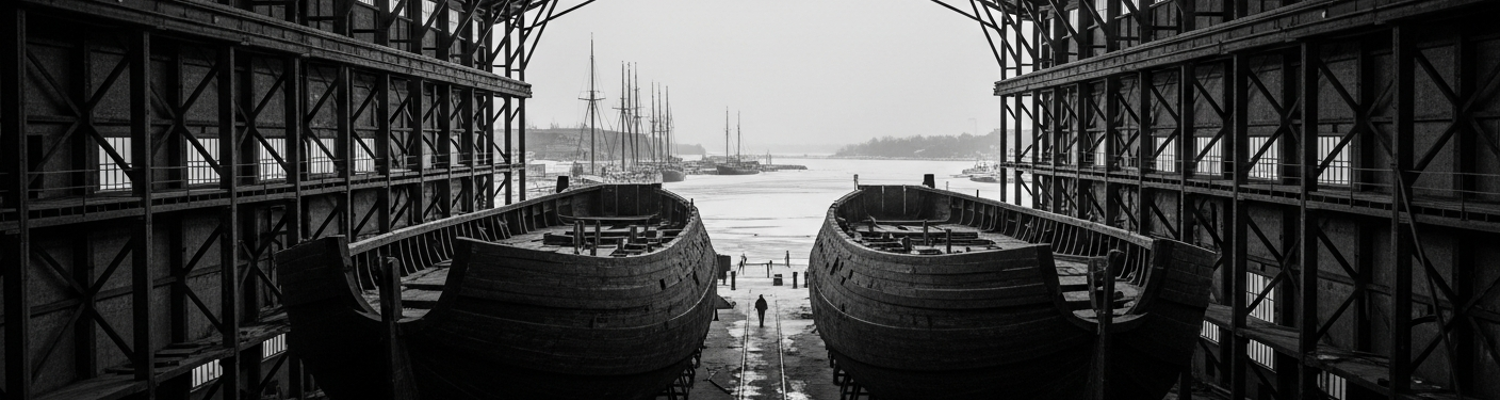
The most ambitious and visually striking preservation method was the construction of enormous ship houses. These were essentially colossal barns, built on Navy Point to completely enclose the most valuable assets, the unfinished ships-of-the-line New Orleans and Chippewa. These structures were engineering marvels in their own right, vast wooden skeletons sheathed in planks, designed to protect the hulls from direct exposure to rain, snow, and the damaging effects of the sun. Inside these dim, cathedral-like buildings, the two warships sat on their building stocks, silent and incomplete. The New Orleans, a vessel that would have been one of the most powerful warships on the planet, spent its entire existence under a roof, never touching the water. For decades, these ship houses dominated the Sackets Harbor skyline, tangible symbols of latent military power and a reminder of the war that had so recently ended. They were monuments to a fleet in waiting.
A Fleet's Slow Surrender
Despite the innovative efforts, the war against decay was a losing one. Congressional funding for maintenance was inconsistent. Budgets were cut, inspections became less frequent, and the skeleton crews could not keep up with the relentless progress of rot. By the mid-1820s, many of the smaller warships from the war were already gone. The brigs Jefferson and Jones and the sloop Sylph decayed and sank into the mud of Navy Point, where their remains still lie. The proud frigate Superior was sold for scrap in 1825. The Mohawk and General Pike followed. At the depot in Erie, Pennsylvania, Perry's victorious brigs Lawrence and Niagara were intentionally sunk in Misery Bay in 1825, a different preservation method that submerged the hulls in cold fresh water to halt decay. For over half a century, the primary mission at Sackets Harbor was not sailing or gunnery, but a desperate, low-budget campaign of maintenance. The end of an era came on September 24, 1883, when the U.S. Navy sold the great ship-of-the-line New Orleans. After 68 years sitting silently in its house, the unfinished warship was broken up for scrap. The massive white oak timbers, felled in the forests of New York for a war long past, were hauled away. The legacy of the Great Lakes fleet was not one of glorious combat, but a sixty-year, unglamorous struggle against the forces of nature, the constraints of diplomacy, and the realities of a nation at peace.