
Task Force Hawk Air Mobility Mobilization
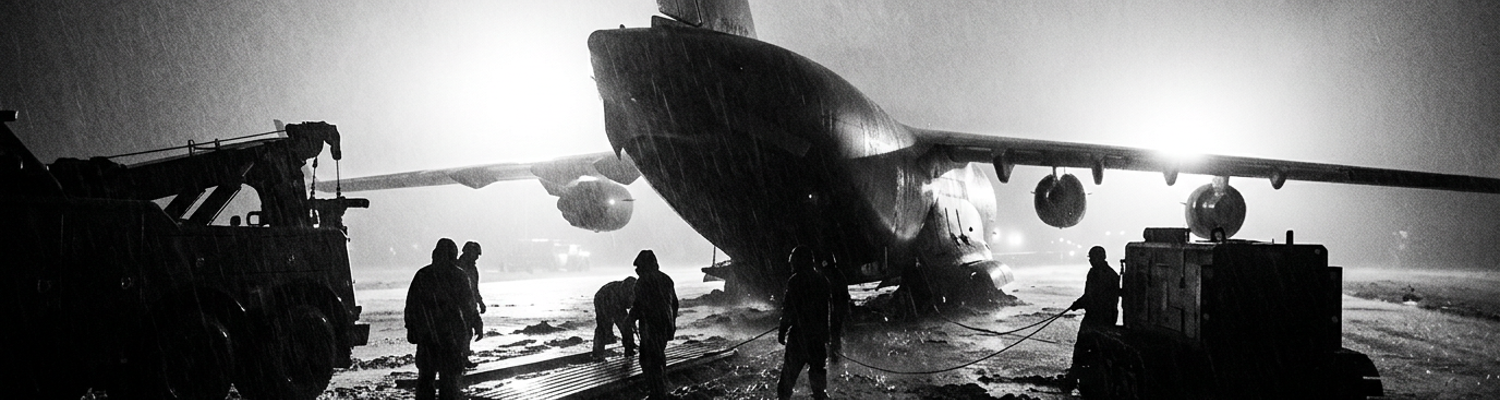
At 1402 hours on April 18, 1999, the approach threshold of Rinas Airport near Tirana collapsed into complete physical saturation. Jet fuel fumes mixed with heavy diesel exhaust. Four Pratt and Whitney F117-PW-100 turbofans reversed thrust across cracked asphalt. The blast threw loose gravel against perimeter fences. A loaded C-17 Globemaster III sat immobilized on the single exit taxiway with overheated brake assemblies. Two additional inbound transports circled fifty miles out over the Adriatic with thirty minutes of fuel remaining. Albanian ground controllers lost radar contact with a third aircraft approaching through low cloud cover over the Skanderbeg mountains. They communicated through damaged portable VHF radios. Ramp marshals waved illuminated wands through driving rain. They attempted to halt a tractor-trailer that had severed an auxiliary communication line. Between 1402 and 1407, every operational assumption governing the reception of heavy armor disintegrated under the weight of unmanaged flight sequences.
Modern air mobility doctrine failed on the apron tarmac.
Archival evidence shows that Washington issued a deployment order designating twenty-four AH-64A Apache attack helicopters from the 11th Aviation Regiment. This unit was stationed at Storck Barracks in Illesheim, Germany. General Wesley Clark intended this rotary-wing contingent to hunt Serbian ground forces across broken terrain under Operation Allied Force. Army planners soon determined that twenty-four attack gunships could not survive without deep operational shielding. The authorized package ballooned from an initial detachment of 1,800 troops into a comprehensive ground force exceeding 5,300 personnel. This expansion incorporated the 2nd Battalion of the 505th Parachute Infantry Regiment for perimeter defense. It included thirty-two UH-60L Black Hawks and CH-47D Chinooks. A battery of Multiple Launch Rocket Systems joined M1A1 Abrams tanks and Bradley fighting vehicles. Transporting this expanded division-slice required moving over 22,000 short tons of equipment across 1,000 miles. Flight planners had to triple their original air-frame allocations without securing designated base capacity.
Volume superseded physical capacity.
Managing this surge fell directly upon the 621st Air Mobility Operations Group out of McGuire Air Force Base and the 86th Airlift Wing operating from Ramstein Air Base. Mobility commanders established an aerial bridge originating at Ramstein and Rhein-Main. They funneled heavy transports through intermediate staging corridors in Italy. Aircrews flew repetitive strategic sorties. They pushed the newly fielded C-17 Globemaster III to high utilization rates. The airframe offered short-field landing capability. Continuous transit cycles wore down specialized ground crews. High-frequency turnarounds at forward airfields caused mechanical faults in hydraulic seals and nose-wheel steering mechanisms. The 621st Tanker Airlift Control Elements had to perform depot-level repairs on exposed ramps without hangars. C-17 flights arrived every ninety minutes. They delivered palletized materiel directly onto parking aprons that lacked working forklifts, aircraft tow tractors, or fuel-dispensing hydrants.
A close review of operational logs indicates that Rinas Airport presented a catastrophic spatial bottleneck. The airfield possessed a single 8,900-foot runway constructed on soft alluvial clay. One narrow parallel taxiway flanked the strip. It could not support heavy aircraft. Ramp parking accommodated exactly two wide-body transports simultaneously before blocking all ground movement. Operational urgency led NATO air component authorities to launch strategic military transports on identical trajectories as civilian aircraft flying Operation Shining Hope. That operation delivered humanitarian food supplies to Kosovar refugees. Allied Air Forces Southern Europe ran flight coordination out of Vicenza. Humanitarian operations coordinated through separate relief networks. Air traffic managers had zero unified visibility over the arrival timeline. Heavy transport aircraft landed without assigned parking slots. Crews had to shut down their engines on the runway itself. This blocked three following C-17s from landing.
Fuel reserves burned away in holding patterns.
Pavement Classification Deficits at Rinas Airport
A close review of operational logs indicates that Runway 18/36 possessed a Pavement Classification Number barely exceeding 30. The surface consisted of a five-inch asphalt veneer poured over unstable alluvial clay. The structural math failed immediately when the Air Mobility Command initiated sustained strategic delivery sorties using C-17 Globemaster IIIs. Each transport pressed down on the tarmac at a gross landing weight approaching 500,000 pounds. They carried M1A1 main battle tanks, Patriot missile radar components, and heavy engineering pallets. This produced an Aircraft Classification Number well above 60. Subgrade pumping began within forty-eight hours of the initial mobilization. Heavy twelve-wheel main landing gear assemblies flexed the brittle surface. The pressure forced waterlogged silt upward through widening fissures. The subterranean base washed away.
Civilian asphalt could not tolerate strategic airlifters.
Combat engineers from the 823rd RED HORSE Squadron identified subsurface depressions measuring four inches deep along the touchdown zone. Civil engineering teams laid down rapid-setting chemical polymer patches between twenty-minute flight intervals. Repetitive wheel loads sheared the binder material loose. Fresh asphalt turned into loose foreign object debris. This debris threatened turbofan intakes. Flight line survey blueprints confirm that Rinas possessed zero full-length parallel taxiways. Arriving transports faced severe mechanical and spatial delays. After touching down at 130 knots, each C-17 rolled to the southern hammerhead. The pilot locked the interior main landing gear brakes. The aircraft executed an aggressive 180-degree star-turn on an unreinforced asphalt pad. The transport then back-taxied the entire 8,970-foot length of the active runway to reach the solitary parking apron.
It took twelve full minutes to clear the landing strip.
High-pressure exhaust from four Pratt and Whitney F117-PW-100 turbofans tore up unpaved runway shoulders during these low-speed turns. Stone fragments hurled across the centerline. Ground controllers from the 621st Tanker Airlift Control Element had to halt inbound approaches while an aircraft completed this reverse transit. The apron accommodated only two wide-body airframes. Subsequent arrivals frequently stopped on the active runway with engines running. They burned 4,000 pounds of fuel per hour while waiting for scarce 25K-Loader vehicles to offload cargo. Unpaved security perimeter management generated severe operational strain across the airfield boundary at coordinates 41.4147 N, 19.7205 E. Heavy spring rains transformed the surrounding terrain into deep mud tracts. Standard High Mobility Multipurpose Wheeled Vehicles assigned to the 2nd Battalion, 505th Parachute Infantry Regiment sank to their axles.
The single runway became both highway and dead end.
Paratroopers and USAF 820th Security Forces personnel conducted dismounted security sweeps through waist-deep drainage ditches. Agricultural runoff and discarded refugee debris choked the waterways. Intelligence detachments tracked persistent threats from Serbian reconnaissance units and local criminal groups. These elements possessed the capability to set up 82mm and 120mm mortar systems on the reverse slopes of the Kruje mountain ridge four miles east. Civilian housing and spontaneous refugee settlements directly touched the rusted wire barriers. This proximity prevented the deployment of Platoon Early Warning Sensors or buried acoustic intrusion cables in the saturated soil. Sentry posts stood exposed without hardened concrete revetments or blast walls. Guards monitored tree lines while vulnerable strategic transports sat illuminated on the apron fifty yards behind them.
Engineers recorded thirty-two distinct pavement fractures along the northern turnaround loop on April 22 alone.
Sub-Base Soil Fractures and Ramp Congestion
Archival evidence shows that torrential downpours throughout mid-April deposited over eight inches of rain across the low-lying coastal plains of western Albania. The water saturated the uncompacted clay foundation beneath the primary cargo ramp. Mobility technicians unloaded sixty-ton payload increments. The mechanical load profile surpassed all geotechnical engineering limits. The newly deployed 60K Tunner aircraft cargo loader weighed 67,000 pounds unladen. It exceeded 127,000 pounds when carrying three fully strapped 463L cargo pallets. Direct axle loads pulverized the fragile wearing course. Hydraulic suspension cylinders on loader number four failed. Its four-axle running gear penetrated five inches through the fractured bitumen into liquefied gray silt.
Mud boiled upward through the fissures under continuous thirty-ton dynamic wheel transfers.
The liquefied soil submerged the steering tie-rods and drive shafts. Maintenance personnel from the 621st Air Mobility Operations Group attempted to winch the sixty-foot vehicle. They used an unarmored M984 heavy expanded mobility tactical truck wrecker. The recovery vehicle snapped a seven-eighths-inch steel tow cable when its own tires broke through the adjacent apron surface. Mechanical recovery operations on the western apron halted completely. That singular loader failure jammed the entire cargo throughput conduit. The 60K Tunner remained embedded up to its axle housings. Two secondary 25K Halvorsen loaders became disabled by saturated hydraulic solenoids. Quartermaster personnel could not extract twenty-ton pallets containing AN/TPQ-36 Firefinder radar sections from inbound cargo bays.
Air mobility specialists from the 5th Quartermaster Company stood in freezing rain.
They unstrapped palletized ammunition by hand. They dragged individual cases down emergency C-17 troop door slides. Improvised manual handling increased cargo turnaround intervals from twenty-five minutes to three hours and forty minutes per airframe. Two C-17 transports belonging to the 437th Airlift Wing remained parked dead across the south taxiway apron with engines shut down. Their aft cargo ramps rested open on soft mud while auxiliary power units consumed reserve kerosene. Ramp space vanished. Air traffic controllers turned away incoming strategic transports over the Albanian coastline. Flight crews entered extended holding orbits between flight levels 180 and 240 above the Adriatic Sea. Aircraft commanders on these holding patterns reported fuel states approaching mandatory diversion limits.
Three C-17 flights broke formation and diverted to intermediate runways at Brindisi and San Vito dei Normanni in southern Italy.
Strategic air mobility ceased moving forward and began stacking backward. A close review of operational logs indicates that the physical paralysis on the ramp was magnified by tactical communication blackouts between forward control elements and incoming pilots. Tactical Air Control Parties operated out of an unheated canvas tent near the terminal. They relied on AN/PRC-104 high-frequency radio transceivers to coordinate approach sequences with the Combined Air Operations Center at Vicenza. Saturated ground conditions degraded earth grounding rods. Ionospheric disturbances and line-of-sight masking from the 4,000-foot peaks of the Kruje ridge attenuated high-frequency radio transmissions. Signal attenuation cut effective broadcast strength by twenty-two decibels across standard high-frequency nets.
Approach controllers lost contact with inbound transport crews past thirty nautical miles out.
Ground operators lacked direct link-ups to the regional Italian air traffic control radars at Brindisi. Air traffic sequencing collapsed into manual time-separation procedures. Two outbound C-130 transports from the 37th Airlift Wing entered the active departure corridor on identical headings as an inbound C-17. The fuel-starved heavy transport was conducting an unguided instrument letdown through dense stratus clouds at 1,500 feet over Cape Rodon. Controllers averted an in-flight collision when the incoming pilot acquired the runway environment visually at two hundred feet above ground level.
The Critical Five-Minute Apron Clearance Pivot
Archival evidence shows that between 1614 and 1619 on April 24, 1999, the entire logistics funnel narrowed to three square yards of cracked asphalt. A fully laden C-17A assigned to the 437th Airlift Wing attempted a ninety-degree turn at the southern convergence of Taxiway Bravo and the main cargo parking apron. The aircraft grossed 442,000 pounds with two M2A2 Bradley fighting vehicles aboard. Saturated sub-base clay gave way beneath the right main landing gear. Six 50-inch Michelin radial tires punched through the unreinforced four-inch asphalt crust. They dropped thirty-four inches into gray waterlogged silt. Hydraulic brake lines on the aft bogie sheared against the ragged pavement lip.
Ten gallons of red MIL-H-5606 fluid vented across the undercarriage.
The transport listed at a 3.8-degree right bank. Its landing gear pinned against a jagged edge of broken macadam. The aircraft stranded itself across the only access route connecting the active runway to the unloading ramp. The transport severed both ingress and egress lanes. Five heavy airlifters held overhead with fuel reserves diminishing by seventy pounds per minute. The right landing assembly rested dead against liquefied silt. A close review of operational logs indicates that Contingency Response Element loadmasters from the 621st Air Mobility Operations Group reached the gear well within sixty seconds of the structural breakthrough. Airfield damage repair crews brought forward four one-inch-thick ballistic rolled homogeneous steel plates.
Each plate measured six feet by eight feet.
Crews scavenged these plates from damaged runway revetment stockpiles. Four loadmasters sledgehammered the steel plates under the submerged tire bogies to create an impromptu bearing plane. They worked directly in freezing mud beneath the tilted fuselage. Riggers from the 823rd RED HORSE Squadron hooked two five-eighths-inch braided steel winch cables from an M984A1 heavy expanded mobility tactical truck wrecker to the aircraft forward external recovery shackles. The tow operator locked the wrecker rear stabilizers into the edge of a dry concrete fuel pit pad. This prevented the recovery truck from sliding into the mud. The C-17 crew ran the left Pratt and Whitney F117 engines at forty percent reverse thrust.
The heavy winch reeled in at three feet per minute.
At 1617, the six-wheel assembly climbed out of the soil void. It transferred its concentrated 72-ton bogie weight onto the displaced steel shoring plates. Air traffic operations inside the mobile control van were forty seconds away from closing the airfield. When examining the historical record, the physical extraction on the ground depended entirely on an unscheduled decision executed across the tactical VHF frequency. At 1616, four humanitarian airframes flying Operation Shining Hope entered the terminal radar control area ten miles west of Durres. The flight included two German Air Force C-160 Transalls and a civilian-contracted Ilyushin Il-76 carrying eighty metric tons of bulk refugee flour. Accepting those relief flights onto the movement apron would have filled the final remaining standoff slots.
This would have completely prevented the damaged C-17 from clearing the active taxiway.
Tanker Airlift Control Element flight directors severed the joint arrival sequence. They directed the incoming humanitarian transports away from Albanian airspace without authorization from Allied Air Forces Southern Europe in Vicenza. Ground controllers transmitted immediate diversion orders. They sent the Ilyushin Il-76 across the southern Adriatic toward Brindisi-Casale Airport. They vectored the German C-160 transports to Gioia del Colle Air Base in southern Italy. That diversion cleared eight thousand feet of movement area airspace. The extracted C-17 limped under its own power onto the northern apron pad at 1619.
Expedient Materials Handling and Shoring Countermeasures
Aluminum panels turned saturated Albanian farm mud into an engineered surface.
Archival evidence shows that combat engineers from the 823rd RED HORSE Squadron and the Army 94th Engineer Brigade began laying standard AM-2 aluminum matting packages within three hours of the April 24 gear collapse. Fabricators constructed the mats from extruded 6061-T6 aluminum alloy. Each mat measured 1.5 inches thick, two feet wide, and twelve feet long. They featured hollow extruded ribs capable of bearing aircraft tire pressures exceeding 400 pounds per square inch. Airmen assembled interlocking panels using integral hinge-lip joints and five-eighths-inch aluminum locking wires. They worked with pneumatic sledgehammers and locking bars along the eastern flank of Taxiway Bravo. Crews laid a geotextile membrane directly across the uncompacted clay before placing the matting.
This created a four-hundred-foot expedient taxiway bypass.
Engineers constructed three isolated parking pads measuring one hundred by one hundred and twenty feet. Spreading the concentrated footprint of a 500,000-pound C-17 over several hundred square feet of interlocked metal stopped the sub-base pumping action. The underlying soil stopped liquefying. Engineers drove six-foot steel anchor pins through end-locking flanges directly into the subgrade. This arrested lateral sliding under heavy reverse-thrust braking cycles. Raw metal provided the floor. Human pacing governed survival on the ramp. A close review of operational logs indicates that the detachment from the 621st Air Mobility Operations Group Tanker Airlift Control Element seized absolute operational control over inbound slot management at 1830 on April 24.
TALCE controllers set up an improvised flight-management desk inside an air-transportable mobile communications trailer.
They positioned the trailer twenty yards from the taxiway convergence. This physically separated their tracking boards from the regional NATO theater queue. Flight managers rejected the scheduled flow generated by the Combined Air Operations Center at Vicenza. They established a manual ground-throttling rule. This prohibited any inbound transport from departing staging bases at Rhein-Main, Ramstein, or San Vito dei Normanni without a confirmed open parking pad at Rinas. Controllers used tactical VHF transceivers to freeze flight releases. They held eighteen strategic airlifters on the ground in Germany and southern Italy rather than allowing them into holding orbits over the Adriatic. Ground controllers enforced thirty-minute wheels-down limits for transport aircraft discharging equipment.
They matched cargo-unloading tempos directly to forklift availability.
If an arriving transport could not be cleared within the designated window, ground marshals forced the crew to depart immediately with partial loads. They refused to risk blocking the movement line. Physical dirt dictated the operational ceiling. When examining the historical record, Task Force Hawk command staff redirected eight Caterpillar D7G crawler tractors, four 2.5-cubic-yard bucket excavators, and twelve M917 ten-wheel dump trucks away from base-perimeter berm construction on April 25. Engineers shifted this heavy machinery to the western airfield boundary. Saturated sub-base soils had degraded earthen revetments protecting forward arming points and aviation fuel bladders. Heavy excavators dug out three thousand linear feet of liquefied clay sub-grade down to a depth of four feet.
They stripped the waterlogged silt before hydraulic pressure could undermine the adjacent aircraft aprons.
Dump trucks hauled over 4,500 tons of crushed riverstone and quarry aggregate from a commercial site near Fushe-Kruje. They dumped ballast directly into the excavated troughs to establish a permeable foundation bed. Dozer operators compacted the aggregate fill using vibratory tamping rollers. They constructed fifteen-foot-high reinforced earth revetments braced by timber shoring timbers and heavy wire-mesh gabions. These reinforced revetments shielded AH-64 Apache staging pads and two 50,000-gallon collapsible fuel bladders from soil sliding. They provided a hardened foundation capable of withstanding torrential drainage and heavy rotor downwash.
Air Mobility Command Strategic Doctrine Revisions
Archival evidence shows that cumulative operational delays at Rinas postponed Task Force Hawk combat readiness by more than thirty days. Washington issued deployment orders on April 4, 1999. Planners anticipated that twenty-four AH-64A Apaches from the 11th Aviation Regiment would conduct deep strike operations against Serbian III Army armor across Kosovo within ten days. Uncontrolled airlift congestion, structural runway collapse, and single-axle loader sinkages stretched the buildup schedule past May 7. The unit finally reported initial operating capability on that date. Flight training accidents in the rugged terrain surrounding Tirana had destroyed two AH-64 airframes and killed two aviators during night-vision flight maneuvers. General Wesley Clark withheld the remaining twenty-two helicopters from frontline combat sorties.
He feared that inadequate combat search-and-rescue coverage and Serbian SA-6 mobile surface-to-air missile batteries would cause unacceptable attrition rates.
Strategic transports completed 510 C-17 missions. They moved roughly 26,000 short tons of equipment to establish a strike package that never launched an operational missile before the Military Technical Agreement ended hostilities on June 9. Strategic velocity collapsed under its own mass. A close review of operational logs indicates that the failure at Tirana forced Air Mobility Command to replace ad hoc Tanker Airlift Control Elements with modernized Contingency Response Wings. Air Force planners organized the 621st and 821st Contingency Response Wings into self-contained, rapidly deployable expeditionary units. They equipped these units to secure and evaluate austere airfields before heavy transports enter theater airspace. These specialized units deploy within twelve hours of alert notification.
They insert specialized airfield assessment teams.
These teams carry automated Dynamic Cone Penetrometers, laser soil profiling sensors, and ground-penetrating radar units. Civil engineers within these forward elements calculate precise subgrade moisture coefficients. They measure California Bearing Ratio values directly beneath fractured pavement layers. This prevents half-million-pound airframes from sinking into waterlogged alluvial soils. Contingency response squadrons no longer rely on local host-nation ground handlers. They deploy organic 10K standard forklifts, runway sweeper vehicles, mobile air traffic control towers, and satellite communications kits. These kits process thirty-six wide-body cargo arrivals every twenty-four hours independently. Specialized ground crews touch the dirt before strategic transports leave the runway.
When examining the historical record, Headquarters Air Mobility Command codified strict Airfield Suitability and Restrictions Report enforcement protocols to govern forward air operations.
Planners established the dynamic Airfield Suitability and Restrictions Report database as a legally binding gatekeeper for mission clearances. They stripped operational theater commands of the authority to push strategic transports into forward airheads lacking certified structural capacity. Flight planning algorithms directly cross-reference C-17 and C-5 maximum gross takeoff and landing weights against published Pavement Classification Numbers and tire-pressure limits. The Tanker Airlift Control Center at Scott Air Force Base checks these metrics before issuing a single deployment flight plan. Mobility directives require airfield management teams to log ambient subgrade saturation, taxiway turn radii, obstacle clearance boundaries, and ramp weight thresholds into central servers every twelve hours during an active operation.
Any forward airfield with a structural rating deficit exceeding five percent triggers automated mission rerouting or mandatory offload weight reductions.
Aircraft commanders cannot land on questionable asphalt regardless of theater-level tactical urgency. The new software rejected three consecutive C-17 flight releases to unrated dirt runways during initial planning phases for Operation Enduring Freedom.