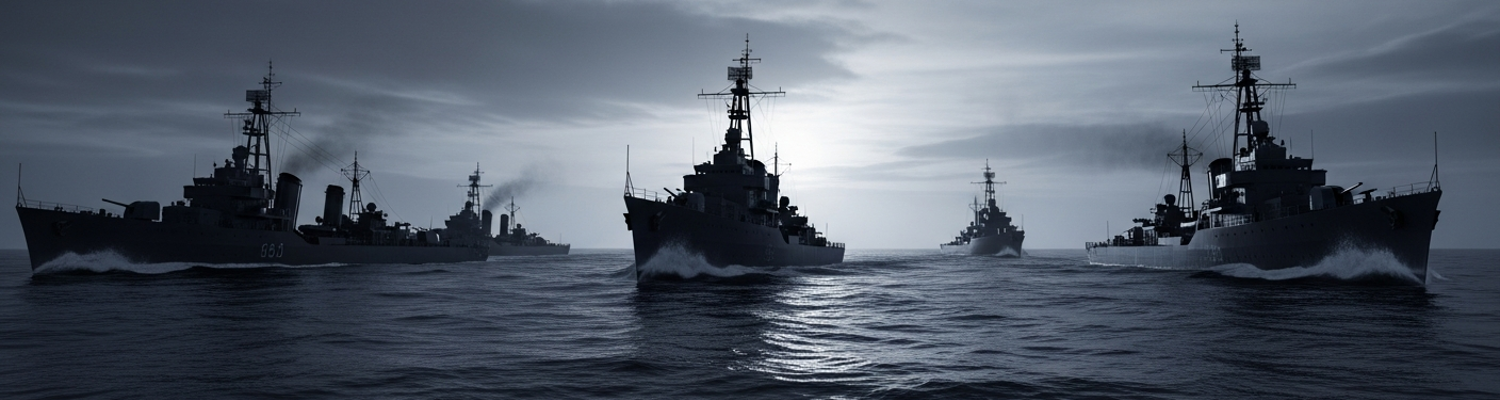

The Treaty's Shadow on Steel
The Great War's end bequeathed the United States Navy a vast, yet suddenly obsolete, destroyer force. Hundreds of hastily constructed Wickes and Clemson-class destroyers, known colloquially as "flush-deckers" or "four-pipers," crowded naval anchorages. These ships were a direct answer to the German U-boat threat, designed for the singular purpose of anti-submarine convoy escort in the North Atlantic. Their continuous main decks provided structural strength for mass production but made them notoriously wet vessels, with green water often sweeping from bow to stern. Life aboard was a punishing affair of cramped quarters and constant exposure. As the world entered the 1920s, their strategic purpose evaporated. The Washington Naval Treaty of 1922, followed by the London Naval Treaty of 1930, fundamentally reshaped global sea power. These agreements, born of a desire to prevent a ruinously expensive naval arms race, placed strict tonnage limits on capital ships like battleships and aircraft carriers. This diplomatic act cast a long shadow over naval architecture, inadvertently elevating the destroyer's role. It could no longer be a mere escort. It had to become a primary offensive weapon, a fleet screener and a torpedo delivery system capable of striking at the heart of an enemy battle line.
The existing flush-deckers were wholly inadequate for this new mission. While they carried a respectable torpedo armament of twelve 21-inch tubes, their 4-inch guns were anemic, their open bridges offered no protection, and their poor seakeeping qualities made high-speed fleet maneuvers in the open Pacific a brutal ordeal for their crews. The Navy's General Board recognized the problem. A new breed of destroyer was essential. Many of the old four-pipers were decommissioned, placed into the "red lead row" of the reserve fleet, or converted into minelayers, seaplane tenders, and fast transports. For those that remained in service, modifications were made, but they were stopgap measures at best. Naval architects, shackled by the 1,500-ton displacement limit dictated by the London Treaty, faced a formidable challenge: create a ship that could outfight and outrun potential adversaries while remaining treaty-compliant.
The first answer was the Farragut class, laid down in 1932. These ships marked a radical departure from everything that came before. A raised forecastle provided superior seakeeping, keeping the forward gun mounts drier and more effective in heavy seas. A powerful new propulsion plant generated over 42,000 shaft horsepower, pushing the ships to a blistering 36.5 knots. Their main armament of five 5-inch/38 caliber dual-purpose guns represented a quantum leap in firepower, capable of engaging surface targets and aircraft with equal lethality. Critically, their design embraced the new offensive doctrine. Eight torpedo tubes were mounted in two quadruple centerline mounts, allowing a full eight-torpedo broadside to be fired to either port or starboard. The destroyer was now a torpedo platform first and foremost.
The design evolution accelerated. The Mahan class of 1934 introduced a more advanced high-pressure, superheated steam propulsion system, increasing efficiency and range. They also upped the torpedo complement to twelve tubes in three quadruple mounts, though one was awkwardly placed on each side. This design choice sparked intense debate within the Navy. The "torpedo-first" faction argued for maximum offensive punch. They won a decisive victory with the subsequent Gridley and Benham classes. These ships sacrificed the fifth 5-inch gun mount to carry a staggering sixteen torpedo tubes in four centerline mounts. They were, in effect, fast torpedo boats designed to race towards an enemy fleet, unleash a massive, coordinated volley of torpedoes, and use their speed to escape. The men who designed them were not just building ships; they were forging the instruments of a bold, aggressive, and ultimately risky tactical vision.
Forging the Night Attack
The steel hulls and powerful engines were only half of the equation. The true weapon was the doctrine, honed over two decades of relentless training in the vast, empty expanses of the Pacific Ocean. The US Navy turned the interwar period into an intense and continuous laboratory for naval warfare. The primary instrument of this education was the annual Fleet Problem, a series of massive, unscripted exercises that pitted the fleet against itself to test emerging technologies, strategies, and the endurance of men and machines. It was in the cold, dark nights of these simulated battles that the complex art of the coordinated torpedo attack was perfected.
Navy planners operated under the assumption that any future war in the Pacific would be against the Imperial Japanese Navy. They knew they would likely be at a numerical and geographical disadvantage, fighting far from home bases. They also knew the Japanese were masters of night combat and possessed the formidable Type 93 torpedo. Dubbed the "Long Lance" by the Allies, this oxygen-propelled weapon was a technological marvel, boasting a range and warhead size that dwarfed its American counterparts. It could strike from well beyond the range at which American ships could effectively return fire. To counter this terrifying weapon, the US Navy had to rely on superior tactics, coordination, and aggression. The answer was the massed night destroyer attack.
The doctrine was intricate and demanded almost inhuman precision. Destroyer divisions, consisting of four ships, would operate under strict radio silence, navigating by dead reckoning, rudimentary radar (in later years), and shielded lamp signals. A squadron commander, leading two or more divisions, had to be a master of geometry and timing, maneuvering his ships into an optimal firing position without alerting the enemy. A single miscalculation by a navigator, a moment of hesitation from a helmsman, or a mechanical failure in an engine room could compromise the entire attack. The Fleet Problems ruthlessly exposed weaknesses. Fleet Problem IX in 1929 saw the carrier USS Saratoga (CV-3) conduct a daring mock raid on the Panama Canal, proving the viability of carrier power. Subsequent exercises focused heavily on how destroyers would screen these valuable assets while also preparing to detach for independent offensive action against an enemy battle line.
This relentless training regimen cultivated a generation of audacious and brilliant destroyer commanders. Men like Arleigh Burke, who would later earn the moniker "31-Knot Burke" for his aggressive combat leadership, learned their trade in these demanding interwar drills. As commander of Destroyer Squadron 23, Burke developed and perfected tactics that emphasized speed, decentralized command, and absolute trust between himself and his ship captains. He drilled his crews until the complex maneuvers of a multi-division night attack became second nature. The sailors who stood watch on the windswept bridges and toiled in the hot, loud engine rooms were not just practicing. They were forging a lethal craft, preparing for night battles their countrymen could not possibly imagine, confident in their ships and their training.
The Unreliable Steel Fish
The entire edifice of US destroyer doctrine, from the sixteen-tube loadouts of the Benham class to the intricate night attack plans drilled by Arleigh Burke, rested on a single, critical piece of technology: the Mark 15 torpedo. Developed in the mid-1930s as the standard surface-launched anti-ship weapon, the Mark 15 was intended to be the fleet's great equalizer. It was a complex weapon, driven by a steam turbine and carrying an 800-pound HBX warhead. On paper, it was formidable. In the crucible of combat, it was a catastrophic failure, a flaw that would cost American sailors dearly in the opening years of World War II.
The Mark 15 torpedo was plagued by the same triad of defects that afflicted its submarine-launched cousin, the Mark 14. The first was depth control. The torpedoes consistently ran deeper than their set depth, often by as much as ten or eleven feet. A torpedo aimed to strike a destroyer's hull would instead pass harmlessly underneath. The second flaw was the secret Mark 6 magnetic influence exploder. This device was designed to detonate the warhead as it passed under the magnetic field of a ship's keel, breaking its back for a mission kill. In practice, the exploder was far too sensitive. It could be triggered prematurely by the Earth's own magnetic field, a phenomenon that varied by latitude, or even by the magnetic signature of the launching destroyer itself.
The third and most infuriating problem was the contact exploder. When frustrated crews began disabling the unreliable magnetic feature, they discovered that even direct hits often failed to detonate. The firing pin mechanism was poorly engineered. On a solid, perpendicular impact, the pin's own inertia would cause it to bend or break before it could strike the detonator cap. The torpedo would literally crumple against the target's hull, a useless steel fish.
What transformed these technical problems into a strategic crisis was a profound institutional failure within the Navy's Bureau of Ordnance (BuOrd). BuOrd was an insular, almost feudal organization, fiercely protective of its designs and deeply resistant to outside criticism. Peacetime budgets were tight, and at $10,000 per unit, torpedoes were almost never live-fired against actual targets. Test firings used dummy warheads and were considered successful if the weapon ran correctly and passed under a target barge. This procedure completely failed to test the exploders or reveal the critical depth-keeping errors. When the war began and combat reports flooded in from the fleet detailing duds and premature explosions, BuOrd's initial response was denial. They blamed the fleet for poor maintenance, incorrect firing solutions, and crew error. This created a disastrously delayed feedback loop. For the first twenty-one months of the war, American destroyer crews went into battle with a primary weapon that was fundamentally broken.
The brutal night battles in the Solomon Islands laid the truth bare. During the Battle of Tassafaronga on November 30, 1942, a US task force under Rear Admiral Carleton H. Wright ambushed a Japanese destroyer column. The lead US destroyers executed their doctrine perfectly, firing over twenty torpedoes at optimal range. Not a single one found its mark. The Japanese, alerted by the attack, responded with their devastatingly effective "Long Lance" torpedoes. They sank the heavy cruiser USS Northampton and crippled three others in one of the most lopsided tactical defeats in US Navy history. The American sailors had done everything right, only to be betrayed by their own technology. It was only after frustrated submarine commanders like Charles "Swede" Momsen conducted their own unauthorized tests, firing torpedoes through fishnets to prove the depth errors and at cliffs to expose the contact exploder flaws, that BuOrd was finally forced to confront the failure. The fixes were eventually implemented by late 1943, but not before countless opportunities were squandered and many lives were needlessly lost.