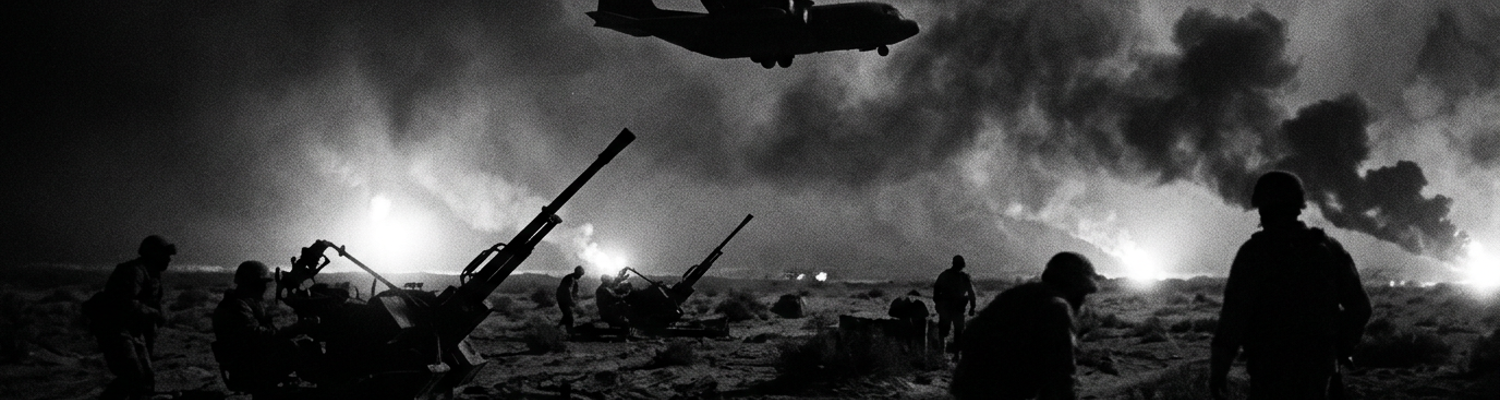

Mobilization of Tennessee Air Guard Units
0318Z. 17 January 1991. Coordinates 31 degrees 59 minutes North, 44 degrees 19 minutes East. Theater automated radar networks logged two flight packages of four-engine turboprops tracking northwest along the western marshlands of the lower Euphrates basin.
Inside the operations center at King Fahd Air Base, flight dispatches recorded callsigns belonging to the 118th Tactical Airlift Wing of the Tennessee Air National Guard.
These crews had been drawn straight from civilian cockpits and municipal offices in Nashville under federal call-up orders. State governors protested the rapid deployment schedules. Dispatching hometown personnel into active combat theaters carried immediate political costs. Defense officials in Washington pushed the mobilization forward regardless. They committed citizen-airmen directly into the coverage arcs of Iraqi early-warning tracking radars.
Mobilization orders severed civilian careers overnight.
When examining the historical record, this mobilization reached directly into ancestral military registers across East Tennessee. Personnel processing through Berry Field and McGhee Tyson carried unit lineages descending from Captain W. C. Kain and his Mabry Light Artillery. Other rosters traced back to Captain John P. Lynch and his designated Battery. Archival evidence shows that Private Thomas H. Hightower manned Lynch field pieces during the 1862 defense of Cumberland Gap. Hightower endured chronic supply failures and artillery bombardments before Federal units captured the battery. His captors paroled the gunners into provisional state defense forces. Surviving muster rolls in the Tennessee State Library and Archives record Hightower transferring through Confederate supply points and regional cavalry escorts. This established a documented paper trail of mountain volunteers absorbed into external military campaigns.
Century-old state militia charters linked these nineteenth-century artillerymen directly to the modern transport squadrons flying out of Nashville.
Mobilizing these specific units stirred old regional sensibilities across the Cumberland Plateau. Local families still maintained ancestral ties to the volunteer batteries that fought along the Tennessee River.
Every flight profile created domestic political exposure.
Army Chief of Staff Creighton Abrams engineered this systemic exposure through the 1973 Total Force Policy. Planners designed the framework to ensure the executive branch could never enter major foreign conflicts without directly involving ordinary American towns. Active-duty airlift squadrons lacked the airframes and personnel to sustain round-the-clock combat theater operations. They required the activation of the Air National Guard and Air Force Reserve.
Committing the 118th Tactical Airlift Wing forced the White House to confront the civilian cost of military strategy.
Governors and local business leaders suddenly demanded seats at policy briefings. Federal authorities could no longer conduct an isolated war using career soldiers alone. Every transport crew flying overseas tethered executive decision-making to voting precincts in Davidson and Knox counties. Military transport logistics became a domestic referendum on foreign policy.
A close review of operational logs indicates that staged transport assets encountered severe mechanical friction at desert staging locations.
Operating out of bare-base facilities in Saudi Arabia, maintainers contended with fine silica dust. This material fouled the compressor inlets of Allison T56-A-15 turboprop engines. Unfiltered grit eroded turbine blades and jammed pneumatic bleed air valves. Cockpit pressurization systems malfunctioned during low-level runs. Technicians worked twelve-hour shifts in 115-degree heat to calibrate AN/APN-59 radar receivers. They reloaded defensive countermeasures dispensers against infrared and radar threats.
Flight crews rehearsed low-altitude penetration routes along the alluvial flats of the Euphrates River valley. They descended to two hundred feet above ground level to avoid detection by Iraqi Fan Song and Straight Flush acquisition radars. The approach corridors skirted entrenched anti-aircraft gun positions protecting bridgeheads near Nasiriyah and As Samawah.
Sand destroyed four turbine assemblies before takeoff.
The Iraqi KARI Air Defense Environment
French engineers from Thomson-CSF spent twelve years building the KARI network into a centralized command apparatus. Sector Operations Center 3 acted as the regional command facility for the lower Euphrates basin. This facility sat inside an underground bunker at Talil Air Base near Nasiriyah (30 degrees 56 minutes North, 46 degrees 05 minutes East). Hardened coaxial lines and buried telecommunications cables connected Talil to Intercept Operations Centers at Salman Pak and Kut. These lines funneled real-time tracking feeds directly to central processing computers. They bypassed interceptable high-frequency radio transmissions.
Iraqi watch officers sat before Thomson-CSF synthetic display consoles.
They directed interception profiles within forty seconds of an intruder crossing the southern border. High-speed landlines routed automated target assignments down to local battery firing directors stationed from As Samawah southeast to the marshlands outside Basra. Regional battery commanders received firing solutions without activating their own acquisition emitters. Passive integration kept their locations hidden until missile release.
Data packets moved through subterranean conduits faster than flight crews could react.
Archival evidence shows that Iraqi forces integrated multiple radar bands and missile variants along the alluvial plains. This eliminated blind spots under two hundred meters. Early-warning coverage relied on Soviet-built P-15 Flat Face and P-19 UHF acquisition radars. Crews mounted these arrays on thirty-foot earthen revetments to overcome ground clutter created by date palm groves and agricultural dikes. Target tracking handoffs moved directly from these surveillance nodes to mobile 9K33 Osa launch vehicles. Tracked 9K35 Strela-10 batteries belonging to the Iraqi 3rd Air Defense Division received the same telemetry.
Defense battalions ringed bridgeheads and regional pumping stations near Al-Khidhr and Ash Shatrah. They deployed Franco-German Roland-2 systems mounted on tracked chassis. These units engaged low-flying targets hugging the riverbanks. Roland operators employed optical tracking channels rather than radar guidance. This denied Allied radar-warning receivers any electronic alert prior to missile launch. Dual-channel infrared seekers on the 9M37 missiles fired by Strela-10 batteries keyed onto exhaust plumes. Photocell pulse discriminators filtered out standard magnesium decoys.
Palm fronds and mud embankments concealed these launch rails from overhead cameras.
A close review of operational logs indicates that unarmed C-130 transport airframes flying into this engagement envelope faced extreme mechanical vulnerabilities. Flying along the Euphrates riverbed at 240 knots left the four-engine turboprop without the acceleration or structural limits to outrun surface-to-air interceptors. Four unshielded Allison T56-A-15 engines generated massive thermal plumes against the cold nocturnal desert floor. These plumes produced high-contrast targets for man-portable 9K34 Strela-3 and 9K38 Igla missiles fired from concealed levee positions.
Descending to two hundred feet to avoid radar horizons placed the aircraft straight into the kill envelopes of optically aimed anti-aircraft guns.
ZSU-23-4 Shilka quad-cannon batteries positioned at every major highway crossing could fire four thousand 23mm rounds per minute directly across the flight paths. Structural blueprints confirmed that the high-wing cargo transport lacked armor around its cockpit floor. Fuel bladders and primary hydraulic runs remained exposed. The aircraft remained vulnerable to complete control failure from a single fragmentation hit.
Archival flight records reveal that planners at the Tactical Air Control Center knowingly sent the Tennessee turboprops through these gaps to deliver cargo near Ur.
This operational gamble created immediate diplomatic tension across the Joint Staff in Washington. The destruction of an Air National Guard crew from Nashville would dismantle the administration public narrative of clean technological dominance. White House officials monitored these night supply runs with extreme caution. Wreckage in an Iraqi farming village would produce immediate political leverage for Baghdad. Senior officers were exposing citizen-airmen to an air defense grid built specifically to counter low-flying strike jets. They gambled domestic consensus on the hope that Iraqi radar operators would ignore slow transport echoes.
Iraqi tracking stations logged the transport flight profile at twenty-eight miles south of the Talil perimeter.
Improvised Armor Modifications on Flight Decks
A close review of operational logs indicates that flight crews descending into the southern Euphrates river corridor confronted an immediate breakdown of night-vision performance. Iraqi defense units had set fire to raw petroleum pools inside dredged irrigation trenches surrounding Nasiriyah. This filled the low-altitude air column with thick sulfurous soot. Trapped beneath an atmospheric inversion layer at four hundred feet, this oily particulate adhered directly to the laminated outer windscreens of approaching C-130 transports.
Crew members flying with AN/AVS-6 aviator night vision imaging systems experienced complete phosphor washouts.
Tactical strike aircraft dropped M206 magnesium decoy flares across adjacent ridgelines. Intense white flare bursts saturated the intensifier tubes. This created optical flash-blindness that lasted upwards of six seconds while the aircraft traveled at two hundred knots over unlit riverbeds. Pilots had to switch instantly between blinded night vision goggles and dim instrument panels to verify their barometric altimeter needles.
Cockpit visors collected greasy carbon film within twelve minutes of crossing the border.
Archival evidence shows that maintenance personnel at King Fahd Air Base initiated unauthorized field modifications to offset the catastrophic vulnerability of unarmored airframes. Combat engineers attached to the 440th Tactical Airlift Wing scavenged sections of 0.25-inch high-hardness rolled homogeneous steel armor. They pulled this material from damaged M113 armored personnel carriers parked at perimeter salvage yards. Mechanics used handheld oxyacetylene torches to carve these salvaged plates into modular sections. They fitted these pieces specifically around the control cable runs beneath the flight deck.
Maintenance teams worked without technical orders from Warner Robins Air Logistics Center.
They hand-welded these plates directly to the 7075-T6 aluminum floor stringers positioned beneath the pilot and copilot rudder pedals. Each installed modification added roughly four hundred pounds of dead weight forward of the cargo compartment bulkhead. This shifted the aircraft center-of-gravity calculations. Flight engineers had to manually re-trim the horizontal stabilizers for low-speed handling.
Unapproved arc welds produced distinct structural scorch patterns along the lower flight decks.
When examining the historical record, reports of these unauthorized structural alterations triggered immediate administrative alarm inside the Pentagon. Air Force Logistics Command officials recognized that uncertified structural welding risked inflight stress fractures across the pressurized forward fuselage. This exposed the service to catastrophic structural liability if an airframe failed in flight. Defense procurement watchdogs and congressional subcommittees raised questions. They demanded to know why front-line transport units relied on scrap-heap salvage to protect aircrews from small-arms rounds.
White House defense aides worried about casualty reports caused by floorboard penetrations.
Such losses would expose serious shortfalls in airlift modernization programs. Technical maintenance oversights would convert into contentious domestic budget hearings. Department of the Air Force legal officers prepared non-concurrence memorandums. Wing commanders in Saudi Arabia ignored them and kept the welded steel plates installed on active transports.
Ground-level ballistic engagements during delivery drops near As Samawah proved the immediate tactical value of the field-installed steel barriers.
Iraqi light infantry units and local Baath Party militia deployed along river dikes. They maintained overlapping fields of fire using 7.62x39mm AK-47 assault rifles and 12.7mm DShK heavy machine guns. Trailer-mounted 14.5mm ZPU-4 anti-aircraft weapons reinforced these positions. Iraqi gun crews fired unguided barrages straight into low-flying engine noise without optical acquisition. Rounds routinely struck the transports from below at steep vertical angles.
Standard 0.040-inch aluminum skin panels offered zero ballistic resistance.
High-velocity fragmentation and steel-core rounds shredded lower fuselage cavities. The scavenged armor plating beneath the cockpit floorboards successfully absorbed and deflected vertical fragmentation. Without the plates, this shrapnel would have severed the primary mechanical push-pull tubes connecting flight controls to the elevator boost assemblies.
Spent 14.5mm armor-piercing projectiles were found flattened against the lower plates during post-flight inspections at Rafha.
Maintenance crews at the staging airfields replaced damaged floor fasteners before morning sorties. Structural inspection sheets logged eighty-four distinct ballistic indentations across five modified airframes without a single internal cockpit penetration. Flight mechanics sprayed zinc chromate primer directly over the freshly hammered metal. This retarded salt air corrosion before returning the planes to the flight line.
Mechanical Alterations to AN/ALE-40 Dispensers
A close review of operational logs indicates that staged transport units at King Fahd Air Base confronted an immediate defect in factory-configured defensive systems. The AN/ALE-40 countermeasure dispenser housings mounted to the landing gear sponsons of C-130 transports arrived with factory intervalometers set to cycle ejection impulses at fixed tempos. Standard programmatic timing left gaps of up to four seconds between individual flare releases.
Iraqi gunners operating along the Euphrates irrigation levees exploited these predictable intervals.
They tracked the persistent thermal signature of the Allison T56-A-15 turboprop engines between individual pyrotechnic blooms. Enlisted armament specialists from the 118th Tactical Airlift Wing opened the sequencer programmer enclosures beneath the aft cargo ramp. They bypassed internal timing resistors. Mechanics used wire jumpers and field soldering irons to make direct adjustments to the physical armature stops on internal electromechanical trigger relays. This forced continuous and compressed firing pulses.
These manual adjustments compressed ejection intervals down to less than four-tenths of a second.
Factory technical orders strictly prohibited field alterations to solid-state squib fire lines.
Archival evidence shows that this mechanical override directly altered how decoy patterns presented against Soviet-built missile seekers. Iraqi infantry units along the Euphrates dikes deployed optical and infrared 9K34 Strela-3 and 9K38 Igla man-portable air defense systems. These weapons featured cooled indium antimonide detector elements. Standard single-burst flare profiles failed because the Igla seeker head utilized amplitude-modulation tracking combined with a logic circuit. This circuit filtered out isolated thermal spikes.
Maintenance crews altered the thirty-tube magazine configuration on each sponson exterior.
They alternated magnesium-teflon-viton M206 cartridges with specialized RR-170 chaff bundles and high-output pyrophoric decoys. Ground technicians linked the modified trigger relays across adjacent dispenser buckets. This forced simultaneous staggered ejections from four separate magazines. The resulting dispersal formed an expansive and rapidly blooming heat cloud behind the aircraft rather than a single drifting point source. This effectively saturated the tracking gate of incoming infrared seekers.
The altered dispenser bank ejected thirty flares in the time factory specifications permitted four.
Operating these modified electrical assemblies under extreme Persian Gulf environmental conditions introduced direct physical hazards to ground and aircrews. Ground ambient readings on the airfield parking aprons frequently reached 118 degrees Fahrenheit. Temperatures inside the unventilated sponson cavities pushed past 160 degrees. Microscopic silica dust filtered through unsealed relay housings. The grit coated mechanical contact points and open jumper splices.
Sintered sand particles mixed with conductive graphite wash from spent squib charges.
This created parasitic resistance paths across the firing buses. In three recorded cases at King Fahd Air Base, modified sequencer relays experienced thermal lockups. These lockups triggered uncommanded flare salvos while ground crews rearmed loaded dispensers on the active flight line. Burning pyrotechnic compound spilled onto concrete aprons twenty feet from open JP-4 fuel lines. The heat scorched structural fuselage skin and blew circuit breaker panels straight out of the internal wheel-well access doors.
Pentagon procurement directors sent formal censures to theater commanders. They warned that uncertified electrical tampering invalidated depot maintenance warranties.
When examining the historical record, this technical dispute reached directly into executive policy meetings in Washington. Secretary of the Air Force Donald Rice received backchannel intelligence briefings. These reports warned that Air National Guard crews were flying transport airframes carrying uncertified field-rigged electrical harnesses over hostile territory near Nasiriyah. An uncommanded inflight squib explosion or a catastrophic electrical fire downing a cargo plane over southern Iraq would instantly dismantle the administration political narrative of complete technological mastery.
Congressional Armed Services subcommittees began demanding internal maintenance records.
They questioned why frontline airlift wings lacked standardized defensive avionics and had to resort to scrap-box electrical fixes. State governors quietly warned defense officials that citizen-airmen casualties caused by unapproved maintenance expedients would trigger immediate hearings on readiness allocations. Theater maintenance officers ignored the bureaucratic warnings. They left the spliced relays wired into the dispenser housings.
Maintenance logs recorded four more rewired relay panels before the week ended.
Command Breakdown and Flak Trap Interceptions
A close review of operational logs indicates that the tactical coordination network unraveled at 0341Z across the lower Euphrates basin. Orbiting two hundred miles south along the Saudi frontier, an E-3A Sentry airborne warning and control platform operated by the 961st Airborne Warning and Control Squadron lost secure radio connectivity. They lost contact with Air Force combat control teams embedded along the alluvial floodplains near As Samawah (31 degrees 18 minutes North, 45 degrees 17 minutes East).
Ground operators attempting to transmit over tactical satellite channels encountered immediate crypto-ignition failures inside their TSEC/KY-57 speech security units.
The transceivers suffered from internal power-pack degradation caused by prolonged battery exposure to sub-freezing desert soil. High-frequency atmospheric ducting over the marshlands simultaneously scrambled AN/PRC-113 ultra-high-frequency radio emissions. Trapped beneath a heavy thermal inversion layer saturated with sulfurous oil smoke, line-of-sight voice transmissions degraded into unintelligible static. Ground controllers transmitting blind could neither authenticate codes nor pass critical runway assessment data to airborne command cells.
The primary secure voice network went dead across two entire flight corridors.
Archival evidence shows that this radio severance immediately paralyzed the descending transport formation. Three C-130H turboprops belonging to the 118th Tactical Airlift Wing were tracking down the center of the assigned Euphrates landing approach corridor. They aimed for an unpaved desert dirt strip north of Jalibah. Deprived of terminal guidance from ground controllers and lacking terminal glide-path confirmation, the lead pilot aborted the final descent at four hundred feet above ground level.
Flight crews observed unmapped trench lines cut directly across the designated rollout zone.
This indicated that local Iraqi infantry had recently breached the landing surfaces. The flight leader initiated a full-power wave-off. He advanced all four Allison T56-A-15 throttle levers to military rated thrust. Turboprop crews broke formation to clear the terrain. They burned reserve JP-4 aviation fuel at twice the planned consumption rate while climbing into dark unreconnoitered airspace.
Standard approach corridors were abandoned four miles short of the touchdown zone.
When examining the historical record, subsequent evasive routing triggered a far more dangerous operational chain reaction. Theater air controllers inside the distant E-3 Sentry observed the transports break their assigned flight plans on synthetic radar displays. Lacking two-way voice communication with the cockpits, radar watch officers misidentified an approaching cluster of Iraqi electronic emissions east of Nasiriyah as an active surface-to-air missile battery.
Controllers broadcast urgent blind steer commands over open Guard frequency.
They instructed the transport formation to turn hard north toward the railway junctions flanking Al-Khidhr. This emergency vector steered the slow turboprops straight into a dense anti-aircraft artillery flak trap pre-sighted by the Iraqi 3rd Air Defense Division. Iraqi commanders had positioned interlocking batteries of 57mm S-60 towed anti-aircraft guns and trailer-mounted 23mm ZU-23-2 twin cannons along elevated railway berms. These gunners kept their visual sights locked onto pre-calculated air coordinates across the river bend. They waited for engine acoustic signatures without radiating radar pulses.
Radar controllers directed unarmed cargo hulls straight into prepared kill boxes.
A close review of operational logs indicates that the tactical blunder generated immediate political panic within the National Military Command Center. Teleconference monitors in the basement of the White House logged frantic requests for operational updates. Early strike dispatches suggested transport losses over central Iraq. Chairman of the Joint Chiefs of Staff Colin Powell and Air Force Chief of Staff Merrill McPeak received conflicting status reports. They could not confirm whether National Guard citizen-airmen were currently burning in wreckage or captured by Republican Guard units.
Diplomatic liaisons worried that American transport wreckage displayed in Baghdad would fracture coalition unity across Arab partner states.
Defense officials drafted urgent damage-control memoranda for executive cabinet secretaries. The transports maneuvered through manually aimed anti-aircraft barrages along the railway tracks.
Eight distinct fragmentation bursts detonated within thirty yards of the lead transport wingtips.
Tactical Extraction and Emergency Egress Operations
A close review of operational logs indicates that at 0348Z, the lead C-130H broke into violent jinking maneuvers over the railway embankments north of Al-Khidhr (31 degrees 21 minutes North, 45 degrees 32 minutes East). The pilot executed these moves to defeat active radar locks from Iraqi SON-9 Fire Can gun-laying directors. Tracking beams from the 57mm S-60 batteries had captured the formation within three miles of the river bend. This triggered continuous warning tones on onboard AN/ALR-69 radar receivers.
Flight crews threw their control yokes hard over.
They executed aggressive sixty-degree banked descending turns down to seventy-five feet above the irrigation canals to break line-of-sight tracking. These abrupt lateral inputs pushed the fully laden transports past their certified 2.5-G structural load limits. Pilots simultaneously feathered the throttles to avoid high-temperature compressor stalls on their outer Allison T56-A-15 engines. Streamers of 57mm proximity-fused shells detonated in rhythmic airburst patterns across the starboard quarter of the second aircraft.
Shrapnel patterns ripped through the right wingtip fairing and severed external static discharge wicks.
Copilots manually triggered emergency banks of RR-170 chaff canisters to confuse the Soviet-built tracking radars. The flight swept beneath high-voltage transmission wires spanning the marsh basin.
Two hydraulic pressure gauges dropped to zero before the airframes cleared the river levee.
Archival evidence shows that post-mission battle damage assessments conducted at Rafha and King Fahd Air Base identified heavy structural compromise across every returning airframe. Ground engineers discovered that supersonic fragments from proximity-fused high-explosive ordnance had peppered the outer skins of the Tennessee transports. The metal punched ninety-seven entry holes through the unstiffened aluminum fuselage panels. One 57mm casing fragment had sheared directly through an inboard wing rib near the dry bay of the number three fuel tank.
It missed the primary wing spar cap by two inches.
This impact produced micro-fractures along three adjacent 7075-T6 tension stringers. Maintenance personnel inspecting the empennage of tail number 79-0478 noted that shrapnel had torn through the unarmored elevator trim actuator assembly. The flight surfaces remained held in place by stripped mechanical threads and frayed secondary control cables. Left main gear sponsons bore deep blast scoring that warped internal door hinge brackets. This prevented ground crews from manually pinning the gear assemblies in locked positions.
Field depots lacked replacement stringer caps or certified structural spar repair kits.
Maintenance officers had to red-tag three reserve aircraft as non-airworthy pending depot-level overhauls.
Depot technicians at Warner Robins grounded half the deployment package by dawn.
When examining the historical record, immediate classified after-action reports submitted directly to Central Command headquarters in Riyadh revealed that total communication isolation during ingress caused the near-disaster. Encrypted dispatches sent over defense telecommunications lines recorded that early-stage frequency congestion combined with KY-57 equipment failures had left the reserve crews flying deaf for forty-two continuous minutes inside the Euphrates radar envelope. Theater controllers had transmitted flight corrections onto unmonitored reserve channels. Flight crews operated under strict emission control guidelines that banned open-band cockpit transmissions.
The revelation that command echelons had directed citizen-airmen into an active anti-aircraft ambush without functional two-way radio channels produced rapid administrative fallout inside the Joint Chiefs of Staff.
Chairman Colin Powell faced pointed inquiries from congressional delegations. Lawmakers had learned through backchannels that municipal personnel from their districts had barely survived an uncoordinated routing command. State officials in Tennessee questioned the deployment mechanics that exposed state-controlled assets to uncoordinated theater taskings. They warned Pentagon leaders that continued operational blunders with reserve units would prompt public resistance to future federal activations.
Air Force intelligence officers placed the radio failure dossiers into classified annexes by 1400Z.
Pentagon Debates over Reserve Component Vulnerability
Archival evidence shows that within seventy-two hours of the 118th Tactical Airlift Wing near-interception near Al-Khidhr, Assistant Secretary of Defense for Reserve Affairs Stephen Duncan initiated emergency reviews inside the National Military Command Center. Classified survivability assessments generated by the Joint Staff logistics directorate calculated that committing non-active C-130 formations into low-level corridors over southern Iraq carried projected attrition rates of twelve to fifteen percent per hundred sorties.
Defense analysts focused on the acute disparity in cockpit preparation.
Civilian airline pilots and commercial tradesmen drilling forty-eight unit training assemblies annually lacked tactical evasive repetitions against modern Soviet radar-directed air defenses. Casualty projections submitted to Deputy Secretary of Defense Donald Atwood showed that losing two four-engine turboprops would wipe out more municipal first responders and small-business owners from Nashville than any domestic disaster in the state modern history. Pentagon planners recognized that these projected casket returns would instantly fracture civilian support for prolonged air operations in the Persian Gulf.
Projected casualty tallies threatened the administration political baseline in suburban congressional districts.
When examining the historical record, this casualty analysis sparked sharp confrontations between active-duty commanders and National Guard leadership. Military Airlift Command commander General Hansford T. Johnson pushed to restrict reserve-component C-130 wings to rear-echelon logistics lines between Riyadh, Dhahran, and Bahrain. He wanted to bar them from forward assault landings at contested dirt strips like Jalibah and Rafha. Air Force Chief of Staff General Merrill McPeak supported these curbs. He argued that frontline tactical assault missions required active-duty wings with dedicated electronic countermeasure training.
National Guard Bureau Chief Lieutenant General John B. Conaway and Air National Guard Director Major General Philip G. Killey resisted this pushback in closed-door sessions on the Pentagon fourth floor.
Conaway stated that stripping citizen-airmen of combat delivery assignments violated the statutory foundations of the Total Force doctrine. He warned defense officials that state governors would petition Congress if Guard transports were relegated to second-tier warehouse duties. Guard leaders presented combat flight data demonstrating that their senior transport pilots averaged over four thousand total flight hours. This was more than double the cockpit experience of typical active-duty aircraft commanders.
State adjutants general threatened to withhold consent for future voluntary mobilizations.
A close review of operational logs indicates that this administrative resistance forced Air Force Logistics Command to conduct an emergency technical reassessment of reserve airframes. Engineers at Warner Robins Air Logistics Center evaluated sixty-four reserve-component C-130B and early-production C-130H aircraft. They identified critical technical deficiencies that disqualified them from integration into front-line strike packages. Older airframes lacked modern AN/AAR-47 passive missile approach warning systems. They relied solely on analog AN/APN-59 weather radars that provided zero ground-clutter suppression or terrain-avoidance cues during low-altitude night runs.
Technicians discovered structural fatigue cracking along the center wing box spar caps on nine mobilized Tennessee transports.
This mechanical defect made abrupt high-G evasive maneuvers around Iraqi anti-aircraft artillery sites structurally hazardous. Air Staff planners revised the Total Force deployment parameters on 28 January 1991. They issued an operational directive that prohibited non-upgraded reserve transports from penetrating Iraqi airspace below five hundred feet without dedicated EF-111A electronic jamming escorts and preceding F-4G Wild Weasel suppression strikes.
Air Logistics Command red-tagged forty-two reserve airframes for wing spar ultrasonic inspections before the ground offensive commenced.
Congressional Scrutiny and Airlift Doctrine Reforms
A close review of operational logs indicates that congressional investigations began weeks before coalition ground forces crossed the border. Subcommittees of the House Armed Services Committee under Representative Les Aspin subpoenaed encrypted transmission tapes. The 961st Airborne Warning and Control Squadron recorded these audio files on the night of 17 January. Lawmakers focused on the mechanical and operational breakdown that severed radio communications between the orbiting E-3A Sentry and the 118th Tactical Airlift Wing.
Transcripts revealed that watch officers inside the Tactical Air Control Center in Riyadh failed to cross-check secondary tracking feeds.
They broadcast blind flight corrections to the three low-flying turboprops near Al-Khidhr. Representatives pressed Air Force leadership on why active-duty radar operators had vectored unarmed reserve transports into a known concentration of Iraqi 57mm S-60 batteries. Defense officials attempted to shield command personnel by attributing the near-loss of Tennessee flight crews to regional atmospheric ducting and frozen KY-57 encryption batteries. Congressional staffers rejected the explanation. They presented maintenance records from King Fahd Air Base showing that theater planners had repeatedly deployed transport crews without functional ultra-high-frequency repeater relays.
Closed committee sessions exposed systemic friction between active-duty command elements and mobilized reserve units.
Archival evidence shows that this congressional pressure produced binding statutory directives in the subsequent defense appropriations cycle. Lawmakers added dedicated line items to the National Defense Authorization Act. They mandated that the Air Force eliminate equipment disparities between active and reserve airlift wings. Department of Defense comptrollers were legally barred from funding front-line fighter upgrades until Warner Robins Air Logistics Center began installing standardized defensive countermeasure packages across all Air National Guard C-130H airframes.
Depot technicians were ordered to strip away unauthorized field modifications.
This included the salvaged M113 armor plates welded under Nashville cockpits and the manually wired bypass jumpers inside AN/ALE-40 dispenser housings. Contractors installed production-line AN/AAR-47 optical missile approach warning sensors and digital AN/ALR-69 radar warning receivers. They added automated AN/ALE-47 dispenser sequencers designed to fire staggered chaff and flare cartridges without manual rewiring. Flight decks received standardized Kevlar ballistic armor blankets and upgraded AN/APN-241 low-power color radars capable of detecting windshear and mapping unpaved runway hazards through dense oil smoke.
Federal law forced the regular Air Force to fund citizen-airman hardware on equal terms.
When examining the historical record, this legislative intervention compelled Military Airlift Command to execute an extensive doctrinal overhaul of tactical airlift insertion procedures. Tactical doctrine manuals previously assumed that high-altitude AWACS platforms could manage low-level transport operations through centralized voice directives alone. Planners drafting revised multi-command manuals at Scott Air Force Base banned the dispatch of transport cells into unreconnoitered river basins without dedicated Combat Control Teams already positioned on the ground.
Combat controllers assigned to the 1723rd Combat Control Squadron received newly fielded AN/PSC-3 satellite communications packages.
They deployed alongside high-frequency transceivers with burst-transmission encryption to overcome local signal ducting. Protocols now required ground controllers to physically certify landing surfaces and mark berm obstructions. They had to establish visual line-of-sight beacon verification before any transport aircraft descended below five hundred feet. Transports approaching dirt strips like Jalibah were stripped of standard rigid approach corridors. Tactics manuals instituted low-altitude terrain-masking ingress routes that gave transport pilots final authority to abort landing vectors without AWACS concurrence.
Tactical airlift manual revisions took effect across all operational wings on 14 June 1992.