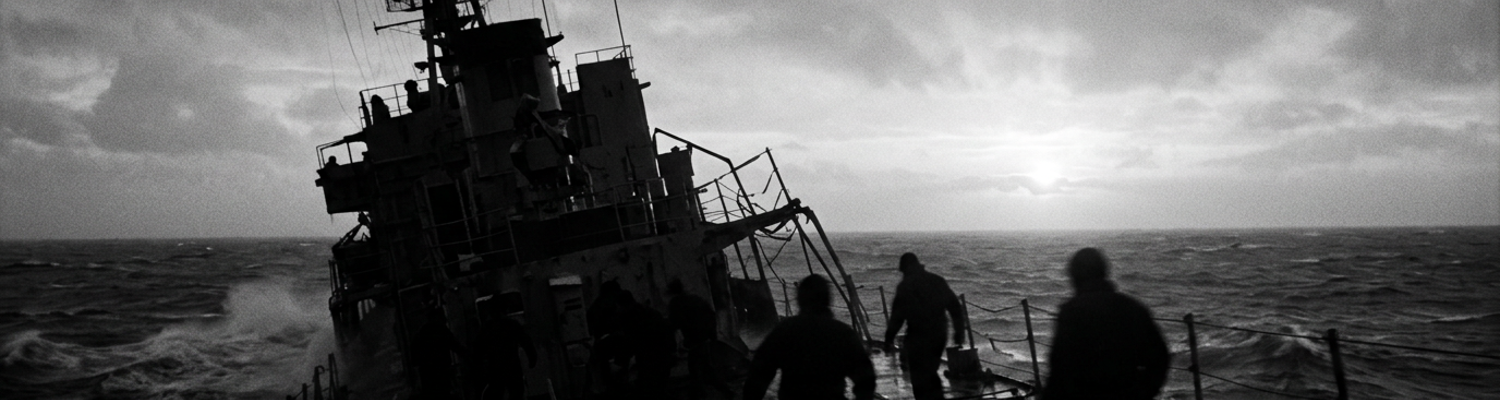

Cold War Signals Intelligence and Auxiliary Platforms
081200Z JUN 67. POSITION 31-23.5N, 033-22.5E. COURSE 283 DEGREES TRUE. SPEED 5 KNOTS. Archival evidence shows that the vessel tracking thirteen nautical miles off the Sinai Peninsula began life as the merchant freighter SS Simmons Victory. Built in Portland, Oregon, in early 1945 by the Oregon Shipbuilding Corporation, the 455-foot hull was designed to haul bulk cargo across the Pacific. The United States Navy pulled it out of the National Defense Reserve Fleet in February 1963. Shipbuilders at the Willamette Iron and Steel Works stripped the dry-cargo holds. They reinforced the decks to house electronic intelligence workspaces. The platform was redesignated as auxiliary technical research ship USS Liberty (hull number AGTR-5). Deep inside the hull, a single Westinghouse geared steam turbine supplied 8,500 shaft horsepower to a single propeller shaft. This drove a 10,700-ton deep-load hull that could barely exceed eighteen knots in calm water. Four open-mount Browning M2 caliber .50 machine guns provided the entire defensive battery. These were mounted in exposed pairs on the forecastle and the aft superstructure.
Steel bulkheads divided intelligence collectors from the naval crew sailing them.
When examining the historical record of the 1964 refit (Bureau of Ships Project 104-A), naval architects packed the forward cargo spaces with radio receivers, signal analyzers, and cryptographic equipment. Compartment 2-46-0-E became the secure operations space. Three officers and one hundred and thirty enlisted technicians from the Naval Security Group staffed this area. Forty-five distinct antenna systems covered the masts and rigging. These arrays intercepted high-frequency, very-high-frequency, and ultra-high-frequency radio emissions alongside radar signatures. Engineers installed a sixteen-foot parabolic dish on the fantail for the Technical Research Ship Special Communications system. This specialized link bounced ten-kilowatt microwave signals off the moon to a receiving station in Cheltenham, Maryland. Salt spray repeatedly jammed the antenna hydraulic actuators. Rough Mediterranean swells disrupted the directional tracking gears. Contact with the lunar surface broke frequently. Real-time data feeds dropped entirely.
Operational control did not rest with the fleet commander.
A close review of operational logs indicates a bifurcated command structure. This arrangement severed intelligence tasking from naval defense. The National Security Agency at Fort Meade directed all intercept priorities, collection targets, and cryptographic exploitation. Incoming intercepts were processed through specialized civilian and service cryptologic agency channels. Vice Admiral William I. Martin commanded the Sixth Fleet from the cruiser USS Little Rock. He maintained administrative command and tactical defense responsibility without direct visibility into the collection tasks of the ship. Orders from the Joint Chiefs of Staff routed through the Commander in Chief, US Naval Forces Europe in London (Admiral John S. McCain Jr.) and General Lyman Lemnitzer at US European Command in Stuttgart. This military hierarchy treated AGTR-5 as an ordinary fleet auxiliary. Fort Meade managed the ship as a national intelligence collector.
During the rapid Israeli advance across the Sinai in early June, the Joint Chiefs of Staff decided to pull the ship one hundred nautical miles away from the coast. The goal was to prevent accidental engagement. Five urgent retasking messages sent on June 7 and June 8 through military relay stations suffered misroutings and administrative delays. Signal personnel at the Army communications station in Asmara, Ethiopia, misfiled a priority redirect message to the naval communications center in Port Lyautey, Morocco. Another cable intended for the Sixth Fleet traveled by mistake to the Pacific Fleet headquarters in Hawaii before routing back to the Pentagon. The Israeli Air Force launched its first reconnaissance flight over the hull at 0600 on June 8. Commander William L. McGonagle had received none of the repositioning directives.
The top-priority advisory directing the vessel to maintain a fifty-mile standoff distance arrived in the radio room sixteen hours after the strike ended.
Sinai Littoral Surveillance and Joint Reconnaissance Tasking
Archival evidence shows that early on June 8, 1967, USS Liberty steamed into its designated surveillance track along the northern edge of the Sinai Peninsula. The ship held a course thirteen nautical miles off El Arish. Commander William L. McGonagle kept the ship inside international waters. The hull skimmed just one nautical mile outside the twelve-mile territorial sea boundary claimed by the United Arab Republic. The Joint Reconnaissance Center in the Pentagon assigned this patrol line to monitor coastal radar installations and tactical communications across the Gaza Strip and northern Sinai. Bridge watchstanders logged continuous soundings on the AN/UQN-1 fathometer. They watched the bottom shoals rise to twenty fathoms beneath the single screw as the hull crept westward at five knots.
Smoke from burning ammunition depots in El Arish drifted directly across the starboard bow.
When examining the historical record of deck logs, lookouts using the bridge pelorus could easily spot the physical landmarks of the ground war unfolding ashore. General Israel Tal and the 84th Armored Division had broken through Egyptian defensive fortifications at Rafah. They smashed into the Egyptian 7th Infantry Division holding El Arish. Gun flashes from Israeli M-50 and M-51 Super Sherman tanks and British-built Centurions flickered along the sand dunes south of the coastal railway line. McGonagle adjusted course between Point Alpha at 31-27.2N, 34-00E and Point Bravo at 31-22.3N, 33-42E. He maintained an exact track that exposed the entire broadside of the ship to shore surveillance. Naval Security Group personnel needed this exact geographical placement. High-frequency ground waves and line-of-sight very-high-frequency signals attenuated rapidly over the coastal desert terrain.
The antennas captured everything transmitted across the dunes.
A close review of operational logs indicates that two decks down in Compartment 2-46-0-E, ninety-three cryptologic technicians operated continuous search banks across the high, very-high, and ultra-high frequency spectrums. Banks of Collins 51S-1 receivers and AN/URR-35 UHF radio sets pulled raw military voice traffic out of the air. Technicians routed signals into Ampex magnetic tape recorders running at seven and a half inches per second. Operators tuned their equipment to the tactical nets of Soviet-built R-105 and R-123 transceivers mounted inside retreating Egyptian T-54 tanks and BTR-152 armored personnel carriers. Intercept operators logged chaotic transmissions of Egyptian commanders attempting to coordinate retreats toward the Mitla Pass under heavy air strikes. Every incoming frequency strip was transcribed onto paper logs. Clerks stamped them with local intercept times and filed them into three-ring binders according to target identification codes assigned by the National Security Agency.
Voice channels suddenly flooded with Hebrew traffic.
Technical surveillance reports confirm that the receivers simultaneously picked up Israeli Defense Forces tactical VHF nets operating between 30 and 76 megahertz. The arrays also caught UHF air-to-ground tactical frequencies used by Israeli Air Force flight leaders flying Dassault Mirage IIIC and Super Mystere fighters. The Joint Reconnaissance Center had configured the intercept detachment primarily for Soviet bloc and Arabic communications. Six Arabic-speaking linguists and three Russian-language specialists were stationed aboard. Not a single qualified Hebrew linguist was stationed inside Compartment 2-46-0-E during the patrol. Technicians had to log the intercepted Israeli tank-to-tank and forward air control transmissions onto magnetic tape without real-time evaluation. They stacked unmonitored Scotch 201 reels inside aluminum storage bins along the forward bulkhead.
Bureaucratic Routing Failures of Pentagon Navigational Cables
When examining the historical record of Pentagon telecommunications, the Joint Chiefs of Staff made the formal decision at 2230Z on June 7 to pull USS Liberty back from the Sinai coast. Growing concerns over regional combat escalation prompted the Joint Reconnaissance Center to establish a safety buffer. They ordered the technical research ship to shift from its thirteen-mile surveillance track to a position at least one hundred nautical miles off the coastlines of Egypt and Israel. Generating the paperwork inside the Pentagon was straightforward. Transmitting it through the Defense Communications System proved disastrous. Five separate priority and flash navigational withdrawal directives filed between 2230Z on June 7 and 0917Z on June 8 fragmented across global teletype relays. Communications clerks fed punched paper tape into automatic digital network transmitters. They routed messages through convoluted fallback nodes that defied geographic logic.
Paper tape backed up across four continents while the ship held its drift off El Arish.
Archival evidence shows that clerical errors and terminal transpositions systematically sent the withdrawal orders in the wrong direction. Message 080110Z (drafted by the Joint Chiefs of Staff to order a one-hundred-mile standoff) contained a garbled geographic routing indicator entered by a Pentagon communications operator. Automated relay switches at the Defense Communications Agency misread the header. The system routed the electronic pulse across the Pacific to the Naval Communications Station at San Miguel in the Philippines instead of transmitting it across the Atlantic to Europe. Halfway across the globe at the United States Army Strategic Communications Command installation at Kagnew Station in Asmara, Ethiopia, another urgent withdrawal directive suffered complete handling abandonment. Watchstanders at Kagnew Station received a high-precedence message destined for Commander in Chief, US Naval Forces Europe. They misread its header routing indicators and tossed the teletype copy into an inactive file basket instead of relaying it immediately to the naval transmitter site at Port Lyautey in Morocco.
Electronic pulses traveled twelve thousand miles away from the target hull.
A close review of operational logs indicates that administrative congestion inside Naval Communications Station Morocco at Kenitra thoroughly paralyzed whatever traffic survived the transatlantic hops. Port Lyautey operated as the primary communication link for the United States Sixth Fleet. Its tape-relay room suffered a massive backlog of unrouted traffic generated by regional diplomatic crises and routine administrative reports. By 0600Z on the morning of June 8, Commander William L. McGonagle should have been turning the vessel north to open the ordered one-hundred-mile perimeter. Instead, the Moroccan terminal had accumulated hundreds of low-precedence administrative messages that physically clogged the teletype punch sets. Transmitting gear running model 28 teletype apparatus lacked modern automated queue overrides. Top-priority navigational warnings sat static behind ordinary logistic manifests and personnel requisitions. Vice Admiral William I. Martin attempted to transmit his own direct navigational warning at 0917Z. This order also bogged down in the Kenitra teletype queues.
Signals personnel in Morocco did not clear the transmission channel to the onboard radio terminal until late in the afternoon. At 1525Z, precisely three hours and twenty-five minutes after Israeli jet fighters rolled into their initial strafing runs and one hour after a patrol boat torpedo tore a forty-foot hole through Compartment 2-46-0-E, the receiving equipment finally recorded the text of the first Pentagon standoff directive.
The Torpedo Strike and Compartment Research Losses
Archival evidence shows that at 1358 local time, two delta-wing Dassault Mirage IIIC fighters from Israeli Air Force 101 Squadron dove out of the sun at three thousand feet. Stripped of distinguishable national insignia or displaying markings obscured by exhaust grime and low-altitude haze, the jets approached without radio warning. Flight leader Captain Iftach Spector initiated high-angle strafing passes across the bridge and exposed superstructure. Twin 30mm DEFA cannons poured explosive fragmentation shells into the forward deck. The rounds pierced the thin steel sheeting of the deckhouse and cut down crewmen servicing the open-mount .50-caliber machine gun tubs. Armor-piercing incendiary rounds severed high-frequency antenna leads. They knocked out the primary gyrocompass and drilled dozens of holes through the bridge windows, driving metal splinters into the right leg of Commander McGonagle.
Shrapnel shredded the American ensign within ninety seconds.
A close review of operational logs indicates that three Dassault Super Mystere B2 strike fighters from 105 Squadron swept in immediately behind the Mirages to execute low-level ordnance drops. Pilots released unguided 68mm SNEB folding-fin rockets alongside finned napalm canisters filled with thickened polystyrene gasoline. Rocket warheads tore through the motor whaleboat. They ruptured high-pressure steam lines and pulverized auxiliary emergency radio transmitters on the boat deck. The napalm canisters ruptured on impact near the bridge wing and frame 85. Burning gel splashed across the main deck. This ignited fifty-five-gallon drums of motor gasoline and volatile hydraulic fluid stored near the deckhouse. Thick black petrochemical smoke entered the ventilation intakes. The fumes blinded the bridge watch and forced boiler technicians deep in the engine spaces to operate with Scott Air-Paks as ambient compartments reached blistering temperatures.
Every operational radio whip on the superstructure was sheared off at the ceramic insulators.
When examining the historical record of naval tracking logs, three French-built 62-ton motor torpedo boats from Israeli Navy Division 914 out of Ashdod converged on the burning ship at twenty-seven knots twenty minutes later. Patrol boat MTB-204 (operating within the division formation of Lieutenant Commander Moshe Oren) matched speed and drew abreast of the starboard hull at a range of eight hundred yards. At 1435 local time, MTB-204 fired a direct spread of German-built 450mm torpedoes across the wave troughs. One torpedo ran true. It penetrated the outer plating at frame 53 slightly forward of the bridge and exploded directly inside Compartment 2-46-0-E, the subterranean Research Compartment. Detonation forces ruptured an adjacent fuel bunker. A concussive surge of seawater, diesel oil, and sheared structural ribs tore through rows of Collins receivers and Teletype printers. Twenty-five naval intelligence technicians and a civilian cryptologist died instantly from blast pressure, machinery collapses, and rapid flooding. Seawater reached five feet above the lower platform deck within forty seconds. Survivors dogged down watertight hatches against the rising flood. Classified intercept tapes dissolved in fuel-slicked water.
The vessel took on an immediate nine-degree starboard list.
Emergency Triage on Flooded Mess Decks
Archival evidence shows that when the torpedo explosion shook the hull at frame 53, Lieutenant Commander Dr. Richard Kiepfer was already bleeding heavily from eleven distinct shrapnel penetrations across his back, legs, and abdomen. Blast fragments from 30mm high-explosive cannon shells had struck Kiepfer while he treated earlier casualties near the bridge ladder. The metal cracked his ribs and embedded jagged steel fragments into his torso. Refusing morphine injections to maintain clear mental judgment, Kiepfer established an emergency collection point on the crew mess deck after rocket detonations shattered the main sickbay forward on the main deck. Across a crew of two hundred and ninety-four men, one hundred and seventy-one sailors required immediate trauma stabilization for compound fractures, third-degree thermal burns from burning polystyrene gel, ruptured eardrums, and traumatic amputations. Kiepfer worked alongside two enlisted hospital corpsmen (Thomas Lee Brooks and Charles Rowley). He categorized incoming casualties according to survivability. He manually checked carotid pulses and applied tourniquets made of surgical tubing while leaning against bulkheads to offset his own blood loss. Navy medical logs indicate that Kiepfer spent twenty-eight continuous hours on his feet without rest or pain suppression. He administered whole blood, injected broad-spectrum penicillin, and directed litter bearers through smoke-filled passageways.
Blood pooled across tables normally used for serving rations.
A close review of operational logs indicates that the torpedo detonation destroyed the primary electrical distribution boards, plunging the lower deck levels into near-total blackness. Emergency diesel generators failed within minutes as saltwater filled lower cable chases. This left the medical crew dependent on six-volt dry-cell battle lanterns lashed to overhead piping with electrical friction tape. Beneath the triage stations, seawater entering through the forty-foot hull breach forced oily bilge water up through fractured floor drains. The liquid coated the mess deck deckplates in six inches of mixed bunker fuel, sewage, and saltwater. Toxic chemical fumes compounded the darkness. Heavy petrochemical smoke pulled inward by damaged auxiliary intake blowers mixed with acrid vapor from burning polyurethane insulation, vaporized hydraulic fluid, and lingering cordite fumes from machine gun impacts. Uninjured cryptologic technicians and deck ratings knelt directly in this corrosive liquid to hold handheld lanterns steady. They directed beams of dim yellow light across stripped stainless-steel dining tables.
Protective respirators were entirely unavailable for the surgical team.
When examining the historical record of deck casualties, Kiepfer performed emergency surgical interventions using unsterilized instruments boiled in galley kettles over canned-heat Sterno burners. Enlisted deck hands held thrashing patients down on the steel mess tables. Kiepfer carried out tracheotomies with simple scalpel blades to bypass airways swollen shut by burning napalm vapors. Lacking mechanical surgical suction apparatus, corpsmen manually swabbed arterial bleeders with compressed cotton gauze to locate severed femoral arteries. Kiepfer threw deep hemostatic sutures under the erratic glare of battery-powered beam lights. Splints for shattered limbs were fashioned out of split aluminum mess trays and broken wooden swab handles bound together with coarse canvas rolls. At 1730 local time, as the list settled at nine degrees to starboard, Kiepfer closed an open sucking chest wound on an engineering rating using a curved suture needle and black braided silk pulled from a standard general-service surgical pack.
Recalled Interceptors and Pentagon Command Paralysis
Archival evidence shows that at 1220Z, radio operators aboard the aircraft carrier USS Saratoga intercepted an authentic tactical distress flash transmitted from the jury-rigged wire antenna on USS Liberty. Vice Admiral William I. Martin, stationed aboard the command ship USS Little Rock four hundred miles to the northwest, authorized immediate armed intervention under standard defense directives. Flight deck crews on USS Saratoga and USS America responded instantly. Steam catapults pressurized along the flight decks as flight deck officers spotted McDonnell Douglas F-4B Phantoms of Fighter Squadron 102 and Douglas A-4 Skyhawks belonging to Carrier Air Wing 6. Four F-4B interceptors rolled onto the catapult shuttles of USS America. Their twin General Electric J79-GE-8 turbojets spooled to full military thrust. Catapults flung eight strike aircraft into twenty-knot headwinds across the Mediterranean swells. Their mission parameters dictated a direct dash at Mach 1.2 across four hundred miles of open sea to establish a defensive umbrella over the burning research platform.
Catapults cleared the deck edge in under ten minutes.
A close review of operational logs indicates that ordnance handlers had armed the scrambled Phantoms and Skyhawks with live air-to-air and air-to-surface weapons stores. The F-4B Phantoms carried radar-guided AIM-7E Sparrow and heat-seeking AIM-9B Sidewinder missiles mounted on belly recesses and wing pylons. Four A-4 Skyhawks from USS Saratoga climbed away carrying Bullpup air-to-ground guided missiles alongside iron general-purpose fragmentation bombs. Flight leaders established an initial climb to thirty-two thousand feet. They steered southeast on heading 135 directly toward the coordinates logged off the Sinai coast. Rear Admiral Lawrence Geis, commanding Carrier Division Two from USS America, authorized pilots to defend the intelligence ship and destroy any naval or air units actively engaging the American hull. Long-range naval radar operators aboard the escort destroyers monitored the outbound strike flights. They tracked their transponder returns as the aircraft closed to within twenty minutes of the combat zone.
The strike force never crossed the Egyptian coastline.
When examining the historical record of Pentagon communications, the secure teletype lines between the National Military Command Center and the Sixth Fleet erupted in chaos within fifteen minutes of the launch. Secretary of Defense Robert McNamara received notification of the carrier strikes via an open-line telephone patch to the Joint Chiefs of Staff. McNamara feared that American carrier aircraft would strike Soviet-flagged intelligence vessels shadowing the Sixth Fleet. He worried they might bomb Egyptian shore installations at Port Said. He intervened through direct operational channels. Department of Defense policy required White House consultation before conducting combat operations against unidentified forces in an active war zone. McNamara bypassed the traditional chain of command through Commander in Chief, US Naval Forces Europe in London. McNamara used a direct radio-telephone hookup into the Sixth Fleet flag bridge. He told Admiral Geis to abort the air mission and return every launched aircraft to the carrier decks immediately.
Geis questioned the legitimacy of the order, reminding Washington that an American naval vessel was burning and taking torpedo strikes.
National military leadership refused to permit unverified tactical engagements that risked bringing the Soviet Union into the regional conflict. McNamara returned to the communication link within minutes to confirm his direct directive. He stated that President Lyndon B. Johnson would not risk an international war to save a single auxiliary ship. Geis had no choice under military law. He keyed his tactical radio transmitter and sent code words ordering the strike leader to reverse course. Outbound A-4 Skyhawks banked hard to port three hundred miles out over the Mediterranean Sea. They dumped fuel through wingtip vents to reduce landing weights before entering the carrier recovery pattern. By 1345Z, every American fighter-bomber touched down back onto the arresting wires of Saratoga and America. This left the crippled auxiliary hull completely defenseless against closing Israeli torpedo boats.
Prolonged Medevac Delays and Final Operational Casualties
Twenty-four hours elapsed between the first cannon strike and the arrival of the first aeromedical evacuation helicopter.
Archival evidence shows that through the night of June 8, Commander McGonagle nursed the crippled hull northward at less than nine knots. He steered by hand with a magnetic compass while seawater sloshed against fractured bulkheads. Sixth Fleet headquarters kept escort destroyers held back during the initial hours of confusion. Not until 0632 local time on June 9 did the destroyers USS Davis and USS Massey pull within visual distance of the smoking superstructure. Heavy sea chop and electrical damage aboard the auxiliary hull blocked rapid personnel transfer. Flight deck crews on the carrier USS America had to hold their Sikorsky SH-3A Sea King helicopters on standby while surface teams evaluated structural buoyancy and fuel leaks. Medical officers Lieutenant Commander Peter Flynn and Lieutenant John Utz crossed over in small open motor whaleboats to begin stabilizing casualties on the listing deck. The first SH-3A aeromedical helicopter lowered its hoist over the forecastle shortly before midday on June 9. Wire baskets hauled men with deep tissue burns and compound fractures into hovering aircraft for flights back to the surgical suites of USS America.
Flight surgeons found the casualty deck stacked with corpses wrapped in damp bedding.
When examining the historical record of casualty tallies, the final human cost amounted to thirty-four dead and one hundred and seventy-one wounded out of a crew of two hundred and ninety-four. Thirty-one regular naval personnel, two United States Marines, and one civilian National Security Agency cryptologist lost their lives in the bombardment and subsequent flooding. Deep divers from salvage teams later descended into the flooded ruins of Compartment 2-46-0-E to cut free bodies pinned beneath flattened receiver racks and collapsed steel overheads. Shrapnel had shredded nineteen men beyond visual recognition. This required identification through dog tags and forensic dental charting. As medical personnel transferred the last injured survivors to transport aircraft bound for the naval hospital at Naples, naval authorities moved swiftly to lock down the information environment. Rear Admiral Isaac C. Kidd Jr. arrived via helicopter with explicit instructions from the Commander in Chief, US Naval Forces Europe. He initiated a formal Court of Inquiry under conditions of absolute operational secrecy.
Armed couriers seized every technical document remaining aboard.
A close review of operational logs indicates that naval intelligence officers immediately impounded the surviving radio teletype rolls, raw audio tape reels, and bridge tracking charts. Security details confiscated the personal notebooks of watchstanders. They classified every shipboard communication log under top secret handling restrictions before the vessel reached the repair drydock at Valletta, Malta. Admiral Kidd cautioned every crew member that discussing the events of June 8 with unauthorized personnel or the press would result in court-martial or imprisonment under the Uniform Code of Military Justice. Pentagon censors intercepted personal mail from the crew, stripping references to the torpedo strike or the delayed fleet response. The official navy record of outgoing transmission tapes and incoming Pentagon advisories was placed inside secured intelligence vaults in Washington. The files were sealed away from civilian oversight and exempt from public disclosure. The bureaucratic machinery that stranded AGTR-5 off the Sinai coast ensured that the mechanics of its destruction remained buried within classified archives for decades.