
Frontline RR&C Service Operations
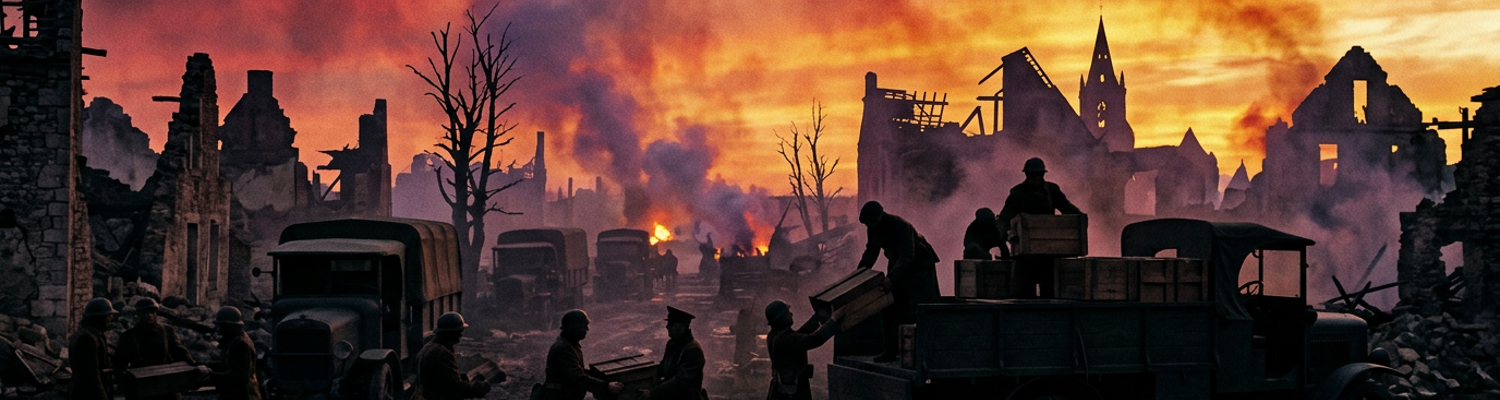
Holt caterpillar tractors dragged heavy artillery pieces through cratered tracks north of Verdun as First Army gunners prepared to smash German defenses across the Meuse-Argonne sector. Steel tracks tore up narrow roads while supply trucks, French Renault FT tanks, and horse-drawn caissons jammed into single-file lanes that blocked the forward supply network. Military planners faced a massive logistical liability because advancing infantry required immediate shelter and storage space in ruined civilian towns without sparking bitter financial disputes with French authorities. General Headquarters addressed this dilemma by taking a controversial gamble, violating standard doctrine by ordering non-combatant financial officers to operate directly behind assault waves under active shellfire. General Orders No. 50 in 1918 had created the American Expeditionary Forces Renting, Requisitions, and Claims Service to lease property, procure local supplies, and settle damages, yet official policy kept those administrative specialists miles behind the frontline trenches. Skeptics within the general staff argued that pushing unarmed claims evaluators into artillery barrages was a reckless waste of personnel that would collapse under enemy fire.
Officers on the First Army staff accepted the danger and pushed the gamble forward, calculating that waiting days for fighting to stop would leave forty thousand reserve troops without shelter and produce millions of dollars in untraceable damage disputes. Frontline claims officers deployed directly in trace of First Army I and V Corps infantry divisions as the assault battalions attacked through the morning fog on September 26, 1918. Claims teams carried notebooks, billeting forms, and measuring tapes right behind the lead rifle companies, stepping across fresh craters and severed communication wires along the advance routes. Splintering shrapnel and lingering mustard gas forced these administrative agents to wear steel helmets and rubber respirators while keeping pace with advancing soldiers through the ravines of the Aire Valley. Requisition officers immediately calculated floor space for division field hospitals, ammunition dumps, and regiment headquarters while German artillery rounds still hit nearby tree lines. Field commanders quickly discovered that having billeting specialists at their side prevented chaotic scrambles for cellars and established working agreements with local French town leaders.
Mayors in ruined villages such as Varennes and Montfaucon guided these claims officers through the rubble to execute rapid structural damage evaluations and troop billeting surveys amidst persistent artillery fire. German high-explosive shells shattered stone walls into mounds of debris as the teams walked through ruined streets, recording baseline structural conditions before combat units could alter the buildings. Officers chalked troop capacities and unit numbers onto surviving masonry, securing dry sleeping quarters for exhausted assault battalions while documenting blast holes to separate enemy shell damage from soldier vandalism. Falling stones and sniper bullets repeatedly drove the evaluators into damp cellars alongside wounded infantrymen before the officers stepped back outside to inspect roof timbers and floor stability. Claims personnel wrote inspection logs on wooden scraps, signed emergency rental certificates on battered farmhouse tables, and handed billeting slips directly to arriving quartermasters. Battalion quartermasters used those billeting slips to route reserve companies into inspected cellars before launching the next dawn assault against the German second line.
Civilian Crisis and Toxic Cellars
Infantrymen clearing these designated basements in Grandpre stumbled upon dozens of destitute French civilians sheltering alongside army medics inside forward combat dressing stations. Heavy concentrations of German mustard gas settled directly into the subterranean rooms because the oily chemical vapor was denser than air and clung to damp stone walls, dirt floors, and wool blankets. Exhausted medical personnel in rubber respirators bandaged shrapnel lacerations on bleeding soldiers while local villagers, including small children and elderly women, breathed the toxic air without military protective masks. Continuous German counter-battery barrages hammered the stone houses overhead, collapsing street-level walls and blowing limestone chunks through the cellar grates onto the crowded occupants below. Renting, Requisitions, and Claims evaluators who arrived to record room capacities found that these families had spent days in the dark without food, potable water, or clean bandages.
Villagers endured acute starvation and untreated blast wounds that festered in the damp masonry vaults as German mustard gas concentrations remained deadly. Chemical burns covered the eyes and throats of the elderly townspeople, leaving them unable to swallow dry rations even when soldiers offered scraps from their personal haversacks. German artillery crews maintained heavy interdiction fire across the Aire River crossings, shattering road surfaces and preventing relief convoys from pushing food and clean water forward to the frontline sector. Medics treated severe respiratory trauma with limited gauze and saline solution, watching helplessly as young children slipped into unconsciousness from chemical asphyxiation. Evaluators documenting local property damages realized that keeping dozens of dying non-combatants trapped under active counter-battery barrages would result in complete civilian loss of life within forty-eight hours.
Trucks returning empty from frontline ammunition runs sat parked on the ruined roadway, but drivers refused to carry the injured French civilians because strict War Department prohibitions barred tactical transport from evacuating non-combatants. General Headquarters had established these rigid transportation rules to guarantee that every available motor vehicle and gallon of fuel supported combat operations and offensive logistics. Staff officers faced severe disciplinary action and potential court-martial if they diverted tactical motor assets from the frontline combat zone to haul foreign refugees. Military police stationed at rearward road junctions held written orders to halt and inspect every returning vehicle, turning back any transport that carried unauthorized civilian passengers. Institutional paralysis seized the forward command posts as field officers weighed the certainty of official punishment against the humanitarian disaster unfolding in the poisoned cellars.
Officers resolved this operational crisis by taking a calculated gamble, knowingly violating standing army regulations to commandeer the empty ammunition trucks for emergency civilian evacuation. Claims evaluators dissected the bureaucratic math, calculating that assuming personal financial liability and facing disciplinary charges outweighed the legal and moral liability of letting sixty allied civilians die inside an American military zone. Personnel from the Renting, Requisitions, and Claims Service drew up emergency requisition certificates on billeting paper, signing their own names to authorize the tactical vehicles as temporary hospital carriers under allied civil agreements. Medics wrapped the burned children in wool blankets and lifted them over high wooden tailgates alongside wounded American infantrymen while drivers started their engines under falling shrapnel. Drivers accelerated down the shell-pitted road toward rear-echelon field hospitals, carrying the evacuated civilians past the military police checkpoints to complete the unauthorized rescue mission.
Frontline Fiscal Violations and Emergency Requisitions
Officers watched the taillights of the ammunition trucks vanish into the fog and turned immediately toward the remaining crowds of starving French civilians who could not be evacuated from the sector. Shivering families filled every surviving basement between Varennes and Grandpre, where infants, elderly farmers, and wounded non-combatants had eaten nothing for three days while sheltering under continuous shellfire. Heavy German artillery rounds repeatedly struck the fields outside, yet several stone barns and mill silos near the river still held undamaged stores of unthreshed wheat and rye. French communal officials and local farmers refused to release these grain stores on credit because previous retreating armies had left behind worthless paper receipts. Frontline claims evaluators realized that waiting for rear-echelon supply convoys would cause mass starvation across the sector within forty-eight hours, leaving them with no choice but to secure food on the spot.
Iron field chests assigned to division paymasters held the only liquid currency anywhere near the fighting, packed with paper French banknotes meant exclusively for American troop wages. Renting, Requisitions, and Claims officers marched directly into division command posts and demanded immediate access to these cash reserves, executing an emergency requisition of franc notes directly from the field chests without receiving prior authorization from the AEF Services of Supply. Paymasters protested vigorously, warning the claims evaluators that seizing combat division operational funds breached army regulations and would leave the officers personally liable for hundreds of thousands of missing francs. Staff evaluators calculated the administrative risk against human survival, deciding that facing an official military board of inquiry was preferable to watching children starve in cellar dressing stations. Evaluators signed personal hand receipts on scrap paper, loaded bundles of French currency into canvas map pouches, and carried the cash back toward the ruined village squares under falling shrapnel.
Paper franc notes pulled from the payroll boxes represented a blatant, unilateral decision by the claims officers to bypass rigid War Department fiscal accounting directives and inter-Allied currency parity agreements. Treaties between Washington and Paris strictly mandated that American field units purchase foreign supplies solely through centralized bureaucratic clearinghouses at fixed international exchange rates, preventing wild price swings and keeping field commanders from meddling with Allied monetary policy. Inflation in the devastated combat zone had rendered these official intergovernmental parity figures completely unrealistic, as French farmers demanded actual cash premiums to part with their winter sustenance during an active bombardment. Claims officers threw out the official conversion tables and formal voucher ledgers, choosing to pay inflated open-market values in hard banknotes to close transactions instantly. Personnel knowingly committed multiple federal financial violations on the spot, calculating that an orderly paper trail meant nothing if the people they were sent to protect died of malnutrition behind American lines.
Mayors and communal councilmen gathered around splintered wooden tables in cold municipal cellars as the American evaluators dumped thick stacks of twenty-franc and fifty-franc notes directly onto the damp stone. Frontline officers completed immediate cash disbursements to these French communal authorities to purchase standing grain stores and feed the trapped civilian refugees throughout the division sector. Local leaders inspected the bills, signed emergency communal release forms on stamped municipal stationery, and handed heavy iron keys over to waiting army truck drivers. Work details of uninjured French villagers and off-duty American engineers immediately unlocked the reinforced storage barns, loaded dozens of fifty-kilo grain sacks onto horse-drawn wagons, and hauled the wheat toward functioning stone ovens in Grandpre. Bakers built wood fires in communal masonry ovens while artillery concussions rattled the chimneys, producing thousands of fresh bread loaves for distribution to hungry children sheltering in the basements below.
Tactical Transport Diversion and Evacuation Convoys
Bread rations nourished the trapped families for only a few hours while exploding German artillery shook the limestone foundations around them. American battery commanders required hundreds of tons of high-explosive shells each morning to sustain the infantry assault, tying up every available vehicle in the sector. Frontline claims evaluators faced an agonizing triage of tactical mobility assets between urgent artillery ammunition replenishment and civilian displacement out of the active combat zone. Division staff officers argued that reassigning even a single cargo bed to non-combatants would starve the gun lines of vital ammunition and stall the entire offensive. Claims officers examined the operational figures, calculating that delaying a handful of supply runs would not silence the artillery batteries, whereas leaving wounded families in crumbling cellars guaranteed their deaths. Evaluators decided to risk their commissions and face courts-martial by intercepting the army transport network directly at the muddy crossroads.
Liberty trucks from corps-level supply trains and returning casualty transport vehicles ground through thick limestone mud along the congested axes between Montfaucon and Rarecourt. Claims officers stepped directly into the path of these rumbling convoys, holding up their hands to force the heavily loaded supply trucks and empty casualty carriers to a dead stop. Drivers pointed to written movement orders signed by Fifth Corps headquarters that strictly forbade detours or unassigned cargo, but the claims evaluators brushed past the military police warnings. Unauthorized diversion of corps-level logistics trucks and returning casualty transport along congested axes between Montfaucon and Rarecourt became an immediate reality as evaluators demanded vehicle ignitions and redirected tailgates toward ruined basements. Empty canvas-topped ambulances and three-ton cargo haulers pulled out of the one-way supply stream under the evaluators' orders, leaving quartermaster sergeants shouting in frustration as the main road jammed with idling engines.
Drivers turned their steering wheels off the jammed main thoroughfare and backed into ruined alleys where claims officers supervised the loading of French families. Soldiers and evaluators lifted shivering mothers, wounded grandfathers, and young children over wooden tailgates into the cargo beds alongside stretcher cases. Creation of improvised civilian transport convoys navigating heavily shelled routes under the personal authority of frontline claims personnel defied every established military supply chain rule. German artillery spotters spotted the vehicle clusters and fired shrapnel rounds that burst in the trees overhead, spraying iron fragments against wooden truck beds and splashing mud across windshields. Evaluators rode on the vehicle running boards, displaying handwritten transit authorizations on Renting, Requisitions, and Claims letterhead to force their way past armed military police posts along the Rarecourt road. Convoys crawled southward through cratered ruts and broken stone roadways under persistent shellfire until they deposited hundreds of evacuated French citizens safely at Allied relief stations behind the corps boundary.
General Purchasing Board Financial Inquest
Accountants stationed behind the corps boundary examined the travel tickets of those arriving French families and discovered hundreds of unrecorded cargo trips made by First Army logistics trucks. Brigadier General Charles G. Dawes directed a comprehensive post-Armistice audit through the AEF General Purchasing Board to review irregular frontline transactions across the entire battle zone. Dawes instructed military comptrollers and field auditors to cross-check every division expenditure against official War Department purchasing codes, determined to bring strict business accountability to the overseas expedition. Examiners traveling along the old First Army front quickly identified widespread procedural breakdowns where combat units had failed to submit standard requisition vouchers, supplier price agreements, and quartermaster receipts. Inspectors uncovered thousands of scrap-paper chits signed by junior officers during the October fighting, prompting board leaders to halt routine account liquidations until investigators verified whether frontline personnel had committed massive financial fraud.
Investigators launched a formal investigation into millions of francs expended via improvised field receipts and unvouchered chits issued in the Meuse-Argonne sector. Ledger specialists traced these paper trails directly to division paymaster safes that were missing massive bundles of French banknotes without matching payroll signatures from American soldiers. French mayors, communal councilmen, and local mill owners converged on American claims offices holding penciled promissory slips, demanding gold-backed settlements for thousands of bushels of unthreshed wheat and rye seized during the push toward Grandpre. Board examiners cross-referenced these rural demands against official inter-Allied monetary parity treaties and discovered that frontline claims evaluators had paid open-market rates far exceeding federal price ceilings. Military police gathered stacks of billeting forms, flour receipts, and fuel logs from field desks, preparing formal dossiers that exposed junior evaluators to personal financial ruination and dishonorable discharges from the army.
Evaluators summoned before the inquiry board presented a comprehensive fiscal and legal defense, arguing that military necessity and the imminent loss of civilian life justified departures from statutory procurement protocol. Frontline officers testified that hundreds of destitute French villagers would have perished from starvation and mustard gas poisoning in damp Grandpre cellars if evaluators had paused operations to request formal procurement warrants from rear depots. Claims personnel produced sworn testimony from French civilian doctors, municipal mayors, and frontline division surgeons who confirmed that seizing local grain stores and commandeering empty ammunition trucks provided the sole means of preventing mass casualties behind American assault lines. Staff lawyers representing the Renting, Requisitions, and Claims Service argued that preserving civil order directly secured the combat zone, transforming emergency humanitarian relief into an essential operational requirement that protected supply lines and tactical rear areas. Defendants laid captured German artillery fragments alongside soiled bread receipts on the witness tables, demonstrating that strict peacetime contracting rules could never function inside active blast zones.
Dawes reviewed the physical evidence, weighed the operational math of the offensive, and chose to endorse the irregular field transactions rather than prosecute his frontline personnel. Board members recognized that strict adherence to War Department fiscal manuals would have produced catastrophic civilian mortality, alienating French authorities and crippling civil cooperation across the liberated territory. Dawes directed his staff comptrollers to validate the outstanding field chits through joint Franco-American settlement commissions, converting the penciled scraps into binding intergovernmental claims. Finance officers stamped official Treasury approval marks onto thousands of salvaged billeting slips and communal grain receipts, clearing division paymasters of personal financial debt. Clerks stamped final settlement vouchers, balanced the division paymaster ledgers, and packed the exonerated paperwork into wooden storage crates at general headquarters in Chaumont.
Liquidation Commission Settlement and Doctrinal Precedents
Wooden crates containing those field records traveled by rail from Chaumont directly to Paris, where Brigadier General Charles G. Dawes issued his official endorsement and retroactive ratification of the unauthorized field expenditures in late 1918. Dawes examined the operational calculations of the frontline evaluators, acknowledging that waiting for rear-echelon approvals would have allowed French non-combatants to starve and blocked combat routes with panicked refugees. Staff auditors initially resisted ratifying transactions that lacked standard contract signatures, but Dawes maintained that field commanders had to treat civil stability as an urgent tactical objective. His binding executive signature formally absolved division claims officers of personal financial liability and validated every emergency grain purchase, billeting chit, and improvised transport run executed during the fighting. Dawes explained to the general staff that the money spent on bread and local rentals had protected the flanks of First Army far more effectively than any delayed voucher system could have achieved. Administrative clerks across the American Expeditionary Forces updated their master balance sheets with these certified chits, transforming what had been treated as criminal insubordination into recognized military expenditures.
Ledgers detailing these resolved battlefield accounts moved directly to the conference tables of the 1919 United States Liquidation Commission under Judge Edwin B. Parker. Parker assumed responsibility for selling off massive American supply depots across Europe and settling all outstanding financial obligations between the United States and Allied governments. French negotiators presented extensive inventories of ruined property and unvouchered municipal demands from the Meuse-Argonne push, warning that unsettled communal debts would trigger prolonged courtroom battles across France. Parker calculated that auditing each handwritten scrap from destroyed towns like Grandpre and Montfaucon would take years and cost millions of dollars in administrative fees. Incorporation of all irregular Meuse-Argonne claims into the final accounts of the 1919 United States Liquidation Commission under Judge Edwin B. Parker allowed the commission to wrap those messy frontline disbursements into an overall four-hundred-million-dollar bulk settlement with the French government. American and French delegates signed the final liquidation contract in Paris, wiping out thousands of pending civilian lawsuits against the War Department and permanently balancing the overseas expeditionary accounts.
War Department planners in Washington studied these settled accounts and after-action reports to evaluate how emergency civilian relief had stabilized the frontline combat zone. General Staff officers at the Army War College recognized that frontline claims teams had prevented logistical gridlock and protected tactical operations by taking immediate financial and legal risks. Military theorists analyzed the Meuse-Argonne reports and concluded that modern coalition warfare required trained administrative personnel to operate directly behind assault infantry rather than miles in the rear. Establishment of modernized civil affairs and frontline claims doctrines for expeditionary operations within subsequent United States Army field manuals formalized the very practices that claims officers had improvised under German shellfire. Writers drafted updated manual sections on military government, non-combatant control, and emergency local procurement, giving future division commanders explicit authority to disburse funds and requisition local resources during tactical crises. Instructors at Fort Leavenworth issued these revised manual pages to student officers across the command schools, teaching future quartermasters to issue emergency field chits and direct civil evacuation convoys during large-scale maneuvers.