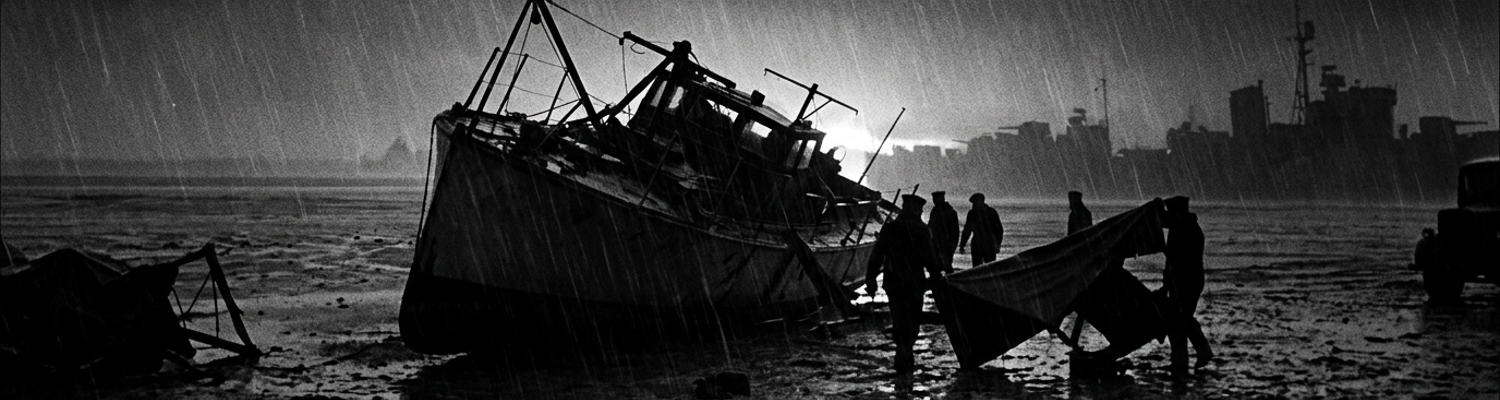

Imperial Japanese Blockade of Swatow Harbor
A sheared drive pin in the bronze cooling pump ground to a halt. Teeth stripped against the motor launch engine housing. Oil pressure needles dropped across the gauge cluster. They plunged from forty-five pounds per square inch down to an erratic five. The needle flattened against the stop peg. Inside the crankcase of the thirty-six-foot naval motor launch, bronze spur gears gnashed into loose brass filings. This jammed the shaft. Boiling water forced its way through cracked cylinder gaskets. Grey exhaust smoke mixed with sulfurous steam. The bilges filled while the craft drifted out into the tidal current off Kakchih. A close review of operational logs indicates the breakdown stripped away all headway precisely when the boat was running alongside Japanese gun positions.
The northern riverbank offered no physical cover.
Archival evidence shows the crisis escalated rapidly on June 21, 1939. Vice Admiral Kondo Nobutake directed the Fifth Fleet to execute Operation J. The objective was the total blockade of maritime supply routes into southern China. Japanese naval transports discharged the Goto Detachment and troops from the Sasebo Ninth Special Naval Landing Force directly into the harbor periphery. Destroyers Asakaze and Matsukaze provided escort. Within forty-eight hours, Japanese infantry took the customs house. They seized the municipal wharves. A naval blockade spanned the Han River estuary to interdict every junk and treaty-port vessel. Shore batteries took position on Dahao Island. Heavy ordnance aimed directly across the transit lanes. Rear Admiral Harry E. Yarnell directed the United States Asiatic Fleet from northern waters. He refused Japanese demands to evacuate foreign naval assets. The destroyer USS Pillsbury (DD-227) stayed anchored off the city bund alongside the British destroyer HMS Thanet. Japanese field commanders designated the river mouth an active combat zone on June 23. They backed their blockade with armed picket boats and Type 92 field guns trained over the water.
Natural elements caused equipment failures alongside hostile fire.
Heavy summer monsoon squalls struck the Han River delta. Line-of-sight visibility across Swatow Harbor dropped to less than fifty yards. Moisture levels stayed near saturation point throughout the day. Water vapor condensed inside unsealed electrical junction boxes. Distributor caps suffered constant internal shorts. Ignition coils grounded out against wet engine blocks. Salt-encrusted magnetos lost their sparks when torrential downpours forced brackish spray into unsealed housings. Swirling tidal currents stirred up bottom silt. This jammed water intake strainers. Cooling jackets starved until cylinder heads warped under thermal stress. Machinist mates stripped down flooded carburetors on open deck plates soaked with rain. They pried grit out of clogged fuel jets with copper wire.
They worked blind against the clock.
Western civilians caught in the assault clustered at the foreign settlement near Kakchih. They waited for waterborne extraction while artillery explosions rattled the waterfront. British and American auxiliary launches attempted to ferry stranded consular staff toward the safety of outer anchorages. Their transit routes were sealed off by Japanese naval patrols. Crossing the main harbor channel required traversing an open stretch of water under the direct observation of newly emplaced Japanese machine gun positions. These positions sat on the Swatow customs wharf. Foreign small craft strayed near the contested docks. Japanese sentries fired warning bursts from Type 11 light machine guns. Water sprayed around wooden hulls. The fire drove them back toward shallow mudbanks. Two auxiliary motor launches carrying noncombatants lost propulsion directly in the field of fire. Floating debris fouled their propeller hubs. A launch from the Pillsbury took three 6.5mm rounds through its forward timber coaming. The engineer cleared the fuel line and got the screw turning again.
Stranded Evacuation Craft on Han River Mudflats
The Han River ebb tide removed four vertical feet of water in less than two hours.
A close review of operational logs indicates the afternoon run on June 23 exposed treacherous sandbars across the Kakchih shallows. Asiatic Fleet coxswains were caught unprepared for the sudden water loss. Standard twenty-six-foot motor whaleboats drew roughly two and a half feet. Thirty-six-foot wooden motor launches drafted to three feet. Both types slid onto the submerged alluvial shelves extending hundreds of yards out from the southern bank. Helmsmen found their bronze rudders embedded deep into gray river sediment. They were unable to swing their sterns toward the central navigation channel. Sailors threw mechanical transmissions into full reverse. The spinning bronze screws carved useless trenches into the bottom clay. This pulled the keels flat against the riverbed. Within twenty minutes, six auxiliary craft from the Asiatic Fleet and foreign concessions rested upright on open mudflats. They were immobilized three hundred yards from safe evacuation piers.
Retreat was physically impossible.
Archival evidence shows attempts to throttle off the bars wrecked the internal cooling systems of the grounded vessels. Raw-water intake scoops mounted flush beneath the wooden keels pulled an undiluted slurry of abrasive sediment directly into the cooling jackets. These were Buda six-cylinder engines. Perforated brass strainers filled with river mud within forty seconds of heavy throttle operation. The wire mesh collapsed under pump suction. Mineral grit forced its way straight into the bronze water pump housings. Impeller vanes ground down against their casings. Circulation failed. Combustion chamber temperatures spiked past two hundred and fifty degrees. Cylinder head gaskets blew with loud reports. Pressurized steam vented through the engine hatches. Pistons expanded inside their sleeves and seized against the cylinder walls. Machinist mates unscrewed scorching filter caps with bare hands. They repeatedly cleared out handfuls of mud. Boiling water flooded the floorboards around their boots.
The smell of burnt oil hung over the mud.
Japanese forces along the northern wharves exploited the immobility of the American craft immediately. Imperial Japanese Army gunners from the Goto Detachment positioned themselves at the maritime customs compound. They also occupied adjacent commercial godowns seven hundred yards away. They opened fire with Type 92 heavy machine guns. High-velocity 7.7mm armor-piercing rounds cracked through the air. They punched through the unarmored cedar and white oak hull planks above the waterline. Type 41 75mm mountain guns emplaced near the harbor perimeter walked high-explosive shells across the exposed mudbanks. This bracketed the grounded flotilla. Shell fragments showered the stranded hulls with heavy mud. American sailors and civilian evacuees were driven flat against the bilge frames beneath the waterlines to avoid the blast radius. Engineers directed manual bilge pumps to clear water from split hull seams. Hot metal clipped through the canvas awnings.
Salvage Crew Insertion from Asheville and Pillsbury
Orders to lower salvage craft cleared the bridge wings of the American warships at 1410 hours.
Archival evidence shows Lieutenant Commander Hughes on the gunboat USS Asheville (PG-21) mobilized specialized engineering detachments within minutes of the grounding. The bridge watch aboard the Clemson-class destroyer USS Pillsbury did the same. Chief machinist mates selected eight ratings from the machine shops below the armored decks of Asheville. These men were equipped with heavy toolbox chests. They carried hand-cranked rotary bilge pumps and spare brass piping. They also brought oxy-acetylene torch sets. Aboard Pillsbury, the damage control party drew replacement copper tubing from the forward repair locker. They gathered soft lead gaskets and raw rubber patch sheeting. Mechanical pullers were added to the gear. The combined detachment numbered twenty-four officers and enlisted technicians. They were predominantly shipfitters and machinists experienced with the crankcases of Buda diesel and standard Navy gasoline engines. Petty officers lashed two-inch salvage suction hoses across the thwarts of twenty-six-foot open motor whaleboats. Boxes of spare impeller shafts and wooden hull plugs sat beside them. Both naval vessels swung their boat davits out over the water. Steam winches lowered the rescue cutters into the brown current off Kakchih.
The tide was still falling.
A close review of operational logs indicates the relief crews faced eight hundred yards of uncharted mudflats. This expanse separated the warships from the immobilized evacuation vessels. The receding waters left less than two feet of depth across the alluvial shelf. The open boats could not run under engine power without sucking mud straight into their own raw-water heat exchangers. Sailors cut the inboard motors two hundred yards out from the mother ships. They manned twelve-foot ash oars. The wooden hulls ground hard onto the sandbars. Shipfitters stepped over the gunwales into three feet of sucking Han River sediment. They dragged the craft by their painter lines. Ratings slogged across mud banks raked by surface crosscurrents that pulled at their canvas gaiters. They carried eighty-pound salvage kits on their shoulders. Working parties used wooden sounding poles to probe for submerged drainage channels. They maneuvered the replacement pump assemblies across exposed mud flats. The midsummer heat reached ninety-six degrees Fahrenheit.
Every movement was visible from the northern docks.
Command orders from Rear Admiral Harry E. Yarnell strictly prohibited American personnel from initiating or returning gunfire under any circumstances. Washington required the Asiatic Fleet to maintain technical non-belligerency. Japanese Type 92 machine gun rounds skipped across the water around the rescue boats. The salvage parties could take no offensive countermeasures. Lewis machine guns mounted on the bows of the Pillsbury whaleboats sat locked in their transport brackets. Canvas rain covers were lashed tight over the breeches. Gun crews standing by the 4-inch 50-caliber battery aboard Pillsbury tracked the Japanese muzzle flashes across the harbor. The 4-inch mounts of Asheville did the same through optical direct-fire directors. Firing circuits stayed physically disengaged. American machinists carrying cold chisels and oak caulking irons had to absorb sniper harassment. They endured mortar splash patterns without drawing their sidearms.
The first salvage detail reached the side of the stranded thirty-six-foot launch at 1445 hours. Three cracked cylinder heads awaited replacement.
Mechanical Triage of Fouled Marine Engines
A close review of operational logs indicates the primary electrical systems aboard the stranded motor launches broke down immediately. Brackish river water washed through the unsealed engine bays. High-tension lead wires connecting the Scintilla magnetos to the spark plug terminals absorbed river spray on the thirty-six-foot launches. This broke down the vulcanized rubber insulation. The current grounded directly into the cast-iron cylinder heads. Japanese machine gun rounds had also severed two of the ignition cables along the forward cylinder bank of launch number four (Bureau of Ships Hull Registry 3644). Machinist mates from the Pillsbury repair party worked in confined bilge compartments slick with fuel oil and river slime. They cut back the frayed wire strands using electrician side-cutters. Ratings stripped away rotted rubber braiding. They twisted the exposed copper cores into tight Western Union splices. Proper vulcanizing kits were unavailable in the small boats. The technicians wrapped the bare splices in double layers of heavy friction tape. They coated each layer with thick waterproof canvas grease taken from the deck seam caulking kits. This petroleum-based tallow repelled the rising bilge water. It prevented the high-voltage magneto output from arcing to the wet engine casing. Spark delivery was restored across all six combustion chambers.
The damp cotton insulation offered no resistance against forty thousand volts of electrical discharge.
Archival evidence shows mechanical failures below the waterline were equally severe. The bronze propellers struck the submerged sandbars off Kakchih. The impact sheared the sacrificial drive pins through the propeller hubs. The bronze screws were left spinning loose on the drive shafts. Asheville engineers slipped over the transoms directly into knee-deep Han River mud to restore propulsion. They sank past their ankles into gray silt while carrying hacksaw frames and cold chisels. Replacement factory parts were entirely exhausted aboard the repair whaleboats. Salvage ratings searched their portable repair chests for raw scrap brass rod. They found salvageable three-quarter-inch and half-inch stock among discarded plumbing fittings and condenser hardware. Technicians stood submerged to their waists in the tidal outflow. They held the brass rods against the wooden hull strakes. They cut custom lengths by hand before beveling the rough edges with flat bastard files. Each makeshift pin was driven through the aligned holes of the hub and the hardened steel propeller shaft using a two-pound ball-peen hammer. Split brass cotter keys were inserted to lock the assembly against axial slippage.
Every swing of a hammer shifted the footing of the mechanics deeper into the alluvial clay.
The most persistent threat to the Buda engine blocks was the solid alluvial silt packed into the raw-water cooling systems. Han River mud had filled the perforated bronze sea suction strainers. It baked into solid plugs inside the cylinder water jackets once engine temperatures exceeded two hundred degrees. Damage control parties rigged improvised manual displacement pumps directly to the raw-water discharge manifolds to clear the blockages without stripping down the entire block. Ratings disconnected the copper lines between the centrifugal circulating pump and the strainer housing. They attached reinforced rubber suction hoses clamped with twisted baling wire. Technicians worked the pump levers by hand. They forced river water in reverse direction through the intake passages. This generated hydraulic back-pressure to dislodge the sediment cakes outward through the bottom hull grates. Black silt and crushed river shells erupted from the exterior intakes beneath the waterline. The channels cleared sufficiently for sea water to flow through the cylinder cooling passages. Engine temperatures dropped below boiling.
Machinist mates secured the final hose clamp at 1535 hours. The cooling water pressure gauge climbed to thirty-eight pounds per square inch.
Hull Shoring and Shrapnel Repair Under Fire
Rising water quickly exposed every fractured strake along the bilges.
A close review of operational logs indicates jagged fragments from Japanese Type 41 75mm artillery shells punched thirty-two distinct holes through the hull of thirty-six-foot motor launch number two. High-explosive detonations across the Kakchih mudflats sheared clear through the outer layer of five-eighths-inch white pine. They also penetrated the inner layer of half-inch cedar planking. Shipwrights from the Asheville salvage detail crawled into the damp bilges. They worked on their stomachs between the floor stringers to locate each puncture. Technicians drove dried soft-pine wedges into the narrower splits using four-pound wooden mauls. This halted the ingress of river water before the sandbars flooded. Soft pine expanded rapidly upon contact with moisture. The wood grain locked directly against the jagged fractures. Carpenter mates wrapped tapered pine plugs in squares of heavy duck canvas soaked in greasy tallow and white lead paste for penetrations wider than two inches. Shipfitters hammered these lubricated canvas plugs straight into the splintered planking. The greased fabric compressed flush against the outer copper sheathing. The inward spurts were cut down to a slow trickle.
The incoming flood tide gave the repair parties less than forty minutes.
Archival evidence shows larger shrapnel tears along the lower port strakes threatened complete flooding the moment the river lifted the hull off the mud. An artillery fragment had torn away an eighteen-inch section of planking near the turn of the bilge. This created an irregular opening that wooden plugs could not bridge. Crew members unrolled a standard four-by-four-foot thrummed collision mat to cover this breach. The mat was constructed from heavy waterproofed canvas backed with dense layers of oakum and short hemp fibers. Ratings dropped into the waist-deep current on the outboard side. They sank lead sounding weights down along the hull to pull wire hogging lines under the keel. Technicians hauled on the bottom lanyard lines from the starboard gunwale. They drew the thick mat down into the river and slid it flat across the exterior gash. Hydrostatic head pressure from the advancing flood tide pressed the flexible canvas directly against the exterior hull strakes. This suction created an external seal. The river current was prevented from overwhelming the hand-operated bilge pumps inside the launch compartment.
Hull planking meant nothing if the underlying frame collapsed under buoyancy loads.
The blast concussion snapped five consecutive steam-bent white oak ribs along the forward displacement curve of the motor launch. Water pressure would crush the repaired strakes inward as soon as the boat floated clear of the sandbar without internal structural rigidity. The salvage party lacked spare structural timber. Technicians boarded a nearby Chinese maritime customs lighter abandoned on the Kakchih flats. Sailors used hand hacksaws to cut sections of three-quarter-inch solid iron bar stock from the broken cargo rail stanchions of the lighter. They worked under intermittent Type 92 machine gun harassment from the Swatow bund. Salvage personnel carried eight-foot lengths of iron stock back across the mud. They used heavy bench vices bolted to the Pillsbury whaleboat thwarts to bend the metal into profiles matching the hull curvature. Ratings clamped these cold-rolled iron bars directly alongside the cracked oak frames. They drilled half-inch holes through both the timber and the metal with hand-cranked breast drills. Shipwrights drove threaded brass rods through the frames. They tightened steel nuts against copper washers to sister the shattered oak ribs directly to the iron reinforcements.
The final retaining nut was torqued down at 1605 hours. This was ten minutes before the launch refloated.
Resuscitation of Waterlogged Tactical Radio Sets
Saltwater in the transmitter casings grounded every circuit.
Archival evidence shows Han River spray breached the unsealed oak cabinets of the tactical spark transmitters aboard motor launches two and four. Current leaked directly into the mounting chassis. Radiomen from USS Pillsbury unbolted the wet front panels under fire. They stripped the units down to individual components across the launch thwarts. Green copper carbonate encrusted the rotary spark gaps and heavy brass contact studs within thirty minutes of immersion. Technicians scrubbed away oxidation layer by layer to restore clean metal interfaces. They used strips of fine emery cloth and dry canvas scraps torn from lifejacket covers. Moisture trapped within the mica plate capacitors dropped circuit resistance to near zero. This shorted out the stepped-up current from the induction coils. Ratings baked the damp capacitor packs and transformer windings against the warm exhaust manifolds of the newly restarted Buda engines. This evaporated internal moisture before dielectric puncture could permanently ruin the coils. Technicians reset the spark gap clearances to twelve thousandths of an inch with brass feeler gauges. They reconnected the primary wiring harnesses. They verified twenty-four-volt battery continuity across the primary circuit to allow the spark discharge to oscillate at peak voltage.
Dead air greeted the first telegraph key strike.
The arrival of the summer monsoon front over the Han River delta flooded the lower frequencies with severe static discharges. Towering cumulonimbus clouds generated continuous cloud-to-ground lightning across the Guangdong coast. This saturated naval receiving sets with heavy atmospheric roar. Communication watchstanders operating Model RE receivers aboard the gunboat USS Asheville struggled to distinguish incoming signals from the wall of crash static. The emergency battery packs on the stranded motor launches were partially drained by bilge pumps and weakened by river silt. They pushed less than twenty watts of power into their oscillation circuits. Every hand-keyed Morse character degraded across the five-mile transit across Swatow Harbor. Five-letter military code groups broke into unintelligible fragments of buzzing interference. Operators inside the wireless shack of Asheville adjusted regenerative feedback knobs and tuned LC filter circuits constantly. Rapid shifts in static intensity washed out the low-amplitude carrier waves. Radio operators on the open water were forced to repeat each call sign five consecutive times. They paused between characters to allow the heaviest static crashes to clear the receiver bands.
A close review of operational logs indicates Imperial Japanese Navy shore positions on Dahao Island and coastal patrol craft compounded the interference. They activated deliberate broadband jamming transmitters (NARA Record Group 38, Asiatic Fleet Intercepts). Japanese operators swept unmodulated carriers and tone-modulated buzzer signals across the 500-kilohertz maritime distress and tactical calling frequencies. This isolated the stranded American craft. Standard two-foot whip antennas on the launches could not radiate sufficient signal strength to override this deliberate electromagnetic barrier. Salvage radiomen acted without replacement parts. They retrieved coils of solid-core copper degaussing cable and insulated hookup wire from the damage control kits. Technicians climbed the swaying twenty-five-foot ash signal masts on the launches. They secured porcelain egg insulators to the mastheads with marline cord. Crew members hoisted fifty-foot lengths of trailing copper wire vertically. They ran the ends out horizontally along the booms. They anchored the array with lead sounding weights to form an improvised inverted-L trailing-wire antenna. This enlarged radiating footprint multiplied transmitter antenna efficiency. It concentrated the meager spark output into a sharp directional lobe. The signal cut through the Japanese jamming screen and registered clearly on the receiver of Asheville at 1640 hours.
Signal acknowledgement from Asheville confirmed the refloating sequence at 1642 hours.
Medical Triage Operations in Swamped Whaleboats
Bilgewater in the bottom of the listing whaleboats rose past twelve inches.
A close review of operational logs indicates Hospital Corpsmen second class assigned from the sickbay of USS Asheville climbed into twenty-six-foot motor whaleboats. These craft were already canted fifteen degrees on the Kakchih sandbars. Medical ratings stood knee-deep in a churning mixture of crankcase oil, brackish river brine, and human discharge. They found casualties pinned between cracked thwarts and flooded floorboards. Fragment detonations from Type 41 mountain guns shredded flesh across extremities. Sailors and civilian evacuees suffered jagged shrapnel penetrations that opened femoral and brachial vessels. Corpsmen applied heavy brass-buckled tourniquets against wet uniforms. They checked arterial pulses with fingers numb from rain. Secondary concussions caused by artillery impacts against the unarmored wooden hulls snapped femurs and tibias. This produced compound bone fractures where jagged bone ends projected through torn work dungarees. Corpsmen lashed split pine oars and wooden sounding poles to limbs using heavy cotton triangular bandages to stabilize these structural breaks. Blast burns from backfiring carburetors and exploded manifold exhaust lines covered the torsos and faces of the engine crews. Medical attendants worked without dry towels. They stripped away scorched cotton shirts to expose raw dermal layers.
Every supply roll dropped into the water spoiled immediately.
Archival evidence shows torrential downpours sweeping across the Han River delta complicated every chemical application. Rain fell at rates exceeding two inches an hour. It washed through open canvas awnings and cascaded into the cockpit triage area. Medical personnel reached for standard quarter-grain morphine sulfate syrettes stored inside rubberized pouch kits. They broke the wire safety seals with their teeth. Hypodermic needle tips could pick up pathogens from the air and saturated garments. Corpsmen swabbed puncture sites on upper arms with iodine swabs before depressing the collapsible lead tubes. Attendants unsealed packages of picric acid gauze dressings to treat extensive second-degree blast burns sustained by motor machinists. Tropical rain diluted the yellow trinitrophenol solution within seconds of exposure. This threatened to rinse away the coagulating agent before it could seal exposed nerve endings. Corpsmen held waterproofed rubber sheeting over wounded chests with one hand. They rapidly wrapped yellow picric strips across weeping tissue with the other. The acidic compound coagulated exudate and created hard protective crusts over damaged skin. This shielded nerve receptors from the stinging wash of falling rain.
Contaminated silt covered the floorboards.
The anaerobic bacteria present in the Han River mudflats posed a mortal hazard to open compound wounds. Harbor mud stirred up by outgoing tides and artillery bursts contained high concentrations of fecal matter and agricultural runoff. It carried clostridium spores capable of causing gas gangrene within eighteen hours. Attendants took measures to prevent casualties from touching the waterlogged timber frames or sloshing floorboards. Salvage sailors unlashed heavy vulcanized rubber deck tarpaulins from the engine cowlings. They stretched the stiff fabric tightly across the thwarts to form suspended platforms six inches above the bilge waterline. Ratings fashioned makeshift litters using lengths of hemp signal halyard and spare ash oars. These elevated wounded personnel away from the mud-caked bottom. Evacuees were secured to these wood-and-canvas stretchers with webbed canvas straps. This prevented them from sliding down into the brackish soup as the hull shifted with each incoming swell. Dry wool blankets from the emergency stores of Asheville were wrapped in protective oiled canvas. This shielded the stabilized men from wind chills before evacuation runs began.
Pharmacist Mate First Class William Reynolds logged forty-two treated casualties aboard motor launch three at 1715 hours.
Tactical Refloating and Asiatic Fleet Evacuation Protocols
A close review of operational logs indicates the Han River flood tide began pushing saltwater back into the estuary at 1915 hours. The harbor level rose by six inches every fifteen minutes. Absolute darkness masked their profiles from Japanese spotters along the Swatow customs bund. The three repaired motor launches engaged their transmissions at dead slow. Coxswains paid out eight-inch manila towing hawsers and steel wire runners across two hundred yards of open water. They secured the lines to the samson posts of the grounded auxiliary craft. Four knots of incoming tidal surge lifted the wooden keels. Buda diesel engines throttled up to fifteen hundred revolutions per minute. Bronze propellers bit into deep water. They snapped the towlines taut before dragging the suctioned hulls out of the alluvial clay. The displaced mud released its vacuum hold with a heavy mechanical jolt that shuddered through the drive shafts. The convoy was guided solely by shielded stern lights. It threaded the deep-water passage south of Dahao Island. All three swamped launches and two civilian cutters were towed into the safe navigational channel by 2100 hours.
The mud yielded completely.
Archival evidence shows USS Asheville and USS Pillsbury commenced recovery operations at 2130 hours. They maintained general quarters under complete light discipline. Deck parties operated on the lee side of the steel hull of Asheville to deflect Japanese searchlight sweeps. They slung wire hoisting bridles beneath the hull strakes of the battered wooden boats. Steam-driven boat cranes lifted thirty-six-foot motor launch number two entirely clear of the water. Its shrapnel-perforated hull was deposited into the cradle chocks on the well deck. Boatswain mates on the destroyer Pillsbury cranked Welin mechanical davits by hand simultaneously. They hoisted the two surviving twenty-six-foot whaleboats out of the river chop. Medical officers supervised the transfer of forty-two wounded evacuees and ratings through the midship gangways. They were moved into the illuminated sickbay compartments below armor. Muster rolls were verified by the Asiatic Fleet executive officers at 2315 hours. All twenty-four salvage personnel, twelve launch crewmen, and foreign civilian evacuees were accounted for. There was not a single American fatality or missing technician.
Not one sailor was left behind in the mud.
The field improvisations tested under artillery fire at Swatow were systematically institutionalized. Asiatic Fleet Headquarters at Shanghai collected after-action damage reports from Asheville and Pillsbury within seventy-two hours of the extraction (File Reference 1939-AF-77). Technical circulars were issued to the Yangtze River Patrol, the South China Patrol, and Destroyer Squadron 5. These mandated that all auxiliary small craft carry specific emergency repair hardware in forward lockers. These kits included custom brass rod blanks for cutting sacrificial drive pins. They contained heavy canvas collision mats with pre-rigged hogging lines. Reverse-flush hose adapters designed to clear silted engine water jackets using hand displacement pumps were added. Standard Scintilla magneto casings were fitted with vulcanized rubber gaskets sealed in petroleum tallow. This protected against high-voltage grounding in monsoons. Radio sections across the fleet adopted the inverted-L trailing wire antenna as standard operating protocol. This was required when operating inside contested coastal channels subject to broadband jamming.
Fleet repair depots at Cavite and Olongapo cut the new equipment specifications directly into naval supply inventories on August 4, 1939.