
Desert Storm TERCOM Failures and Guidance Deficiencies
Missile technicians aboard American warships rushed through crowded passageways to meet a rigid midnight launch deadline, hauling heavy test gear and data cartridges down narrow ladders to the armored launch magazines. Sailors stripped protective weather covers from vertical launch cells, plugged diagnostic cables into the weapon bodies, and loaded magnetic tape cassettes carrying mission routes into the guidance bays of BGM-109 Block II Tomahawk land-attack cruise missiles. These weapons were originally engineered during the Cold War to fly at low altitude over European forests and rolling hills, where rugged terrain gave their guidance systems reliable landmarks. That guidance package relied on Terrain Contour Matching radar altimeters, which bounced radio pulses off the ground to measure elevation variations and compare the readings against stored digital elevation maps. The flat desert topography of southern Iraq stripped the missile of this operational advantage because hundreds of miles of smooth sand and dry mudflats produced nearly identical radar returns. Without distinctive hills or ridges to bounce signals against, the radar altimeters recorded flat horizontal lines that gave the onboard navigation computers no recognizable landmarks to fix their exact location.
Navigation computers failing to find these landmarks forced cartographers at the Defense Mapping Agency to work frantically to solve the terrain mapping problems. Severe Mesopotamian mapping deficits during the 1991 Gulf War left planners with very few usable elevation profiles. Military survey teams had never mapped large swathes of the Iraqi interior with the high-resolution elevation data required by the missile guidance system. Planners could only find reliable terrain features along a few jagged ridges, mountain foothills, and river drainage channels near the Iranian border. These limited topographical features bottlenecked missile ingress routes into predictable terrain corridors that forced every weapon to fly along the exact same paths. Iraqi air defense units noticed the repetitive flight paths within the first days of combat and moved mobile radar trucks, surface-to-air missile batteries, and anti-aircraft artillery guns directly beneath these routes. Antiaircraft gunners fired dense barrages of rapid cannon rounds into the narrow mountain passes to destroy the low-flying missiles before they could reach central Iraq.
Cannon rounds ripping through the airframes were not the only threat, as missiles surviving the concentrated antiaircraft fire encountered a final guidance breakdown during their terminal dive toward assigned targets. Terminal guidance relied on first-generation Digital Scene Matching Area Correlator optical sensors, which used small television cameras in the nose of the missile to record ground images and match them against stored satellite photographs. Frequent regional sandstorms lifted thick clouds of dust into the air, obscuring target structures and scratching the protective optical lenses on the missile nose cones. Shifting sun angles created an equally destructive problem by casting long shadows across target complexes, altering the visual contrast of buildings and tarmac so severely that the sensor images no longer matched the preloaded satellite frames. The guidance computer rejected the mismatched images, causing the missile to lose terminal lock and either crash into open ground or drift away from its aim point. Fleet commanders and design engineers compiled detailed damage reports on these missing and downed weapons, determining that future strike operations would require satellite navigation and completely redesigned guidance hardware.
Block III Navigation and Sensor Enhancements
Hardware redesigns began immediately as engineers at missile contractor facilities used these frontline damage reports to overhaul the guidance bays. Factory workers installed military-grade Global Positioning System receivers inside the forward electronics rack of the new Block III variants. Antennas mounted flush against the missile fuselage caught continuous radio signals sent by orbiting Navstar satellites, giving the navigation computer precise position fixes every single second. Satellite fixes eliminated the weapon reliance on Terrain Contour Matching radar sweeps, allowing the guidance software to track midcourse flight paths entirely independent of land contour features. Strike planners at fleet headquarters suddenly gained the freedom to route missiles across completely flat desert plains, mudflats, and open sea surfaces that had previously confused the older radar altimeters. Mission routes no longer followed predictable mountain gaps or dry river canyons where Iraqi air defense units could wait in ambush. Combat navigators could now program erratic dogleg flight patterns over featureless terrain, bypassing known enemy radar stations and surface-to-air missile rings without losing navigational accuracy.
Accuracy during the critical final moments of flight drove technicians to replace the flawed daylight cameras with upgraded DSMAC IIA optical correlation sensors. Factory teams installed high-intensity flash-lamp illumination systems alongside the new optical sensor package to conquer the problems caused by low daytime contrast and shifting sun angles. Flashing xenon strobe units fired powerful bursts of artificial light straight down through the darkness, illuminating the earth beneath the descending nose cone for tiny fractions of a second. Sensors captured sharp, evenly lighted ground images through heavy night skies, morning mist, or thick plumes of desert smoke that had previously blinded Block II missiles. Flight computers compared these flash-illuminated snapshots against preloaded satellite references in real time, calculating target positions without being fooled by long shadows or flat sand. Actuator rods responded to these calculations by twitching the control fins, steering the diving missile into its exact aim point with relentless precision.
Precision guidance avionics, optical housings, and electrical wiring added substantial weight to the missile fuselage, threatening to drain fuel reserves and sharply restrict its operational flight radius. Engineers eliminated this extra electronic payload weight by discarding the bulky one-thousand-pound warhead from earlier production runs and adopting the lighter WDU-36/B blast-fragmentation warhead. Steel fragmentation casings and seven hundred pounds of advanced high explosives allowed this lighter warhead to produce target destruction equal to the heavier legacy bomb while cutting three hundred pounds of structural weight. Propulsion technicians took advantage of this shaved mass by outfitting the weapon body with extended-range propellant systems and denser fuel mixtures. Pressurized fuel lines fed the high-density fuel into the cruise turbofan, allowing the lightened missile to fly farther than any previous variant while carrying its complex sensor payload. Shipboard ordnance crews began packing these newly designated Block III weapons into vertical launch cells across the fleet, readying an arsenal capable of striking defended targets in total darkness.
Fleet Standoff Deployments and Strike Mandates
Darkness covered the decks as steel hatches locked into place over the loaded weapons aboard United States Fifth Fleet surface combatants and Los Angeles-class submarines. Commanders spread their warships across the Persian Gulf and the Red Sea to prepare for potential strikes. Destroyers, guided-missile cruisers, and nuclear attack boats took up staggered launch positions hundreds of miles from the Iraqi border, positioning their vertical launch arrays to exploit the extended range of the new Block III propellant tanks. Combat technicians inside shipboard combat information centers linked their fire-control consoles to the weapon guidance bays, uploading digital mission data directly into the newly installed satellite navigation computers. Fleet commanders kept these strike platforms widely dispersed over thousands of square miles of open water so that hostile radar networks could not anticipate a single point of origin for the incoming cruise missiles. Submarines drifted at shallow depths beneath the thermal layers of the northern Persian Gulf, extending trailing wire antennas to receive encrypted satellite operational orders from Central Command headquarters.
Headquarters transmitted the operational trigger for Operation Desert Fox when United Nations weapons inspectors abruptly withdrew from Baghdad in December 1998. Inspectors packed their testing equipment and evacuated the country after reporting that Iraqi security officers had blocked access to suspected chemical, biological, and ballistic missile facilities. Diplomats and military commanders recognized that the inspection breakdown ended years of disarmament monitoring, leaving strike aircraft and cruise missiles as the only tools to dismantle the forbidden weapons programs. President Bill Clinton approved military action within hours of the inspection team departing, establishing a firm operational deadline to conclude the campaign before the Muslim holy month of Ramadan began. Tactical coordinators aboard the Fifth Fleet flagship immediately transferred target folders to tactical action officers, assigning specific radar stations, command bunkers, and suspected weapon laboratories to the awaiting Tomahawk arsenal via detailed target folders.
Target folders underwent intense scrutiny under strict National Security Council targeting clearance mandates that required zero-casualty standoff execution. Planners needed to prevent American aircrews from being shot down and captured over central Iraq during the initial wave of attacks. Senior defense officials remembered the political disaster of downed pilots and prisoners of war, deciding that manned fighter-bombers would not penetrate heavily defended rings of antiaircraft artillery around Baghdad during the opening night. Political leadership in Washington restricted strike packages to unmanned cruise missiles for all initial deep-strike missions, forcing the Tomahawk to shoulder the entire burden of suppressing Iraqi air defenses. Clearance authorities vetted every aim point against strict collateral damage models, eliminating targets near schools or hospitals and demanding pinpoint guidance accuracy from the newly upgraded Block III navigation packages. Weapons officers adjusted their launch plans to comply with these restrictions, designating only those military and intelligence sites where automated GPS guidance and optical correlation sensors could guarantee direct structural hits.
Timing requirements for these structural hits prompted warships and submarines throughout the Fifth Fleet to synchronize their internal clocks to coordinate the simultaneous release of dozens of missiles. Navigation officers fed unique dogleg waypoints into each missile flight computer, programming weapons from the Red Sea and weapons from the Persian Gulf to converge over Iraqi territory at the exact same minute. Electricians ran continuous diagnostics through the vertical launch system power feeds, watching for faulty relays, voltage drops, or thermal spikes that could trap a live weapon inside its steel cell. Sailors cleared all weather decks, dogged down watertight blast doors, and evacuated open superstructure catwalks near the exhaust plenums as countdown sequences initiated across the fleet. Launch keys turned in their consoles aboard cruisers, destroyers, and submerged submarines, unlocking solid-fuel rocket boosters for the opening salvo of Operation Desert Fox.
Combat Operations Across Iraqi Airspace
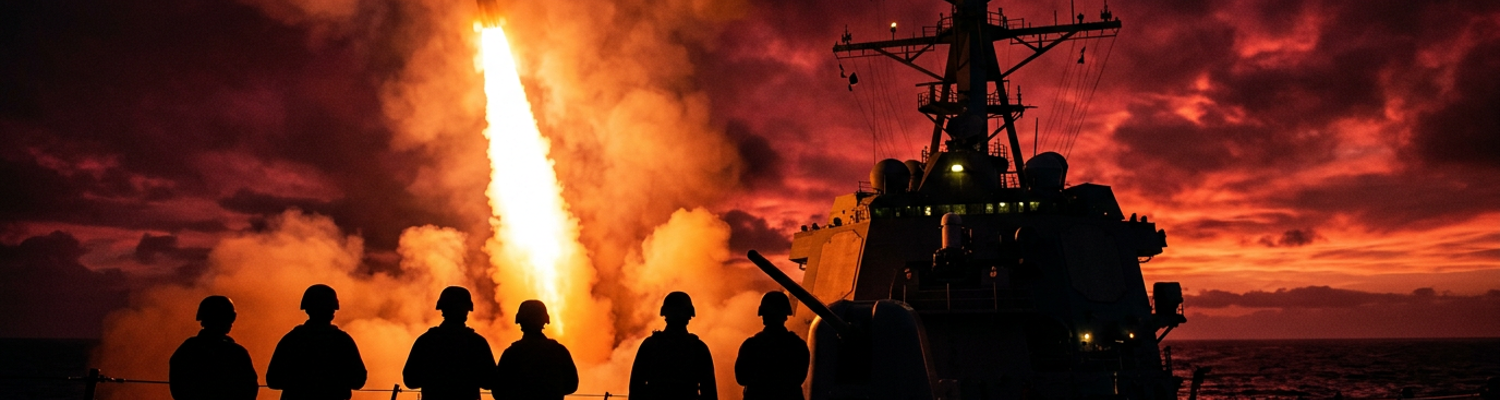
Rocket boosters ignited inside armored vertical launch cells across the fleet, blowing frangible covers open as simultaneous vertical launch system salvos erupted from the decks of Ticonderoga-class cruisers and Arleigh Burke-class destroyers. Flame plumes blasted downward into shipboard exhaust plenums while the missiles surged upward into the clear night air on thick columns of orange fire. Steel holdback bolts sheared away under the rising thrust of the booster motors, releasing each BGM-109 missile into an arcing climb away from the rolling warship hulls. Spring-loaded aerodynamic fins snapped outward from the missile tails the moment the weapons cleared the top edge of the launch canisters. Small explosive squibs fired inside the airframes seconds later, extending the stubby main wings and opening the belly intake scoops as the booster burned out and fell away into the sea. Williams International turbofan engines spooled up to cruising speed, dropping the missiles into a flat sea-skimming glide that kept them beneath Iraqi coastal radar beams as they crossed the shoreline.
Shoreline crossings multiplied as submarines running at periscope depth added to this converging stream of weapons. Fast attack submarines conducted subsurface missile launches tasked with striking hardened leadership and command facilities in Baghdad. Water pressure and compressed gas ejected the watertight capsules from the vertical launch tubes and torpedo rooms, sending them floating upward through the sea until they breached the surface. Rocket engines ignited immediately upon broaching the waves, throwing off the protective nose caps and driving the missiles toward their inland cruise altitude. Flight control software fed precise satellite waypoints into these submarine-launched weapons, routing them on dogleg paths through the southern desert to bypass known antiaircraft artillery belts. Terminal optical sensors scanned the dark urban streets below, matching flash-illuminated rooftops against stored target photos before the missiles dove straight through reinforced bunker roofs.
Bunker roofs collapsing marked only the opening phase of a wider assault, initiating seventy hours of sustained strikes from December 16 to 19 that saw the coordinated expenditure of 325 Tomahawk Land Attack Missiles. Combat information centers aboard the Fifth Fleet vessels processed continuous battle damage assessments, reprogramming follow-up waves of missiles to strike alternate targets when early hits obliterated primary structures. Launch crews worked through consecutive shifts in tight shipboard magazines, monitoring power feeds, updating mission software cartridges, and firing fresh salvos on strict time intervals. Iraqi air defense gunners fired thousands of blind tracer rounds into the night sky, but the low flight altitude and unpredictable routes of the cruise missiles allowed the weapons to evade ground batteries. Cruise missiles knocked out early warning radar sites, surface-to-air missile repair depots, and military communications centers, creating open air corridors through dense defensive networks around major cities. Navy strike planners coordinated each missile volley to arrive minutes ahead of manned naval strike aircraft, ensuring the unmanned weapons suppressed enemy air defenses before carrier-based jets entered contested airspace.
Airspace corridors opened by the cruise missiles allowed pilots flying strike aircraft behind the salvos to find Iraqi radar screens dark and military communications lines severed across the country. Satellite reconnaissance passes over central Iraq recorded direct hits on dozens of suspected chemical, biological, and ballistic missile facilities, proving that the GPS and DSMAC IIA guidance packages could navigate featureless terrain and strike precise coordinates in total darkness. Automated guidance adjustments kept the missiles on target through thick plumes of burning industrial oil and defensive smoke screens that Iraqi troops ignited around government districts. Ground forces in Baghdad managed to shoot down only a tiny fraction of the incoming weapons despite expending immense quantities of antiaircraft ammunition. Shipboard ordnance crews closed empty vertical launch hatches as the final countdown clocks expired on the morning of December 19, just hours before the start of Ramadan, concluding the high-intensity strike campaign without losing a single American pilot or ship.
Mission Planning Realities and Automated Target Deconfliction
Hatches slamming shut on these surviving ships reflected the massive effort of technicians at Cruise Missile Support Activity centers in Norfolk and Pearl Harbor, who drove the rapid launch tempo. Planning personnel worked consecutive twelve-hour shifts inside secured map vaults, stitching together fresh satellite photography, radar elevation files, and target coordinates into electronic flight files for every planned strike. Automated planning terminals reduced the routing timeline from the several days required during the 1991 Gulf War down to just a few hours, but each new route still demanded painstaking manual quality checks to prevent software errors. Analysts pushed every flight plan through simulation engines to ensure low-flying airframes would clear high-voltage power lines, telecommunications towers, and hostile radar detection zones across southern Iraq. Planning teams verified terminal optical correlation scenes against regional weather reports, confirming that nighttime illumination and drifting dust would not blind the onboard cameras. Communications operators then transmitted these completed digital packages over encrypted satellite data links directly to Fifth Fleet combat information centers, feeding validated navigation waypoints into shipboard missile launchers minutes before launch.
Missile launchers receiving these waypoints relied on computers aboard Fifth Fleet warships to process the uploaded routes and enforce strict trajectory deconfliction. Strike coordinators at the joint air operations center divided contested Iraqi airspace into distinct altitude bands and geographic transit corridors so that high-speed cruise missiles and piloted jets would not cross paths in the darkness. Flight deck crews aboard USS Enterprise launched F/A-18 Hornets and F-14 Tomcats into designated high-altitude ingress lanes, while Royal Air Force Tornado GR1 strike aircraft swept across the desert border along medium-altitude approach corridors. Tomahawk missiles moved beneath both manned formations, skimming across desert flats at altitudes under two hundred feet to stay well clear of allied jet exhausts and radar beams. Automated flight paths channeled missile salvos through dry river valleys and unpopulated terrain gaps, isolating unmanned weapons from manned combat orbits and preventing friendly aircraft from misidentifying the cruise missiles as incoming Iraqi targets.
Targets assigned to the Tomahawks required microprocessors inside the guidance bays to translate these segregated corridors into precise arrival time synchronization. Mission planners programmed exact time-on-target countdowns into each missile so that low-altitude warheads detonated against early warning radars, Fan Song target-acquisition arrays, and mobile missile batteries at the exact second allied jets arrived at the border. Blast-fragmentation warheads detonated directly above radar antenna trailers and power vans, tearing through control electronics and severing radar tracking signals across central Iraq. Iraqi air defense operators lost their radar pictures instantly, leaving surface-to-air missile batteries blind and unable to lock onto incoming aircraft. Command networks linking Iraqi missile batteries collapsed under the sudden loss of radar guidance, forcing ground gunners to fire unguided artillery barrages blindly into the night sky. Strike pilots aboard the Enterprise jets and Royal Air Force Tornados crossed into contested airspace over the smoldering radar positions unimpeded, delivering their laser-guided ordnance onto designated Iraqi command centers without encountering radar-guided antiaircraft missiles.
Inventory Exhaustion and Fleet Stockpile Deficits
Missiles expended during the operation left steel vertical launch canisters inside Fifth Fleet warships hollow and scorched as combat aircraft returned to carrier decks. Ordnance officers moved through the narrow passageways of guided-missile cruisers and destroyers, logging empty launch cells into fleet supply computers after firing hundreds of Tomahawk cruise missiles into Iraqi territory. Those tallies confirmed that the operation had expended nearly twenty percent of frontline naval Block III cruise missile inventories during four days of combat operations. The technologically upgraded weapon had performed exactly as engineers had promised, dodging desert terrain and striking coordinates with satellite precision, but its very reliability had convinced commanders to fire it in massive numbers. Dockside supply depots held no ready reserves of the modernized Block III variant, because industrial assembly lines produced only a modest batch of new missiles each month. Technicians aboard the warships bolted protective weather caps over empty launch cells that would remain bare for months, leaving frontline warships with severely weakened magazines.
Magazines sitting empty forced carrier battle groups preparing to deploy from coastal homeports to inherit this critical depletion of forward capacity. Navy task forces faced simultaneous requirements to maintain heavy strike power in the Mediterranean, where ethnic conflict in the Balkans was rapidly deteriorating toward open war in Kosovo, while also keeping armed deterrence patrols active in the western Pacific. Depots in Souda Bay, Guam, and Pearl Harbor lacked sufficient Block III inventories to arm departing destroyers, compelling logistics officers to strip weapons from secondary vessels and ship them by air across the globe. Submarine commanders preparing for deployments into Asian waters were ordered to load older, less capable legacy missiles or depart with empty launch tubes to ensure Middle East combatants had enough weapons. Ordnance crews at naval weapons stations spent grueling shifts removing crated Tomahawks from long-term climate-controlled storage bunkers, running emergency electrical checks on guidance components that had sat idle for years. Supply officers watched these backup reserves dwindle to emergency thresholds, loading the last available precision standoff munitions onto departing vessels.
Vessels departing with limited arsenals forced Pentagon planners to confront intense strategic friction resulting from the recurrent use of high-cost standoff precision munitions as default instruments for routine diplomatic containment. Civilian policymakers had repeatedly turned to the Tomahawk throughout the decade because the unmanned weapon allowed Washington to strike foreign targets and send diplomatic signals without risking the death or capture of American pilots. Each fired missile carried a price tag of more than one million dollars, meaning the brief four-day campaign in Iraq had burned through hundreds of millions of dollars in advanced weaponry to demolish transient barracks, empty radar stations, and dispersed headquarters buildings. Senior military leaders warned the Joint Chiefs of Staff that treating a finite, strategic deep-strike weapon as an expendable diplomatic signaling tool was draining naval magazines faster than defense budgets could replenish them. Industrial contractors required up to two years to manufacture, assemble, and certify replacement guidance sections and rocket motors, creating a persistent lag between missile consumption and factory deliveries. Admirals formally requested restrictions on future cruise missile strikes, urging civilian leaders to preserve the remaining Block III stockpile for major theater wars rather than expending them on short-notice punitive operations.
Factory Remanufacturing and Tactical Tomahawk Transition
Operations to restore the stockpile began as Navy weapons officials established emergency factory remanufacturing lines at Raytheon to refurbish older airframes. Assembly technicians reopened Tucson production bays to strip down worn missile casings, inspect internal wiring harnesses, and test structural components for metal fatigue. Because restarting completely new Tomahawk manufacturing lines would cost tens of millions of dollars and require years of industrial lead time, the service turned to mothballed stockpiles of non-operational weapons. Cranes lifted crated fuselages out of long-term climate-controlled storage bunkers at naval ammunition facilities, loading them onto transport trucks bound for the Arizona overhaul facility. Raytheon workers inspected every returned hull to verify pressure seals and replace degraded fuel bladders before feeding the airframes into the active rebuild queue. These refurbished fuselages gave the fleet a rapid, economical way to restore missile counts after the heavy expenditures over Baghdad without waiting years for newly built weapons.
Weapons entering this remanufacturing pipeline underwent conversion from obsolete Block II anti-ship and land-attack airframes into modernized GPS-configured Block III standards. Assembly crews unbolted outdated active-radar guidance seekers from stored anti-ship variants and removed obsolete terrain-matching radar altimeters from early land-attack missile bodies. Machinists installed military-grade Global Positioning System antennas, updated digital optical correlation guidance sections, and compact WDU-36/B blast-fragmentation warheads into the cleared forward electronics bays. Propulsion teams mounted extended-range fuel tanks inside the center fuselage sections and recalibrated the Williams International turbofan engines to compensate for the altered weight distribution. Quality-assurance specialists attached diagnostic testing cables to each rebuilt missile body, running electrical checks through the guidance computers to ensure the hybrid airframes could reliably acquire satellite signals. Armored canisters carrying these fully converted weapons rolled off the factory floor onto military cargo transports, delivering hundreds of combat-ready missiles to ammunition docks in Virginia and California.
California and Virginia dockside weapon shipments offered only a temporary stopgap, a fact recognized by planners reviewing Desert Fox combat logs. Combat data from the December strikes revealed that while Block III missiles destroyed preplanned static targets with high accuracy, fleet commanders had lacked any ability to redirect weapons once launched from warship vertical launch cells. Iraqi mobile missile units and military leadership convoys had routinely shifted locations during the hours missiles spent in flight, leaving expensive precision weapons to detonate against empty buildings and abandoned vehicle parks. Mission planning centers had also struggled under intense pressure to build rigid flight paths in advance, exposing a critical need for launch platforms to program satellite routes directly from shipboard consoles. Spending over a million dollars per missile to hit dispersed secondary assets had depleted magazines at a rate that defense budgets could not sustain during prolonged combat. These tactical bottlenecks convinced Navy leadership that future conflicts demanded a cheaper, far more flexible weapon capable of responding to fluid ground conditions in real time.
Time critical targeting requirements pushed Raytheon engineers to accelerate the development of the lower-cost, loitering BGM-109E Block IV Tactical Tomahawk. Designers eliminated complex structural assemblies and adopted cheaper molded composites, reducing internal parts counts and cutting the projected production cost of each missile to roughly half that of a Block III weapon. Technicians installed a two-way satellite data link and an electro-optical nose camera, allowing combat controllers aboard warships to redirect the missile mid-flight or order it into an orbiting loiter pattern over target sectors while awaiting new coordinates. Software developers integrated shipboard mission planning capabilities into the Tactical Tomahawk Weapons Control System, enabling cruisers, destroyers, and submarines to generate strike profiles in minutes without waiting for planning files from shore centers. Pentagon officials signed production contracts for the new design in 2002, retooling the Tucson factory lines to manufacture thousands of Block IV airframes to permanently replace the depleted inventory.