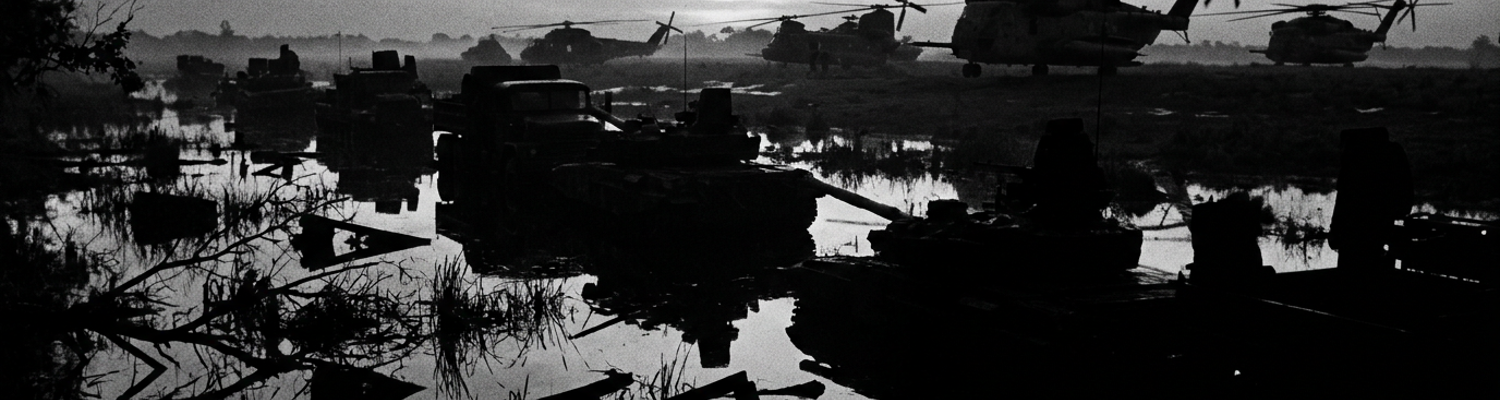

Stranded UH-34D Transports in the Plain of Reeds
At 1542 hours on July 24, 1962, high-frequency radio static washed out the final transmission between the flight lead and the tactical operations center at Soc Trang. This cut off the isolated transport element in the Plain of Reeds. Base operators listened as the signal broke apart into background atmospheric hiss. They lost all coordinates for the three downed aircraft.
The radios stayed dead.
A close review of operational logs (NARA Record Group 338) indicates that three Sikorsky UH-34D Seahorse airframes belonging to Marine Medium Helicopter Squadron 362 settled directly into flooded rice paddies. They went down fifteen nautical miles northwest of Cao Lanh. In late July 1962, multiple UH-34D Seahorse airframes were immobilized in waterlogged paddies. Complete fuel depletion and mechanical seizure caused the groundings. The Wright R-1820-84 Cyclone nine-cylinder radial engines choked on a mixture of water-contaminated 115/145 octane aviation fuel and intense internal heat. Flying continuous troop-insertion cycles through ninety-five-degree heat with humidity exceeding ninety percent pushed the air-cooled cylinders far past safe operating thresholds.
Two transports exhausted their fuel cells entirely.
This happened after repeated wave-offs over marshland landing zones where insurgent automatic weapons fire blocked every approach. Mechanical failure struck the third helicopter when its engine cooling fan drive disintegrated. The failure stripped the accessory gear assembly and seized the main transmission shaft in mid-flight. Waterlogged marsh silt reached the magnesium wheel hubs and lower fuselage panels. The thirteen-thousand-pound airframes sank past their axles.
Recovery teams had no clear path into the swamp before dark.
When examining the historical record of the engagement, the tactical priority centered entirely on defensive preservation around the dead machinery. Ground crews and aircrews established desperate perimeter defenses around dead airframes. They awaited emergency recovery under persistent sniper fire. Downed crewmen and surviving South Vietnamese infantrymen slid off the troop benches into waist-deep water. They dragged M60 machine guns and service sidearms across the submerged paddies to set up three firing points along low mud dikes. Snipers concealed along the tree lines bordering the swamp maintained steady fire throughout the late afternoon. They put rounds through the unarmored aluminum skin of the fuselage and shattered canopy plexiglass.
Flight mechanics used metal toolboxes and empty ammunition cans to brace weapon pintles out of the sulfuric muck.
Hostile marksmen with bolt-action rifles fired from concealed positions less than three hundred yards away. They pinned the men behind the wheels and tail booms. Crew chiefs rationed their remaining thirty-caliber ammunition. They unbolted sensitive radio equipment and pulled cryptographic key sheets from the cockpits to prevent capture. Spent cartridge casings sank into the black sediment beneath their feet.
Archival evidence shows that maintenance personnel at Soc Trang hurriedly organized an emergency recovery package. This package consisted of replacement starter motors, fuel bladders, and fresh oil drums. They dispatched armed escorts to break the isolation. Incoming relief pilots hovered with their rotor wash flattening tall reeds. This exposed their underbellies to ground fire while winch operators dropped steel cables into the water. Marines on the ground worked with hand wrenches in the mud to decouple the seized transmission linkages of the third airframe. They did this so it could be lifted without tearing the rotor mast from the engine bay. Riggers secured the first disabled transport to an external recovery sling at 1810 hours under constant small-arms fire from the southern tree line.
Inadequate Support Infrastructure at Soc Trang Airfield
Archival evidence shows that Marine Medium Helicopter Squadron 362 established operations on an austere Japanese airfield constructed in 1942. Located thirty miles south of the Bassac River in Ba Xuyen Province, the installation at Soc Trang centered on a 3,200-foot runway. Pierced-steel planking covered the surface. This planking buckled under the 13,000-pound gross weight of fully loaded UH-34D transports. Planking sections settled unevenly into the waterlogged alluvial soil. The shifting created jagged metal seams that sliced aircraft tires during taxiing. Low dirt berms and sandbag walls fewer than four feet high provided the only revetments on the flight line.
Helicopter fuselages, magnesium rotor heads, and vulnerable fuel tanks sat completely exposed to horizontal small-arms fire and mortar shrapnel.
Hardened aircraft shelters were entirely absent across the base. Marine mechanics rebuilt rotor heads, replaced wiring harnesses, and conducted five-hundred-hour airframe inspections outdoors in monsoonal downpours. Canvas tarpaulins strung over unpainted wooden framing provided the only protection from the elements.
The flight line offered zero protection.
A close review of operational logs indicates that fuel storage presented an immediate hazard to flight operations. Soc Trang had zero hardened fuel bunkers, concrete revetted cells, or underground pipelines. Aviation gasoline arrived in thousands of unshielded fifty-five-gallon steel drums. Supply personnel stacked these drums three tiers high in open mud fields alongside the active taxiways. Tropical heat and daily rains caused water and rust flakes to collect on the drum lids. The water seeped past deteriorated bung seals directly into the 115/145 high-octane avgas. Line crews used manual hand pumps and field-expedient hoses to service the aircraft. They lacked the commercial-grade filter-separators needed to purge water condensation from the fuel before it entered the aircraft tanks.
Marine units eventually installed collapsible ten-thousand-gallon rubber bladders on open dirt pads.
These exposed fuel farms sat within range of insurgent recoilless rifles and lacked concrete retaining dikes to contain spills. Contaminated avgas clogged carburetor jets and caused cylinder head temperatures to spike dangerously in flight.
When examining the historical record, Operation Shufly deployed twenty UH-34D Seahorse helicopters into the Delta without assigning organic heavy-lift supply transports to the squadron. Command planners required HMM-362 to execute high-tempo troop insertions across thousands of square miles of marshland. They operated entirely without dedicated cargo airframes. The squadron had no Sikorsky CH-37 Mojave heavy-lift helicopters capable of airlifting disabled thirteen-thousand-pound aircraft out of swamp crash sites. They also did not control fixed-wing transports like the C-130 Hercules to haul outsized replacement parts. Flight operations generated daily demands for nine-cylinder Wright R-1820-84 radial engines, dynamic rotor dampers, clutch assemblies, and transmission drive shafts.
Marine planners expected external United States Air Force C-123 Providers and South Vietnamese riverine barges to deliver supplies.
Monsoonal washouts and shallow canal drafts caused supply shipments to stall for weeks at forward transfer points. High operational tempos rapidly outpaced the delivery of replacement hardware. Technicians at Soc Trang relied on emergency requisitions sent through Tan Son Nhut Air Base outside Saigon. They depended on ad-hoc courier flights to transport critical mechanical parts. When an R-1820 engine suffered a catastrophic valve failure or threw a pushrod in the field, ground crews cannibalized intact components from grounded aircraft. This kept flight divisions operational.
This parts starvation steadily eroded squadron readiness.
The available inventory dropped from twenty operational aircraft to twelve mission-capable airframes within eight weeks of arriving in country. The lack of organic cargo aircraft meant that heavy structural assemblies, rotor blades, and major transmission casings had to be packed into wooden crates. Crews loaded these crates onto flat-bottomed wooden sampans to cross delta waterways toward deep-water repair facilities at Vung Tau.
Wright R-1820 Engine Degradation in Tropical Climates
Archival evidence shows that during the 1962 monsoon deployment, ambient temperatures at forward operating zones routinely hovered near one hundred degrees Fahrenheit. Relative humidity exceeded ninety-five percent. These atmospheric conditions drastically altered the density altitude across the Delta. The conditions reduced the volumetric efficiency of the Wright R-1820-84 nine-cylinder air-cooled radial engine. The power plant was rated at 1,525 horsepower at sea level under standard test conditions. It routinely shed up to eighteen percent of its total shaft output during midday sorties.
Superchargers failed to compress the moisture-laden air effectively.
Pilots had to run manifold pressures at emergency redline limits simply to maintain an in-ground-effect hover. As density altitude climbed above three thousand feet over sea-level marshes, rotor blades lost aerodynamic bite. The engines generated insufficient torque to clear tree lines. Cylinder head temperatures climbed past five hundred degrees Fahrenheit. This triggered continuous pre-ignition cycles that degraded internal piston crowns.
Rotor lift evaporated inside the heat.
A close review of operational logs indicates that flight leaders in Ba Xuyen Province were forced to slash combat passenger loads to preserve basic flight safety. Sikorsky designed the UH-34D cabin to transport sixteen fully equipped combat troops. Flight crews routinely restricted lifts to six or seven South Vietnamese infantrymen during noontime operations. Pulling collective pitch to lift out of confined paddies pushed the R-1820 into severe thermal distress. Cooling fan assemblies, driven off the main engine shaft, consumed substantial engine horsepower. They circulated air that was already superheated by ground radiation off the mud flats.
In multiple instances during troop insertions southwest of Phung Hiep, aircraft settling under power-loss conditions suffered complete engine stalls.
Exhaust valves warped in their guides under prolonged thermal overloads. Ground crews worked on burned engines without parts. When examining the historical record, the lack of an established naval replenishment pipeline directly to Soc Trang crippled maintenance schedules throughout the summer of 1962. Seventh Fleet logistics networks routed replacement components through deep-water anchorages at Subic Bay and Vung Tau. Materials stalled indefinitely before reaching inland airfields. Marine mechanics faced severe deficits of spare aviation spark plugs, pushrods, and factory-sealed oil filters.
High thermal cycles and rich fuel-air mixtures suppressed engine detonation.
These mixtures fouled the lower cylinder spark plugs with thick carbon and lead deposits after fewer than twenty flight hours. Lacking fresh boxes of replacement plugs, maintenance personnel scraped electrode gaps clean with wire brushes. They dipped carbon-crusted ceramic insulators in dirty avgas before reinstalling them into misfiring cylinders. Supply lines ended at the coast.
Archival evidence shows that valve-train components suffered catastrophic fatigue under continuous thermal shock.
Intake and exhaust pushrods bowed and snapped under high valve-spring pressures. Ground engineers stripped pushrods from airframes previously written off from combat damage. They installed warped, out-of-spec rods into active flight line helicopters to meet daily mission commitments. Lubrication systems broke down in step with the valve gear. The R-1820 engine circulated sixty gallons of mineral oil per minute. The supply depot at Tan Son Nhut delivered zero replacement filter elements to Soc Trang between June and August.
Line mechanics repeatedly washed clogged metal wire screens and paper filter elements in pans of contaminated kerosene.
They flushed sludge and metal shavings back through the master rod bearings and planetary reduction gears. Internal oil pressures collapsed shortly after.
Breakdown of Tripartite Command and Control Nets
Archival evidence shows that tactical communication disintegrated along rigid radio frequency bands during combined assault waves across Kien Tuong and Chuong Thien provinces. Marine Medium Helicopter Squadron 362 operated Sikorsky UH-34Ds equipped with AN/ARC-52 transceivers. This aviation radio set locked into the ultra-high frequency band between 225.0 and 399.9 megahertz. Ground forces of the Army of the Republic of Vietnam carried AN/PRC-10 backpack transceivers. These operated on very-high-frequency FM bands between 38.0 and 54.9 megahertz. Military Assistance Command, Vietnam field liaisons relied on high-frequency AN/GRC-9 sets or vehicle-mounted radios.
Without cross-band patching hardware, Marine pilots could not speak to ARVN company commanders running across the drop zones below.
When landing waves encountered fortified insurgent bunker complexes near Vi Thanh, aircrews had to route distress calls upward to an orbiting Cessna O-1 Bird Dog. That forward air controller relayed the message over high-frequency channels to a sector advisory operations center in Can Tho. Staff officers telephoned the ARVN regimental post to request smoke markers. The entire transmission chain consumed twelve to fifteen minutes. Transports hovered under small-arms fire during this delay.
No cross-frequency bridging equipment existed in the Mekong Delta.
A close review of operational logs indicates that flight leaders regularly flew into contested sectors without designated alternate landing zones or reliable pre-strike artillery coordinates. Coordination meetings between Marine squadron planners and ARVN 7th Division staff in My Tho exposed severe mapping discrepancies. South Vietnamese officers utilized obsolete French colonial topographic charts printed on the Bonne projection at a scale of 1:100,000. Marine navigators worked with 1:50,000 Universal Transverse Mercator grid maps. Plotting errors between the two mapping standards created targeting discrepancies of six hundred to nine hundred meters.
Fear of operational leaks prompted ARVN corps commanders to withhold artillery schedules until helicopters were already airborne from Soc Trang.
Battery commanders directing American-supplied M101A1 105mm howitzers fired suppressive barrages without synchronized timepieces. Rounds landed fifteen minutes before the transports arrived. This allowed Viet Cong machine gunners to emerge from mud bunkers and set up interlocking fields of fire across the marsh grass. Mission briefings provided zero alternate touchdown sites if the primary paddies became hot. If lead aircraft met heavy ground fire along the Mang Ca canal, the flight division circled in low-altitude patterns over open marshland.
They burned high-octane fuel while waiting for advisory officers to find unmapped clearings.
Transports orbited until their main fuel low-level warning lamps flickered red. When examining the historical record, field expedients devised by Marine crews failed to overcome this command fracture. Advisory liaisons placed inside UH-34D troop compartments attempted to operate portable backpack radios out of the open starboard cargo hatch. Rotor wash bent whip antennas. Cabin noise from the Wright R-1820-84 engine drowned out headphone traffic. Pilots could not confirm whether ARVN infantry had captured perimeter dikes or retreated into irrigation ditches.
During an assault insertion fifteen miles south of Phung Hiep, three Seahorse transports set down into a paddy.
Liaison officers believed friendly artillery had suppressed the area. Five concealed Maxim machine guns opened fire from an unshelled tree line seventy yards away. High-velocity rounds pierced the unarmored lower fuselages. The fire severed hydraulic lines on the division leader and ignited the magnesium accessory housing on the third aircraft. The South Vietnamese infantrymen managed to clear the cabin steps just before the fire spread. The disabled helicopter settled into four feet of stagnant water with shattered pushrods and empty fuel tanks.
Monsoon Navigation and Blind Low-Altitude Sorties
Archival evidence shows that during the southwest monsoon of 1962, ceiling levels across the Mekong Delta collapsed below three hundred feet. This generated violent squalls that blinded flight crews mid-sortie. Heavy rain hammered the curved plexiglass windscreens of the UH-34D Seahorse transports. The water overwhelmed the mechanical wipers and eliminated forward visibility within seconds. Marine Medium Helicopter Squadron 362 operated without instrument flight aids. They relied on basic magnetic compasses, turn-and-slip indicators, and barometric altimeters.
Across the entire IV Corps Tactical Zone, military commanders possessed zero ground-based radar tracking posts.
They had no radio-homing transponder stations to guide airborne formations through adverse weather. Seasonal inundations compounded the disorientation. Swollen channels of the Bassac and Mekong rivers overflowed. The floods submerged dirt roads, paddy dikes, and canal junctions beneath four to eight feet of brown floodwater. Pilots were forced to drop down to seventy-five feet above the surface. They skimmed tree canopies in desperate attempts to maintain visual dead-reckoning contact with isolated mangrove clusters and thatched hamlets.
Flight crews peered through rain-streaked side windows.
Downdrafts from convective thunderstorm cells pushed heavy airframes toward the mud. Rising floodwaters erased every charted visual checkpoint from the cockpit windows. A close review of operational logs indicates that flights of four to eight helicopters entering these localized rain squalls were instantly shattered into isolated single aircraft. Maintaining tight tactical trail formations inside zero-visibility cloud bursts risked fatal mid-air rotor collisions. Flight leaders ordered division wingmen to break off on divergent compass headings.
This scattered individual transports across hundreds of square miles of trackless marsh.
Once dispersed, crews could neither locate each other nor re-establish visual contact with lead elements. Marine pilots spent forty to sixty minutes wandering between rain cells. They searched for unmapped canal intersections while trying to reassemble strike waves bound for contested drop zones in Kien Tuong Province. Planned thirty-minute transit hops stretched into protracted, low-altitude holding patterns. Operating at tree-top levels required constant collective adjustments and high engine power settings.
This accelerated the rate of fuel consumption inside the Wright R-1820-84 radial power plant.
Transports burned high-octane aviation gasoline at rates exceeding one hundred gallons per hour. Flight leaders orbited blindly above the flooded terrain. Scattered flight divisions lost all visual coherence in the torrential rain. When examining the historical record, this disoriented wandering repeatedly pushed aircraft past their calculated bingo fuel limits. UH-34D Seahorse fuel systems held approximately two hundred and sixty gallons of aviation fuel.
The fuel was distributed across forward and aft self-sealing bladder cells.
Squadron doctrine dictated that pilots break off missions and head directly for refueling points at Soc Trang or Can Tho once internal reserves dropped below seventy-five gallons. Low cloud decks and lost checkpoints made direct transit lines impossible. Flight crews attempted to circumvent convective storm cells by steering wide detours around active rain walls. They rapidly burned the fuel reserves required for safe recovery. Red warning lamps illuminated on instrument panels while aircraft were still thirty nautical miles from safe landing strips.
Pilots operating northwest of Vi Thanh faced a grim choice.
They could run their carburetors completely dry over insurgent territory or set down in unprotected paddies. Several transports landed on narrow dikes with fewer than fifteen gallons of usable fuel remaining in their tanks. Others exhausted their supply entirely and entered unpowered autorotations into standing swamp water. Two Seahorse transports exhausted their final gallons over Chuong Thien Province. They autorotated directly into five feet of stagnant paddy water.
Soviet Automatic Weapons Fire at Unsecured Landing Zones
Archival evidence shows that Viet Cong units operating across Chuong Thien and Kien Phong provinces shifted their anti-aircraft tactics during the late summer of 1962. They abandoned haphazard rifle fire in favor of fortified ambush zones along primary canal networks. Insurgent gun crews dragged Soviet-supplied 12.7mm DShK heavy machine guns and water-cooled 7.62mm Maxim systems on timber sledges through tidal mangrove swamps. They concealed the weapons beneath thick nipa palm fronds lining canal banks. Spotters dug camouflaged spider holes directly opposite designated clearings.
They pre-sighted interlocking firing lines across open paddies.
Incoming UH-34D Seahorse transports were forced to bleed airspeed in these exact zones. When HMM-362 flight divisions throttled back into a nose-high flare to set down, the 13,000-pound aircraft hung motionless fifteen feet above the water for ten to fifteen seconds. The landing zones turned into kill boxes. A close review of operational logs indicates that the physical environment compounded the effect of these ambushes. Rotors churning at maximum pitch drove downwash into saturated alluvial silt.
This created blinding sheets of brown spray that obscured the tree lines from the pilots.
As the heavy wheels touched down, the gear sank eighteen inches into anaerobic mud. The mud trapped the undercarriage before South Vietnamese infantrymen could even step onto the cargo ramp. Disembarking ARVN soldiers slipped into waist-deep mire. Their web gear and canvas boots anchored them directly underneath the fuselage. Insurgent gunners withheld fire until the transports settled. They then unleashed concentrated horizontal salvos through the thin aluminum cabins.
Armor-piercing 12.7mm projectiles traveled at 2,800 feet per second.
They tore through the skin of the helicopters, puncturing auxiliary fuel cells and shattering hydraulic boost cylinders. The rounds severed the tail rotor drive shafts that ran along the dorsal spine. Magnesium skin offered zero ballistic resistance. When examining the historical record, this catastrophic vulnerability stemmed directly from the complete absence of dedicated armed escort helicopters during the initial months of Operation Shufly. Marine doctrine in 1962 treated helicopter air assault as a rapid logistical transport mission rather than an armed vertical envelopment.
HMM-362 deployed to Soc Trang with zero gunship escorts.
Tactical planners expected forward air support to come from Republic of Vietnam Air Force Douglas A-1 Skyraiders or American-piloted North American T-28 Trojans. These fixed-wing platforms possessed high stall speeds that prevented them from matching the low, erratic approach patterns of rotorcraft. Fixed-wing ordnance runs often struck tree lines three to five minutes before the helicopter wave arrived. This signaled the exact landing zone to Viet Cong defensive teams. It left the transport flight entirely unprotected during the final approach.
Transports absorbed every round alone.
Lacking dedicated armed airframes to suppress hostile positions with forward-firing rockets or flexible machine-gun pods, transport crews improvised. They strapped single M60 machine guns to nylon web slings in the starboard cargo door. Crew chiefs leaned out into the slipstream to fire hand-held weapons. The 7.62mm light machine gun lacked the range and kinetic energy to suppress heavy 12.7mm weapon emplacements. The enemy guns were buried under dirt and log canal revetments three hundred yards away.
Transport airframes took catastrophic structural abuse.
Heavy machine-gun rounds tore clean through the main transmission housings. The impacts drained pressurized lubricating oil and caused internal planetary gears to weld together under frictional heat within ninety seconds. Hollow aluminum-alloy rotor blades developed jagged exit holes that unbalanced the entire rotor head assembly. This induced violent vertical vibrations that cracked cockpit canopy frames and shattered flight instrument gyros before pilots could claw their way out of the mud. Ground crews at Soc Trang pulled fifty-four armor-piercing 12.7mm slugs from two crippled airframes that limped back on July 28.
Unsanctioned Field Refueling and Contaminated Bladders
Archival evidence shows that by late July 1962, severe fuel exhaustion compelled Marine Medium Helicopter Squadron 362 flight crews to bypass standard naval aviation fuel filtration doctrine. They did this across forward staging clearings near Vi Thanh and Can Tho. Bureau of Naval Weapons instructions strictly mandated the use of multi-stage trailer-mounted filter-separators. These units were engineered to strip suspended water droplets down to five parts per million and catch solid particles down to five microns. None of that equipment existed outside the main base perimeter.
Forward ground crews relied on manual rotary hand pumps and improvised copper pipes dropped into standing fuel drums.
Crew chiefs siphoned volatile 115/145 octane aviation gasoline through wash-leather chamois cloths stretched across open funnel mouths. Flight mechanics operated under the belief that natural chamois leather would block water while allowing hydrocarbons to drain into the UH-34D Seahorse gravity-fill neck behind the main cabin. Tropical humidity and daily afternoon squalls rapidly saturated the porous leather fibers with water. The soaked leather broke down. This allowed water-fuel emulsions to bypass the funnel screen and flush microscopic dirt, lint, and free water directly into the lower fuselage distribution lines.
Water flooded the intake lines.
When examining the historical record, ground personnel systematically scoured provincial river docks and ARVN supply points to compensate for the complete absence of authorized tactical fueling systems. Support details gathered salvaged commercial rubber bladders originally manufactured for Michelin rubber plantations in Binh Duong. They placed these alongside unmonitored fifty-five-gallon steel drums previously utilized by French riverine units to haul lighting kerosene. Civilian commercial bladders lacked hydrocarbon-resistant internal coatings. High-octane aviation fuel dissolved the unvulcanized inner neoprene lining.
The rubber compound broke down into floating flakes of black sediment.
Disused kerosene drums introduced even greater operational hazards. Stored outdoors along rain-swept canal revetments, these drums collected standing water through perished bung gaskets. They harbored thick layers of ferrous rust scale, chemical residues, and canal silt. Ground crews pumped this contaminated brew directly into the aircraft without conducting water-detecting paste swabs or gravity fuel checks. Rubber sediment clogged the internal cells.
A close review of operational logs indicates that this grit-laden cocktail triggered immediate mechanical failures within the UH-34D fuel delivery network.
Particulate matter swept past coarse airframe finger screens. The debris lodged inside the Bendix Stromberg PR-58S2 injection carburetor and jammed the sensitive fuel-metering diaphragm. Rust flakes jammed the bypass relief valves of the engine-driven fuel pump. System fuel pressure dropped from thirty pounds per square inch to fewer than ten during critical takeoff climbs. Water entering the nine radial combustion chambers of the Wright R-1820-84 Cyclone engine quenched ignition sparks.
This induced rapid thermal drops across cylinder exhaust stacks and caused catastrophic engine backfires.
On August 3, 1962, maintenance personnel inspecting two grounded Seahorses north of Long Xuyen drained five gallons of cloudy liquid from the bottom sumps. They recovered thick ribbons of dissolved bladder rubber and red rust silt from the main carburetor bowl. The bottom tank sump yielded two pounds of insoluble black sludge.
Logistical Aftermath and Naval Aviation Doctrine Reform
Archival evidence shows that by the end of July 1962, the combat availability of Marine Medium Helicopter Squadron 362 had cratered. Only six flyable UH-34D Seahorse airframes remained out of the original twenty deployed. Wright R-1820-84 radial engines suffered systemic power loss from unmetered thermal distress, cracked piston rings, and sediment-choked carburetor jets. Main rotor heads sat disassembled on open wooden crates across the Soc Trang flight line. Line mechanics struggled to repair eroded planetary gears without depot-level replacement spares.
Headquarters Marine Corps in Washington monitored incoming status cables from Ba Xuyen Province with mounting alarm.
The unit skirted total operational paralysis. Marine Corps planners recognized that deploying an isolated tactical transport squadron into an austere theater without dedicated intermediate-level maintenance assets was fundamentally flawed. Command leadership understood that the squadron could not survive subsequent combat rotations without an organic logistical architecture. They needed the capability to overhaul complex aviation components in the field. Marine aviation had outpaced its shore-based maintenance capacity.
A close review of operational logs indicates that this near-collapse compelled Headquarters Marine Corps to formalize dedicated aviation logistics squadrons for all future expeditionary deployments.
Marine planners restructured deployment doctrine by mandating that intermediate maintenance detachments drawn from Headquarters and Maintenance Squadrons deploy directly alongside tactical flight units. Instead of relying on distant naval repair facilities at Subic Bay or fragile civilian courier lines through Saigon, Marine task units received organic intermediate maintenance activities. These units were equipped with mobile machine shops, specialized engine test stands, and calibrated hydraulic test benches. When Marine Medium Helicopter Squadron 163 arrived to relieve HMM-362 in September 1962, the rotation incorporated dedicated maintenance personnel.
These mechanics were trained specifically to rebuild Wright Cyclone power plants and re-balance main rotor heads under expeditionary conditions.
This operational overhaul institutionalized the framework that eventually became the Marine Aviation Logistics Squadron. It ensured that future expeditionary air groups maintained self-contained supply warehouses and depot-level component repair capabilities directly within their tactical areas of responsibility. Frontline mechanics had fought mechanical attrition with hand tools and improvised parts. When examining the historical record, Military Assistance Command, Vietnam initiated an immediate overhaul of joint air-ground liaison protocols. They did this to prevent the communication breakdowns that had exposed transport waves to ambush.
General Paul Harkins ordered the replacement of obsolete ARVN radio nets with unified tactical air-ground command channels.
Marine liaison officers were permanently embedded within ARVN 7th and 9th Division command posts. They were equipped with AN/PRC-41 UHF portable radios that communicated directly with UH-34D cockpits on 225.0 to 399.9 megahertz bands. Staff officers scrapped mismatched French colonial maps. They issued standardized 1:50,000 Universal Transverse Mercator topographic sheets across all operational echelons to eliminate coordinate discrepancies. Pre-strike artillery clearances shifted from telephone relay lines to direct radio authorization between flight leads, airborne forward air controllers in O-1 Bird Dogs, and local battery commanders.
Target approval times dropped from fifteen minutes to under sixty seconds.
Fragmented coordination networks yielded to synchronized tactical radio nets. Archival evidence shows that MACV paired these operational liaison reforms with a total restructuring of forward fuel distribution methods for incoming helicopter rotations. Inspectors condemned the contaminated fifty-five-gallon drums and unlined plantation bladders that had fouled HMM-362 carburetors. They replaced them with standardized five-hundred-gallon military-specification rubber blivets. These could be slung directly beneath transport aircraft into forward refueling points.
Logistics personnel installed trailer-mounted filter-separators engineered to the MIL-F-8901 standard at Can Tho and Soc Trang.
They used coalescing elements to remove water down to five parts per million and block particulate matter larger than five microns. Fuel handlers received chemical hydrokit detector tubes and water-indicating paste. They required verified fuel-contamination tests before every operational aircraft servicing cycle. Marine aviation fuel teams at forward operating sites rejected three thousand gallons of bulk aviation gasoline during August 1962 after test swabs detected rust silt and moisture condensation.