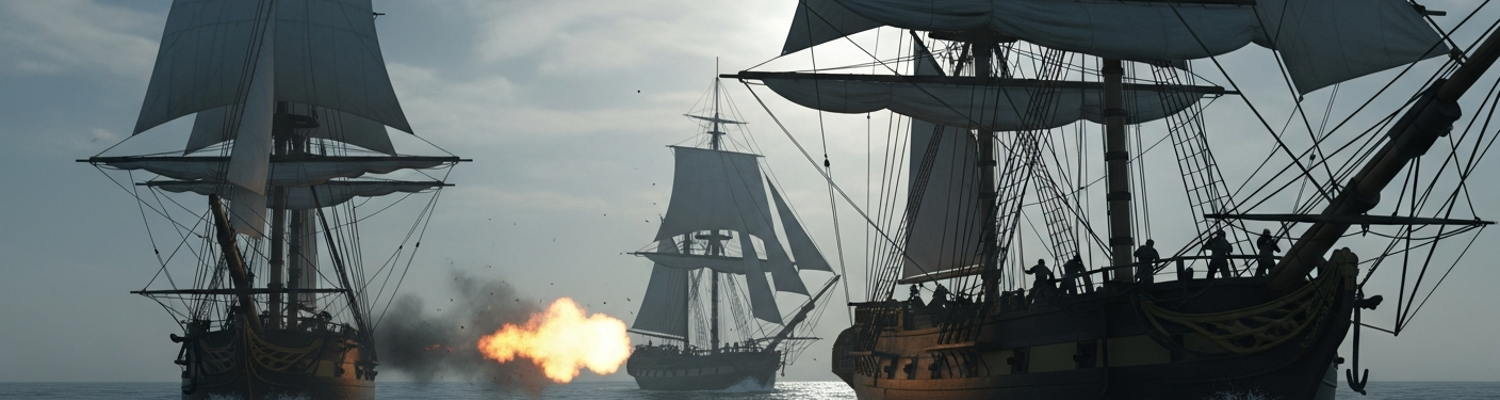

The Treaty of Ghent ended the War of 1812 but failed to secure peace for American maritime commerce. In the sprawling, sun-scorched waters of the Caribbean and the Gulf of Mexico, a new, asymmetric war ignited. The sea lanes, vital arteries for an expanding United States economy, began to hemorrhage profits and lives. This was a war fought not against a uniformed state navy, but against a chaotic and lethal resurgence of piracy. The responsibility for confronting this menace fell to America’s sea services, yet the campaign exposed deep institutional fractures and operational questions that echo with grave concern into the present. The Revenue Cutter Service, direct precursor to the modern U.S. Coast Guard, found itself on the front lines of a brutal, close-quarters conflict that tested its ships, its crews, and its foundational purpose.
A Viper's Nest in the West Indies
The post-1815 Caribbean was a cauldron of violent instability. Spain’s colonial empire was disintegrating, with revolutionary governments rising in Colombia, Mexico, and Venezuela. These fledgling states, lacking formal navies, issued letters of marque to privateers, authorizing them to prey on Spanish shipping. This practice unleashed swarms of armed vessels into the region. The distinction between legitimate privateering and outright piracy dissolved almost immediately. Crews, often unpaid and operating without effective state oversight, attacked any merchantman that appeared to be an easy prize, regardless of its flag. American ships, representing a neutral but wealthy trading nation, became primary targets. The pirates of this era were not romanticized adventurers. They were ruthless predators operating from a network of hidden coves and shallow-water anchorages along the coasts of Cuba, Puerto Rico, and the Gulf shores. Their long, low, black-hulled schooners were built for speed and surprise. They would often fly false flags to lure merchantmen close before revealing their true nature. Attacks were swift and savage. They descended upon unsuspecting vessels, overwhelming their small crews, seizing cargo, and frequently murdering all on board to eliminate witnesses. The economic effects were immediate and severe. Insurance rates for voyages through the Gulf and Caribbean skyrocketed, threatening to paralyze trade. American merchants and ship owners inundated Washington with desperate pleas for federal protection. The threat was not merely economic; it was a direct challenge to the sovereignty and security of the young United States.
Congress Authorizes Force
Washington responded with uncharacteristic speed and clarity. On March 3, 1819, President James Monroe signed into law “An Act to protect the commerce of the United States and punish the crime of piracy.” This was not a declaration of war, but a sweeping authorization of force. It empowered the President “to employ so many of the public armed vessels, as, in his judgment, the service may require” to hunt down and destroy pirates. The act was explicit, naming both the United States Navy and the Revenue Cutter Service as the instruments of this policy. It further authorized the commanders of these vessels to “subdue, seize, take, and send into any port of the United States, any armed vessel or boat” that had committed or attempted piracy. Conviction for piracy, as defined by the law of nations, carried a mandatory death sentence.
This legislation had profound operational consequences. It formally sanctioned a combat role for the Treasury Department’s Cutter Service, which Alexander Hamilton had established primarily to enforce customs law. While cutters had served under Navy command in past conflicts like the Quasi-War with France, the 1819 law established a concurrent authority for anti-piracy missions, setting the stage for a complex and often fraught inter-service relationship. To meet this new mandate, the Treasury Department moved quickly. On April 6, 1819, it authorized the construction of two new cutters at the Christian Bergh Shipyard in New York. These were the sister ships USRC Alabama and USRC Louisiana, designed by the noted naval constructor William Doughty. They were small, 51-ton topsail schooners, measuring just under 57 feet on deck. With sharply raking masts and light rails instead of heavy bulwarks, they were built for speed and agility in coastal waters. Each was designed to carry a single, heavy pivot gun amidships, likely a 9-pounder or 12-pounder cannon mounted on a traversing carriage. This allowed a small crew to bring its main armament to bear on either beam, a formidable weapon for a vessel of its size. Costing $4,500 each, these cutters were dispatched to the pirate-infested waters of the Gulf of Mexico, with the Alabama homeported in Mobile and the Louisiana in New Orleans.
The Cutters Draw Blood
The crews of the Alabama and Louisiana did not wait long for a fight. The cutters were purpose-built tools of maritime interdiction, and their captains put them to immediate use. Their small size and shallow draft, often seen as a limitation compared to the Navy’s deep-draft frigates, became a decisive advantage in the coastal shallows where pirates sought refuge. They were hornets in a nest of wolves.
On August 31, 1819, while patrolling the Gulf of Mexico, the two cutters found their first major target. They sighted the schooner Bravo, a known pirate vessel commanded by Jean Desfarges, a former lieutenant of the infamous Jean Lafitte. Rather than fleeing, the Bravo initiated combat, closing with the Louisiana and unleashing a volley of musketry. The attack wounded the cutter's first officer and three crewmen. The American response was immediate and violent. The cutters’ pivot guns roared to life. Under the command of their respective captains, the cuttermen maneuvered for advantage, their superior gunnery and discipline quickly telling. In a short, sharp gun duel, the pirates were overwhelmed. The cutter crews prepared to board the Bravo and captured the vessel in a fierce hand-to-hand struggle. Jean Desfarges and his crew were taken prisoner and transported to New Orleans to face justice. They were not hanged from the yardarm as legend might suggest, but were instead turned over to the civil courts, a grim, bureaucratic end to their violent careers.
This engagement was a stark demonstration of the Cutter Service's direct combat role. It was not a customs seizure; it was a naval battle fought and won. The action continued. On April 19, 1820, landing parties from both the Alabama and Louisiana went ashore on Breton Island and destroyed a known pirate stronghold, burning their buildings and boats, denying them a critical base of operations. In July of that year, the Louisiana single-handedly captured four pirate vessels off the coast of Belize. The pressure was constant, and the cutters were at the tip of the spear.
An Uneasy Alliance at Sea
The anti-piracy campaign highlighted a persistent and dangerous challenge in American military affairs: inter-service jurisdiction and cooperation. While the Revenue Cutter Service operated under the Treasury Department, the Navy was a separate cabinet-level entity. In 1822, the Navy formalized its presence by establishing the West Indies Squadron, a powerful fleet commanded by distinguished officers like James Biddle and later David Porter. This created two separate American maritime forces operating in the same theater against the same enemy under two different command structures.
Cooperation did occur at the tactical level. On November 2, 1822, the Revenue Cutter Louisiana joined the Navy’s sloop-of-war USS Peacock and the British Royal Navy schooner HMS Speedwell to capture five pirate vessels near Havana. This combined operation shows that tactical coordination was possible and effective. Commodore David Porter, in command of the West Indies Squadron, recognized the absolute need for shallow-draft vessels and created his own “Mosquito Fleet” of purchased schooners and barges, effectively mirroring the capabilities inherent in the revenue cutters.
However, the dual command structure was inherently inefficient and a source of friction. The Navy received the lion's share of resources and congressional attention, deploying frigates and sloops-of-war, while the cutters were smaller, fewer in number, and perpetually underfunded. Questions of command authority in joint operations, the distribution of prize money, and the sharing of intelligence were constant sources of potential conflict. The cutters, answerable to their local Customs Collectors for supplies, payroll, and maintenance, existed in a completely separate logistical chain from the Navy squadron. This fractured command environment risked duplicated effort, wasted resources, and operational gaps that a cunning enemy could exploit.
The pirates were not defeated overnight; the campaign dragged on for years, a direct consequence of the difficulty in eradicating a non-state threat with a divided military effort. The Cutter Service's war in the Caribbean serves as a grave warning. It underscores the absolute necessity of a unified command structure and seamless interoperability in any maritime security operation. The gritty, dangerous work performed by the crews of the Alabama and Louisiana proved the value of small, agile platforms in a coastal fight. Yet the structural divisions between the sea services created operational seams that prolonged the conflict and cost lives. The lessons paid for in blood in the 1820s, concerning the challenges of resource allocation and command unity in a multi-agency environment, remain perilously relevant. History shows that a house divided against a determined maritime enemy risks leaving its vital sea lanes open to predation and chaos.