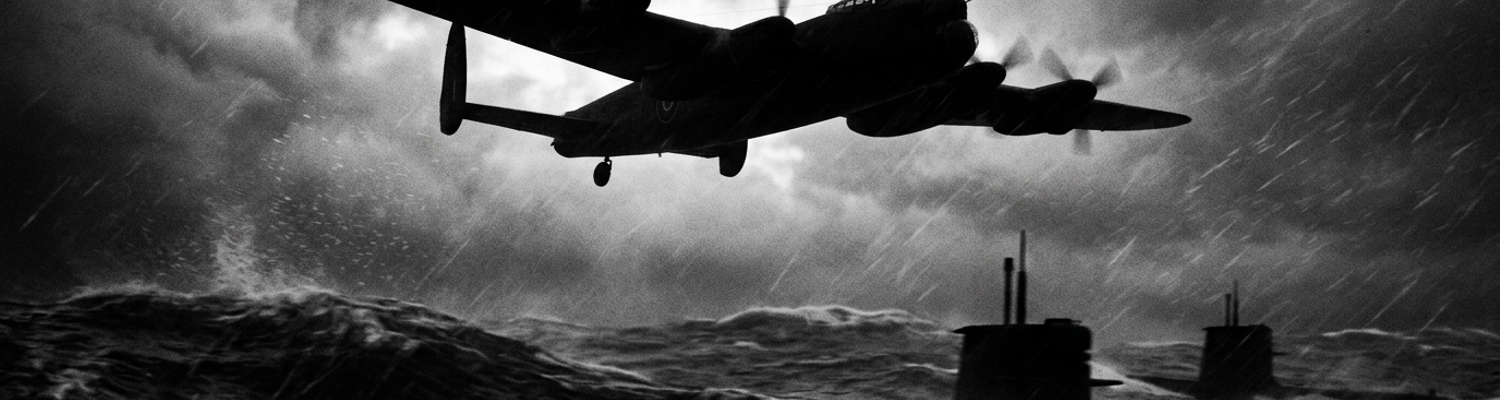

Fleet Air Wing 7 Deployment at RAF Dunkeswell
Mark XI 325-pound Torpex-filled depth charges fitted with hydrostatic pistols set to twenty-five feet. Secondary bomb bays held Mark 24 acoustic homing torpedoes packed with one hundred pounds of high-velocity explosive. Twin .50-caliber Browning M2 machine guns fed by thousand-round continuous metal-link belts were bolted into nose, dorsal, and tail turrets. Racks of high-intensity calcium-carbide sea marker flares sat paired with retro-firing rocket assemblies and expendable AN/CRT-1 radio sonobuoys. This specific destructive payload sat stacked under tarpaulins along the damp tarmac of RAF Dunkeswell in late spring 1944.
Dunkeswell sat eight hundred feet above sea level in the damp hills of Devon.
Archival evidence shows that Fleet Air Wing 7 personnel faced constant mechanical failure from the moment Patrol Squadrons VB-103, VB-105, and VB-110 occupied the sodden concrete dispersals. Consolidated PB4Y-1 Liberators served as naval adaptations of the heavy bomber airframe. These aircraft carried four Pratt and Whitney R-1830-92 Twin Wasp radial engines. Mechanics stripped their high-altitude turbosuperchargers for low-altitude cruising. Flight crews operated aircraft weighing over sixty-four thousand pounds at full fuel capacity. Mechanics worked fourteen-hour shifts in freezing rain. They balanced on bare scaffolding while Atlantic gales whipped water into open engine nacelles. Heavy moisture routinely corroded the internal wiring of the AN/APS-15 surface-search radar units. These units retracted inside the ventral belly radomes. Salt air and driving fog fouled ignition harnesses. This caused persistent engine misfires during pre-flight mag-checks. Pressurized hydraulic lines running along unheated bomb bays frequently fractured under structural vibration. Flammable red fluid soaked the depth charge racks. Short runways cut into the Blackdown Hills plateau ended abruptly at steep perimeter drop-offs and ancient Devon hedgerows. Ground crews frequently had to pull spark plugs by hand in near-freezing mud. Lead-fouled fuel clogged the cylinders on long ground run-ups.
Lift-off was rarely guaranteed.
When examining the historical record of early June 1944, this deployment was organized entirely around the execution of Operation Cork. Run under joint operational direction with RAF Coastal Command No. 19 Group. The plan established a non-stop, interlocking air barrier across the Western Approaches and the mouth of the English Channel. Search boxes covered the maritime corridor running between Land's End, the Scilly Isles, and the French coast off Ushant. Operational logs confirm that patrols were spaced so that an aircraft crossed every square of the oceanic grid once every thirty minutes. Twenty-four hours a day. Fleet Air Wing 7 aimed to choke off the German 1st and 9th U-boat Flotillas. These flotillas operated out of the massive concrete submarine pens at Brest, Lorient, and Saint-Nazaire. Submersible crews attempted to cross into the English Channel. They were forced to run their diesel engines to charge exhausted battery banks. German commanders ordered their boats to run surfaced or on Schnorchel through the Celtic Sea. They intended to intercept the Allied invasion fleet heading for Normandy. Patrol crews flew twelve-hour missions at altitudes as low as two hundred feet. Enlisted bow gunners stood hunched inside vibrating Erco power turrets. They chilled to numbness as Atlantic salt spray caked the Plexiglas viewing ports. Inside the dark fuselage, radar operators fought nausea. They stared for hours at the green sweep of cathode-ray tubes. They tracked faint surface blips through churning swells. Pilot doctrine required rolling immediately into a steep diving attack with Torpex charges. This occurred the instant a Schnorchel or conning tower broke the surface.
German flak gunners fired back before the bomb bay doors had fully opened.
Fourteen-Hour PB4Y-1 Liberator Endurance Missions
A close review of operational logs indicates that standard patrol routes demanded fourteen hours of continuous flight time. Crews operated in unpressurized cabins devoid of soundproofing or heating systems. Four radial engines generated a constant low-frequency vibration. This mechanical resonance transferred directly through the aluminum floorboards into the boots and bones of the enlisted crewmen. The noise level inside the fuselage exceeded one hundred ten decibels. Radiomen and navigators wore heavy fleece-lined leather flight suits (Specification AN-S-31) to combat ambient temperatures hovering near freezing. The PB4Y-1 lacked the thermal insulation found on commercial aircraft. Drafts of sub-zero air blasted through the open waist gun windows and unsealed bomb bay bulkheads. Waist gunners stood tethered to their twin .50-caliber mounts for hours. They stared out into gray rain squalls until their eyes watered and their vision blurred.
Carbon monoxide leaked steadily from the engine exhaust manifolds.
Fumes seeped through the wing roots and pooled in the aft compartment. Flight engineers frequently documented severe headaches and degraded motor skills among the crew by the eighth hour of patrol. The physical toll compounded with every passing hour. Pilots wrestled with heavy manual flight controls. The Liberator lacked hydraulically boosted ailerons. Flying a sixty-four-thousand-pound bomber at two hundred feet required continuous physical exertion. Updrafts and downdrafts off the cold Atlantic swells threw the aircraft off its axis every few seconds. Both the pilot and co-pilot had to grip the yokes with both hands. Muscle fatigue set in before the aircraft even reached the patrol sector. In the belly of the aircraft, the radar operator sat in near-total darkness. He watched the AN/APS-15 radar scope. The cathode-ray tube emitted a harsh green glow. The operator had to keep his face pressed against a rubber viewing hood to block out ambient light. Staring at the spinning sweep line while the aircraft pitched violently caused severe motion sickness. Men vomited into canvas bags. They then immediately returned their eyes to the scope. Missing a single faint blip could mean a U-boat slipping through the barrier.
There was no relief rotation for the radar station.
Rations consisted of cold sandwiches and coffee stored in metal thermoses. The coffee usually froze or spilled during turbulence. Urinating required using a freezing metal relief tube in the tail section. Men frequently chose to hold their bladders for the entire fourteen-hour flight to avoid exposing bare skin to the freezing drafts. The physiological degradation was absolute. Flight surgeons recorded average crew weight losses of eight pounds per man during the first two weeks of June.
June 1944 Channel Gales and Deck-Level Navigation
Archival evidence shows that on June 5, 1944, a deep North Atlantic low-pressure system stalled directly over the Western Approaches. This weather system generated sustained westerly gales exceeding forty-five knots. Solid cloud decks formed a continuous ceiling. The overcast compressed downward until it sat less than one hundred feet above the water. Standard operational doctrine for Fleet Air Wing 7 dictated that Consolidated PB4Y-1 Liberators maintain constant visual surveillance across the English Channel choke points. This prohibited flights above the overcast where German U-boats running on Schnorchel gear could slip past undetected. Pilots from Patrol Squadrons VB-103 and VB-110 pushed their thirty-two-ton four-engine bombers down beneath the cloud base. They entered immediate, violent sea turbulence. Swells running twenty to thirty feet high created sudden micro-scale pressure differentials. These invisible forces repeatedly sucked aircraft toward the surface. Flight crews flew through horizontal rain squalls. They maintained only seventy feet of vertical clearance between the fuselage belly and the froth of breaking ocean rollers.
A single downdraft left zero recovery time before impact.
A close review of operational logs indicates that extreme water penetration rapidly crippled the Liberator interior electrical systems during these low-altitude runs. Unpressurized airframes leaked gallons of driving rain through the unsealed nose wheel bays. Water poured through the bomb bay doors and upper gun turrets. It cascaded directly onto the reverse side of the main cockpit instrument panels. This caused short-circuits across the primary flight arrays. Gyroscopic turn-and-bank indicators locked up. They spun erratically as saltwater seeped into electrical terminal blocks. In the radio compartment, high-voltage dynamotors powering the SCR-274-N command sets shorted out with blue sparks. This cut long-range communications to RAF 19 Group headquarters at Plymouth. Interphone wiring harnesses succumbed to insulation breakdown within two hours of takeoff. Cockpit crews lost voice contact with the ventral radar operator and the waist gunners. Men had to crawl along the narrow ten-inch catwalk over open bomb bays. They delivered handwritten navigation updates while the aircraft dropped through air pockets.
Flight instruments failed within ninety minutes of patrol entry.
When examining the historical record of patrol reports from June 6 through June 18, crews faced severe structural airframe buffeting coupled with sudden icing along the wing surfaces. The narrow, high-aspect-ratio Davis wing on the PB4Y-1 flexed several feet at the tips under violent thermal shears and shifting wind vectors. As air temperatures dropped near the water surface, freezing sea spray combined with supercooled moisture in the cloud base. This coated the leading edges of the wings and horizontal stabilizers in clear ice. Rubber pneumatic de-icing boots ruptured under the combined strain of continuous flexing and heavy ice accumulation. This added dead weight degraded aerodynamic lift. It increased drag on the four Pratt and Whitney R-1830-92 engines. Flight engineers had to run engine manifold pressures at emergency settings to stay airborne. Cockpit crews could not pull up into the freezing fog bank. Doing so meant losing all spatial orientation and accumulating heavier ice loads within seconds. Both pilots had to exert their full physical strength on the dual control yokes. They judged altitude purely through visual observation of whitecaps and breaking swells through rain-smeared windshield glass. Barometric altimeters fluctuated erratically by as much as eighty feet.
Co-pilots kept both hands locked onto the throttle quadrant. They countered sudden engine rpm drop-offs caused by salt buildup on the carburetor air intakes.
Low-Altitude Radar Intercepts and Anti-Aircraft Fire
Archival evidence shows that during the perimeter sweeps off the Ushant approaches, radar operators aboard VB-103 and VB-110 aircraft relied on British-designed ASV Mark II radar sets. They used these to locate submerged vessels running on Schnorchel heads. These radar units operated on a 1.5-meter wavelength at roughly 214 megacycles. They fed raw electrical returns directly into two separate cathode-ray tubes. The screens displayed range and directional deflection. Enlisted radar mechanics inside the unpressurized aft compartment monitored the glowing phosphor screen as Atlantic swells tossed the airframe. Sea surface clutter constantly overwhelmed the primary receiver tubes. The bottom three miles of the sweep line filled with bright static spikes. A German Schnorchel head measured barely eighteen inches in diameter. It was wrapped in synthetic rubber anti-radar coatings. It registered as an intermittent pip. The signal vanished every time a breaking crest washed over the intake valve. Radar officers repeatedly rotated the manual sensitivity knobs. They separated the steel tube return from surrounding whitecap reflections. Vectoring commands passed over the noisy flight-deck intercom in rapid degrees of magnetic heading. This guided the pilots down through thick fog without visual reference.
The radar beam blanked out completely inside eight hundred yards.
A close review of operational logs indicates that descending through solid cloud layers at three hundred feet required pilots to trim the elevators by feel. They trusted the radar operator range count. Flight crews dropped through driving mist at one hundred sixty knots. They leveled off seventy-five feet above the surface just as the target pip merged into the sea-return dead zone. Between June 7 and June 12, patrols searched the shelf waters around coordinates 48 degrees 30 minutes North, 05 degrees 45 minutes West. They repeatedly made blind approaches toward radar pips. These revealed German conning towers running at ten knots. Karl Doenitz had issued explicit tactical instructions. The 1st and 9th U-boat Flotillas were ordered to remain surfaced. They had to fight through air attacks with heavy automatic gunfire. U-boat lookouts spotted the dark silhouettes of incoming four-engine bombers against the cloud base seconds before depth charges could drop. When an aircraft broke out from the fog, the forward view filled with immediate tracer fire.
Surfaced Type VII and Type IX hulls carried dedicated anti-aircraft platforms known as Wintergartens.
When examining the historical record of engagements in the Bay of Biscay, these combat decks mounted twin or quadruple 20mm C/38 Flak cannon. They also utilized a 37mm Flak M42U automatic gun on a rotating pedestal mount. Submarine gun crews stood strapped to waist harnesses on the flooded decking. They fired three hundred rounds per minute of high-explosive incendiary shells into the bomber flight axis. High-velocity 37mm rounds shredded the unarmored aluminum skin of the PB4Y-1 forward nose section. Explosive fragmentation severed hydraulic lines supplying the Erco bow turret. Hot fluid sprayed into the gunner face. The twin .50-caliber machine guns jammed mid-burst. Inboard fuel cells ruptured under continuous 20mm impacts. High-octane aviation fuel vented across hot engine exhaust stacks.
Flight crews faced concentrated defensive fire. They attempted to hold a steady four-second release run at deck level. Pilots could not execute evasive maneuvers without pitching the heavy bomber into the water. Turning would disrupt the intervalometer release settings of the Mark XI depth charges. Shrapnel torn from exploding 37mm shells sliced through control cables in the unarmored aft fuselage. This stripped the pilots of rudder control at sixty feet. On June 8, 1944, a patrol bomber from VB-110 pressed an attack against a surfaced Type VIIC boat off Brest. They flew through direct point-blank fire. The aircraft sustained twenty-seven distinct hull hits before dropping four Torpex charges across the submarine wake. Heavy smoke from burning engine oil poured through the waist openings. The enlisted crew manually cranked the jammed bomb bay doors shut over the churning sea.
Two Pratt and Whitney engines seized from cylinder punctures before the aircraft crossed the Devon coast.
Mast-Height Depth Charge Attacks and Battle Damage
Archival evidence shows that Fleet Air Wing 7 attack doctrine required patrol crews to press attacks down to fifty feet above the sea. This ensured effective straddles against German U-boats. During operations south of the Scilly Isles near coordinates 49 degrees 15 minutes North, 07 degrees 30 minutes West, pilots from Patrol Squadron VB-105 pushed PB4Y-1 Liberators into ten-degree shallow dives. They accelerated past two hundred knots to cross directly over the target wake. Weapon bays carried Mark 54 depth charges. Each casing packed two hundred forty-eight pounds of Torpex. This high-explosive compound consisted of forty-two percent RDX, forty percent TNT, and eighteen percent powdered aluminum. The aluminum powder prolonged the explosive pulse. This mixture was forty percent more destructive by weight than standard TNT. Release officers calibrated the cockpit intervalometer switches. They dropped the charges in stick patterns spaced sixty feet apart. Flight crews aimed to lay these strings across the submersible hull at a thirty-degree angle relative to its course. A delivery run at fifty feet gave the depth charges less than two seconds of air travel before striking the water. This prevented the cylindrical steel weapons from drifting off line in crosswinds. Bombardiers had to visually gauge wave crests while maintaining level wings. A single ten-foot altimeter error meant skimming propeller tips directly into the swell.
Fifty feet of altitude allowed zero margin for elevator correction.
A close review of operational logs indicates that the mechanics of low-level drops exposed the airframe to the immediate destructive effects of its own ordnance. When the Mark 54 charges hit the water, hydrodynamic drag rapidly decelerated the steel cases. Their Mark 29 hydrostatic pistols triggered detonations at depths of twenty-five feet. At two hundred knots, a PB4Y-1 traversed roughly three hundred thirty feet every second. The hydrostatic delay lasted scarcely one second after water impact. The heavy four-engine bomber flew directly into the eruption zone as the Torpex charges exploded beneath the surface. Detonation shockwaves displaced thousands of tons of seawater. Solid hydraulic plumes hurled one hundred fifty feet into the air along the flight path. Flight crews found their forward windscreens obliterated by tons of green water crashing over the cockpit glazing. This crushing hydraulic force struck the lower fuselage with high kinetic energy. It collapsed the thin corrugated metal of the aft bomb bay doors inward against their roller tracks.
Torn aluminum panels bent upward into the bomb bays under thousands of pounds of hydrostatic pressure.
When examining the historical record of patrol sweeps across the Bay of Biscay during June 1944, casing fragmentation and blast percussion caused severe issues. Exploding Torpex sent jagged steel shards from the Mark 54 casings cutting through the unarmored .032-inch Alclad skin of the Liberator ventral fuselage. On June 11, a VB-103 bomber commanded by Lieutenant Commander J. E. Muldrow sustained severe structural penetration. They made a deck-level run against a surfaced submarine at 47 degrees 42 minutes North, 05 degrees 38 minutes West. High-velocity fragments slashed through the exposed 7x19 flexible steel elevator and rudder control cables running along the aft cabin ceiling. The blast concussion simultaneously sheared the mounting bracket of the primary tail control quadrant. This stripped the pilots of manual elevator authority forty feet above the sea. Both rudders locked hard over as severed cables jammed inside their aluminum guide pulleys. Pilots wrestled the dual control yokes. They applied sudden bursts of asymmetric power across the four Pratt and Whitney engines to keep the wings level. Fuel lines in the bomb bay ruptured from the violent vibration. Maintenance crews at Dunkeswell recovered forty-two casing fragments from the aircraft severed tail compartment after landing.
The airframe required three weeks of sheet metal reconstruction.