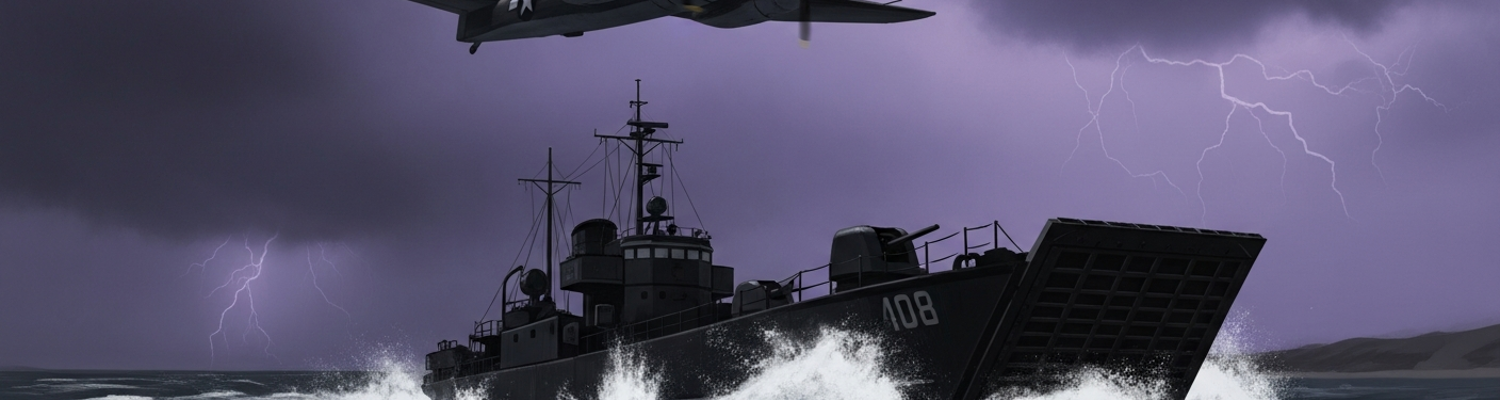

The ghost of Gallipoli haunted the halls of Quantico. In the long, uneasy peace following the Great War, military planners worldwide regarded large-scale amphibious assaults as suicidal, a reckless waste of men and materiel against a defended shore. Yet, for the United States Marine Corps, a service searching for a mission beyond colonial constabulary duties, the unthinkable became its defining purpose. The interwar years were not a period of quietude but a frantic, desperate race to solve a tactical and logistical problem of unprecedented scale: how to project force from the sea, sustain it ashore, and do so against a determined enemy. This was a direct, calculated response to the rising power of Imperial Japan and the grim geography of a potential Pacific war, a conflict that would be decided across thousands of miles of ocean, on scores of fortified islands. The story of this era is not one of seamless innovation, but of brutal trial and error, of logistical nightmares barely overcome, and of a theoretical doctrine forged into a practical weapon on the cusp of global conflict.
The intellectual foundation for this new way of war was laid down in January 1934 with the issuance of the Tentative Manual for Landing Operations. Born from the minds of officers at the Marine Corps Schools in Quantico, this document was a revolutionary attempt to impose order on the inherent chaos of a ship-to-shore assault. In November 1933, all classes were suspended as faculty and students, under Colonel Ellis B. Miller, dedicated themselves to creating this singular text. It was far more than a tactical guide; it was a comprehensive, almost frighteningly detailed logistical framework. For the first time, it codified concepts like naval gunfire support, command relationships, securing a beachhead, aviation support, and ship-to-shore movement in one place. The manual's authors, men steeped in the hard-won lessons of the past and staring into a precarious future, grappled with the immense logistical challenges. They understood that an assault force was at its most vulnerable not just on the water, but in the moments after hitting the beach, when a successful landing could quickly devolve into a catastrophic failure of supply. The document detailed complex procedures for combat loading ships, a painstaking process ensuring that the equipment needed first—machine guns, mortars, communications gear—was loaded last for immediate access. It wrestled with the organization of shore parties, the men tasked with the Herculean effort of moving ammunition, water, and medical supplies from the water’s edge to the front lines under fire. The manual was a theoretical masterpiece, so comprehensive that the U.S. Army and Navy would later adopt it with minimal changes as FTP-167. Yet, its creators knew its limitations. It was a doctrine born of theory, a desperate attempt to script an operation where friction, weather, and enemy action would rip the plan to shreds. The chasm between its pages and the bloody reality of a contested beach remained to be crossed.
A manual, however prescient, is merely paper. The true test of these radical ideas demanded salt, steel, and the sweat of thousands. This test came in the form of the annual Fleet Landing Exercises (FLEX), which began in 1935. These large-scale maneuvers were the crucibles where the theories of Quantico were slammed against the hard realities of operational execution. FLEX 5, conducted in the winter of 1939 off the islands of Culebra and Vieques, Puerto Rico, was a particularly sobering experience. The 1st Marine Brigade, under Brigadier General James J. Meade, found itself battling its own logistics as much as the notional enemy. The exercises revealed glaring deficiencies. Early landing craft, often repurposed standard Navy boats and experimental designs like the early 'Christie' amphibious tractors, proved utterly inadequate for surf-zone operations. They frequently foundered, dropped troops in deep water far from the beach, or became mechanically unreliable. Communication between ships, shore parties, and supporting aircraft was a disaster. The primitive TB-1 radios of the era were fragile, had limited range, and managing frequencies in the chaos of a landing was nearly impossible, forcing a reliance on runners who became easy targets for exercise umpires. The critical ship-to-shore movement, the very heart of the operation, was a logistical tangle. Establishing and clearing the beachhead of supplies proved to be a point of extreme friction. Piles of ammunition crates, water cans, and rations became bottlenecks, creating lucrative targets for notional enemy air and artillery strikes and starving the inland assault of its momentum. FLEX 6, held off the California coast in 1940 with the 2nd Marine Brigade, continued these hard lessons, reinforcing the urgent need for specialized landing craft—a need that would eventually be met by Andrew Higgins’s revolutionary designs—and more robust command and control systems. These exercises were not demonstrations of strength but brutal, honest self-assessments. Every failure, every logistical snarl, every communication breakdown was a vital, if painful, lesson that would save lives when the real storm broke.
The third pillar of the nascent Marine Air-Ground Team was aviation. The Tentative Manual had envisioned a role for airpower, but integrating this new, high-technology asset into the amphibious scheme presented a host of new and daunting logistical problems. The aircraft of the era, like the Vought SB2U Vindicator scout/dive bomber, represented a significant leap in capability but also a tremendous logistical burden. The SB2U-3, developed primarily for the Marine Corps, was a fabric-covered monoplane with a 1,000 hp Pratt & Whitney R-1535 engine, capable of carrying a 1,000 lb bomb. It was a flying fuel tank, designed for the long-range scouting and attack missions envisioned in a Pacific campaign. The Vindicator’s planned roles were diverse and essential: reconnaissance to find the enemy fleet, close air support to suppress enemy strongpoints during the landing, and anti-shipping strikes. Delivering this capability, however, was a nightmare. If carrier-based, the aircraft were tied to the fleet’s location, their range and sortie rates dictated by the carrier’s deck cycle. Operating them from a captured, often damaged, enemy airfield on a contested island presented a different set of horrors. The airfield had to be seized by ground troops, repaired and expanded by engineers with bulldozers, and surfaced with interlocking steel plates of Marston Matting, all while the battle for the island still raged. A single squadron’s operations demanded a logistics tail that stretched back across the ocean, carrying vast quantities of 100-octane aviation gasoline, bombs, ammunition, and spare parts. A failure at any point in this chain—a lost transport, a contaminated fuel drum, a missing toolkit—could ground the entire air component, leaving the infantry blind and exposed. Pilots of the era, flying aircraft like the Vindicator that were on the edge of obsolescence by the time war began, gave them disparaging nicknames like "Vibrator" or "Wind Indicator," reflecting their challenging flight characteristics. The combat debut of VMSB-241's SB2U-3s at the Battle of Midway demonstrated both the bravery of the aviators and the harsh reality of using aging equipment in a high-intensity fight. Of the sixteen Vindicators that took off to attack the Japanese fleet, only eight returned, many shot to pieces. It was a bloody proof of concept, validating the doctrine of expeditionary air support while simultaneously issuing a stark warning about the price of technological inferiority. The interwar struggle was a constant, grinding effort to build a machine of immense complexity from imperfect parts, fueled by a tenuous supply chain, and operated by men who knew they were preparing for the deadliest of tasks. The hard-won knowledge from Culebra's beaches and California's coast, paid for with exhaustion and frustration, became the foundation upon which the Pacific island-hopping campaign would be built.