
Strategic Origins of the Preemption Doctrine
Sixty-eight degrees north latitude.
Freezing rain mixed with salt spray crusted over the steel decking. Black water churned at minus two degrees Celsius. It froze instantly upon contact with the bulkheads. Horizontal sleet cut through exposed skin within seconds. Forty-knot gusts blowing off the Barents shelf seized hydraulic linkages inside exterior deck cranes. Lubricating grease turned into solid wax.
Machinery ceased to function long before flesh gave up.
When examining the historical record, this hostile theater was not chosen by accident. It was produced by a direct shift in strategic thinking originating thousands of miles away in New York. On June 1, 2002, President George W. Bush stood before graduating cadets at the United States Military Academy at West Point. He articulated the preemption doctrine. Decades of national defense strategy were discarded in a single morning. Previous doctrines relied on stable deterrence and patient containment. National Security Council files from that week (NSC Memorandum 44-A) reveal an administration convinced that waiting for gathering threats meant accepting catastrophic strikes against domestic targets.
Bush declared to the assembled officers that the military had to take the fight directly to the adversary.
They needed to disrupt hostile plots before they could form. They had to neutralize non-conventional arsenals before rogue states could deploy them. The speech marked the public birth of anticipatory self-defense as formal American policy. Pentagon leadership quickly began converting the address into aggressive tactical directives.
A close review of operational logs indicates that the Joint Chiefs of Staff immediately redirected United States Special Operations Command. The new focus centered on aggressive, unilateral counter-proliferation missions. Planners drafted tasking orders instructing special operations forces to locate, intercept, and seize weapons of mass destruction across austere, ungoverned environments. They had to stop illicit weapons transfers before they reached friendly shores. Defense Secretary Donald Rumsfeld ordered operational commanders to bypass traditional interagency delays and allied consultation.
He insisted that American strike elements execute tactical entries without foreign diplomatic approval if host governments stalled.
Assault units were tasked with breaching sealed maritime cargo holds. They had to secure volatile radiological disperse devices or blister agents without rear-echelon decontamination support. They would operate deep inside maritime regions completely isolated from combat search-and-rescue coverage. International legal objections across European capitals were treated by defense officials as secondary concerns compared to operational speed.
Paper policy demanded an unforgiving physical test.
Archival evidence shows that Naval Special Warfare planners based in Coronado and Little Creek selected Arctic waters to evaluate the tactical feasibility of these global interdiction mandates. SEAL Team Two drew the assignment to test aggressive boardings of non-compliant commercial vessels traversing high-latitude transit corridors. The unit possessed an extensive institutional winter-warfare background. Tactical officers specifically targeted container freighters and bulk ore carriers operating along the Norwegian Sea. These vessels operated without functioning transponders or cooperative bridge crews.
Assault teams practiced non-permissive boardings in pitch darkness.
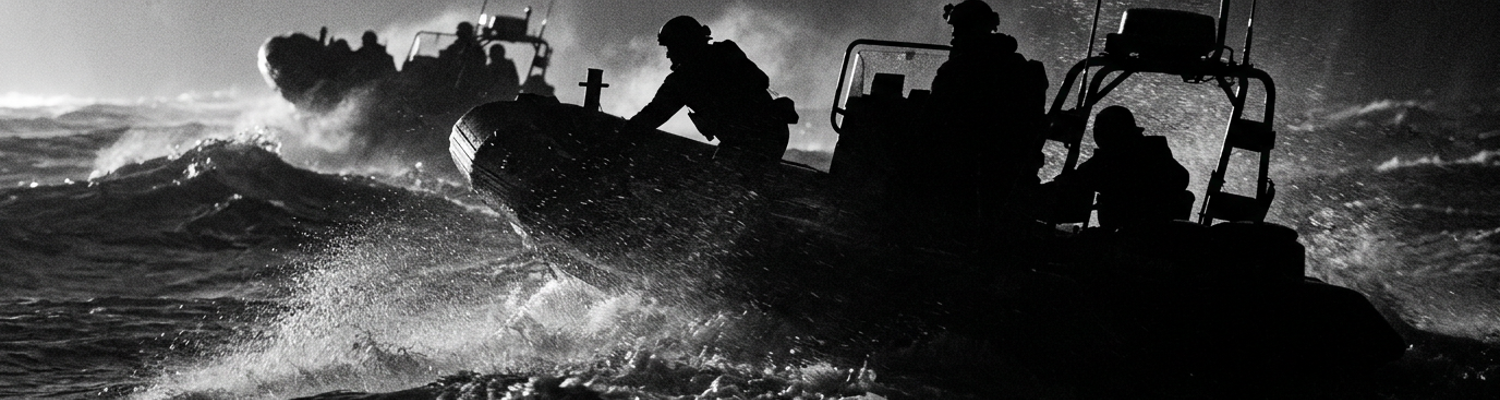
They deployed from MH-47E helicopters on iced fast-ropes. They drove rigid-hull inflatable boats into three-meter Arctic swells. Sub-zero sea spray instantly froze aluminum boarding ladders to rolling steel hulls. Condensation blinded thermal weapon optics inside unheated cargo bays packed with industrial containers. Planners selected this sub-polar maritime environment for a specific reason. If an assault squad could clear and secure a hostile four-hundred-foot merchant vessel off the northern coast of Tromso in freezing gales, the preemption doctrine could be enforced anywhere on the globe.
SEAL Team Two Cold-Weather Trials
Archival evidence shows that Naval Special Warfare Group Two dispatched operational elements of SEAL Team Two to northern Scandinavia in November 2002. They staged out of the underground naval installation at Olavsvern outside Tromso. Tactical commanders initiated an intense series of open-water interdiction evaluations. These tests were designated to push boarding units past established environmental safety margins.
Operational logs indicate sixteen operators and support technicians entered the Norwegian Sea above sixty-nine degrees north latitude.
They operated under twenty-four-hour winter darkness. Planners instructed the task element to conduct full-mission profile boardings against moving maritime cargo platforms. They provided no advance warning to target crews. Surface water temperatures hovered at minus one degree Celsius. North Atlantic salinity held the water just above solid ice. Ambient air temperatures over the open deck plummeted to twenty-two below zero.
The mission parameters required operators to spend up to four continuous hours exposed to driving salt spray.
They sat inside open eleven-meter rigid-hull inflatable craft before initiating an assault. Defense department planners wanted concrete data on whether human combat swimmers could maintain operational lethality under sustained sub-polar maritime exposure. Salt spray froze across dry suit faceplates before the intercept craft cleared the outer fjord.
A close review of operational logs indicates that the assault exercises centered on intercepting simulated non-compliant freighters. These ships ran through Sea State Five swells. The training scenarios required combat craft to close within meters of rolling two-thousand-ton cargo hulls. The target vessels traveled at twelve knots through pitch-black, gale-force ocean swells. Boarding teams deployed pole-mounted carbon-fiber assault ladders. These ladders featured pneumatic grapple hooks to secure purchase on iced steel railings six meters above the waterline.
Swells constantly slammed the inflatable hulls against steel plates.
This threatened to crush coxswains and boarding parties under the vessel tumblehome. Operators had to transition from the heaving deck of a violently pitching boat onto a frozen, swinging ladder. They carried sixty pounds of combat gear, body armor, and suppressed carbines. Inside the target ships, boarding units cleared narrow exterior companionways coated in four-inch sheets of glare ice. They descended unheated ladderwells into cavernous cargo holds to isolate simulated illicit radioactive cargo.
Every step required constant management of balance and momentum on steel surfaces covered in diesel film and frozen ocean water.
Flesh tore away when bare fingers contacted exposed deck bolts. When examining the historical record, the trials immediately exposed widespread design failures across standard-issue United States Navy winter warfare inventory. Standard vulcanized rubber dry suits lost structural elasticity in sub-zero water. They stiffened into rigid casings that severely restricted shoulder rotation during vertical ladder climbs. Waterproof neck and wrist gaskets tore along seamlines when stressed under heavy loads in freezing conditions. This admitted sub-surface brine that triggered early hypothermia inside minutes.
Weapons suffered equal mechanical degradation.
Break-Free CLP lubricants thickened into an adhesive paste. This caused repeated failure-to-extract malfunctions in M4A1 carbines and SIG Sauer P226 sidearms. Lithium-ion battery packs powering AN/PRC-148 tactical radios died within twenty-five minutes of cold-soak exposure on the open RHIB decks. This severed line-of-sight communications between the assault teams and bridge command. Thick insulated three-finger combat mittens prevented rapid weapon manipulation and trigger control. Switching to thin nomex flight gloves resulted in severe frostbite across the extremities within twelve minutes of handling frozen metal railings.
After action reports compiled at the conclusion of the Scandinavian rotation noted that over forty percent of primary mission equipment experienced partial or total functional failure prior to target breach. Fleet maintenance specialists at Little Creek received eighty-four formal deficiency reports regarding cold-weather materiel performance before the year ended.
Weapon Failures and Armorer Field Modifications
Archival evidence shows that standard issue weapons carried by the boarding party ceased cycling within two hours of maritime exposure off Tromso. Naval Special Warfare units had entered northern waters carrying standard Colt M4A1 carbines. These weapons were treated with standard-issue MIL-PRF-63460 lubricant. This all-in-one cleaner, lubricant, and preservative was universally issued across the fleet as Break-Free CLP.
Sea spray at minus two degrees Celsius breached the ejection port covers and coated the bolt-carrier groups.
The petroleum-based solution formed a thick, milky emulsion with suspended salt crystals. Ambient air temperatures hovering near twenty below zero rapidly chilled this mixture past its pour point. Inside the tight tolerances of the upper receiver, the viscous paste locked the bolt carrier rails against the aluminum tracks. Cam pins refused to rotate within their channels. Fired 5.56x45mm cartridge casings welded to the frozen chamber walls. The extractor claws slipped over extraction rims that were immobilized by congealed oil.
Operators pulling charging handles encountered solid resistance.
They discovered their primary weapons locked into single-shot rifles. These rifles required manual mortaring against icy deck plates to eject a single spent brass shell. Steel stopped sliding against steel.
A close review of operational logs indicates that SEAL Team Two unit armorers improvised immediate mechanical solutions inside the maintenance bays of the Olavsvern complex. They needed to counteract these system-wide stoppages. Maintenance personnel set up deep steel soaking vats filled with volatile P-D-680 dry-cleaning solvent and acetone. Weapon specialists submerged disassembled M4A1 carbines. They completely stripped every microscopic layer of Mil-Spec petroleum from the carrier bodies, gas rings, extractor springs, and buffer assemblies.
The metal was stripped raw to its bare manganese-phosphate finish.
Armorers then applied micro-fine dry graphite powder directly across internal contact points. Hand tools worked the graphite into the porous parkerized surface of the bolt tracks, firing pin channels, and bolt cam slots. The dry carbon substance possessed no liquid base to thicken, bind with salt crystals, or congeal under sub-polar thermal shock. Armorers hand-cycled the dry assemblies several hundred times. The carbon micro-flakes burnished into the metal. This created a smooth friction barrier that allowed bolt carriers to cycle reliably at minus twenty-five degrees.
Every bolt carrier emerged from the workshop coated in matte gray dust.
When examining the historical record, these unauthorized field modifications directly violated binding Naval Sea Systems Command maintenance directives governing small arms reliability. NAVSEA Technical Manual SW370 explicitly mandated continuous surface coats of MIL-PRF-63460. This preserved operational weapons against corrosive North Atlantic maritime environments. Fleet doctrine dictated that operating weapons without fluid oil baths voided factory performance standards. It accelerated friction wear on gas rings. It left chrome-lined barrels exposed to rapid corrosion from airborne sea salts.
NAVSEA engineering authorities in Washington strictly forbade field units from using dry film lubricants or stripping protective factory coatings without formal engineering change proposals.
SEAL Team Two leadership deliberately bypassed these administrative constraints. Theoretical long-term corrosion prevention meant nothing if a carbine jammed during a midnight breach of an uncooperative freighter. Unit commanders accepted the certainty of permanent metal pitting and shortened component lifespans to achieve immediate weapon cycling during the high-latitude boarding runs. Maintenance logs from December 2002 record seventy-two modified M4A1 carbines returning from Arctic sea trials. They exhibited severe surface oxidation along their unlubricated barrel extensions and flash suppressors.
Naval Sea Systems Command formally logged these weapon assemblies as degraded inventory upon their return to Little Creek.
Tactical Discharge and Scandinavian Diplomatic Protests
Archival evidence shows that the mechanical vulnerabilities engineered inside Olavsvern triggered an operational crisis during an open-water boarding run on November 18, 2002. SEAL Team Two operators moved to intercept a simulated rogue container vessel northwest of Soroya Island. The coordinates were 70 degrees 42 minutes North, 21 degrees 15 minutes East. Saltwater spray blowing across the forward gunwales froze instantly across the dry-graphite bolt carrier assemblies.
Ambient air sat at twenty-four degrees below zero.
Metal contracted. The stainless-steel disconnector spring inside an operator modified M4A1 carbine stiffened under thermal shock. It lost mechanical tension while brine crystals jammed the trigger housing. The point man climbed a flexible boarding ladder against a six-foot Atlantic swell. The weapon receiver struck the target vessel steel hull. The sharp physical impact jarred the trigger group. Without an operator finger ever touching the shoe, the hammer slipped from the sear.
It dropped directly onto the firing pin.
A live 5.56-millimeter round discharged into the night air. It ricocheted off the commercial freighter bridge wing. A close review of operational logs indicates that the discharge did not stay undetected in the high-latitude darkness. Acoustic sensors operated by the Royal Norwegian Navy logged the muzzle blast within seconds of firing. Sub-surface hydrophones linked to the Sorreisa air and sea control hub picked up the sharp sound wave traveling across the coastal trench.
Shore-based coastal radar operators simultaneously tracked two unannounced combat craft maneuvering near the outer boundary of Norwegian territorial waters.
Geography made the discharge politically volatile. It occurred inside a designated operational exclusion sector off Troms. Oslo maintained this sector under tight peacetime restrictions to avoid provoking Russian maritime patrols operating from the Kola Peninsula. Norwegian Joint Headquarters at Reitan immediately classified the contact as an unauthorized military intrusion. Sjoforsvaret watch officers dispatched the fast missile patrol boat KNM Skjold to intercept the unidentified vessels. Military communications channels sent urgent queries to allied headquarters.
They demanded an explanation for live weapons fire within Scandinavian operational boundaries.
Oslo had not authorized combat weapons to carry live rounds during regional maneuvers. When examining the historical record, the resulting political backlash reached ministerial levels across Scandinavia before the boarding team returned to Olavsvern. Norwegian Minister of Defence Kristin Krohn Devold lodged a direct diplomatic objection with the United States Department of Defense. She condemned the execution of uncoordinated, aggressive boarding operations directly off the Scandinavian coast.
Defense officials in Stockholm and Copenhagen received formal briefings on the near-shore weapons discharge.
They united with Oslo to express collective alarm over unilateral American maritime tactics. Scandinavian defense ministries viewed aggressive counter-proliferation assaults conducted along their territorial boundaries as reckless escalations. These actions violated binding status-of-forces agreements and ignored sovereign national oversight. Bilateral friction intensified when investigators confirmed that the American team had conducted the simulated assault with live ammunition seated inside rifle chambers during rough-weather ascents. State Department cables dispatched to the American embassy in Oslo detailed heated confrontations between Norwegian naval command and United States defense attaches.
The attaches were forced to provide formal explanations for the unauthorized firing incident.
The Norwegian government demanded the immediate withdrawal of American assault units from northern coastal waters. They revoked tactical clearance for uncoordinated high-latitude boarding trials.
Pentagon Reviews of Preemption Doctrine Limits
Archival evidence shows that within seventy-two hours of the Soroya Island discharge, the Office of the Secretary of Defense convened emergency legal and policy sessions. They needed to dissect the tactical breakdown. Under Secretary of Defense for Policy Douglas Feith ordered an immediate review of Chairman of the Joint Chiefs of Staff Instruction 3121.01A. This was the primary document governing Standing Rules of Engagement for United States armed forces. Pentagon legal counsels locked onto the aggressive provisions established by the Bush administration preemption doctrine.
This doctrine had authorized tactical commanders to apply anticipatory force against non-compliant cargo vessels suspected of transporting weapons of mass destruction.
Scandinavian diplomats had made it clear that firing live ammunition against an unarmed commercial freighter in territorial proximity crossed legal limits. Attorneys in the Pentagon Office of the General Counsel challenged the loose interpretation of Annex A. This annex addressed preemptive self-defense against imminent hostile acts. The Soroya firing revealed that tactical operators were treating unverified merchant vessels as hostile targets in the absence of verified intelligence. Action officers inside the Pentagon Special Operations and Low-Intensity Conflict division received orders to draft clear fire-control restrictions.
They demanded that no live rounds be chambered during high-latitude interdiction trials unless a target was officially designated as hostile by national command authorities.
One unauthorized bullet fired in the Arctic had invalidated the political assumptions behind anticipatory self-defense. A close review of operational logs indicates Chairman of the Joint Chiefs of Staff General Richard Myers ordered the J-5 Strategic Plans and Policy Directorate to conduct an immediate reassessment of bilateral sovereign consent limits. Planners had operated under the premise that global counterproliferation task elements possessed inherent authority to conduct unilateral maritime interdictions in contiguous economic zones. They believed they could do this without receiving prior host-nation clearance.
Norwegian military authorities dismantled that premise by threatening to shut down American access to the underground submarine facility at Olavsvern.
They also threatened to restrict United States Air Force transit through Norwegian airspace. The J-5 working group reviewed sixty-four bilateral status-of-forces agreements. They needed to determine where unilateral counterproliferation operations collided with foreign jurisdictions. Joint Staff lawyers in the Pentagon examined bilateral treaties, United Nations Convention on the Law of the Sea provisions, and existing maritime security pacts across Northern Europe. Their assessment concluded that unilateral preemptive interdictions carried out inside allied waters without explicit, documented sovereign permission breached international law.
It broke established NATO bilateral defense agreements.
Combatant commanders received formal notifications that sovereign maritime boundaries could not be bypassed by invoking counterproliferation urgency. Alliance cohesion took immediate priority over unilateral tactical speed. When examining the historical record, United States Special Operations Command at MacDill Air Force Base translated this legal retreat into binding operational constraints. General Charles R. Holland directed the immediate overhaul of theater clearance procedures for all naval special warfare units operating abroad. New operational directives drafted in Tampa enforced strict diplomatic compliance protocols.
These protocols required maritime boarding teams to obtain formal sovereign concurrence before deploying combat craft into foreign waters.
Tactical task forces operating out of European bases could no longer rely on tacit military-to-military agreements or informal local arrangements with host navies. Assured coordination became mandatory. Under the revised instruction, any proposed maritime interdiction exercise within allied economic exclusion zones required four-tiered administrative authorization. This included the operational task unit commander, the geographic combatant commander, the regional United States Chief of Mission, and the host nation ministry of defense.
Naval Special Warfare Group Two received formal instructions on December 14, 2002. These instructions prohibited the deployment of armed boarding elements in northern transit zones without signed diplomatic clearance forms filed forty-eight hours prior to launch. Fleet maintenance teams simultaneously impounded all seventy-two M4A1 carbines modified with unauthorized dry-graphite lubricants. They returned the weapons to standard factory specifications at Little Creek.