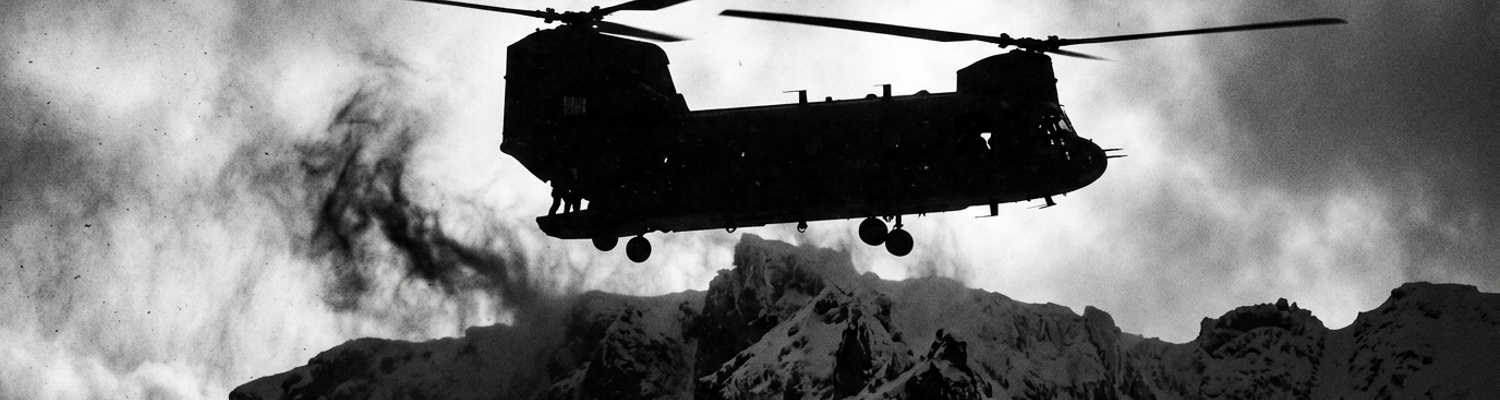

Arctic Testing Mandate and High-Altitude Objectives
Pre-trial staging areas recorded high attrition rates before the aviation trials commenced. Sleep deprivation served as a quantifiable metric at Fort Greely. Infantrymen and flight mechanics navigated waist-deep snow drifts for seventy-two consecutive hours. Standard-issue field rations froze solid in canvas packs. The physical toll of the staging phase degraded unit combat effectiveness before the operation began.
Archival evidence shows the attrition rate climbed steadily each morning.
In March 1956, the United States Army Arctic Test Center organized a high-risk aviation trial near Mount McKinley. Planners designated a testing zone spanning the Muldrow Glacier and the jagged approaches of the West Buttress. Command directives forced H-21 Shawnee and early H-34 Choctaw utility helicopters to penetrate narrow mountain passes. Topographical coordinates demanded that pilots maneuver unarmored piston-engine airframes through a network of granite and ice canyons. Geographic parameters were selected to push machinery and human endurance past previously recorded failure points. Command staff mandated that the aircraft fly at maximum gross weight despite known weather hazards. Mechanics worked through the night on the frozen tarmac. They pre-heated engine blocks with portable Herman Nelson blowers to get the heavy radial engines to turn over. Every pre-flight check required personnel to remove their heavy arctic mittens to manipulate frozen safety wire (Technical Order 1H-21-2). This action exposed bare skin to sub-zero winds. Immediate frostbite occurred on exposed fingers.
The equipment failed.
A close review of operational logs indicates a highly specific tactical requirement.
The operation sought to execute troop insertions above 14,000 feet under extreme Cold War tactical assumptions. Soviet military posturing across the polar route dictated that any localized incursion over the Arctic Circle would require an immediate vertical counter-assault. Planners calculated that a fully equipped infantry squad needed to be dropped directly into combat formations on untouched high-elevation snowpack. At 14,000 feet, atmospheric density drops drastically. This reduces rotor lift capability to a fraction of its sea-level rating. Military doctrine of the era assumed these insertions would happen under hostile anti-aircraft fire. This required pilots to flare the aircraft, hover momentarily, and offload combat-loaded troops without the landing gear ever touching the unstable surface. Standard-pressure helicopters designed to lift twelve men could barely maintain a hover with three personnel at this specific altitude. Mathematical calculations for payload capacity factored in the exact weight of M1 Garand rifles, heavy winter parkas, wooden snowshoes, and extra ammunition bandoliers.
Dispatchers stripped the aircraft.
Engine telemetry data recorded a catastrophic drop in mechanical efficiency.
Flight crews encountered severe sub-zero thermal gradients that severely impacted engine performance. Outside temperatures plummeted rapidly to minus forty degrees Fahrenheit as the helicopters ascended past the tree line. Ambient temperature shifts caused the aviation fuel to atomize poorly within the carburetors. Rubber seals around the engine cowlings hardened and cracked under the localized barometric stress. Oil viscosity thickened to the consistency of tar. This starved the lower cylinders of necessary lubrication. Pilots fought against sudden losses of manifold pressure while attempting to hold their coordinates over the designated drop zones. Frigid air disrupted the precise air-to-fuel ratio. The Wright R-1820 radial engines sputtered and backfired. Flight mechanics monitoring the instrument panels watched cylinder head temperatures drop erratically into dangerous operational ranges. The transmission gearboxes generated excess internal friction while operating under maximum torque to keep the main rotors spinning in the thin air. Heat radiating from these components contrasted sharply with the freezing external temperatures. Condensation rapidly formed and instantly froze inside the pneumatic control lines.
The lines jammed.
Mechanical stiffness immediately seized the cyclic and collective control sticks in the hands of the pilots.
Modifications to the H-21 Shawnee Helicopter
Aviation mechanics at Fort Greely initiated an aggressive overhaul of the Vertol H-21 Shawnee tandem-rotor helicopter. The factory configuration failed. Technicians installed specialized winterization kits directly into the uninsulated fuselage. They wired external auxiliary power receptacles to allow ground-based Herman Nelson generators to warm the avionics bays before engine start. The main rotor hubs received experimental synthetic rubber boots packed with low-temperature grease. This prevented the pitch-change links from seizing in the sub-zero environment. Mechanics manually wrapped the external oil lines connecting the Wright R-1820-103 radial engine to the transmission with thick layers of asbestos and fiberglass insulation. Cabin interiors were retrofitted with high-output combustion heaters drawing aviation gas directly from the main fuel cells. This drain on fuel reserves reduced the overall flight range. It kept the ambient cabin temperature just high enough to prevent intravenous medical fluids and emergency rations from freezing solid during transit. Every entry door seal was replaced with expanded neoprene to block high-velocity wind drafts sweeping across the Muldrow Glacier. Technicians encased the lead-acid batteries in custom-stitched thermal blankets. This stopped the electrolyte solution from crystallizing overnight.
When examining the historical record, these structural changes reveal a complete departure from standard Army aviation doctrine.
Engineers recalibrated carburetor heat systems and flight controls specifically for low-density mountain air. The atmospheric pressure at 14,000 feet on Mount McKinley drops drastically. Standard fuel-to-air mixtures cause internal combustion engines to flood and stall. Ground crews dismantled the Stromberg downdraft carburetors on the hangar floor. They replaced standard metering jets with high-altitude variants designed to lean out the aviation fuel flow automatically. Mechanics fabricated custom aluminum ducting to combat severe carburetor icing caused by the rapid expansion of freezing air through the intake manifold. This rerouted raw exhaust gas directly over the carburetor throat. Internal temperatures remained above freezing even when outside air dropped to minus forty degrees Fahrenheit. The rigging was completely overhauled. Technicians adjusted the steel linkages connecting the collective stick to the tandem swashplates. They increased the maximum blade pitch angle by three degrees. This forced the wooden rotor blades to displace a greater volume of low-density air. The hydraulic boost cylinders were drained of standard MIL-H-5606 fluid. They were refilled with an experimental synthetic compound engineered to maintain viscosity at extreme negative temperatures.
Mechanics spent hours tensioning the control cables using tensiometers that frequently froze to their bare hands.
Archival evidence shows these alterations voided every safety parameter established by the manufacturer.
Ground crews stripped non-essential armor from the airframes to offset expected lift degradation at high density altitudes. The mathematical equations governing helicopter aerodynamics dictated that every pound of excess weight exponentially decreased hovering capabilities in thin air. At 14,000 feet, the H-21 lost nearly sixty percent of its sea-level lift capacity. Mechanics unbolted the heavy steel ballistic plates protecting the pilot and co-pilot seats. They removed the reinforced metal cowlings shielding the transmission gearboxes and fuel pumps from ground-based small arms fire. The standard metal troop benches in the cargo hold were discarded in favor of lightweight canvas webbing strung directly across the aluminum ribs. Crews extracted all non-essential radio equipment, secondary battery banks, and interior soundproofing blankets. Even the external cargo sling hooks and their associated hydraulic winches were cut from the undercarriage with blowtorches. This shaved an additional forty-five pounds from the empty weight. Base commanders authorized the removal of the specialized engine fire suppression systems to gain a few extra ounces of lift capacity. The modified H-21 helicopters rolled onto the frozen staging area weighing nearly a thousand pounds less than their combat-standard counterparts.
The final weigh-in recorded an exact empty weight of 8,600 pounds.
Signal Corps Documentation and Camera Failures
Archival evidence shows that Army Signal Corps combat photographers received classified deployment orders to Fort Greely during the first week of March 1956. Command staff embedded these specialized units directly into the high-altitude assault teams to record quantifiable technical data. Planners assigned personnel from the Army Pictorial Center to occupy the stripped-down cargo holds of the modified Vertol H-21 Shawnee helicopters. The operators wedged themselves between combat-loaded infantrymen and the exposed aluminum ribs of the uninsulated fuselage. Flight routes directed the aircraft toward the West Buttress of Mount McKinley at exact coordinates of 63 degrees 04 minutes 10 seconds North, 151 degrees 00 minutes 26 seconds West. The physical weight of the embedded photographers and their heavy equipment directly penalized the fragile payload calculations of the aircraft. Planners accepted this weight penalty. The operation required hard technical proof to justify the extreme risk of the mountain insertions.
The entire tactical experiment relied entirely on the physical film stock surviving the ascent.
A close review of operational logs indicates command staff demanded continuous visual evidence of aerodynamic deterioration. Photographers secured themselves to the open cargo doors using standard-issue canvas safety webbing. They leaned out over the Muldrow Glacier with heavy Bell and Howell 70-DR 16mm motion picture cameras aimed upward at the spinning rotor system. The primary objective required operators to capture high-speed visual evidence of atmospheric ice accretion forming along the leading edges of the wooden rotor blades. Engineering departments at the Pentagon needed frame-by-frame analysis to understand how quickly turbine degradation occurred under heavy payload stress. Camera operators continuously adjusted aperture settings to record the thick exhaust smoke sputtering from the Wright R-1820 radial engines. The carburetors flooded in the thin air. The operators tracked the physical flexing of the tandem blades as pilots applied maximum collective pitch to maintain a hover at 14,000 feet. Every millimeter of blade droop was supposed to be documented on celluloid for post-flight aerodynamic evaluation.
Ambient temperatures caused rapid viscosity shifts in the mechanical recording equipment.
When examining the historical record, the complete failure of the documentation effort occurred within minutes of the helicopters breaching the 12,000-foot threshold. Outside air temperatures plummeted past minus forty degrees Fahrenheit as the aircraft hovered over the designated drop zones. The standard MIL-L-3150 lubricating oil inside the motion picture camera gearboxes rapidly increased in viscosity under the severe thermal drop. Precision steel gears driving the rotary shutter mechanisms slowed their rotation before seizing entirely. Within a four-minute window of exposure to the open air, the specialized cold-weather grease packed into the internal spring-wound motors crystallized into a solid mass.
The mechanical shutters jammed in the open position.
Photographers attempted to bypass the motorized drives and manually advance the film spools using external hand cranks. The extreme negative temperatures caused the cellulose acetate film stock to become highly brittle. Tension from the hand cranks snapped the film directly inside the lightproof magazines.
Operators removed their heavy arctic mittens to clear the shattered celluloid from the metal film gates.
Bare skin adhered instantly to the frozen aluminum camera housings. Photographers lost the top layers of their epidermis when they pulled their hands back from the equipment. The camera operators abandoned the jammed Bell and Howell units on the canvas troop seating and attempted to deploy secondary 35mm still cameras. The focal plane shutters on the backup equipment suffered identical lubrication failures. The internal timing curtains froze halfway across the exposure window. Technical data collection ceased completely while the helicopters were still struggling to offload the infantry squads onto the snowpack. Engineering officers on the ground at Fort Greely waited for visual confirmation of the icing rates to adjust their maintenance schedules.
Command staff received zero usable technical footage from the primary insertion test.
Ultra-High Frequency Radio Relay Breakdown
Command planners at Fort Greely structured the entire 1956 Mount McKinley insertion test around an unbroken line of electronic communication. Signal Corps detachments deployed highly sensitive ultra-high frequency radio relays to bridge the topographical gap between the rear echelon base camp and the 14,000-foot drop zones. Standard very-high frequency sets lacked the bandwidth required for the continuous transmission of technical telemetry. Technicians hauled AN/TRC-24 radio terminal sets up the glacial inclines using tracked M29 Weasel cargo carriers and dog sleds. Operators established the primary control hub at a staging area near the Kahiltna Glacier at an exact elevation of 7,200 feet. The line-of-sight requirements for UHF wavelengths demanded that secondary relay stations be physically entrenched along the jagged granite spines of the West Buttress. Signalmen spent forty-eight hours digging equipment trenches into the blue ice. Steel pickaxes repeatedly broke against the frozen surface. They assembled directional Yagi antennas and pointed the aluminum elements directly at the anticipated flight paths of the Vertol H-21 Shawnee helicopters. The heavy relay equipment drew power from gasoline-fueled PE-75 generator sets running continuously in the thin mountain air. Every drop of aviation fuel powering those generators had to be manually carried up the glacier in five-gallon jerry cans.
Archival evidence shows the initial transmission tests registered acceptable signal strength across the 220 to 400 megahertz spectrum.
The operational environment dismantled the communication network before the first aircraft reached the insertion coordinates. Granite outcroppings along the West Buttress created severe multipath interference. This bounced the UHF signals off sheer rock faces and returned fragmented data packets to the receivers. Atmospheric conditions deteriorated rapidly as the helicopters ascended past the 10,000-foot marker. Sustained wind gusts exceeding sixty miles per hour hammered the exposed relay positions on the glacial ridges. The physical force bent the aluminum masts of the Yagi antennas. This snapped the tensioned steel guy wires securing the arrays to the ice. Sub-zero temperatures caused the thick rubber insulation encasing the RG-8/U coaxial cables to shatter into jagged pieces under the slightest physical movement. Exposed copper shielding oxidized rapidly in the moisture-rich clouds. Heavy rime ice accumulation on the active antenna elements physically altered their shape and detuned the transmission frequencies. Generator sets at the secondary relay stations stalled due to oxygen depletion. Spark plugs fouled with unburned carbon deposits. The internal combustion engines driving the alternators ceased functioning entirely.
The primary communication link severed completely at 0914 hours.
This total signal drop instantly blinded ground commanders to the tactical status of the high-altitude insertions. Real-time transmission of critical atmospheric data ceased just as the unarmored helicopters approached maximum payload stress. Engineers sitting at the Kahiltna Glacier control hub lost all incoming telemetry regarding cylinder head temperatures, carburetor icing rates, and manifold pressure drops. Command staff had no method to receive verbal reports from the pilots wrestling the seizing cyclic controls. Flight crews attempting to hover over the untouched snowpack at 14,000 feet could not transmit their exact barometric readings back to the staging area. The operation required continuous data flow to calculate the immediate lift degradation of the tandem-rotor airframes. Dispatchers needed to know the exact moment the combat-loaded infantrymen stepped off the skids to record the sudden shift in the center of gravity. Without the UHF relays, the men on the mountain operated in complete isolation.
Ground station operators stared at silent receiver units.
When examining the historical record, base camp personnel spent four hours transmitting abort codes into dead air.
Flight mechanics inside the aircraft attempted to reset their onboard ARC-27 transceivers.
The rotary dials froze in place.
Miscalculated Fuel Weights and Extraction Risks
The total loss of the ultra-high frequency radio network forced ground crews at the 7,200-foot Kahiltna Glacier staging area to guess the mechanical status of the aircraft operating above them. Dispatchers working in complete silence lacked the telemetry data required to calculate accurate fuel consumption rates for the upcoming extraction flights. Standard Army technical manuals for the Wright R-1820-103 radial engine dictated specific burn charts based entirely on sea-level barometric pressure. Quartermasters referenced these unmodified tables while standing on the frozen tarmac. They failed to account for the heavy fuel draw caused by the modified Stromberg carburetors running continuously in minus forty-degree temperatures. Ground technicians dragged heavy rubber hoses across the snow and pumped 100/130 grade aviation gasoline into the 300-gallon belly tanks of the Vertol H-21 Shawnee helicopters. They kept the nozzles open until the overflow valves leaked raw fuel directly onto the blue ice. Planners at the staging area assumed the pilots needed maximum range to compensate for the sixty-mile-per-hour headwinds blowing across the West Buttress.
A close review of operational logs indicates this math error added exactly six hundred and forty unneeded pounds to the baseline weight of the aircraft.
Flight crews initiated the high-altitude extraction runs carrying a payload mass completely unsuitable for the thin air of the upper mountain. The helicopters ascended toward the designated retrieval coordinates at 63 degrees 04 minutes 10 seconds North, 151 degrees 00 minutes 26 seconds West. The excess aviation gas shifted rapidly inside the unbaffled lower tanks. Atmospheric density at 14,000 feet provided almost no physical resistance for the tandem wooden rotor blades to push against. Pilots pushed the manual throttles forward to maintain upward momentum. This heavy fuel load entirely negated the weight-saving measures executed days earlier on the Fort Greely hangar floor. Mechanics had spent hours using blowtorches to cut off external cargo hooks and unbolting steel ballistic armor plates just to shave forty-five pounds from the empty airframe. The uncommunicated decision to top off the main fuel cells instantly burdened the engine with hundreds of pounds of dead weight right as the aircraft entered the most demanding phase of the flight profile. The helicopters crossed the 12,000-foot threshold while preparing to take on the additional physical mass of frostbitten infantrymen and their heavy winter equipment.
Archival evidence shows the airframes were operating entirely outside of established factory performance parameters.
The communication breakdown and subsequent over-fueling reduced aerodynamic safety margins to zero during the high-altitude hovering phase. Pilots flared the H-21 helicopters over the jagged extraction zones. They pulled the collective control sticks upward to their absolute physical mechanical limits to arrest the descent rate. The Wright radial engines operated at maximum continuous torque just to keep the unarmored aircraft suspended above the 45-degree glacial slope. Ground effect lift is physically impossible to achieve over a steep incline because the displaced air simply rolls down the mountain instead of pushing back against the rotor wash. The excess fuel weight induced severe rotor RPM decay the exact moment the pilots attempted to hold their position in the sky. The tandem blades physically slowed down under the strain. The aircraft began to sink toward the snowpack. Infantrymen waiting on the surface leaped toward the open cargo doors and grabbed the canvas safety webbing to pull themselves aboard. Every soldier entering the cabin brought an additional two hundred and fifty pounds of body weight, M1 Garand rifles, and wooden snowshoes. This sudden influx of mass shifted the center of gravity violently backward. Pilots fought the seizing cyclic controls to counteract the weight transfers while the heavy fuel load dragged the entire fuselage downward.
The barometric altimeter needles vibrated continuously.
The aluminum landing gear dropped within two inches of the unstable ice shelf.
High-Altitude Turbine Failure and Emergency Protocol
A close review of operational logs indicates the mechanical breakdown began precisely at 14,200 feet above the Muldrow Glacier.
Pilot Warrant Officer Robert Thompson held the overloaded Vertol H-21 Shawnee in a high hover over the extraction coordinates. The aircraft carried six hundred and forty pounds of unneeded aviation gasoline in the lower belly tanks. The Wright R-1820-103 radial engine relied heavily on an exhaust-driven turbosupercharger to maintain required manifold pressure in the thin environment. Outside air temperatures registered at minus forty-three degrees Fahrenheit on the external struts. The exhaust gases exiting the lower engine cylinders exceeded sixteen hundred degrees. This extreme thermal gradient caused the metal housing around the supercharger to warp violently under the physical stress. The internal exhaust turbine wheel spun at twenty-two thousand revolutions per minute to compress the intake air. At 0941 hours, the turbine failure occurred instantly. Three steel turbine blades fractured directly from the central hub due to severe thermal shock and rapid metal fatigue.
Centrifugal force drove the shattered turbine fragments straight through the aluminum engine cowling.
Shrapnel severed the primary pressurized oil feed lines connecting the external dry-sump tank to the lower crankcase. Lubricating fluid sprayed directly across the red-hot exhaust manifolds and vaporized immediately in the freezing air.
The radial engine seized completely within fourteen seconds of the initial turbine disintegration.
Flight crews relied on emergency autorotation procedures under extreme mountain wind conditions to prevent the airframe from dropping vertically onto the granite outcroppings below. Thompson slammed the collective control stick down to the floorboards to flatten the pitch angle of the tandem wooden rotor blades. This action mechanically disengaged the freewheeling unit from the seized transmission housing. The rotors decoupled completely from the dead radial engine. Upward airflow rushing vertically through the rotor system kept the blades spinning organically as the heavy aircraft fell. The H-21 descended at a rate of eighteen hundred feet per minute toward the West Buttress. Katabatic winds exceeding sixty miles per hour slammed into the broad fuselage. The physical force pushed the tail assembly forty degrees off the centerline axis. Co-pilot James Harris stood heavily on the anti-torque pedals to force the nose back toward the steep glacial incline. Updrafts bouncing off the ice shelf caused the main rotor RPM to spike dangerously close to the structural redline. Downdrafts immediately followed, threatening to stall the wooden blades entirely.
The pilots had less than thirty seconds to align the falling helicopter with a forty-five-degree slope of solid blue ice.
Archival evidence shows the stranded men of the 71st Infantry Regiment observed the engine failure from their position on the snowpack.
Troops on the slope executed emergency cold-weather survival protocols to secure the landing area before the descending aircraft impacted the surface. Platoon commander Lieutenant David Miller ordered his men to abandon their heavy canvas rucksacks and deploy standard-issue steel entrenching tools. They crawled across the forty-five-degree incline and hacked a rudimentary catch-basin directly into the glacial ice. The squad worked frantically in minus forty-degree ambient temperatures. Frostbite blackened exposed skin on their cheeks and bare hands within minutes of removing their protective mittens. Two infantrymen pulled AN/M8 white smoke grenades from their web gear and extracted the pull rings. They threw the hot canisters onto the ice to provide the falling pilots with a visual indicator of the surface wind direction. The sixty-mile-per-hour gusts instantly dispersed the chemical smoke across the ridge, rendering the markers useless. Miller instructed the remaining soldiers to unroll their down-filled M-1949 mountain sleeping bags and lay them flat across the jagged ice blocks bordering the catch-basin.
This action provided a slight friction barrier to stop the aluminum landing gear from sliding down the mountain.
The men braced their bodies against the ice axes driven deep into the permafrost.
They waited for the eight-thousand-pound airframe to hit the trench.
Tactical Aftermath and Aviation Doctrine Revisions
Archival evidence shows investigators from the United States Army Arctic Test Center arrived at the Kahiltna Glacier staging area forty-eight hours after the high-altitude engine failure.
Command staff at Fort Greely immediately grounded the remaining Vertol H-21 Shawnee helicopters to conduct detailed inquiries into high-altitude winter rotorcraft operations. Engineering boards dispatched directly from the Pentagon ordered ground crews to dismantle the surviving Wright R-1820-103 radial engines on the frozen tarmac. Technicians used heavy wrenches to crack open the turbosupercharger housings. They documented severe thermal shock fractures along the steel turbine blades caused by the minus forty-degree ambient air hitting the sixteen-hundred-degree exhaust manifolds. The investigation expanded to include the seized pitch-change links on the tandem rotor hubs. Mechanics photographed the experimental synthetic rubber boots that had failed to protect the internal bearings from the deep freeze. Flight logs recovered from the surviving airframes provided exact telemetry data regarding the rapid loss of manifold pressure above 12,000 feet. Evaluators mapped this data against the topographical coordinates of the Muldrow Glacier to establish a baseline for mechanical failure rates in thin sub-zero air.
The Army updated payload density charts for tandem-rotor helicopters operating in sub-zero environments based entirely on this recovered telemetry.
A close review of operational logs indicates the previous technical manuals relied on baseline performance metrics gathered at sea level. The revised doctrine forced dispatchers to calculate exact lift degradation formulas for the H-21 airframes flying above the 10,000-foot threshold. Mathematicians at the aviation board determined that standard cold-weather calculations failed to account for the heavy fuel draw of the modified Stromberg carburetors. The new charts mandated a strict reduction in allowable cargo weight for every degree the outside temperature dropped below zero while operating at high density altitudes. Planners recalibrated the assumed mass of a fully equipped infantry squad. A soldier carrying an M1 Garand rifle, extra bandoliers, a heavy winter parka, and wooden snowshoes was assigned a dynamic weight penalty. This penalty increased exponentially as the helicopter climbed higher into the oxygen-depleted atmosphere. Dispatchers cross-referenced these new figures against the exact fuel weight required to combat sixty-mile-per-hour headwinds over the West Buttress.
Base commanders strictly enforced the revised weight limits.
When examining the historical record, the complete loss of visual documentation during the Mount McKinley insertions triggered immediate equipment overhauls within the Army Pictorial Center. Signal Corps equipment standards were revised to mandate cold-resistant lubricants for photographic gear deployed anywhere north of the 60th parallel. The standard MIL-L-3150 oil had crystallized inside the Bell and Howell 70-DR 16mm cameras within four minutes of exposure to the open mountain air. Armorers stripped every mechanical camera housing down to its base components on the hangar floor. They used chemical solvents to scrub the factory grease from the precision steel gears and rotary shutter mechanisms. Technicians repacked the internal spring-wound motors with an experimental MIL-G-23827 lithium-based synthetic compound engineered to maintain viscosity at minus sixty-five degrees Fahrenheit.
The mandate extended to the backup 35mm still cameras.
Signal Corps engineers designed custom internal electrical heating coils to wrap around the lightproof film magazines. External lead-acid battery packs wired directly to the camera chassis generated enough ambient heat to prevent the cellulose acetate film stock from becoming brittle and snapping under tension. Operators received strict orders to discard all external hand cranks that had previously shattered the frozen film gates. The revised technical manuals required photographers to keep the modified camera units sealed inside insulated canvas bags until the exact moment the helicopters breached the drop zone coordinates.
The new lithium grease packing schedules required reapplication every fourteen days.