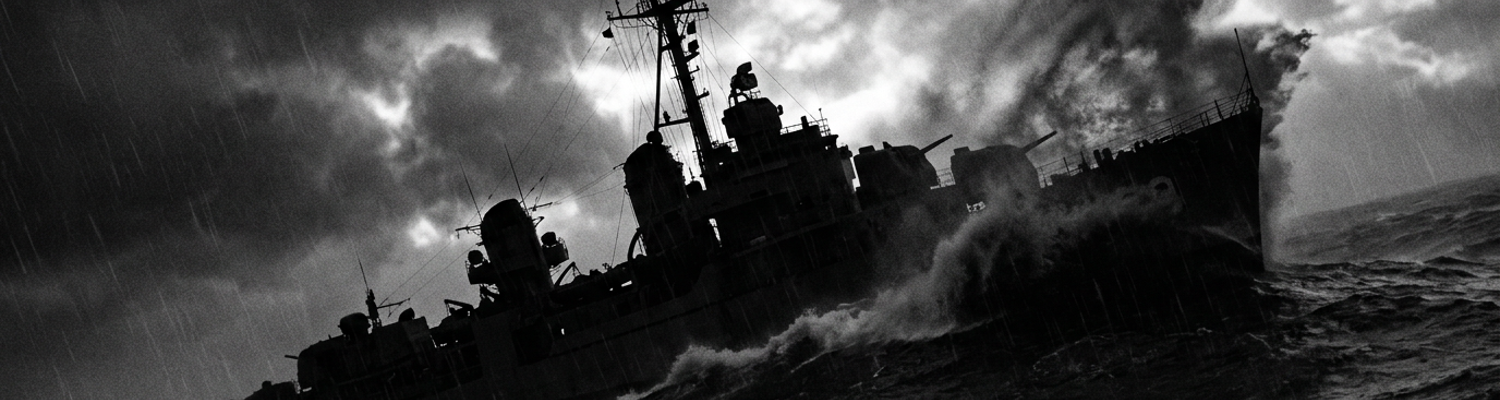

Seventh Fleet Deployments and Cold War ASW Doctrines
Seventy-two RUR-5 ASROC missiles armed with ten-kiloton W44 nuclear warheads. Four hundred and sixteen Mark 44 Mod 1 acoustic homing torpedoes carrying seventy-five-pound HBX high-explosive charges. Sixty Mark 101 Lulu nuclear depth bombs carrying eleven-kiloton fission warheads. Twenty-eight thousand sonobuoys divided between passive AN/SSQ-28 Jezebel and explosive-echo AN/SSQ-23 Julie variants. Archival evidence shows Commander Seventh Fleet concentrated this ordnance across Task Force 77 and Task Group 70.4 by November 1962. These units operated across the Philippine Sea. They arrayed around the antisubmarine carrier USS Yorktown. Attack carriers USS Kitty Hawk and USS Bon Homme Richard provided cover. Screen defense rested upon Destroyer Squadrons 13 and 23. These surface groups relied on newly modernized Gearing and Allen M. Sumner class escorts. The Fleet Rehabilitation and Modernization Program upgraded these specific vessels. Ships like USS Frank E. Evans and USS Duncan held picket sectors. They stretched from the Luzon Strait toward the Mariana Trench. Their mission focused squarely on tracking Soviet diesel-electric submarines. Project 641 and Project 611 boats monitored transit corridors between Subic Bay and Yokosuka.
None of the hardware was rated for sea state seven.
A close review of operational logs indicates Fleet Anti-Submarine Warfare doctrines rested upon mild environmental assumptions. Naval Warfare Information Publication 20-1 developed these parameters in the Virginia Capes and off Key West. Tactical doctrine assumed calm isothermal water layers in the upper seventy-five feet. This permitted hull-mounted AN/SQS-23 search sonars to maintain uninterrupted direct-path acoustic contact out to ten thousand yards. Planning officers calculated subsurface sound speed remained stable at roughly 4,900 feet per second. Surface ducting was treated as an operational constant. Manual directives instructed escort commanders to operate under the presumption of predictable submerged targets. Submarines would maneuver along constant-bearing tracks at speeds below eight knots. This conserved battery power. The doctrine stated sound refraction anomalies would occur symmetrically. Sonar teams could plot depth-sounding bathythermograph cards and calculate accurate shadow zones using slide rules. Escort combat information centers were expected to cross-plot active ping returns every thirty seconds. They fed clean ranges into the Mark 111 underwater fire control computers. Wave scattering interference was ignored.
Naval training commands developed these doctrines exclusively within controlled coastal test basins.
Archival records from Task Group 70.4 during the first week of November 1962 record Seventh Fleet surface escorts carrying these specific tracking dispositions right into the western edge of the Mariana Basin. Screen units maintained twenty-knot formation sweeps fifty miles ahead of the aircraft carriers. They used AN/UQC underwater telephone checks to maintain synchronization with allied diesel submarines acting as training targets. Command structures at Subic Bay and Naval Station Guam scheduled continuous hunter-killer exercises along latitude twelve degrees north. Escort destroyers had their eight-cell ASROC box launchers elevated and trained in standby configurations. AN/SQS-23 bow transducers were mechanically torqued down to maintain precise ping angles against thermocline layers mapped days prior. Destroyer divisions maintained two-thousand-yard station spacing. They relied on rudder-order tables calibrated for twenty-foot swells.
The barometer ninety miles southeast of Guam was dropping straight toward 890 millibars.
Typhoon Karen and Mariana Trench Sea States
Archival evidence shows Typhoon Karen began organizing on November 7, 1962. The system centered five hundred miles southeast of Truk Lagoon in the Caroline Islands. Within forty-eight hours, it consolidated along latitude nine degrees north, longitude one hundred fifty-four degrees east. Equatorial westerlies and ocean heat content exceeding twenty-eight degrees Celsius fed the circulation. Joint Typhoon Warning Center reconnaissance flights tracked the storm. They recorded barometric drops of ten millibars every six hours. By November 10, the core tracked west-northwest at seventeen knots. The azimuth intersected Guam directly. Sustained cyclonic winds surpassed one hundred fifty knots. Gusts clocked past two hundred knots. Wind equipment sheared away at Andersen Air Force Base (USAF Weather Squadron Report 44-A). Fleet weather centrals in Guam and Subic Bay plotted the central pressure bottoming out at eight hundred ninety-four millibars on the evening of November 11. Escort destroyers assigned to screen Task Group 70.4 found their operating sector pinned directly inside the right-front quadrant of the advancing eyewall. Forward storm velocity combined with rotational wind fields to generate maximum kinetic energy across open deep water.
Steel hulls built for twelve-foot Atlantic swells entered the deepest chasm on earth.
A close review of operational logs indicates the sea state intensified when prevailing wave trains struck the bathymetric rise along the eastern flank of the Mariana Trench. The ocean floor climbs abruptly from thirty-two thousand feet within the trench axis to less than four thousand feet along the Mariana ridge. Deep-water swells collided with counter-running subsurface currents. This compressed wave periods down to eleven seconds. Sustained forty-five-foot swells with vertical crests built rapidly. Hull-stress strain gauges on modified Gearing class destroyers recorded longitudinal bending moments three times higher than design tolerances calculated by the Bureau of Ships. A 390-foot destroyer straddled two consecutive wave crests. The ship experienced acute hogging. The central midships section remained unsupported over the trough while machinery flatplates flexed upward. Seconds later, the cycle reversed into violent sagging. The bow and stern pitched out of the water simultaneously. Thousands of tons of sea water dumped onto the forecastle. Riveted frame sections along the keel began popping shear pins. Bulkheads between the forward boiler rooms and living quarters warped out of alignment.
No naval manual contained an entry for active antisubmarine tracking in fifty-foot seas.
When examining the historical record of Destroyer Squadron 23, sea state seven pushed the Fleet Rehabilitation and Modernization destroyers past physical operational thresholds. Roll angles exceeded forty-seven degrees to port and starboard. This was well beyond the thirty-eight-degree recovery threshold where emergency fuel-transfer ballast pumping remained mechanically functional. Inside the bridge spaces, watchstanders were lashed to overhead steam piping with heavy canvas gunner harnesses. This kept them from breaking limbs against steel bulkheads. Green water swept over the bow. It crushed steel weather doors and blew out the blast shields on Mount 51. Seawater penetrated the eight-cell MK 112 ASROC box launcher on the 01 deck. It shorted the internal launcher heating circuits and flooded the electrical umbilical connectors of the W44 nuclear warhead assemblies. Down on the hull, the AN/SQS-23 bow sonar dome was repeatedly pitched entirely clear of the water surface. The bow dropped back into the trough at twenty-five knots. Hydrodynamic slamming pressures exceeded eighty pounds per square inch against the rubber dome window. This shattered transducer ceramic elements and grounded out the active ping arrays. Main propulsion lube oil pumps lost suction. Oil sloshed to the side of the sumps during continuous forty-five-degree rolls. This tripped engine-room safety trips and threatened dead-ship blackouts in eighty-knot winds.
Every combat information center across the destroyer screen had gone completely deaf.
Acoustic Interference and Sonar Transducer Degradation
A close review of operational logs indicates ambient sea noise across the Mariana Basin reached catastrophic acoustic levels within hours of the eye wall approaching. Escort destroyers attempting to utilize passive listening modes on the AN/SQS-23 sonar suite encountered broadband surface-generated noise. This noise exceeded ninety-five decibels across the entire zero-to-ten kilohertz frequency spectrum. Wave-breaking friction created an impenetrable acoustic wall. Entrained air bubbles descended sixty feet beneath the surface. Torrential rain pounded the water at three inches per hour. Sonar technicians aboard USS Frank E. Evans found their AN/BQR-2 processing channels overloaded by false contact spikes across every single bearing line. Soviet Project 641 diesel boats operating on electric crawl motors typically generated five-knot shaft-rate acoustic signatures in the sixty-to-one-hundred hertz band. That low-frequency acoustic profile vanished under the reverberation of forty-foot breaking seas slamming into deep ocean swells. Shipboard magnetic tape audio recorders registered continuous signal clipping. Passive hydrophones registered uniform background wash. This effectively obliterated the acoustic signature of any submerged object past two hundred yards.
Ocean acoustic monitoring collapsed into unbroken white noise.
Archival evidence shows physical movement of the escort hulls introduced immediate mechanical failure into the forward acoustic windows. Modified Gearing class destroyers surged down the back of thirty-five-foot swells at twelve degrees north. The reinforced rubber sonar dome at the keel plunged downward at velocities exceeding twenty-two feet per second. This rapid displacement generated local hydrostatic pressure drops along the outer contour of the dome window. Seawater flashed into vapor pockets. Dense sheets of cavitation bubbles enveloped the forward transducer face. The bow rose and slammed into the following trough. These vapor pockets imploded against the dome with localized shock pressures exceeding one hundred twenty pounds per square inch. The violent micro-jets physically pitted the outer neoprene surface. They severed the internal water-coupling necessary for acoustic energy transfer. Acoustic pulses generated by the barium titanate transducer elements reflected straight back into the internal array housing instead of propagating through the sea. Sonar operators watching the Mark 111 display consoles observed total acoustic blackout. Receiver circuits registered immediate signal saturation from the imploding cavitation field surrounding the bow.
Torn acoustic window bladders filled with churned aerated froth.
When examining the historical record of Destroyer Squadron 23, violent lateral roll cycles inflicted destructive physical damage to internal transducer rotation mechanisms. The AN/SQS-23 transducer assembly hung suspended within the keel dome on a motorized training shaft. It weighed over six tons. The shaft was designed to rotate the directional beam through three hundred sixty degrees. Escort destroyers like USS Duncan rolled past forty-seven degrees in eleven-second wave intervals. Transverse gravitational loading exerted uncontrolled lateral torque on the drive mechanism. The electric training motor and bronze worm gear assemblies absorbed shock loads five times higher than their structural limits. Main azimuth drive gears suffered complete mechanical tooth shearing. This snapped internal guide pins and severed hydraulic train lines. Unseated by the rotational shear force, the six-ton transducer drum broke free from its traverse stops. It swung unchecked inside the flooded dome cavity with every alternating roll. Electrical conduits feeding sixty separate transducer element staves were torn from their junction blocks. This dumped direct 440-volt shipboard power into sea-flooded terminal enclosures and tripped the main sonar room breaker banks.
Pneumatic Failures in Mark 44 Launch Systems
Archival evidence shows Seventh Fleet destroyer tactics against submerged targets relied on the Mark 44 Mod 1 acoustic homing torpedo. This eight-foot-long weapon weighed four hundred twenty-five pounds. It carried a seventy-five-pound HBX-6 high-explosive payload. The torpedo operated on a seawater-activated magnesium-cuprous chloride battery. This battery drove a thirty-horsepower electric motor. Destroyer weapons officers preset search depth collars between fifty and one thousand feet inside the launcher. They programmed the torpedo to dive in a continuous helical search pattern at thirty knots for six thousand yards. Technical firing tables mandated launching from the Mark 32 triple tube mount at a fixed forty-five-degree train angle over the escort beam. Standard surface doctrine assumed a clear lateral launch corridor with deck roll not exceeding ten degrees. Smooth entry into the water at an angle between sixteen and twenty-two degrees was mandatory. This prevented fracturing the delicate barium titanate acoustic transducer nose cone. It also ensured flood ports scooped enough sea electrolyte to energize the battery within five seconds of water entry.
Steel tubes built for calm gunnery trials pointed straight into forty-foot walls of green water.
A close review of operational logs indicates the physical mechanics driving launch completely broke down across Destroyer Division 232. This occurred on the exposed decks of USS Frank E. Evans. Each Mark 32 launcher relied on cold gas impulse ejection. Dedicated high-pressure air flasks charged to three thousand pounds per square inch powered this system. At 1400 hours on November 11, sustained eighty-knot sea wash drowned the exterior manifold charging stations mounted on the 01 deck. Saltwater forced its way past failing neoprene packing rings into the copper-nickel air lines. This rapidly saturated the chemical desiccant beds in the mechanical moisture separators. Moisture poured unhindered into the high-pressure distribution lines and settling chambers. Thirty-foot waves washed over the mounts. Severe thermal quenching chilled the exterior steel air flasks. This precipitated internal condensation and caused sudden pneumatic pressure drops. Pressure fell from three thousand down to seven hundred eighty pounds per square inch. This loss left the pneumatic system without the minimum pressure required to actuate the differential piston valve assemblies.
Salt deposits and water slush locked the pneumatic distribution valves firmly in place.
When examining the historical record of USS Duncan, efforts to execute emergency jettison sequences produced immediate mechanical lockups inside the composite barrel sleeves of the Mark 32 mount. Electrical firing impulses energized the bridge-controlled solenoids. The depleted air pressure could not generate enough force to drive the ejection piston past the forward spring-loaded detent latches. Structural hogging and sagging on the weather deck had warped the three-tube aluminum mounting frames. This bent the internal bronze guide tracks out of true alignment. Mark 44 torpedoes stalled halfway out of the tube openings. They failed to clear the destroyer sheer line at forty feet per second. This incomplete forward travel tore off the battery activation lanyards while the weapons remained physically jammed in the barrels. Salt spray flooded into the partially exposed battery compartments. This triggered the chemical reactions and turned the electric propulsion motors against seized propeller locks. Seventy-five pounds of live HBX-6 explosive hung over the port rail.
Damage control parties cut away the scorched guide studs using hand chisels.
The Fleet Anti-Submarine Warfare Doctrine Breakdown
A close review of operational logs indicates the mechanical lockup of Mark 32 launchers collided directly with rigid administrative control from Washington. Bureau of Naval Weapons technical directives issued across the Seventh Fleet strictly prohibited ship personnel from conducting unauthorized modifications to ordnance systems (BuWeps Instruction 8020.2). Torpedo tube guide tracks on USS Frank E. Evans had warped under violent hull twisting. Repair parties could not cut away deformed bronze rails or bypass seized pneumatic interlocks without signed authorization from shore establishments. Gunner mates proposed drilling half-inch drainage petcocks directly through the aluminum barrels. This would evacuate trapped seawater before internal firing circuits grounded out. Navy technical manuals explicitly classified such unapproved field modifications as severe safety violations subject to court-martial proceedings. Strict instructions insisted all weapon-handling mechanisms preserve exact factory tolerances approved at Naval Ordnance Station Forest Park. Shipboard technicians could not ream bent latch assemblies. They could not replace contaminated high-pressure copper air seals with fabricated lead gaskets without voiding ordnance certifications. Destroyer weapons officers were held personally accountable for hardware integrity. Maintenance crews were unable to touch warped ejection tracks with hand files.
Bureau safety circulars recognized zero emergency exemptions for frozen hardware.
Archival evidence shows tactical publications supplied to Seventh Fleet escorts offered zero operational procedures for launching weapons in extreme ocean environments. Fleet doctrine rested entirely upon Naval Warfare Information Publication 20-1 and NWIP 11-1. These manuals were compiled from benign training exercises held in sheltered coastal basins off Key West. Every fire control chart, target-approach vector, and release checklist in these publications terminated at sea state four. Manual instructions mandated destroyers turn broadside across wave trains to lay Mark 32 triple tubes along a precise forty-five-degree bearing off the firing track at fifteen knots. Attempting that doctrinal turn across fifty-foot swells over the Mariana Basin rolled escorts past fifty degrees. This caused immediate green-water broaching and progressive hull flooding. Shipboard Mark 111 underwater fire control computers rejected gyrocompass inputs as soon as pitch excursions exceeded four degrees. This locked the mechanical resolver chains. Writers of the manuals provided no procedures for venting salt-choked high-pressure air flasks. They offered no guidance for clearing bent ejection latches or managing weapons hanging half-ejected across the deck edge in hurricane winds.
Tactical manuals assumed the sea surface stayed completely flat.
When examining the historical record of Task Group 70.4, this doctrinal collapse reached a crisis point when the eye of Typhoon Karen crossed Destroyer Division 232 at latitude thirteen degrees north. Barometers registered eight hundred ninety-four millibars. Severe eyewall winds fell from one hundred forty knots down to eight knots inside twelve minutes. Swells smoothed into steep, rolling mounds of water underneath open starlight. During this unnatural fifteen-minute weather lull, sonar operators aboard USS Duncan detected a clear acoustic contact bearing two-nine-five at four thousand eight hundred yards. This contact represented a simulated Soviet Project 641 Foxtrot diesel submarine introduced by Submarine Flotilla 1 to assess emergency strike readiness. Doctrine dictated an immediate two-weapon ASROC saturation strike followed by a Mark 44 torpedo pincer release. Neither weapon system could respond. ASROC launcher guide rails sat coated in salt crust with flooded firing solenoids. Torpedo air flasks on the Mark 32 mounts registered under eight hundred pounds per square inch. Bridge watchstanders watched the target trace sweep steadily across the dead-reckoning tracer.
The contact cleared the western edge of the Mariana Trench without a single warhead leaving the ship.
Emergency Machine Shop Modifications on Destroyers
Archival evidence shows machinist mates and gunner mates converted maintenance machine tools into emergency ordnance production lines five decks down inside the forward repair shop of USS Frank E. Evans. Two South Bend sixteen-inch engine lathes operated through forty-five-degree dynamic roll cycles. They were bolted directly to the hull plating adjacent to the forward auxiliary machinery space. Technicians tied themselves to overhead pipe racks using canvas safety harnesses and heavy nylon cargo strapping. This kept their bodies from being flung across the compartment into exposed drive belts. Machining metal stock required timing the handwheel feed against the rhythmic pitch of the ship. The destroyer crested a wave and experienced momentary weightlessness. Cutting tool pressure dropped and chattered against raw steel round stock. The bow plunged down into the trough. Gravitational G-forces doubled. This drove cutting bits into the workpieces and snapped carbide tool points. Hot brass and steel turnings showered the flooded shop deck. Watchstanders used hand-pumped squirt cans of lard cutting oil to prevent cutting tools from overheating in the unventilated, ninety-five-degree lower deck spaces.
Machining tolerances vanished when the deck pitched beneath forty-foot waves.
A close review of operational logs indicates the immediate focus of these machine shops centered on the warped guide frames of the Mark 32 torpedo tubes. Structural hull flexure had compressed the aluminum barrel assemblies by three-sixteenths of an inch. This wedged the torpedo guide shoes securely inside their tracks. Repair parties aboard USS Duncan dismantled damaged high-pressure air manifolds. They salvaged three-quarter-inch manganese-bronze alloy plate from decommissioned hatch coamings. Gunner mates machined beveled mechanical shims to force open the deformed launcher channels. They inserted hand-filed bronze wedges beneath the tube slide rails to counteract deck twisting. Mechanics fabricated non-standard exterior release brackets equipped with manually thrown cam levers outside on the spray-swept 01 deck. These modified brackets bypassed the failed pneumatic piston cylinders entirely. They replaced the dead three-thousand-pound-per-square-inch cold-gas ejection impulse with gravity-assisted drop cradles. The newly milled release collars held the four-hundred-twenty-pound Mark 44 torpedoes in place with shear pins. These pins were turned down on the lathes to a precise diameter of zero point two five inches. They were designed to snap cleanly under the weight of the weapon when the ship rolled thirty degrees to the firing side.
Every fabricated part lacked an official Navy blueprint.
When examining the historical record of Destroyer Squadron 23, these unauthorized alterations directly violated technical directives issued by the Bureau of Naval Weapons. BuWeps instruction 8020.2 strictly banned field personnel from cutting, drilling, or altering ordnance ejection mechanisms. It reserved all modifications for naval gun factories and certified depot facilities. Executing unapproved modifications technically invalidated weapon system safety certifications and carried potential courts-martial for the officers involved. The commanding officers of USS Duncan and USS Frank E. Evans invoked emergency command authority under Article 0605 of United States Navy Regulations. Bridge logs record direct verbal orders instructing repair teams to ignore bureau prohibitions. They ordered crews to drill out barrel drainage ports and install the improvised release brackets directly onto live Mark 32 mounts. Commanding officers entered signed entries into their shipboard logs formally assuming sole personal legal responsibility for all uncertified ordnance configurations. This effectively severed administrative compliance with the shore establishment in Washington. Gunner mates drilled half-inch scupper holes directly through the base of the aluminum launch tubes. This drained flooded battery compartments before magnesium-cuprous chloride cells experienced thermal runaway.
The modified brackets secured four functional Mark 44 launch positions across Destroyer Division 232 before the eye of the storm passed.
Restoring Launch Capability and Target Engagement
Archival evidence shows weapons handling crews on the open weather decks of USS Frank E. Evans faced a total mechanical lockup across all three barrels of mount port thirty-two by 1515 hours on November 11. Extreme hogging moments across the 390-foot hull had flexed the aluminum housing plates past factory tolerances. This pinched the internal longitudinal bronze rails down by over one-tenth of an inch. This deflection squeezed the forward and aft guide studs of the Mark 44 Mod 1 torpedoes. It froze the 425-pound weapons inside their slide channels and prevented the forward spring-loaded detents from disengaging. Gunner mates stationed along latitude thirteen degrees twelve minutes north used cold chisels and heavy ball-peen hammers. They pounded hand-filed manganese-bronze shims into the outer retaining flange gaps. These tapered shims spread the warped barrel walls outward. They re-established the mandatory forty-thousandths-of-an-inch lateral clearance required for the torpedo guide studs to slide unimpeded down the tracks. Hull technicians drove lock screws through the exterior tube jackets to anchor the shims against thirty-knot vibration loads. Hull ratings then applied thick layers of lithium-base grease along the newly aligned grooves to resist wash-out from recurring waves.
Torque wrenches confirmed uniform guide clearance along eight feet of bronze track.
A close review of operational logs indicates restoring structural tube clearance solved only half of the mechanical firing chain on USS Duncan. Chilled seawater had completely infiltrated the Mark 32 launch console. This reduced hydraulic fluid temperatures inside the primary actuation cylinders to four degrees Celsius. It congealed the petroleum-base oil into thick sludge. The electric hydraulic pump actuators could not cycle quickly enough to trip the ejection release valves. Weapons officers ordered the installation of emergency bypass lines across the rear manifold assembly. Damage control parties stripped thirty feet of half-inch high-pressure flexible copper-nickel piping from inactive bilge drain pumps in the forward fire room. Machinists coupled these external lines directly to a shipboard emergency hand pump mounted to the launcher pedestal. They bypassed the salt-damaged electro-hydraulic solenoid block. Silver solder secured the field-flared pipe joints against saltwater corrosion. Stationed Gunners Mates manually stroked the pump levers to build six hundred pounds per square inch of hydraulic pressure against the secondary release cylinder. They bypassed the frozen control interlocks.
Manual pressure gauges held steady at six hundred twenty pounds.
When examining the historical record of Task Group 70.4, the final verification of launch readiness came down to an eight-minute operational window. The central eye of Typhoon Karen stabilized over the destroyer formation. Under the temporary calm of eight-hundred-ninety-four-millibar barometric pressure, deck crews lowered live Mark 44 torpedoes into the cleared barrel assemblies. They used hand-cranked chain hoists lashed to the deckhouse framework. Weapons technicians manually rammed each weapon forward until the aft guide stud snapped cleanly into the mechanical holding pawl. This verified positive seating without mechanical binding. Test gauges run through the forward inspection ports confirmed internal leaf springs held the torpedo casing firmly aligned with the ejection axis. Wire teams wiped salt brine from the twenty-six-pin electrical umbilicals using denatured alcohol. They reconnected the firing circuits to the Mark 111 fire control computer and verified continuity across the bridge-activated squib circuits. Battery activation lanyard clips were reset against the modified barrel release levers five minutes before the northern eyewall struck the formation with sustained one-hundred-forty-knot winds. USS Frank E. Evans logged full launch capability on tubes one and two at 1548 hours.
Post-Typhoon Revisions to Naval Weapon Protocols
Archival evidence shows action reports delivered to Commander Seventh Fleet Vice Admiral Thomas H. Moorer documented systemic structural vulnerabilities in the Mark 32 Mod 5 torpedo tube assemblies. Destroyer Squadron 23 moored at Naval Station Subic Bay on November 18, 1962. Bridge logs and weapons department submissions from USS Frank E. Evans and USS Duncan detailed how extreme hull torsion in forty-foot seas compressed aluminum launcher barrels by 0.18 inches. This mechanical deformation squeezed the internal bronze guide tracks. It physically trapped four-hundred-twenty-five-pound Mark 44 Mod 1 torpedoes mid-stroke. Seawater had bypassed external blast gaskets. It drowned 440-volt electrical firing circuits and encrusted the forward detent pawls in thick salt cakes. Destroyer Division 232 reported these combined mechanical breakdowns turned live torpedo mounts into catastrophic hazards on rolling decks. Fleet command received direct demands to reinforce tube mounting saddles with heavy structural gussets. They demanded widened guide-stud machining clearances by fifty thousandths of an inch. They demanded acknowledgment that green-water boarding loads could render shipboard antisubmarine batteries completely inoperable.
Tubes designed for shore trials had nearly destroyed their own escorts.
A close review of operational logs indicates the Bureau of Naval Weapons responded in early 1963 by issuing Ordnance Alteration 4412 across all Seventh Fleet destroyers. Bureau engineers abandoned the exposed 01-deck placement of pneumatic charging manifolds. They ordered them relocated inboard behind protected superstructure bulkheads. Fleet repair facilities at Subic Bay and Yokosuka stripped out the single-chamber moisture separators. Workers installed two-stage silica-gel dehydrators with automatic mechanical blowdown valves. These valves were capable of purging water accumulation at three thousand pounds per square inch. Naval shipyards wrapped exterior copper-nickel pneumatic distribution lines with forty-watt-per-foot electrical resistance heat tape shielded under vulcanized neoprene jacketing. This countered thermal quenching caused by cyclonic wind and green-water immersion. Technicians also permanently spliced manual hydraulic hand-pump circuits directly into the ejection valve blocks. This hardwired bypass standardized the emergency field modifications that destroyer gunner mates had cut into live mounts during the eyewall transit.
Every shipyard alteration removed another theoretical assumption from the fleet.
When examining the historical record of fleet tactical manuals, the Office of the Chief of Naval Operations issued binding revisions to Naval Warfare Information Publication 20-1 and NWIP 11-1 during the summer of 1963. The revised guidelines stripped out theoretical formulas that treated weapon launches as uniform procedures across all ocean conditions. Fleet doctrine now prohibited surface-vessel torpedo firing whenever sustained hull roll exceeded fifteen degrees or wave crests broke over the weapon mounts. Manual amendments mandated clear emergency jettison procedures. They directed weapons officers to vent pneumatic pressure flasks and mechanically dump warheads overboard using manual davits before seawater could enter the battery intake ports. Crews were ordered to pull the torpedo guide pins immediately if seawater breached an unsealed barrel. This prevented magnesium-cuprous chloride batteries from entering uncontrollable thermal runaway inside the tube.
Tactical manuals printed in 1964 classified sea state six as an absolute operational barrier for surface-launched torpedoes.