
Fort Belvoir Engineering and Design Parameters
During the first quarter of 1968, United States military units in III Corps documented 4,118 non-combat hospital admissions directly tied to waterborne enteric diseases. Combat engineer battalions in the Saigon basin lost thirty-one percent of their organic water production apparatus to mechanical attrition. Archival records from the Engineer Research and Development Laboratories at Fort Belvoir show the Erdlator entered development under specifications drawn up for atomic-era European combat. Army field commanders in 1948 wanted rapid decontamination capabilities for mobile armored columns countering Soviet tank divisions across the North German Plain. Equipment specifications mandated that the apparatus neutralize radioactive particulate, biological spores, and persistent blister agents within temperate river systems such as the Rhine, Fulda, and Weser. Mobility parameters dictated that a single two-and-a-half-ton M35 truck could tow the machinery. Crews had to deploy operational lines within forty-five minutes. They needed to break down before enemy counter-battery radar pinpointed the internal combustion engine exhaust.
European operational assumptions dictated the mechanical layout.
A close review of operational logs indicates that the standard 1,500-gallon-per-hour model functioned around an upflow solids-contact clarifier tank. Raw water entered a central conical reaction well via a gasoline-powered intake pump. It received simultaneous injections of powdered calcium carbonate, coagulant chemicals, and calcium hypochlorite. Mechanized agitator impellers stirred the chemical slurry at fixed rotations per minute. This developed a suspended floc blanket. Influent passed downward under a skirt baffle. It then pushed upward through this suspended blanket of chemical solids. The solids trapped physical particulates through mechanical filtration and chemical sorption. Clarified effluent poured over peripheral radial collector launders at the tank rim. It moved directly into pressurized diatomaceous earth filter septa. Technical manuals (Department of the Army Technical Manual 5-4610-208-14) specified that this hydrodynamic equilibrium depended on constant water density. Settling velocities had to remain uniform. Surface water temperatures needed stabilization between forty and sixty degrees Fahrenheit.
The machinery was built for the cold rivers of the West German border.
When deployed to forward bases such as the engineer landing at Phu Cuong along the Song Saigon, this hydrodynamic balance shattered. Silt-laden monsoon runoff drove the river turbidity past 1,200 Jackson Turbidity Units. Raw intake lines filled with abrasive laterite clay, decaying vegetation, and tidal estuarine mud. Chemical feeding systems designed in Virginia proved unable to handle this volume of suspended solids. The mechanical hoppers feeding dry ferric chloride into the reaction cone required low humidity to prevent chemical agglomeration. Relative ambient humidity along the riverbank consistently exceeded ninety percent. Dry coagulant salts absorbed atmospheric moisture directly through the sheet-metal hopper covers. Caking occurred inside the vibrating trays within minutes. Hardened ferric chloride blocks repeatedly sheared the mechanical drive pins. They stripped the reduction gear teeth. They jammed the chemical feed gates.
Deprived of precisely calibrated coagulant ratios, the suspended sludge blanket inside the clarifier tank collapsed into the raw stream. The resulting uncoagulated red mud bypassed the settling zones entirely. It surged into the diatomaceous earth filters and blind-caked the woven wire septa under excessive hydraulic backpressure. Pressure differential gauges pegged into the red zone within fifteen minutes of pump startup. Filter bags ruptured. Crews from the 588th Engineer Battalion dumped millions of gallons of contaminated river water directly back into the bypass channels.
Deployment along the Song Saigon
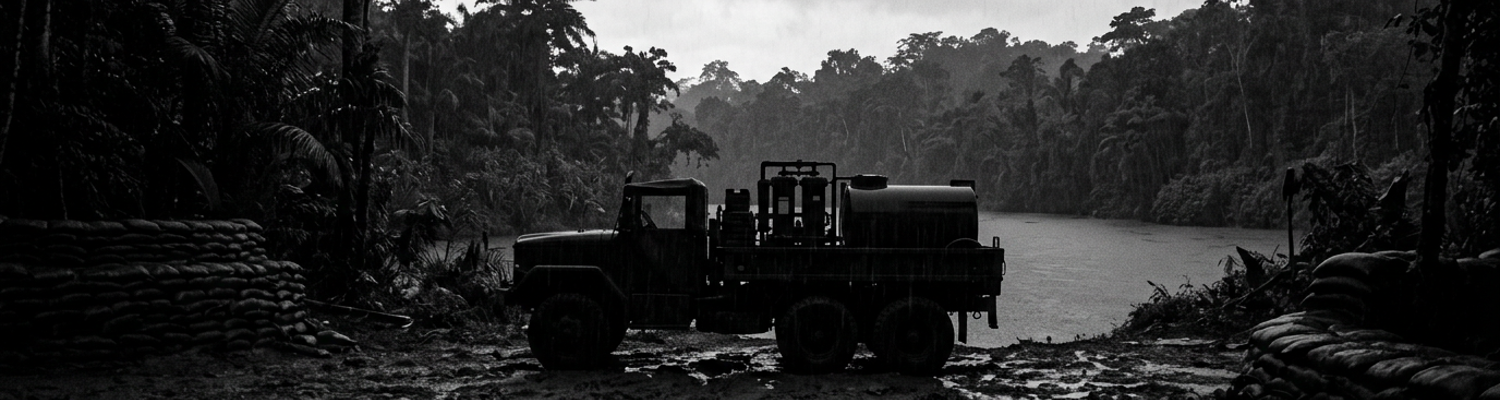
Archival evidence shows that in May 1968, Company A of the 588th Engineer Battalion established a dedicated riverine water extraction perimeter north of the Phu Cuong pontoon bridge. The map coordinates were XT 815 142. Tactical commanders situated three truck-mounted Erdlator assemblies inside semicircular sandbag revetments. These revetments were cut into a red laterite bluff thirty feet above the riverbank. Battalion mechanics drove timber piles into the tidal mud to secure floating intake barges constructed from interlocking aluminum balks. Gasoline-driven Gorman-Rupp centrifugal intake pumps rested directly on these pontoons. Weighted foot valves submerged into twelve feet of turbulent brown current. Engineers strung anchored log booms upstream to deflect drifting bamboo rafts and combat debris. Diurnal tidal fluctuations exceeding eight vertical feet pulled the intake strainers directly across alluvial silt beds. Hostile rifle teams from the Viet Cong 4th Sub-Region harassed the exposed pontoons with intermittent small-arms fire from tree lines on the western shore. Operators routed four-inch reinforced rubber suction hoses up the forty-five-degree bluff. They fought chronic pump cavitation whenever receding waters dropped river levels below the intake impellers.
The river conditions disabled the machinery within forty-eight hours.
A close review of operational logs indicates that seasonal monsoon squalls across Binh Duong province flushed thousands of tons of decomposing vegetation, forest humus, and suspended laterite clay into the water supply. Turbidity readings spiked past 1,400 Jackson Turbidity Units. The raw intake stream filled with abrasive suspended solids that overwhelmed the internal chemical feed systems. Dry chemical delivery systems failed. They were calibrated at Fort Belvoir for granular alum and dry soda ash. Ninety-five percent ambient humidity turned the powders into paste before they ever reached the liquid slurry tanks. The Erdlator internal brass chemical injection lines measured three-eighths of an inch in diameter. They blocked repeatedly when raw river tannins interacted with the concentrated ferric chloride coagulant. Dense precipitation choked the small-diameter orifices. It pinned the ball-check valves against their seats. Chemical feed pumps groaned under hydraulic resistance. Fractional-horsepower electric motors burned out within four hours of continuous pumping. Without regular chemical feeds to initiate coagulation, suspended colloidal sediment bypassed the reaction cone entirely. The clarification vessel transformed into a reservoir of stagnant sludge.
Factory replacement assemblies never reached the company motor pool.
When examining the historical record of depot supply manifests at Long Binh, field engineers discovered an absolute deficit of standard Erdlator repair kits. Supply chains prioritized cold-climate rubber seals rather than tropical slurry components. Maintenance crews inside the 588th Engineer Battalion kept the primary upflow clarifiers turning through relentless improvised machining. Machinists set up field lathes in the back of five-ton maintenance vans. They turned down spent 105-millimeter brass artillery shell casings into custom spray nozzles and threaded chemical pipe fittings. Operators cut out clogged copper lines. They clamped five-sixteenths-inch automotive rubber fuel lines stripped from wrecked M35 transport trucks directly onto the chemical injection ports. Soldiers rotated on round-the-clock maintenance watches to prevent total sedimentation within the upflow tanks. Crews disassembled the agitator assemblies twice per shift. They cleared stringy river weed from the reduction gears by hand. They scraped laterite paste from the cone baffles with bayonets. They flushed the bottom sludge drain cock with pressurized river water tapped off an auxiliary fire pump. Mechanics also ground down scrap leaf springs from utility trailers to fabricate replacement scraper blades. They bolted them to the rotating clarifier arms with threaded rebar pins. By July, every operating clarifier in Company A ran on scavenged truck parts.
Mortar Harassment and Administrative Strain at Phu Cuong
Archival evidence shows that following the January 1968 Tet Offensive, civilian displacement across Binh Duong province overwhelmed municipal infrastructure along the Song Saigon corridor. More than eighteen thousand refugees moved into makeshift encampments surrounding the Phu Cuong airstrip. Water production quotas assigned to Company A of the 588th Engineer Battalion rose from twelve thousand gallons per day to a continuous demand exceeding forty-five thousand gallons. Combat engineers ran their three truck-mounted Erdlators twenty-two hours per day. They filled an unbroken shuttle of 1,200-gallon M149 water trailers and Vietnamese municipal fire trucks. Laterite silt, human waste, and petroleum runoff from combat zones upstream plugged the diatomite filter septa every forty-five minutes. Operating crews worked double shifts in the open sun. They hand-washed the clogged septa elements with wire brushes and kerosene to keep the potable distribution manifolds pressurized. Untreated river water carried high concentrations of Vibrio cholerae and Entamoeba histolytica cysts. Any production shortfall immediately triggered disease outbreaks throughout the squalid civilian perimeter.
Chlorine demand spiked wildly each afternoon. Tidal backwash pushed raw municipal sewage north against the intake strainers.
A close review of operational logs indicates that Viet Cong gunners from the Phu Loi local force battalion capitalized on these fixed distribution stations situated along the exposed river flat at coordinate XT 815 142. Enemy spotters positioned in the rubber trees across the western shore zeroed their Soviet-manufactured 82mm Type 53 mortars directly onto the loud Gorman-Rupp centrifugal intake pumps. Fragmenting high-explosive mortar rounds exploded across the open-air water point at erratic fifteen-minute intervals. Jagged steel shrapnel shredded two 3,000-gallon collapsible rubber fabric storage bladders on March 14. This dumped six thousand gallons of treated water across the red mud inside thirty seconds. Inside the revetment, flying fragments punched twenty-two holes through the unarmored sheet-steel clarifier shell of Erdlator unit three. The blasts severed internal copper hydraulic lines and detonated the small air compressor running the pneumatic slurry discharge valve. Soldiers bolted scavenged boiler plate directly onto the engine cowlings with hand-cut brackets to deflect blast splinters. They refused to cease purification cycles while shrapnel slashed through canvas distribution hoses ten feet away.
Engineers patched shredded pump lines under ongoing blast impacts using bailing wire and tire vulcanizing cement.
When examining the historical record of MACV Civil Operations and Revolutionary Development Support, administrative conflict escalated between combat engineers and visiting civilian-military advisory teams during the height of these mortar barrages. CORDS field inspectors arrived unannounced at the Phu Cuong landing during April to audit consumption records for potable chemical supplies. Provincial advisers discovered immediate discrepancies between the gross tonnage of calcium hypochlorite and coagulant salts delivered from the Long Binh depot and the exact gallonage recorded in the company chemical expenditure ledgers. Ninety-five percent relative humidity had soaked the fifty-pound multiwall paper bags of granular calcium hypochlorite. This turned dry oxidizer crystals into heavy saturated cakes that weighed twenty percent more than factory specifications while losing half their chemical potency. Official citations penalized the engineer detachment for accounting negligence. They cited the battalion for suspected black-market leakage and administrative diversion of controlled chlorination compounds.
Bureaucratic citations accumulated while soldiers filled sandbags to protect the remaining chemical drums from mortar blasts.
First Lieutenant operational watch reports reveal that company officers repeatedly explained how physical humidity gain caused ledger variances during active fire missions. Inspecting officers rejected these technical field explanations. They demanded daily balance sheets down to the individual pound before authorizing additional replacement coagulants from depot stocks. Water team sergeants bypassed the formal paperwork chain. They bartered diesel fuel and capture-tag weapons to local transportation units in exchange for uninventoried sacks of dry alum. Production continued without authorized depot replenishment. The unit relied entirely on off-book chemical exchanges executed while shrapnel whistled over the revetment walls.
Expedient Field Modifications and Ballistic Protection
A close review of operational logs indicates that during late July 1968, Company A of the 588th Engineer Battalion began field-modifying the Erdlator units at map coordinates XT 815 142 to survive persistent shrapnel damage. Standard factory assemblies arrived from Fort Belvoir with upflow clarifier hulls formed from fragile fourteen-gauge carbon steel. These hulls measured barely eighty-three thousandths of an inch thick. Soviet-made eighty-two-millimeter mortar fragments regularly perforated these unarmored cones. The impacts sprayed thousands of gallons of chemically treated water into the mud and disabled internal agitating paddles. Mechanics at the Phu Cuong perimeter scavenged quarter-inch high-hardness ballistic steel plates from the hulls of disabled M113 armored personnel carriers abandoned along Route 13. Armed with oxyacetylene cutting torches, company welders sliced the salvaged armor into curved rectangular segments. They heated the plates over open diesel fires to hand-hammer them against curved wooden forms. Maintenance teams welded these quarter-inch steel sections directly around the perimeter of the exposed clarifier tanks. They secured the armor to the Erdlator frame with structural angle iron brackets and continuous bead welds.
The added armor crushed the rear leaf springs of the carrier trucks into flattened iron bars.
Archival evidence shows that weapon vibrations and mortar concussions destroyed the precision fluid dynamics engineered into the chemical delivery train. Factory specifications mandated three-eighths-inch annealed copper chemical injection lines coupled to borosilicate glass rotameters and delicate diaphragm proportioning pumps. The small-bore copper lines choked on thick laterite silt. Ground shock from mortar impacts repeatedly shattered the thin glass sight gauges. Company A machinists stripped out the factory chemical feed trees down to the clarifier wall couplings. In their place, technicians plumbed ruggedized bypass systems using heavy one-inch schedule 40 threaded galvanized water pipes and wire-braided hydraulic hoses cannibalized from damaged five-ton dump trucks. Mechanics mounted manual gate valves directly onto the intake manifold. They bypassed the electric proportioning units entirely and vented chemical slurries straight into the central cone through gravity-fed lines.
Glass sight tubes disappeared from company supply requisitions by August.
When examining the historical record of depot distribution, regular shipments of specified coagulants ceased arriving from the Long Binh logistical complex after ambushes closed provincial supply routes. This included anhydrous ferric chloride and powdered coagulant aid. Saturated monsoon air had already turned the remaining battalion stocks of dry coagulants into solid insoluble chemical bricks inside their paper sacks. Company officers avoided system shutdowns by deploying procurement teams into Thu Dau Mot and the Cholon commercial district of Saigon. Engineers purchased commercial-grade potassium alum and unrefined aluminum sulfate crystals from Chinese merchant warehouses and private French rubber processing depots. Back at the Phu Cuong water point, soldiers poured the crushed alum lumps into halved fifty-gallon petroleum drums. They stirred the acidic liquid with wooden paddles while adding bags of local slaked lime to balance pH levels. Operators calculated dosages through visual inspections of floc formation along the clarifier rim. They dumped the raw alum solution through the top of the bypass piping by hand to maintain forty-five thousand gallons of daily output. Chemical consumption climbed to forty-two pounds of raw commercial alum per ten thousand gallons treated. This accelerated galvanic corrosion that pitted the inner tank steel within twelve weeks.
Obsolescence and Transition to Reverse Osmosis
Archival evidence shows that after-action analyses compiled by the Army Mobility Equipment Research and Development Center in 1972 documented a crippling supply footprint directly tied to the Erdlator chemical-dependent clarification architecture. Operating a standard 1,500-gallon-per-hour unit at maximum daily output consumed 120 pounds of anhydrous ferric chloride, 80 pounds of pulverized calcium carbonate, and 60 pounds of diatomaceous earth every twenty-four hours. Supply lines choked under this dead weight. Multiplied across an infantry division operating four extraction points, tactical sustainment convoys hauled more than eight tons of volatile chemical reagents each month to sustain troops. Tropical transport destroyed this cargo. High ambient humidity penetrated multiwall paper sacks inside transit depots at Cam Ranh Bay and Long Binh. This turned dry coagulants into solid uncrushable slag before supply trucks reached forward perimeters. Upflow clarification demanded unbroken chemical precision. Specialized technicians performed jar tests every two hours to reset dosing pumps against rapid swings in river turbidity. A fifteen-minute drop in raw water alkalinity collapsed the suspended sludge blanket. This forced operators to shut down production, purge the conical tank, and scrape fouled filter septa with wire brushes.
Chemical bulk reagents immobilized the forward engineer companies.
A close review of operational logs indicates that the United States Army Training and Doctrine Command initiated an absolute departure from chemical coagulation in 1976. They directed Fort Belvoir engineers to develop solid-state physical separation platforms. By 1979, testing programs finalized the baseline for the trailer-mounted 600-gallon-per-hour Reverse Osmosis Water Purification Unit. This was designated the ROWPU. It was engineered around high-pressure spiral-wound thin-film composite membranes. Raw water no longer required chemical conditioning inside an agitating conical vessel. Diesel-driven triplex plunger pumps drove raw influent through synthetic polyamide membranes under hydraulic pressures exceeding eight hundred pounds per square inch. This mechanically stripped out suspended solids, dissolved salts, and biological pathogens down to two-tenths of a nanometer. Complex proportioning gearboxes, chemical agitator motors, pneumatic sludge valves, and diatomaceous earth slurry tanks vanished from tactical engineer doctrine. The new units handled brackish estuarine currents, nuclear fallout runoff, and dissolved chemical agents without delicate flocculation blankets. Field evaluations at Fort Story demonstrated that two operators running a trailer-mounted ROWPU produced potable water within forty-five minutes of arrival. They required zero coagulant replenishment.
Pressure replaced chemistry.
When examining the historical record of Tables of Organization and Equipment across active engineer battalions, the Department of the Army systematically purged mechanical upflow clarifiers between 1982 and 1989. Combat engineer companies that operated truck-mounted Erdlator assemblies along river systems in Southeast Asia transferred their surviving clarification cones directly to scrap yards at Anniston Army Depot and Sharpe Army Depot. The 588th Engineer Battalion, alongside division engineer units like the 1st Engineer Battalion and the 8th Engineer Battalion, deleted the equipment from active property books. They replaced them with factory-fresh 600-gallon-per-hour ROWPU trailers and five-ton tactical transport chassis. Table of Distribution and Allowances modifications reassigned water teams to direct-support supply companies. This removed mechanical water production from organic combat engineer work packages. Department of the Army Supply Bulletin 700-20 formally strike-listed the 1,500-gallon-per-hour and 3,000-gallon-per-hour Erdlator variants by October 1990. During the rapid force buildup of Operation Desert Shield that autumn, central logistical commands deployed more than two hundred ROWPU complexes into the Persian Gulf theater. Not a single Erdlator clarifier entered the port of Dammam.