
A Global War on Commerce
The American Civil War was not confined to the battlefields of Virginia or the Mississippi River. It was a global conflict fought on the high seas, a war of economic attrition where the Confederacy, lacking a conventional navy, unleashed a campaign of commerce raiding. This strategy, a modern application of the old French concept of guerre de course, aimed to cripple the Union’s merchant marine, inflate maritime insurance rates to unsustainable levels, and compel Union Secretary of the Navy Gideon Welles to divert warships from the vital coastal blockade. Confederate Navy Secretary Stephen Mallory, operating with a nonexistent industrial base, understood he could not match the Union ship for ship. Instead, he dispatched skilled agents like James Dunwoody Bulloch and Matthew Fontaine Maury to neutral Great Britain. These men exploited loopholes in British neutrality laws to commission fast, modern cruisers from British shipyards. These vessels were built for speed and endurance, designed to outrun Union warships while being powerful enough to overpower unarmed merchantmen.
The most destructive of these raiders was the CSS Alabama. Built in secret by John Laird Sons and Company in Birkenhead, England, the ship was initially known as Hull Number 290. It slipped out of Liverpool on July 29, 1862, under the guise of a trial run, narrowly evading the frantic diplomatic efforts of US Minister Charles Francis Adams to have it impounded. At a rendezvous in the Azores, she took on her armament, supplies, and her commander, Captain Raphael Semmes. Semmes, a veteran U.S. Navy officer who had resigned his commission, was an experienced practitioner of this disruptive naval warfare. Over a devastating 22-month career, the Alabama captured or burned 65 Union vessels, costing an estimated $6 million and sowing panic across global shipping lanes. The success of the Alabama and other raiders like the CSS Florida and CSS Shenandoah forced Welles to detach squadrons in a frustrating, globe-spanning hunt that stretched Union naval resources to their breaking point.
Designing the Commerce Destroyer's Nemesis
To counter this threat, the Union Navy needed its own specialized hunters. The USS Kearsarge, a Mohican-class steam sloop-of-war, was a product of the emergency shipbuilding program initiated at the war’s outset. Laid down in 1861 at the Portsmouth Navy Yard in Kittery, Maine, and commissioned on January 24, 1862, the Kearsarge was a 1,550-ton vessel designed for sustained, long-range pursuit. Her hull combined the endurance of a sailing ship with the power of a 400-horsepower steam engine that could drive her at a respectable 11 knots. This hybrid propulsion was essential for the logistical challenges of operating for years in foreign waters, far from reliable coaling stations.
Her armament was formidable for her class, centered on two powerful 11-inch Dahlgren smoothbore pivot guns. These massive cannons, nicknamed "soda bottles" for their distinctive shape, were designed by Rear Admiral John Dahlgren to withstand higher pressures, allowing them to fire heavy shells with devastating accuracy. The main battery was supplemented by four 32-pounder guns and a 30-pounder Parrott rifle. While the Kearsarge was well-armed, her captain, John Ancrum Winslow, took an additional, clever precaution. Winslow, a North Carolina native who remained loyal to the Union, had taken command in April 1863. During a stop in the Azores, he had workers drape 720 feet of heavy, single-link iron anchor chain vertically along the sides of his ship, protecting the vital engine spaces. This makeshift armor, weighing over 20,000 pounds, was then concealed with one-inch thick wooden planks painted black to match the hull, a deception that rendered the ship's most vital area visually indistinguishable from any other sloop. This improvisation would prove decisive.
Winslow was a driven, professional officer who had once shared a cabin with Raphael Semmes during their service together in the pre-war U.S. Navy. His assignment to the Kearsarge came after a serious injury from a burst chain link earlier in the war had cost him the use of one eye. Tasked with hunting Confederate raiders in European waters, he instilled a fierce discipline in his crew of 163 sailors. For over a year, he and his men patrolled the eastern Atlantic, from the coasts of Spain and France to the British Isles, gathering intelligence, chasing false leads, and maintaining their vessel in a constant state of readiness. Winslow relentlessly drilled his gun crews, ensuring their gunnery was fast, precise, and deadly.
The Long Pursuit Across the Atlantic
The hunt for the CSS Alabama was an exercise in patience and frustration. For nearly two years, Semmes led Union warships on a chase that spanned from the North Atlantic to the Caribbean, the coast of Brazil, and even into the Indian Ocean and the South China Sea. The vastness of the oceans and the lack of rapid communication made finding a single ship a monumental task. Union captains relied on month-old newspapers, consular reports from agents in foreign ports, and dockside rumors to try and predict the Alabama’s next move. Welles organized dedicated "flying squadrons" whose sole purpose was to track and destroy the handful of Confederate cruisers, but they were consistently outmaneuvered by Semmes, who rarely stayed in one place for long.
The Kearsarge spent months on this duty, enduring the monotony of blockade and patrol from its base in Cadiz. The operational challenges were immense. Neutral ports offered limited hospitality, often strictly enforcing rules that allowed warships to take on just enough coal to reach their nearest home port, a rule that heavily favored the raiders who had no home port to return to. Maintaining crew morale and ship readiness during such a prolonged and often fruitless deployment was a significant test of command. While Semmes was racking up prizes and becoming a notorious figure in the international press, Winslow and the Kearsarge were a slow, methodical, and determined countermeasure, a symbol of the Union’s industrial and naval resolve closing in.
The Duel Off Cherbourg
On June 11, 1864, the CSS Alabama, worn out from her long campaign, put into the port of Cherbourg, France, for a much-needed overhaul. Her hull was fouled with marine growth, her machinery was in disrepair, and her gunpowder had degraded from dampness. News of her arrival traveled fast via telegraph. On June 14, the USS Kearsarge appeared off the harbor entrance. Trapped and with his ship’s fighting ability likely to degrade further with a long internment, Semmes made a fateful decision. He issued a direct challenge to Winslow for a single-ship duel. Winslow accepted and moved his ship into international waters to await his opponent, using the intervening days to ensure his ship and crew were perfectly prepared.
On the morning of Sunday, June 19, 1864, the Alabama steamed out of Cherbourg, escorted by the French ironclad Couronne to ensure the fight occurred outside French territorial waters. Crowds of spectators gathered on the French coast and in small boats to watch the spectacle. Winslow, ever the tactician, steamed further out to sea, drawing the Alabama about seven miles from shore to prevent any attempt by Semmes to run back to the safety of neutral waters. At 10:57 AM, the Kearsarge came about and closed with her adversary.
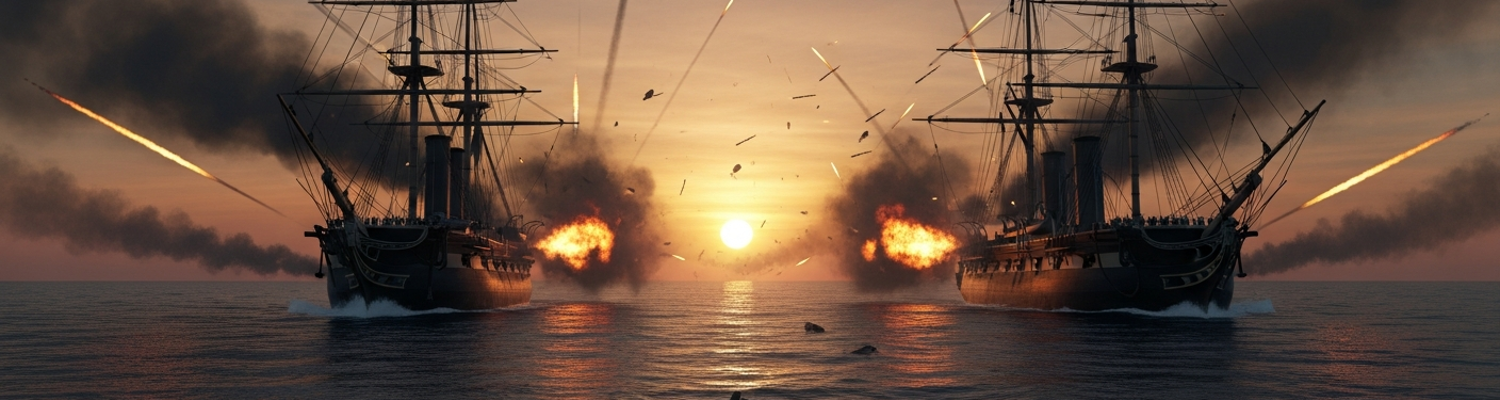
The Alabama opened fire first, at a range of about one mile. Her gunnery was rapid, firing over 370 rounds during the engagement, but it was also wild and ineffective. Many shells, victims of damp powder and faulty British-made fuzes, failed to explode. One 100-pounder shell from the Alabama’s powerful Blakely rifle struck the Kearsarge’s sternpost but was a dud. Had it exploded, it might have disabled the Union ship’s steering and changed the battle's outcome. As the range closed to half a mile, Winslow ordered his gunners to open fire. The two ships, with guns trained to starboard, began to circle one another, creating seven complete circles on the sea as each commander tried to gain a tactical advantage. The superior gunnery of the Kearsarge’s crew and the power of its 11-inch Dahlgren guns soon told. The concealed chain armor of the Kearsarge deflected two 32-pounder shots that struck amidships, shots that could have otherwise crippled the vessel. The Kearsarge’s fire was slower but far more accurate. Heavy shells slammed into the Alabama’s hull at the waterline. About an hour into the fight, a 175-pound shell from a Kearsarge Dahlgren ripped open a section of the Alabama’s side and doomed the raider. Water poured into the engine room, extinguishing the boilers. Semmes attempted to turn his sinking ship toward shore, but the Kearsarge cut him off. With his vessel foundering, Semmes struck his colors. The Alabama sank beneath the waves shortly after 12:00 PM.
The Aftermath and Strategic Victory
The battle lasted just over an hour. The Alabama suffered 19 killed and 21 wounded. In contrast, the Kearsarge had only three wounded, one of whom later died from his injuries. As the Confederate ship sank, Winslow’s crew began rescue operations. The British civilian yacht Deerhound, which had been observing the battle, was asked by Winslow to assist in picking up survivors. The Deerhound rescued Semmes, several of his officers, and about three dozen sailors, but instead of turning them over to the Kearsarge, the yacht's owner sped away to Southampton, England, allowing the Confederate captain to escape capture.
The sinking of the CSS Alabama was a massive strategic and psychological victory for the Union. It effectively ended the career of the Confederacy’s most destructive commerce raider. The news electrified the North and sent a clear message to Europe, particularly Great Britain and France, about the growing power and effectiveness of the Union Navy. The duel off Cherbourg demonstrated that the Union could not only maintain its blockade but could also project power across the globe to hunt down and destroy its enemies. The subsequent "Alabama Claims" against Great Britain for the damages caused by British-built raiders resulted in a major international arbitration case. The 1872 Geneva Tribunal awarded the United States $15.5 million and established important precedents in international law regarding the responsibilities of neutral nations during wartime. The long hunt was over, and the USS Kearsarge, through tactical preparation and superior gunnery, had secured a victory with consequences that echoed far beyond the English Channel.