
Strategic Importance of Pacific Underway Replenishment
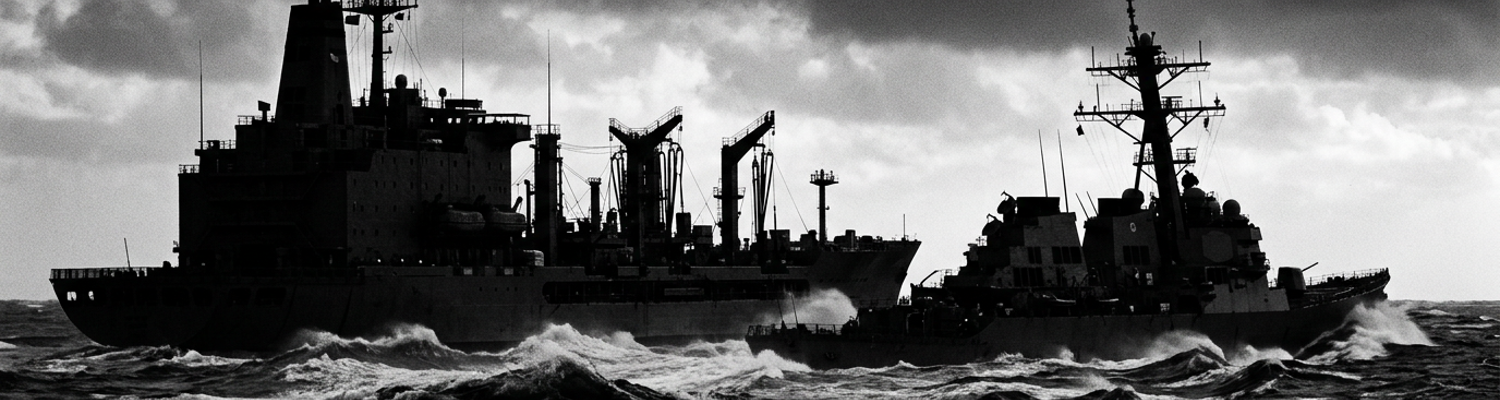
Deep inside the forward pump room of the fleet oiler USS Neosho, a machinist mate leaned over an iron manifold. He steadied a heavy dog wrench against a weeping flange stud. Warm bilge water sloshed over his work boots. The compartment vibrated at eighty-two revolutions per minute. He gave the nut a quarter-turn. This seated the asbestos gasket against twenty-four pounds of backpressure. Thick Bunker C fuel oil stayed inside the pipes instead of spraying across the steel floor plates. Copper telltales flickered under yellow incandescent bulbs on the bulkheads around him. He checked the packing gland temperature with the back of his hand.
Everything hinged on that copper-seated gate valve.
Archival evidence shows that underway replenishment mechanics determined carrier combat radius across the Pacific. Fleet carriers like the USS Yorktown carried hungry boilers demanding vast stores of bunker oil. Launching and recovering aircraft required steaming into the wind at speeds exceeding thirty knots. A Yorktown-class hull burned over thirty tons of heavy fuel every single hour at maximum output. A task force exhausted its operational reserves in less than three days of combat maneuvering. Ships could not run all the way back to protected anchorages in Tongatabu or repair yards in Pearl Harbor every time their tanks ran low.
Steaming abreast at nine knots became the core requirement for projecting power into the southern hemisphere.
Heavy hemp lines and six-inch rubber hoses linked the vessels together. Task Force 17 had no margin for error. A close review of operational logs indicates that fleet oiler USS Neosho sustained Rear Admiral Frank Jack Fletcher operations in the South Pacific. Fletcher commanded Yorktown and later united with Rear Admiral Aubrey Fitch Task Force 11 around the massive carrier Lexington. Operating in the Coral Sea, Fletcher pushed his task force against the southern flank of the Japanese thrust toward Port Moresby. Commander John S. Phillips commanded Neosho (Bureau of Ships File AO23-42). He maintained continuous pumping watches. His crew delivered millions of gallons of Bunker C and volatile aviation gasoline across churning ocean swells.
Between May 2 and May 6, Neosho took Yorktown, Lexington, and screening destroyers alongside in rolling open seas.
Empty fuel tanks meant absolute defeat. Pre-war naval planning designated Fleet Fueling Point Justo as a logistics rendezvous south of the Solomon Islands. Codenamed Justo and plotted deep in the Coral Sea at coordinates fifteen degrees south, one hundred sixty degrees east, this open stretch of empty ocean served as an invisible staging hub. Moving the logistical anchor point into unpatrolled blue water gave Fletcher a disguised fueling position outside primary land-based air search sectors. After completing tank replenishment on May 6, Fletcher detached Neosho under the escort of the Sims-class destroyer USS Sims. Phillips received instructions to proceed directly to Fueling Point Justo and hold position until summoned. Phillips set a course of one hundred seventy degrees true. He took his slow-moving cargo into a map grid that commanders in Honolulu and Washington assumed was safely clear of the enemy strike fleet.
Task Force Seventeen Cryptographic Sighting Errors
At 0815 on May 7, 1942, Ensign John L. Nielsen of Yorktown Scouting Squadron Five spotted an enemy naval detachment northwest of the Louisiade Archipelago.
Inside the cramped cockpit of his Douglas SBD-3 Dauntless, Nielsen reached for his emergency cryptographic contact pad. US Navy aircrews carried printed paper lookup sheets (using the standard CSP-888 cipher pad) designed to convert ship types, coordinates, and bearings into prearranged cipher groups. They transmitted these codes via Morse key over high-frequency channels. Rushing to clear the combat area, Nielsen misread his column alignment on the printed page. His raw visual observation recorded two heavy cruisers and two gunboats steaming south of Misima Island. Decoded by Yorktown radio personnel, the burst message reported two aircraft carriers and four heavy cruisers.
A scrambled pencil mark redirected the naval war.
Rear Admiral Frank Jack Fletcher reacted instantly to what appeared to be Japan primary carrier division. Fletcher ordered both fleet carriers to commit their full striking power. Between 0926 and 1013, Yorktown and Lexington launched ninety-three combat aircraft into the humid morning air. Lexington contributed twenty-eight SBD dive bombers, twelve TBD-1 Devastator torpedo planes, and ten Grumman F4F-3 Wildcat fighters. Flight crews aboard Yorktown spotted twenty-five dive bombers, ten torpedo planes, and eight fighters across her timber flight deck. They sent them westward toward the coordinates Nielsen provided.
This massed strike drained Fletcher tactical reserves.
He eliminated his ability to launch follow-up missions for four hours. Nielsen touched down on Yorktown at 1038. Debriefing officers in the ready room discovered that his notebook listed only two light cruisers and two auxiliary gunboats. Ninety-three American strike aircraft were flying into empty ocean toward a false target. When examining the historical record, this communication breakdown opened a wide operational blind spot in the northern Coral Sea. Fletcher aviators chased gunboats near Misima Island. Vice Admiral Takeo Takagi Carrier Strike Force steamed completely unlocated north of the Louisiades. Takagi commanded the fleet carriers Shokaku and Zuikaku.
Heavy cruisers Myoko and Haguro accompanied them.
They ran beneath low clouds and rain squalls. Naval planners in Washington later studied how this cryptographic failure pointed American reconnaissance away from the actual threat. Operating unmonitored, the Japanese admiral maneuvered his flight decks without facing aerial interception or counter-scouting from Task Force 17. Japanese flight decks maintained absolute radio silence. They tracked toward the Allied carrier group while Fletcher committed his air wings to the wrong quadrant. Two fleet carriers vanished from Allied tactical plots. A close review of operational logs indicates that the miscoded sighting exposed the fragile mechanics of Allied command structures.
Communications officers neglected to implement double-check verifications for pilot-coded transmissions.
Pacific Fleet command under Admiral Chester Nimitz relied on unconfirmed contact reports. Intelligence staff monitoring naval cables in Washington recognized that a simple transcription error in an aircraft cockpit put the United States Pacific Fleet remaining carrier strength at extreme hazard. At 1115, dive bombers from Lexington broke through overcast skies near Misima. They sighted the light carrier Shoho instead of the reported fleet units.
Japanese Aerial Misidentification at Fueling Point Justo
A single Nakajima B5N2 carrier aircraft from the fleet carrier Shokaku altered the tactical geometry of the Coral Sea at 0722 on May 7, 1942.
Archival evidence shows that this three-man reconnaissance crew flew search sector six south of the Louisiade Archipelago. They spotted two American vessels cutting through whitecaps near fifteen degrees south, one hundred fifty-eight degrees east. Below their canopy rolled the fleet oiler USS Neosho and the escorting destroyer USS Sims. The ships held position roughly thirty miles south of Fueling Point Justo. Viewed from an altitude of three thousand meters through morning sea haze, Neosho presented an atypical profile. Her broad hull measured twenty-three meters across the beam. She displaced over twenty-five thousand tons when fully ballasted.
A long horizontal deck ran from her forward bridge structure to the stern kingposts.
To an observer straining through grease-smudged cockpit glass, the oiler horizontal silhouette resembled the unarmored timber flight deck of an American aircraft carrier. The accompanying Sims-class destroyer screened five hundred yards off the oiler port quarter. Sims matched the visual footprint of an escorting light cruiser. Radio keys aboard the B5N2 tapped out an urgent coded sighting report directly to the fleet. The crew used standard Type 96 Model 3 transmission gear. They identified the two auxiliary vessels as one carrier and one cruiser. That transmission triggered an immediate strike order.
When examining the historical record, Rear Admiral Chuichi Hara commanded Carrier Division 5 aboard the flagship Zuikaku.
Hara accepted the contact report without hesitation. He ordered his strike wings into the air. Hara diverted seventy-eight combat aircraft away from Task Force 17 actual coordinates. Between 0740 and 0815, flight deck crews launched eighteen Mitsubishi A6M2 Zero fighters, thirty-six Aichi D3A1 dive bombers, and twenty-four Nakajima B5N2 torpedo bombers from Shokaku and Zuikaku. Lieutenant Commander Kakuichi Takahashi led the aerial formation on a heading of two hundred seventy-five degrees. They flew southwest over hundreds of miles of open ocean toward the reported carrier.
Fletcher actual fleet carriers operated two hundred twenty-five nautical miles to the northwest.
Japanese search planes completely missed Yorktown and Lexington. Hara sent seventy-eight frontline aircraft after an auxiliary fuel ship. He left his own carriers without their primary striking power for over four hours. Fletcher simultaneously launched his strikes against the light carrier Shoho. Flawed combat doctrine produced this tactical diversion. A close review of operational logs indicates that Imperial Japanese Navy doctrine prioritized immediate concentration against capital hulls over verification scouting. Interwar tactical manuals enforced the strategy of the decisive fleet encounter.
Carrier task forces won air battles through instantaneous offensive massing.
Naval planners in Tokyo operated on the principle that Japanese carrier divisions could not survive a prolonged exchange of aerial strikes. Their wooden flight decks lacked protective horizontal armor. Doctrinal instructions mandated that carrier division commanders launch maximum-effort strikes the moment a spotter reported an enemy carrier. Regulations forbade delays to launch secondary verification scouts. Search operations were chronically under-resourced. Planners typically assigned them to single-plane patrols without escort or radio-relay backup. Hara adhered to rigid tactical guidelines by emptying his hangar decks to attack the reported hull before locating his own carriers. Takahashi aircrews arrived over the grid coordinates at 0915. They discovered only an auxiliary oiler and a lone destroyer beneath clear skies.
The Destruction of Destroyer Sims and Oiler Neosho
Archival evidence shows that at 1201 on May 7, 1942, Lieutenant Commander Kakuichi Takahashi rolled thirty-six Aichi D3A1 Type 99 dive-bombers out of the cloud deck at twelve thousand feet.
He divided his group to crush the isolated American surface pair. Four aircraft peeled off first to suppress the antiaircraft battery of USS Sims. Thirty-two bombers circled into an overhead dive queue. Lieutenant Commander Willford M. Hyman twisted the destroyer through radical evasive turns at thirty-five knots. He threw up wall-to-wall fire from his twin 5-inch/38 caliber dual-purpose guns. The defensive screen collapsed within minutes under sustained high-angle diving runs. Three 250-kilogram high-explosive bombs penetrated the destroyer thin five-eighths-inch hull plating in rapid succession.
The first bomb smashed into the forward deckhouse.
This wiped out the bridge personnel and severed internal steering lines. A second bomb detonated inside the forward fireroom. It ruptured high-pressure steam headers and cooked the watchstanders instantly. The final bomb penetrated the after engine room. The blast ignited stored ammunition and triggered the ship thirty-two live depth charges in the stern racks. Broken in two by the massive internal detonation, Sims slid beneath the waves stern-first at 1212. Only fifteen men from the destroyer complement of two hundred fifty-two survived the sinking.
When examining the historical record, the twenty-four surviving D3A1 Val dive-bombers turned their full bomb loads onto the unarmored bulk of Neosho.
Captain John S. Phillips had empty ballast compartments flooded with seawater to prevent vapor flash fires. The oiler lacked armor belts or heavy deck plating. Seven 250-kilogram general-purpose bombs struck the auxiliary hull between 1205 and 1220. One weapon detonated squarely in the stack casing. The explosion blew the main boilers off their saddles and tore through electrical trunks. All shipboard lighting, inter-compartment telephones, and motorized fire pumps failed. Another bomb blast penetrated the after crew quarters. It punched holes through the starboard fuel trunks below the water line.
During the height of the attack, gunners firing an unshielded 20mm Oerlikon mount hit a dive-bomber.
The crippled aircraft banked steeply and crashed deliberately into the starboard bridge wing. Flaming aviation fuel showered the boat deck. Fire raged through the topside kingposts, fuel-handling winches, and midship deck structures. Deprived of boiler steam, Neosho drifted dead in the water. The ship tilted thirty degrees to starboard as progressive flooding engulfed the after propulsion spaces. The auxiliary hull began a four-day unpowered drift of one hundred seventy miles to the southwest. A close review of operational logs indicates that the loss of Neosho fractured Task Force 17 operating structure.
Carrier operations demanded constant fuel consumption.
Fletcher combat units burned over two hundred thousand gallons of fuel oil every twenty-four hours to sustain the thirty-knot speeds needed for continuous flight operations. Destroyer escorts carried bunkers sized for only three days of high-speed antisubmarine screening. Takahashi aviators destroyed the mobile fuel reserve sustaining Allied sea control in the south Pacific. Fletcher possessed no replacement oiler within one thousand nautical miles. His fleet carriers had to withdraw toward Noumea and Tongatabu immediately following the main fleet action. Running dry in hostile waters guaranteed total loss. The tactical sacrifice of thirty-six dive-bombers placed a non-negotiable operational deadline on American naval control of the Coral Sea. Fletcher operated on borrowed fuel from the moment Neosho main engines died.
Radio Silence and Washington Communication Blackouts
Following the afternoon internal explosions aboard USS Lexington on May 8, Rear Admiral Frank Jack Fletcher clamped Task Force 17 under absolute radio silence.
Standard operating procedure barred the use of high-frequency long-range transmitters like the shipboard model TBK and TBL sets. Energizing a single antenna on Yorktown pumped megawatt pulses across the sky on frequencies between 2,000 and 18,100 kHz. Japanese direction-finding stations at Rabaul, Tulagi, and Kwajalein could triangulate the crippled carrier coordinates within twenty nautical miles. Fletcher knew Vice Admiral Takeo Takagi Carrier Strike Force still patrolled the northern Solomon Sea with thirty-nine operational strike aircraft. Sending an encrypted battle damage assessment to Commander in Chief, Pacific Fleet headquarters meant risking another coordinated air assault against a formation stripped of combat air patrol.
Signalmen secured transmitter keys in locked canvas pouches.
Radiomen sat over silent Model RAK-7 receivers. They monitored incoming fleet broadcasts while forbidden from tapping out a single acknowledgment. The surviving fleet carrier limped southeast at sixteen knots with three flooded boiler rooms. The ship remained completely invisible to friends and enemies alike. Fletcher prioritized hull survival over keeping Pearl Harbor informed of his tactical status. Silence shielded hulls while blinding commanders. When examining the historical record, this self-imposed electronic blackout allowed Imperial Japanese Navy propaganda to fill the global vacuum.
Beginning late in the evening of May 8, listening posts operated by Navy intelligence unit OP-20-G in Maryland and Station Hypo in Pearl Harbor intercepted celebratory radio traffic from Tokyo.
Imperial General Headquarters released official communiques claiming the sinking of two American fleet carriers. Japanese broadcasters identified them as the Saratoga and an unnamed Yorktown-class hull. Radio Tokyo broadcast martial marches between announcements of absolute naval victory in the South Pacific. Axis news services fed these operational claims directly to German and Italian state media. Accounts of total Allied fleet destruction spread across European capitals. Prime Minister Hideki Tojo addressed the Japanese Diet to announce that Allied sea power south of the equator was finished.
Without contrary data from Fletcher, Allied codebreakers at Station Hypo could not confirm whether these Japanese claims were complete fabrications or accurate reports of Task Force 17 destruction.
Dispatches from London and Canberra poured into the Navy Department seeking verification of Japanese broadcast reports. Washington possessed only Japanese victory declarations. A close review of operational logs indicates that operational communication delays left Navy leadership uninformed regarding the survival of Task Force 17 for over forty-eight hours. Inside the Main Navy Building on Constitution Avenue in Washington, Admiral Ernest J. King paced through the headquarters map room with zero incoming tactical data. President Franklin D. Roosevelt requested hourly operational updates from the White House. He received empty intelligence folders from his naval aides.
Admiral Chester W. Nimitz stationed at Pacific Fleet headquarters at Makalapa Ridge, Pearl Harbor, refused to transmit a direct query to Fletcher.
A coded signal demanding a status report forced Yorktown to reply and betray her position to enemy listening posts. Fletcher battered force had to steam over seven hundred nautical miles outside the operational radius of Japanese land-based Mitsubishi G4M bombers before communications personnel could risk transmitting. The communication blackout persisted through May 9 and into the morning of May 10. Strategic planning across the Pacific stalled completely. War cabinet officials could not formulate defensive deployments for Hawaii or the West Coast without knowing if Fletcher retained any operational flight decks.
Two full days elapsed without a single Allied transmission.
Fletcher finally broke silence on May 10 after Task Force 17 reached the defensive perimeter of New Caledonia. Radio operators aboard Yorktown transmitted an encrypted summary to naval radio facilities at Noumea for retransmission to Pearl Harbor. The message reported Lexington sunk, Yorktown damaged by a 250-kilogram bomb, and sixty-six aircraft lost.
Admiral King and the Navy Department Crisis
Inside the Main Navy Building on Constitution Avenue, Commander in Chief US Fleet Admiral Ernest J. King evaluated worst-case carrier losses.
King scrutinized fleet readiness reports under the working assumption that Fletcher lost both Yorktown and Lexington in the Coral Sea. This outcome left the United States Pacific Fleet with only two operational flight decks. USS Enterprise and USS Hornet were returning from the Doolittle Raid under Vice Admiral William F. Halsey Jr. Repairs on USS Saratoga at the Puget Sound Navy Yard could not be finished before late May. A Japanese submarine I-6 torpedo strike damaged her in January. USS Ranger confined to the Atlantic lacked the speed, hangar capacity, and deck armor necessary to survive fleet engagements against frontline Japanese naval aviation.
Facing the Imperial Japanese Navy six fleet carriers and five light carriers, King confronted an unfavorable balance of three to one in modern combat hulls.
The ratio stood at four to one in carrier aircraft. A total loss in the South Pacific threatened to collapse the American defense perimeter back from the Central Pacific to the continental West Coast. Fleet parity ceased to exist. When examining the historical record, Secretary of the Navy Frank Knox convened emergency strategy sessions assessing carrier attrition prior to the anticipated Midway strike. Gathered in Knox executive office, senior naval planners studied intelligence summaries originating from Commander Joseph Rochefort cryptanalysts at Station Hypo in Pearl Harbor.
Intercepted Japanese naval transmissions encoded in JN-25b indicated that Admiral Isoroku Yamamoto organized the Combined Fleet for an attack against target AF.
Analysts identified AF as Midway Atoll. The attack date fell during the first week of June. Knox reviewed aircraft replacement pipelines. Fletcher Coral Sea air wings suffered severe personnel and material attrition. Losses included over eighty downed aircraft and dozens of lost flight leaders. Deprived of two fleet carriers, Pacific Fleet forces mustered only seventy-nine carrier-based dive-bombers and torpedo planes to defend Hawaiian waters. Military leadership debated whether committing the remaining Pacific carriers to an ambush at Midway constituted an acceptable gamble or an invitation to total defeat.
Knox ordered the Bureau of Aeronautics (BuAer Directive 42-11) to expedite shipments of replacement Grumman F4F-4 Wildcats and Douglas SBD-3 Dauntless dive-bombers from East Coast factories directly to naval air stations in San Diego and Alameda.
Midway was scheduled for attack within four weeks. A close review of operational logs indicates that war plans personnel drafted contingencies to reposition Atlantic fleet elements to protect Hawaiian sea lanes. Rear Admiral Richmond Kelly Turner and planners within the War Plans Division calculated transit tables to strip capital units from the Atlantic theater despite escalating German submarine attacks. Their contingency plans centered on USS Wasp. This eleven-thousand-ton carrier operated in the European theater after launching Spitfire reinforcements to Malta during Operation Bowery on May 9. Orders placed Wasp, the fast battleship USS North Carolina, and four escort destroyers on notice for immediate transfer through the Panama Canal.
Diverting these warships left Atlantic convoy routes vulnerable to Operation Drumbeat.
German Type IX and Type VII U-boats sank American coastal merchantmen without organized surface opposition during this ongoing offensive. Planners prioritized the five thousand miles of ocean between California and Oahu over coastal defense. Losing Hawaiian sea lanes isolated Pearl Harbor and opened Pacific ports to direct naval bombardment. Transit directives instructed Wasp to replenish dry stores at Hampton Roads, run south to the Caribbean, and clear the locks at Miraflores by the end of May.
White House Geopolitical Fallout and Australian Defense
Canberra faced immediate isolation.
Archival evidence shows that on May 9, 1942, Prime Minister John Curtin bypassed routine diplomatic channels. He sent high-priority cables straight to President Franklin D. Roosevelt desk. Curtin confronted the White House with raw geographic math. Twelve thousand miles of open coastline lacked protection. Only two battered Australian divisions and minimal naval tonnage stood in defense. Following reports that Fletcher carriers disengaged without holding the Louisiade sea gates, the Australian War Cabinet calculated that Japanese invasion forces based at Rabaul could bypass Port Moresby entirely. This severed maritime routes running between San Francisco, Noumea, and Brisbane.
Curtin demanded that Washington guarantee permanent protection for the trans-Pacific supply corridor by stationing at least three frontline fleet carriers and one thousand combat aircraft directly in the Southwest Pacific Area under General Douglas MacArthur.
Australian defense planners feared that without verified carrier screens along the 160th meridian east, commercial freighters carrying aviation gasoline, small-arms ammunition, and radial engine parts faced destruction by Japanese submarine flotillas or carrier-based strikes. Roosevelt found himself managing an ally threatening to pull its remaining ground forces out of global deployment pools if Pacific maritime corridors were not reinforced with steel. Coalition warfare fractured over hull counts. When examining the historical record, strategic uncertainty regarding carrier survival in the Coral Sea reopened bitter arguments over the Arcadia Conference agreements.
British Prime Minister Winston Churchill insisted that the Allied coalition maintain the Germany First doctrine.
He argued that any diversion of capital ships or heavy bombers to the Pacific jeopardized the planned build-up for Operation Bolero in the United Kingdom. Inside the White House map room, Roosevelt and Army Chief of Staff General George C. Marshall weighed Churchill demands against the unconfirmed status of Yorktown and Lexington. If both American flight decks sank alongside Sims and Neosho, Allied air-sea parity in the Pacific was finished. Hawaii and Australia lay open to amphibious assault. Admiral Ernest J. King used the carrier intelligence vacuum to press Roosevelt for an immediate reallocation of naval production.
He demanded that new construction hulls, repair dock space, and long-range Consolidated B-24 Liberators earmarked for British operations be rerouted south of the equator.
The British Chiefs of Staff warned that diverting escort vessels and carrier aviation away from North Atlantic convoy lines invited German U-boats to choke off the British Isles before the year ended. Troop convoys sat anchored in harbors. A close review of operational logs indicates that the Joint Chiefs of Staff suspended Pacific sailing timetables (War Department File 381) while intelligence officers tried to locate the missing carrier forces. Army planners arranged transport vessels at San Francisco and San Diego to embark thousands of soldiers from the 37th Infantry Division. These troops were intended for garrison duty on Fiji.
Support elements assigned to the 32nd and 41st Infantry Divisions already staging in Australia waited alongside them.
Marshall and King halted these unescorted movements. Unverified control of the sea lanes between Pearl Harbor, Suva, and Melbourne exposed troop-laden passenger liners to Japanese carrier strikes. Converted liners like the USS West Point and commercial hulls of the Matson Navigation Company carried up to five thousand men per vessel. They possessed zero torpedo defense systems, thin unarmored hulls, and minimal antiaircraft armament. Exposing an entire division at sea without an operational carrier task force running ahead to sweep Japanese patrol lines presented an unacceptable risk. Sailing orders stayed locked in War Department safes until naval intelligence could verify whether Fletcher still possessed a flight deck capable of shielding the southern transit routes. Ten troop transports waited at the docks for six days with steam up. They burned through fifteen hundred tons of fuel oil each morning.
Reconnaissance Doctrine Reform Ahead of Midway
Archival evidence shows that Ensign John Nielsen cipher misstep aboard Yorktown forced the Bureau of Aeronautics and Pacific Fleet communication officers to dismantle the Navy aerial contact reporting framework within forty-eight hours of the engagement.
Aircrews flying Douglas SBD-3 Dauntless scouts previously relied on cramped paper conversion pads. Adjacent columns separated auxiliary vessels from fleet aircraft carriers by a single pencil stroke. Pacific Fleet communications specialists at Pearl Harbor scrapped this ambiguous gridded lookup layout. New tactical instructions issued in mid-May 1942 mandated standardized contact reporting pads. These replaced numerical matrix lookups with bold, visually distinct alphanumeric sequences. They required phonetic designators for ship classifications. Radio rooms aboard carriers were barred from routing raw, single-source contact reports directly to task force plot boards without immediate two-way radiotelephone verification with the pilot.
If an aviator spotted enemy carrier tonnage, communication regulations now required the scout to hold position from cloud cover.
The pilot verified the target vessel flight deck operations. He transmitted a secondary descriptive report confirming hull length, screening formations, and course headings before strike groups were spotted on the flight deck. Bad paperwork nearly cost the Pacific Fleet two fleet carriers. A close review of operational logs indicates that Admiral Chester W. Nimitz recognized that tactical scouting failures stemmed from deep administrative rivalries between naval intelligence branches. Officials inside the Navy Department in Washington, led by Director of Naval Communications Captain John R. Redman, insisted on controlling the flow of signals intelligence from Maryland.
They routinely second-guessed combat estimates originating near the frontline.
Nimitz sidelined the Washington bureaucracy by elevating the Combat Intelligence Unit, known as Station HYPO. This unit operated in the windowless basement of the 14th Naval District administration building at Pearl Harbor. Commander Joseph Rochefort oversaw a team of cryptanalysts and linguists. Lieutenant Commanders Thomas Dyer and Joseph Finnegan worked around the clock in an unventilated vault deciphering the Imperial Japanese Navy JN-25b naval code. Nimitz authorized Rochefort to bypass normal administrative channels. Rochefort delivered raw decrypted Japanese operational traffic directly into Pacific Fleet morning strategy briefings.
By combining recovered callsigns, directional bearings, and water transport schedules, Rochefort verified that the Japanese designator AF signified Midway Atoll rather than Johnston Island or Port Moresby.
He established the Japanese attack date for the first week of June 1942. Rochefort slept on an iron cot in the basement beside his IBM sorting machines. When examining the historical record, the loss of Lexington and the unlocated maneuvers of Carrier Division 5 prompted an immediate rewiring of carrier doctrine before Task Forces 16 and 17 sortied toward Point Luck. Fletcher squandered strike aircraft on piecemeal 360-degree search arcs at Coral Sea. This left combat formations disordered and carriers poorly shielded. Revised tactical directives detached carrier dive-bombers from long-range scouting responsibilities.
The burden of broad ocean surveillance transferred to thirty-two Consolidated PBY-5 and PBY-5A Catalinas staging from Sand Island at Midway.
Freeing the SBD Dauntless dive-bombers preserved full ninety-plane strike packages on Enterprise, Hornet, and the hastily patched Yorktown. Tactical changes transformed carrier Combat Air Patrol operations. During the Coral Sea fighting, CXAM radar operators struggled with altitude resolution. Japanese dive-bombers plunged unintercepted out of high overcast. Pacific Fleet fighter direction officers discarded single-altitude fighter patrols in favor of layered defensive stacks. Grumman F4F-4 Wildcat divisions were stationed in stepped tiers at five, twelve, and twenty thousand feet. They linked to fighter directors by designated VHF channels (VHF Channel 4) to prevent defensive fighters from diving en masse after low-altitude torpedo decoys. Every carrier fighter pilot entering Hawaiian waters received this revised intercept manual before the fleet departed Pearl Harbor on May 30.