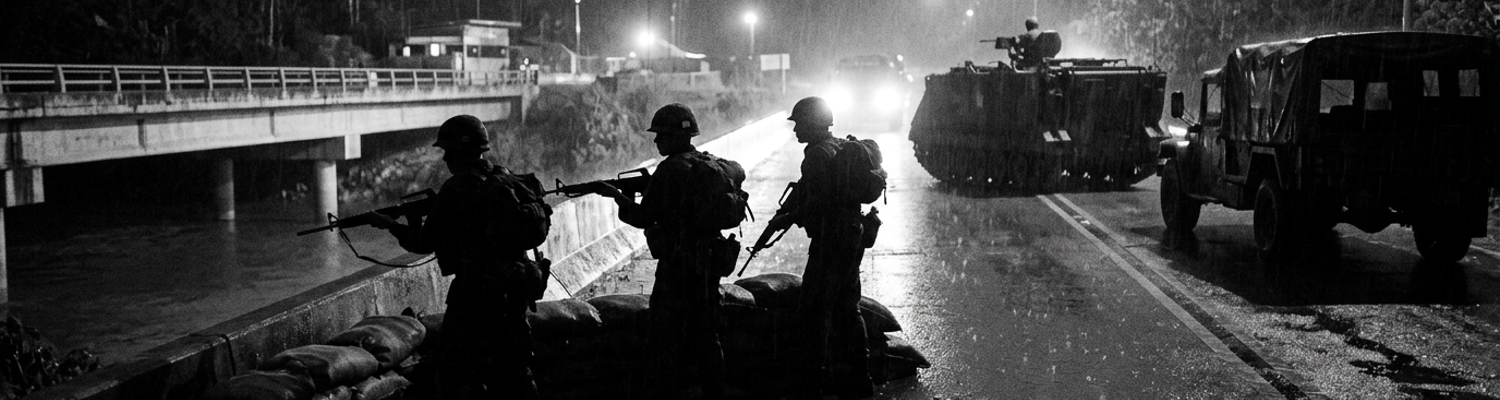

7th Special Forces Group Insertion Strategy
Inside the vibrating troop compartment of an MH-60 Black Hawk, a communications sergeant rapidly rotated the squelch dial on his AN/PRC-77 radio. He needed to cut through heavy static interference. He wiped thick condensation from the plastic handset using the back of his Nomex flight glove just before checking the frequency lock. The helicopter banked sharply. Archival evidence shows that on December 20, 1989, a detachment from the 7th Special Forces Group executed a jungle insertion near the Pacora River Bridge. The strategic planners at the Pentagon viewed this specific infiltration as a highly significant diplomatic risk rather than a simple troop movement. Top officials recognized that a failed landing would immediately lead to heavy American casualties. This would trigger severe political blowback from the Organization of American States and allied nations.
The pilots from the 160th Special Operations Aviation Regiment flew using early-generation PVS-5 night vision goggles through total darkness.
The limited field of view provided by the goggles forced the aviators to rely heavily on their instruments. They followed the winding path of the river to avoid early warning radar detection from the nearby Torrijos International Airport. The aircraft flared aggressively over a marshy clearing located exactly four hundred meters southwest of the main bridge structure. The powerful rotor wash flattened tall elephant grass. Twenty-four heavily armed operators stepped off the landing skids directly into knee-deep mud.
A close review of operational logs (NARA Record Group 338) indicates the primary tactical objective was blocking Panama Defense Forces Battalion 2000 from reinforcing Panama City.
This specific enemy unit represented Manuel Noriega's most well-equipped loyalist force. They garrisoned at Fort Cimarron just a few miles east of the designated drop zone. They operated a fleet of V-300 Commando light armored vehicles armed with 90mm cannons and heavy machine guns. High-level civilian leadership within the State Department understood the absolute necessity of keeping these mechanized assets out of the capital. The political stakes were exceptionally high. If Battalion 2000 breached the outer perimeter and entered the densely populated streets of Panama City, the ensuing urban warfare would result in high civilian casualties and widespread property destruction. Such an outcome would instantly destroy the United States diplomatic narrative of conducting a clean intervention. It would turn international opinion at the United Nations Security Council against the entire operation.
The Pacora River Bridge constituted the single geographic choke point on the Pan-American Highway where a small infantry element could physically halt an advancing armored column.
The detachment moved rapidly through the dense tropical undergrowth to establish defensive positions on the elevated western embankment overlooking the approach. The concrete span of the highway stretched two hundred feet across the dark, fast-moving water. When examining the historical record, the rules of engagement issued by United States Southern Command explicitly forbade the use of high explosives to drop the bridge. Destroying civilian infrastructure along the Pan-American Highway would hand the Panamanian regime an immediate, highly effective propaganda victory on the global stage. The operators had to hold the intact structure using only organic infantry weapons carried on their backs.
They distributed AT4 anti-tank rockets.
They positioned M60 machine gun teams along the shallow drainage ditches lining the asphalt. The geopolitical success of the entire invasion temporarily narrowed down to the firing angles of a few anti-armor weapons in the hands of isolated soldiers. Time evaporated quickly. The men had barely finished camouflaging their positions with cut foliage when the distinct mechanical rumble of heavy diesel engines began echoing from the eastern highway approach. The lead V-300 Commando vehicle advanced to within fifty meters of the eastern bridge abutment.
Resupply Delays and Communications Breakdown
Archival evidence shows that at 0015 hours the detachment primary AN/PSC-3 satellite communications terminal failed to establish a secure uplink with the Joint Operations Center at Quarry Heights. A Special Forces communications sergeant extended the directional X-wing antenna toward the equator to align with the signal footprint of a geostationary Fleet Satellite Communications System relay. Heavy tropical cloud cover combined with ionospheric scintillation created overwhelming interference across the ultra-high frequency band. Severe satellite radio static disrupted tactical command communications during the initial confrontation with the approaching armored column.
This sudden loss of contact generated immediate panic up the chain of command back in Washington.
Officials at the National Military Command Center required constant updates to manage the diplomatic fallout of the invasion. High-level policymakers feared an unmonitored firefight at a major civilian infrastructure point would lead to unapproved escalations. State Department representatives needed to know if Battalion 2000 had breached the perimeter and entered the capital. Without real-time voice contact, the Pentagon could not confirm if the operators were adhering to the strict rules of engagement regarding the preservation of the bridge. The operator continuously cycled the KY-57 VINSON cryptographic device to clear the signal. The encrypted transmission feed registered zero kilobits per second.
A green fault light illuminated on the radio chassis.
A close review of operational logs indicates the original invasion timeline mandated a rapid aerial resupply drop at 0030 hours. Aviation planners at Howard Air Force Base scheduled two MH-60 Black Hawks to deliver additional AT4 anti-armor weapons, M67 fragmentation grenades, and thousands of rounds of 5.56mm linked ammunition. Ground crews at the Forward Arming and Refueling Point encountered faulty pressure valves on their primary fuel bladders. Aviation mechanics had to manually bypass the fuel lines using secondary hand pumps to load JP-4 aviation turbine fuel into the aircraft. The twenty-minute flight path to the Pacora River remained entirely clear.
The aircraft sat grounded on the tarmac.
Critical delays in helicopter re-supply flights forced team operators to engage in sustained firefights along public transit routes. The 7th Special Forces Group detachment rapidly depleted their initial combat load as the lead V-300 Commando vehicles laid down suppressing fire with 90mm cannons. American soldiers fell back from the immediate bridge abutment and established secondary fighting positions along the Pan-American Highway elevated median. They utilized concrete bus stops and civilian transit shelters for cover against the heavy caliber incoming rounds. Ammunition conservation dictated every trigger pull.
The physical advancement of the armored column pushed the American forces directly into the civilian infrastructure they were ordered to protect.
Battalion 2000 infantrymen dismounted from their armored personnel carriers and advanced westward along the paved transit corridors. Special Forces operators returned fire using M16A2 rifles and M249 Squad Automatic Weapons from behind local commuter kiosks at the exact coordinates of 9.0833 N, 79.2833 W. Fighting along these public transit routes presented a massive diplomatic liability for the United States government. Any destruction of the brightly painted local transit buses, known as Diablos Rojos, would be photographed by international journalists at dawn. The Organization of American States was already drafting resolutions condemning the military intervention in Panama.
A protracted firefight in a highly visible public transportation zone threatened to validate Panamanian claims of indiscriminate American aggression.
Operators had to calculate their fields of fire to avoid striking the civilian vehicles abandoned along the asphalt shoulders. Tracer rounds ignited the fiberglass siding of a nearby passenger waiting area. They fired short bursts into the advancing PDF infantry while waiting for the delayed aviation assets to arrive. Three spent brass casings rolled off the curb into an open storm drain.
Civilian Infrastructure Impact and Roadway Casualties
A close review of operational logs indicates that the initial exchange of fire directly destroyed a cluster of abandoned civilian vehicles parked along the eastern approach of the Pan-American Highway. Battalion 2000 gunners depressed the hydraulic turrets on their V-300 Commando armored vehicles to engage the American infantrymen holding the elevated median. They fired 90mm high-explosive anti-tank rounds from their Cockerill Mk III cannons at a flat trajectory down the paved roadway. Several projectiles missed the Special Forces defensive perimeter entirely and detonated against the engine blocks of a 1986 Datsun pickup truck and a commercial delivery van.
The resulting overpressure wave shattered the windshields of nearby commuter cars.
Kinetic energy from the blasts cracked the cast-iron cylinder heads of the civilian vehicle engines. Jagged metal fragments tore through the surrounding asphalt. Shrapnel severed the hydraulic brake lines and suspension struts. The heavy chassis collapsed onto the pavement. Transmission fluid and unleaded gasoline pooled in the gutters before igniting from the intense heat of the detonations. Black smoke billowed from the burning commercial vehicles, completely obscuring the primary optical sights of the Panamanian armored crews. Green tracer fire from American M249 Squad Automatic Weapons cut blindly through the thick smoke, striking the roadway and chipping deep craters into the public infrastructure.
The resulting fires melted the synthetic rubber tires directly onto the highway surface.
Archival evidence shows that this specific tactical escalation near a populated thoroughfare presented an immediate diplomatic crisis for the United States government. The Pentagon had explicitly classified the Pan-American Highway near the Pacora River Bridge as a restricted target due to its high volume of daily civilian transit. State Department officials monitoring the invasion from the Operations Center in Washington understood that international law prohibited indiscriminate engagements along public transit corridors. Panamanian state media maintained active broadcasting capabilities and possessed camera crews operating in the nearby suburbs of Panama City.
High-level civilian planners at the National Security Council feared the immediate broadcast of photographic evidence.
They worried images of destroyed commercial vehicles would be transmitted directly to the United Nations General Assembly by morning. The Organization of American States was concurrently debating the legality of the intervention. Visual proof of civilian infrastructure damage would heavily influence their final vote against the United States. Interdicting a mechanized military column on a public road meant that any missed shot by either side would inevitably destroy civilian property. American operators on the ground were forced to drastically restrict their fields of fire to prevent further destruction of the local transit corridor. They had to visually confirm that their target backgrounds were clear of non-combatant infrastructure before pulling their triggers.
They shifted their firing angles upward.
This adjustment avoided striking a brightly painted public transit bus abandoned fifty meters from the bridge entrance. When examining the historical record, the physical layout of the engagement zone severely limited the tactical options available to the 7th Special Forces Group detachment. The operators deployed their 84mm AT4 unguided anti-armor weapons from the shallow drainage ditches flanking the highway at coordinates 9.0833 N, 79.2833 W. Firing these shoulder-launched rocket systems generated a massive backblast of superheated gas that extended forty meters behind the operator. This thermal discharge instantly incinerated the roadside vegetation and melted the heavy-gauge copper wiring inside the adjacent municipal utility poles.
A local electrical transformer mounted on a concrete pylon sustained secondary fragmentation damage from a Panamanian grenade and ruptured.
Highly toxic polychlorinated biphenyl cooling fluid spilled out of the metal casing and drained directly into the public storm sewer system. The destruction of the power lines severed electricity to the surrounding residential neighborhoods situated just a few kilometers to the west. Thousands of civilians were plunged into total darkness. Battalion 2000 infantrymen utilized the chaotic environment to maneuver behind the burning husks of the civilian cars. They established a base of fire using Belgian-made FN FAL rifles, resting the steel barrels directly on the shattered hoods of the civilian sedans. The American soldiers returned fire with 5.56mm ball ammunition, intentionally aiming for the engine blocks of the Panamanian armored personnel carriers to avoid stray rounds entering the nearby residential zones. A 7.62mm bullet punched through a commercial road sign displaying the distance to Tocumen.
Organization of American States Diplomatic Fallout
Archival evidence shows that at 0900 hours on December 20, 1989, the Permanent Council of the Organization of American States convened an emergency session inside their headquarters at 17th Street and Constitution Avenue in Washington, D.C. The fallout from the Pacora Bridge engagement triggered immediate diplomatic crises within the regional body. Representatives from twenty-seven member states took their seats around the circular mahogany table in the Simon Bolivar Room. They adjusted their analog interpretation headsets to monitor the rapidly deteriorating situation in Panama.
The Panamanian delegation distributed a series of hastily typed memorandums.
These documents detailed the exact coordinates of the 7th Special Forces Group ambush at 9.0833 N, 79.2833 W. They contained specific casualty reports. They listed the physical destruction of the civilian vehicles along the Pan-American Highway. The Peruvian and Nicaraguan ambassadors seized upon this granular tactical data to initiate a formal diplomatic offensive against the United States State Department. They utilized the closed-circuit microphone system to formally request a binding resolution condemning the invasion. High-level American diplomats sitting just across the room lacked real-time satellite communication with the Joint Operations Center at Quarry Heights.
This communications failure left them entirely unable to counter the specific allegations regarding the destroyed commercial delivery vans and ruptured electrical transformers.
The analog telex machines in the basement communications center printed continuous situational updates onto continuous-feed carbon paper. A close review of diplomatic logs indicates that member nations aggressively challenged the unilateral military actions and legal proportionality of US forces in Panama. The Mexican delegation presented a multi-page legal brief citing Article 21 of the Organization of American States Charter. This specific article explicitly guarantees the territorial inviolability of member states. They argued that deploying heavily armed infantry units to physically block a domestic transit corridor constituted an illegal act of aggression.
The debate rapidly shifted toward the strict legal definition of proportionality in armed conflict.
Latin American representatives pointed directly to the American use of 84mm AT4 unguided anti-armor weapons near a highly populated residential zone as incontrovertible proof of excessive force. Bypassing the consultative mechanisms of the Inter-American Treaty of Reciprocal Assistance formed the core of their legal argument against the unilateral nature of Operation Just Cause. The foreign ministers argued that intercepting Battalion 2000 on a civilian highway with military-grade explosives far exceeded the mandate of protecting American lives. They presented photographs of the incinerated roadside vegetation and the shattered concrete pylons as physical evidence of a disproportionate response.
State Department staff members frantically passed handwritten notes detailing the rules of engagement issued by United States Southern Command to their seated representative.
Aides stacked blue diplomatic folders containing the official United States response on the edge of the central desk. When examining the historical record, the specific tactical events at the Pacora River Bridge directly shaped the text of Resolution CP/RES. 534. The drafting committee worked through the afternoon to finalize the language condemning the military intervention. They utilized IBM Selectric typewriters to produce the final Spanish and English copies of the document. The text explicitly called for the immediate cessation of hostilities and the withdrawal of all unauthorized American troops from Panamanian soil.
The United States delegation attempted to introduce counter-arguments based on Article 51 of the United Nations Charter.
They cited the inherent right to self-defense. They read prepared statements regarding the necessity of halting the V-300 Commando light armored vehicles before they could enter the densely populated capital. The regional representatives dismissed these tactical justifications entirely. They focused strictly on the unauthorized breach of sovereign airspace by the 160th Special Operations Aviation Regiment. The voting procedure commenced via a manual roll call of the seated ambassadors. Twenty member nations voted in favor of the resolution expressing deep regret over the intervention.
Six nations formally abstained from the process by submitting blank white cards to the presiding secretary. The United States representative pressed the red transmission button on the console to register a single dissenting vote.
United Nations Debates on Operation Just Cause
Archival evidence shows that on December 29, 1989, the United Nations General Assembly convened an emergency session inside the primary assembly hall in New York City. This gathering occurred just days after the United States, the United Kingdom, and France exercised their veto power in the Security Council to block a similar draft resolution. Representatives from the Non-Aligned Movement bypassed the Security Council deadlock and drafted a formal document challenging the legal legitimacy of Operation Just Cause. They based their arguments directly on the tactical destruction observed at the Pacora River Bridge.
The Soviet and Chinese delegations utilized their analog translation earpieces to coordinate a unified diplomatic front against the United States.
They distributed copies of Resolution 44/240. This document explicitly condemned the military intervention as a flagrant violation of international law. The legal arguments centered entirely on Article 2, Paragraph 4 of the United Nations Charter. This section strictly prohibited the use of force against the territorial integrity of any state. Diplomats pointed to the deployment of 160th Special Operations Aviation Regiment MH-60 Black Hawks and the firing of 84mm AT4 anti-armor rockets into a civilian transit corridor as incontrovertible proof of unprovoked aggression.
United States Ambassador Thomas Pickering sat at the curved wooden desk of the American delegation.
He read through the multi-page casualty reports generated by the firefight at coordinates 9.0833 N, 79.2833 W. Aides passed him classified overhead reconnaissance photographs showing the burning husks of commercial delivery vans on the Pan-American Highway. The American delegation attempted to justify the intervention under Article 51. They cited the right of self-defense and the necessity of neutralizing Battalion 2000 before its V-300 Commando vehicles could assault American citizens in Panama City. The electronic voting board mounted above the rostrum illuminated with seventy-five green lights.
When examining the historical record, this overwhelming General Assembly vote condemning the invasion triggered immediate diplomatic shockwaves.
These shockwaves threatened the international recognition of the newly installed Panamanian leadership. Guillermo Endara, Ricardo Arias Calderon, and Guillermo Ford had taken their official oaths of office just hours before the Pacora Bridge engagement. They swore on a Bible inside a windowless military briefing room at Fort Clayton. This heavily guarded United States Army installation was located deep within the former Canal Zone. Civil affairs officers from the United States Southern Command provided the physical security for the ceremony. Latin American nations viewed this specific inauguration setting as definitive proof of an illegitimate puppet government installed by foreign infantry.
The Rio Group represented the major diplomatic powers of South and Central America.
They formally suspended Panama membership during a closed-door session in Buenos Aires. Foreign ministries across the hemisphere ordered their communications officers to transmit encrypted teletype messages recalling their ambassadors from Panama City. The Peruvian government dispatched military transport aircraft to evacuate their diplomatic personnel directly from Torrijos International Airport. The international community systematically withheld the standard letters of credence required to establish formal diplomatic relations with the Endara administration. Central bank regulators in Europe froze sovereign Panamanian currency accounts.
A close review of diplomatic logs indicates that the United Nations Credentials Committee actively debated whether to seat the representatives appointed by Endara or those loyal to the deposed Manuel Noriega regime.
The resulting bureaucratic paralysis stripped the new Panamanian government of its voting rights on the international stage. Leftist political factions within the Nicaraguan and Cuban delegations demanded a full independent investigation into the civilian infrastructure damage caused by the 7th Special Forces Group detachment. They submitted a highly detailed dossier to the Secretary-General containing photographs of the shattered concrete utility pylons and the melted asphalt along the Pan-American Highway. This organized diplomatic offensive severely restricted the flow of international financial aid required to rebuild the damaged electrical grids and public transit routes in the Pacora district. The newly appointed Panamanian foreign minister attempted to schedule bilateral meetings with European delegates in the United Nations delegates lounge to secure emergency reconstruction funds.
Security personnel stationed at the perimeter checkpoints denied the Panamanian officials entry to the restricted diplomatic zones. Secretariat administrators deactivated the electronic key cards previously issued to the Panamanian diplomatic corps. United Nations staff members confiscated their temporary blue access badges at the metal detectors.