
Anti-submarine warfare manuals for the high north promised a seamless net of detection. They depicted a world where fixed seabed hydrophones, patrol aircraft, and hunter-killer submarines functioned as one organism. The conditions encountered by naval personnel in the Greenland-Iceland-United Kingdom (GIUK) gap presented a disjointed and improvised fight for acoustic control. This chokepoint was the primary artery for the Soviet Northern Fleet’s passage from the Kola Peninsula into the Atlantic. Its surveillance was a cornerstone of NATO defensive strategy.
The operational environment was a nightmare of physics. Extreme cold created unpredictable thermal layers in the water column that bent and distorted sound. The constant grinding of sea ice generated a background noise that could mask a submarine’s signature. Fixed installations like the Sound Surveillance System (SOSUS) array, monitored from Naval Facility Keflavik in Iceland, were revolutionary. Their performance was subject to the whims of oceanography, often leaving vast zones of uncertainty.
A declassified operational log from the winter of 1978 details the acute nature of these challenges. Deep within the Arctic Circle, sonar technicians aboard the Sturgeon-class submarine USS Puffer (SSN-638) monitored the BQQ-5 spherical sonar array. They registered a faint, intermittent contact. The signature was wrong. It did not match the known acoustic profiles of early-generation Soviet Hotel or Echo-class boats, nor did it align with the more recent Victor-class attack submarines. This was something new. It exhibited a blade-rate frequency and deep-diving resonance that suggested a vessel of advanced propulsion.
Analysts at shore-based processing stations came up empty. The contact was an unknown, and its potential classification as a new type of Soviet ballistic missile submarine sent a shockwave through the chain of command. The Soviet bastion strategy, which aimed to keep their most valuable nuclear deterrents in defended home waters like the Barents Sea, meant any new submarine capable of breaking out into the Atlantic represented a major strategic threat.
Commander, Submarine Force, U.S. Atlantic Fleet (COMSUBLANT) elevated the theater-wide alert to ASW Condition 3. This was not a drill. P-3 Orion maritime patrol aircraft were scrambled from airfields at Keflavik and Andøya, Norway, their crews briefed mid-air. Arriving over the last known position, the Orions began executing a vectoring strategy, dropping a series of AN/SSQ-53 DIFAR sonobuoys. These expendable passive acoustic sensors transmitted data back to the aircraft, where operators tried to regain the scent. The process was painstaking, complicated by the very Arctic conditions that made submarine operations so difficult.
The northernmost tip of Ellesmere Island was selected for its unforgiving geography. Here, less than 500 miles from the geographic North Pole, the United States Air Force constructed Aurora Station. It was a highly classified experimental facility operated by the 489th Radar Squadron. The station’s official cover was atmospheric research. Its true purpose was housing a prototype Over-The-Horizon Backscatter (OTH-B) radar, a system designed to detect inbound Soviet bombers on polar attack vectors. Its construction was an engineering project built upon what were believed to be revolutionary foundation techniques. The main operations building and antenna array were anchored by hundreds of thermal piles, steel supports drilled deep into the permafrost and frozen in place to create a supposedly monolithic base.
Station engineering logs from the winter of 1978 reveal the first hints of systemic failure. The initial anomalies were minor. A maintenance technician in the primary power generation annex filed a report that a fire-control door on the west wall would no longer latch, its steel frame visibly warped. Weeks later, a civil engineering survey noted new, hairline cracks in the concrete slab floor of the vehicle maintenance bay. These reports were cross-referenced with data from the station’s environmental sensors. The data showed the active layer of the permafrost, the upper soil that thawed and refroze seasonally, had melted to a greater depth than original construction surveys predicted. The thermal piles, designed to be anchored in permanently frozen ground, were now experiencing seasonal movement. The ground was not static. The weight of Aurora Station was beginning to shift.
The situation escalated from a series of maintenance issues to a full-blown crisis. The central operations room was dominated by the main tactical plot, but a smaller console for the Structural Integrity Monitoring (SIM) system sat to the side. This system used a network of strain gauges and accelerometers embedded into the station’s load-bearing foundations and the superstructure of the main radar antenna. Just before 0300 local time, a high-priority alarm flashed across the SIM console. The readout indicated a failure warning for Pylon Delta-Nine, one of twelve primary supports for the multi-ton OTH-B transmitter array. Acoustic sensors registered a sharp spike in micro-vibrations consistent with metal under extreme stress. Strain gauges showed the load on the pylon had shifted by several millimeters. This was not slow degradation. It was a sudden lurch in the ground that transferred immense physical force through the foundation and into the structure.
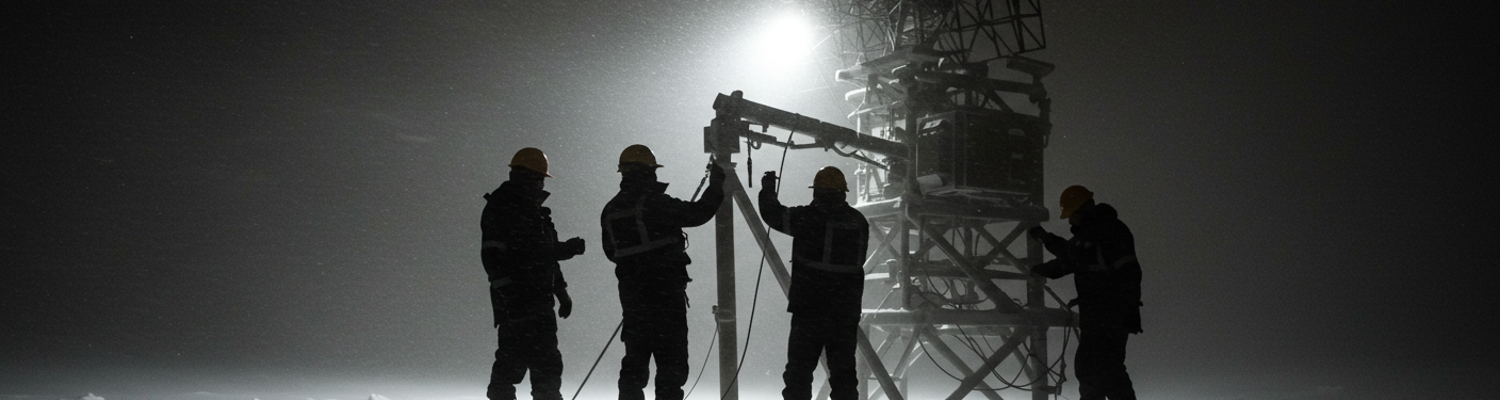
The alarm for Pylon Delta-Nine was a declaration of structural war. The on-duty commander of the 489th Radar Squadron followed emergency protocol for catastrophic failure. A full shutdown of the AN/FPS-118 transmitter. A site-wide alert. A damage control team, bundled in extreme cold weather gear, was dispatched into the polar night. Their headlamps revealed a scene of destruction. The massive geodesic radome, a structure of interlocking fiberglass panels, was coming apart. A visible depression in the dome’s curve centered directly over Pylon Delta-Nine. Popping sounds echoed across the compound. High-tensile steel bolts were shearing under loads they were not meant to bear. The pylon’s shift had transferred stress into the radome framework, causing a buckling failure that cascaded from one panel to the next. A large triangular section of the dome tore away and crashed onto the gravel below.
The arctic wind now had direct access to the station's core. That wind found the primary power trunk conduit, a heavily insulated, triple-sheathed cable bundle running from the power generation annex to the main operations block. The falling radome section, weighing several tons, crushed it. The main 4160-volt distribution lines were instantly shorted. A blue-white arc flashed, followed by the immediate thump of the station’s three primary diesel generators tripping offline. The entire Aurora Station complex plunged into absolute blackness. Emergency battery systems flickered on, casting mission control in a dim red glow. This was no longer a radar problem. It was a survival crisis. Without the main generators, the station had no heat, no water circulation, and no power for the OTH-B radar. The power system architecture was designed for redundancy, but not against a simultaneous, catastrophic short across all three main phases just outside the generator building.
The root cause analysis began under flashlight beams in the station’s engineering office. The site’s civil engineer, cross-referencing SIM data with maintenance logs, established the direct link. The warped door frames and cracked concrete were symptoms of a terminal diagnosis. The ground was failing. Environmental sensor logs confirmed the active layer of the permafrost had thawed to a depth nearly a meter greater than predicted in original geological surveys. The upper portions of the thermal piles were no longer anchored in permanently frozen soil but in a seasonal slurry of mud and ice with little structural strength. When investigators later examined the base of Pylon Delta-Nine, they found the pile had not broken. It had moved, subsiding several inches and shifting laterally as the once-solid ground around it lost cohesion.
The P-3C Orion aircraft from Patrol Squadron 49 (VP-49), flying out of Keflavik, were operating at the edge of their mission capabilities. Their tactical plot boards showed the last known position of the unidentified sonar contact. Their crews were seeding the frigid sea with AN/SSQ-53 DIFAR sonobuoys. A critical element of this system was the high-bandwidth data link, a stream of information relayed through a network of ground and satellite stations back to mainframe computers at Naval Facility Keflavik for deep signal processing. Suddenly, that link went dead. Onboard the lead Orion, the tactical coordinator’s screen for the AN/USQ-78B data link flashed from green to red. A systems check confirmed the aircraft’s equipment was functioning. The problem was external. The primary communications relay for their entire sector, the TR-280/SQR data-burst multiplexer, was housed at Aurora Station. With the power grid failure at the radar site, the relay was offline. The ASW patrols were now effectively blind. They could still receive raw audio from their sonobuoys, but the ability to process it collaboratively or triangulate the source with precision was gone. The acoustic technicians onboard, relying solely on their AN/AQA-7 DIFAR processor, were forced to analyze complex acoustic signatures on their own, a process that was slow and less accurate.
A post-crisis analysis by NAVAIR Systems Command pointed to a design flaw not in the aircraft, but in the operational architecture of the surveillance network. The decision to co-locate a vital ASW communications hub with an experimental Air Force radar station was a product of inter-service consolidation and budget efficiency. Archival planning documents show the assumption was that Aurora Station represented a hardened, reliable node. This consolidation created a single point of failure. The TR-280/SQR multiplexer was the primary conduit for all sonobuoy data traffic in the high north sector. Its failure severed the most effective tool the P-3 crews had. Internal engineering reviews from as early as 1975 had flagged the risk of relying on a single, non-redundant ground station for such a large operational area, but these concerns were set aside.
The paper trail for the disaster led investigators to a series of engineering Reference Information Papers used for Arctic construction. These papers were found to be fundamentally inadequate. A review of the specific papers used for Aurora Station’s design revealed they were adaptations of standards for temperate or sub-arctic climates, failing to account for the unique behavior of permafrost in the high Arctic. They provided tables for load-bearing capacity and thermal pile depth based on geological surveys that dramatically underestimated the potential thaw depth of the active layer. The documents contained no specific guidance on the compounding effects of structural subsidence combined with extreme wind loads on large structures like the radome. The foundation of Aurora Station, and by extension the communications link for the ASW patrols, was built upon flawed assumptions.
Declassified personnel rosters for Aurora Station reveal the skeleton-crew nature of the deployment. The team tasked with fixing a cascading structural and power failure was a small group composed of a handful of Air Force non-commissioned officers from the 489th Radar Squadron’s maintenance flight and a few civilian contractors. These were technicians whose expertise lay in the proprietary electronics of the AN/FPS-118 radar and the station’s power generation systems. The Air Force personnel provided systems knowledge, while civilian field representatives from Raytheon and General Electric were on-site for the specific radar and generator components they had designed. They were a maintenance crew, not a recovery unit.
The operational environment at the northern tip of Ellesmere Island was a constant physical assault. Ambient temperatures of -50 degrees Celsius, before accounting for wind chill, pushed materials and human beings past their designed limits. Maintenance logs from that winter detail the physics of this reality. Standard-issue lubricants for heavy equipment congealed into useless wax. The steel of tools and vehicle chassis became brittle, with reports of wrenches shattering under normal torque. Rubber and plastic components, like hydraulic lines and electrical insulation, lost all flexibility and cracked. For the damage control team, any work outside the heated modules was a race against time where exposed skin would freeze in less than a minute. The blizzard that accompanied the radome’s collapse created a total whiteout.
Aurora Station was one of the most remote land-based military installations on the planet. The nearest logistical support was at Thule Air Base in Greenland, hours away by a C-130 flight that could not operate in the prevailing blizzard conditions. Station supply manifests show they were stocked with spare electronic cards and fuel filters, but had no inventory of major structural components. There were no replacement sections for the main power trunk and no spare fiberglass panels for the geodesic radome. The engineering team was forced into a state of extreme improvisation. They had to salvage materials from other parts of the station to attempt a fix. The initial effort to restore power involved a plan to cannibalize heavy-gauge wiring from the vehicle maintenance bay’s welding equipment to bypass the crushed main conduit, a dangerous workaround that demonstrated their complete reliance on the limited resources at hand.
A review of the 489th Radar Squadron’s post-crisis engineering logs reveals the immediate objective was not the repair of the shattered AN/FPS-118. It was an act of electronic triage. The primary OTH-B array was a lost cause. The engineering team shifted focus to a more achievable goal: creating a functional, if limited, surveillance system from the station’s wreckage. Their target for resurrection was the station’s AN/MPN-14, a mobile Ground-Controlled Approach radar set normally used for guiding aircraft landings. It was a system never intended for broad-area surveillance, but its transmitter and receiver were intact within a secondary storage building that had escaped the main collapse. The effort began with a campaign of cannibalization. Technicians physically stripped hundreds of feet of high-gauge copper wiring from the walls of the powerless vehicle maintenance bay. They scavenged power inverters and capacitor banks from atmospheric research pods deemed non-essential. The team even used a cutting torch to remove sheet metal from a collapsed supply shed to build a makeshift housing for their new project.
The team discovered that the Arctic invalidated their most basic technical assumptions. A General Electric contractor attempting to solder a bypass onto a damaged power regulator found that the frozen metal of the chassis acted as a massive heat sink, wicking away the soldering iron’s energy and preventing the solder from reaching a liquid state. Standard lubricants on their small portable crane congealed, causing the gears to seize while attempting to lift a salvaged antenna pedestal. A report from the second week notes that a technician’s attempt to bend a length of salvaged copper tubing resulted in the metal, made brittle by the cold, snapping in two. Work could only be done in 15-minute intervals before the risk of frostbite became a certainty, forcing the team into a slow cycle of intense work followed by long periods of recovery inside one of the few remaining heated modules.
The core challenge was forcing incompatible systems to communicate. Archival notes from the lead Raytheon field representative document a 21-day ordeal to integrate the salvaged AN/MPN-14 with the station’s surviving communications gear. The ground-approach radar’s magnetron operated on a completely different frequency and required a specific power input. Two technicians spent nearly a week building a crude step-down transformer using salvaged coils from the disabled generator control units. The most difficult hurdle was the data stream. The radar’s raw output was analog, designed for a dedicated circular scope, while the TR-280/SQR data-burst multiplexer required a specific digital input. The solution was a display of on-site ingenuity. The team physically aimed a black-and-white video camera at the radar’s circular scope inside a heated container. They then fed that video signal into a repurposed analog-to-digital converter that had been part of a defunct weather monitoring experiment. The resulting data was a crude, low-resolution approximation of the radar picture, filled with noise and display artifacts.
The catastrophic structural failure at Aurora Station represented a direct and perilous strategic cost. Declassified records from COMSUBLANT show the immediate operational impact. The loss of the TR-280/SQR data-burst multiplexer severed the intelligence link for all P-3 Orion patrols hunting the unidentified Soviet submarine. The hunt was called off. The failure exposed a deep vulnerability in NATO’s layered defense, revealing that an isolated engineering oversight on land could create a massive, exploitable gap in naval surveillance hundreds of miles away.
The collapse forced a complete reassessment of Arctic infrastructure design. Post-failure analysis, detailed in internal Air Force civil engineering reports, identified the core problem as a blind adherence to inadequate doctrine. The disaster directly led to the development of new, more rigorous standards for all subsequent polar construction, including the North Warning System that would later replace the DEW line. These new protocols mandated deep-core geological surveys at all proposed sites to map the precise depth and composition of the permafrost. Future designs abandoned the simple thermal pile concept in favor of more complex cryo-anchor foundations, which actively refrigerated the ground around structural supports to ensure a permanently frozen and stable base. Redundancy became doctrine, with regulations explicitly forbidding the co-location of primary mission systems with critical support infrastructure.
The improvised radar system, unofficially logged as the 'jury-rigged array', was a monument to battlefield engineering. Its antenna was fixed to the roof of a shipping container and tilted towards the horizon. It offered less than a tenth of the range of the OTH-B. Its power was supplied by a web of exposed cables running directly from the barely-functioning emergency generator. Yet, after three weeks of continuous effort, the team established a flickering, unstable data link. The P-3 Orion patrols in the GIUK Gap did not regain the powerful, processed intelligence they once had. They were no longer completely blind. Their tactical screens now received a degraded, ghost-like image of air traffic, a single data point that restored a fraction of their situational awareness.