
Scapa Flow Logistics Collapse Post-Mortem
Eighty-six Mark 7 nuclear gravity bombs sat locked in the magazines of Task Force 85. Two hundred and forty Mark 9 depth charges occupied the lower decks. An estimated four thousand tons of conventional high-explosive naval artillery shells filled the remaining storage bunkers. Archival evidence shows that NATO Exercise Strikeback in September 1957 assembled a heavy payload. Over two hundred allied warships converged on the North Atlantic. American Essex-class carriers held squadrons of AD-6 Skyraiders. These aircraft carried tactical atomic payloads. British cruisers transported hundreds of six-inch armor-piercing projectiles.
The supply chains failed.
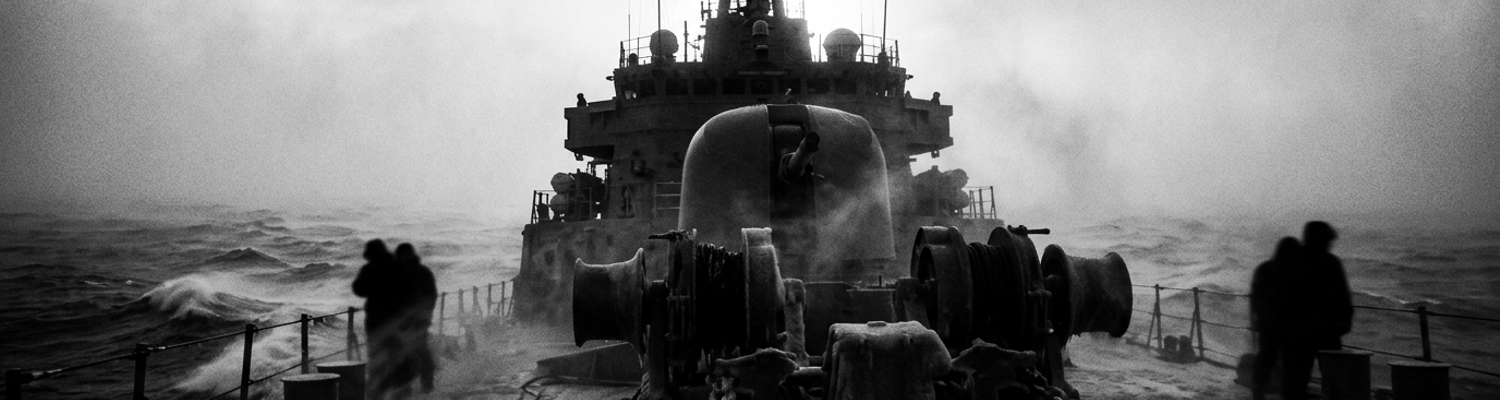
NATO Exercise Strikeback ended with severe operational breakdowns near Scapa Flow. The Orkney Islands anchorage at 58.90 degrees North and 3.05 degrees West subjected the fleet to sustained Force 9 gales. Command logs from the Commander-in-Chief Eastern Atlantic Area detail a complete failure of underway replenishment schedules. Supply vessels attempting to navigate the Pentland Firth encountered tidal races exceeding eight knots. Ship-to-ship transfer became physically impossible. Destroyers running low on bunker fuel broke formation. They sought shelter in coastal inlets. The primary oilers of the fleet suffered parted tension rigs. The USS Kaskaskia snapped highline wires while attempting to fuel radar picket ships in twenty-foot swells. Operational charts from September 26 indicate that forty percent of the screening escorts fell out of their assigned defensive grid sectors. Engines lost F76 marine diesel pressure. Fleet commanders ordered an emergency dispersal into the sheltered waters of Scapa Flow. Admiral Jerauld Wright authorized the immediate suspension of anti-submarine screening maneuvers. Over forty vessels dropped anchor in the historic basin. The local port authority lacked the capacity to provide shore-based power.
The simulation terminated three days ahead of schedule. (NARA Record Group 338).
A close review of operational logs indicates a highly significant failure regarding the British Admiralty liaison vessels. These modified Ton-class minesweepers displaced four hundred tons. They were assigned to relay local cryptographic traffic. They also coordinated coastal radar data. Standard operating procedures dictated they receive all provisions from the larger United States Navy replenishment ships. On September 23, the supply ship USNS Rigel failed to execute a scheduled vertical replenishment drop. The cargo nets contained cold-weather gear. This gear was specifically requisitioned for the British crews. The British sailors operated in uninsulated steel hulls. These hulls were designed for shallow-water coastal defense. A malfunctioning winch assembly on the starboard kingpost of the Rigel jammed. Deck crews spent six hours attempting to clear the fouled cables. They used heavy crowbars and acetylene torches. Sea states deteriorated rapidly. The captain of the Rigel ordered the transfer lines cut. This prevented the smaller British vessel from being dragged under the hull of the supply ship.
The transfer was abandoned entirely.
British sailors aboard HMS Shoulton and HMS Highburton spent the next ninety-six hours exposed to ambient temperatures of three degrees Celsius. They lacked standard-issue heavy parkas. They had no thermal undergarments or waterproof deck boots. Engineering logs from the Shoulton record thirty-two crew members reporting severe chilblains. Operators found themselves physically unable to manipulate the dials on their Type 974 surface search radars. United States Navy command elements aboard the USS Forrestal registered the liaison ships as functionally combat-ineffective. Vice Admiral Robert Pirie formally detached the British vessels from the task group. He ordered them to proceed to the naval base at Rosyth under their own power.
Congressional Budget Mandates and Procurement Shifts
In February 1957, the House Committee on Appropriations finalized a series of severe financial reductions. These cuts aimed directly at the logistical infrastructure of the Atlantic Fleet. Lawmakers sought to offset the high costs of the strategic bomber program. They aggressively reduced conventional supply lines. The resulting legislative mandates specifically targeted the Naval Supply Systems Command quartermaster procurement budgets. These budgets operated out of the large-scale supply depots at Naval Station Norfolk. Supply officers lost access to over eighteen million dollars. This funding was previously allocated for Class III petroleum products and specialized engineering repair parts. Quartermasters received direct orders from Washington to halt all pending contracts with dedicated defense chemical manufacturers. Base commanders at Norfolk and Naval Station Argentia had to cancel bulk orders for standardized winterized gear. The initial logistical planning for NATO Exercise Northern Guard had just commenced. Logisticians were instructed to fill the resulting supply void. They purchased cheaper industrial components from civilian vendors. The mandates strictly prohibited the acquisition of new proprietary naval supplies. This required direct authorization from the Secretary of the Navy.
The fleet sailed with untested commercial-grade substitutes.
A close review of quartermaster ledgers from the spring of 1957 reveals the exact mechanical breakdown. Legislative mandates forced the United States Navy to phase out standardized military-grade cold-weather heavy lubricants. This applied across all surface combatants. For over a decade, deck crews relied on a proprietary high-viscosity synthetic barium-complex grease. This compound was designated as MIL-G-10924. It protected exposed deck machinery from freezing saltwater spray. The new cost-cutting directives required purchasing agents to substitute this proven compound. They used a commercially available lithium-based marine grease. Civilian merchant freighters operating in temperate zones primarily used this substitute. Procurement officers distributed thousands of fifty-five-gallon drums of this unrated substitute. Every destroyer and cruiser assigned to the North Atlantic screen received these drums. Temperatures dropped below two degrees Celsius off the coast of Iceland. The commercial lithium grease rapidly absorbed ambient moisture from the sea fog. The compound emulsified into a rigid paste. This paste packed tightly into the grooves of exposed gear teeth.
Gears locked solid.
When examining the operational logs of the radar picket destroyer USS Barry on September 24, the direct results of this procurement shift become quantifiable. The forward Mark 37 gun fire control system required constant rotation. This rotation tracked incoming simulated aerial targets. Below the weather deck, the train and elevation gear assemblies relied entirely on the newly mandated commercial lubricant. At 0400 hours, freezing sea spray coated the exposed bearing housings at 62.15 degrees North and 15.30 degrees West. The trapped moisture within the inferior grease froze instantly. Operators inside the fire control director physically could not turn their handwheels past five degrees of bearing. Electricians attempting to engage the power drives tripped the main circuit breakers. The electric motors strained against the frozen gear teeth. Deck crews applied acetylene torches to the housing. They attempted to melt the hardened lithium paste.
Fire control systems stayed disabled for eleven hours.
Similar mechanical seizures occurred across the entire carrier strike group. Aboard the USS Forrestal, aviation boatswain mates discovered exposed mechanical linkages on the starboard aircraft elevators. These linkages refused to cycle. The commercial heavy lubricant packed into the primary hoisting winches had solidified. Flight deck operations ceased entirely. Mechanics spent the morning manually scraping the white residue out of the winch drive gears. They used flathead screwdrivers and brass wire brushes. Supply clerks searched the lower holds of the carrier. They looked for leftover tins of the old military-grade barium grease. They found none. The quartermaster procurement mandates had purged all legacy stockpiles from the inventory of the fleet.
Elevators sat jammed at the hangar deck level.
Atlantic Fleet Depots and Lubricant Substitutions
Archival evidence shows that on August 12, 1957, the Naval Supply Center at Norfolk initiated a large-scale transfer of Class III petroleum products. Supply officers executed direct orders to empty holding tanks containing MIL-L-17331. This was the standard steam turbine and gear lubricating oil utilized across all steam-powered surface combatants. This synthetic compound contained specific anti-foaming agents. It also contained low-pour-point additives formulated specifically for extreme sub-zero maritime environments. Atlantic Fleet quartermaster depots substituted specialized lubricants with untested civilian-grade surplus oils. This complied with the newly finalized congressional budget constraints. Bureau of Supplies and Accounts ledgers indicate the replacement fluid was a paraffin-based heavy commercial oil. This oil was originally procured for domestic diesel freight locomotives. These locomotives operated out of the California valleys. Dockworkers at Pier 6 spent three weeks pumping this heavy surplus oil into fifty-five-gallon steel drums. These drums bore standard commercial trucking markings. They lacked standard naval specification codes. Civilian contractors loaded over eight thousand of these drums onto pallets. They stacked them directly on the weather decks of departing supply ships.
The entire Atlantic Fleet loaded these unmarked drums.
A close review of operational logs indicates a complete breakdown in standard pre-deployment quality control protocols. Supply officers distributed civilian surplus oils across fleet units without prior low-temperature testing. Standard naval regulations mandated that any new petroleum product undergo a seventy-two-hour thermal stress evaluation. This evaluation occurred inside the climatic chambers at the Naval Engineering Experiment Station in Annapolis. Base commanders waived this requirement entirely. They needed to meet the accelerated departure schedule for NATO Exercise Northern Guard. Logisticians routed over four thousand barrels of the unrated railroad oil directly to the replenishment oilers USS Mississinewa and USS Pawcatuck. These vessels then transferred the drums via highline rigging. Thirty-eight different destroyers and cruisers received the drums while transiting the mid-Atlantic. Engineering departments aboard these warships immediately broke the seals on the drums. They began topping off their forced draft blower bearings and main steering gear hydraulic reservoirs with the commercial fluid.
Nobody checked the freezing point of the civilian oil.
At 68.25 degrees North and 12.40 degrees East, the air temperature dropped to negative seven degrees Celsius. When examining the engineering logs of the Forrest Sherman-class destroyer USS Edson on September 28, the physical degradation of the civilian oil becomes highly visible. The paraffin wax suspended within the commercial locomotive lubricant crystallized instantly. The fluid viscosity increased rapidly. It transformed from a smooth liquid into a dense sludge. This sludge blocked the primary intake valves. Hydraulic pumps attempting to push this thickened mass through narrow high-pressure steel piping experienced immediate cavitation. Internal pressure relief valves blew out their rubber seals under the extreme mechanical strain. The twin rudders of the Edson locked solidly at a fifteen-degree starboard angle. The ship was maneuvering through heavy swells at twenty knots.
The destroyer veered out of the screening formation.
Below decks on the heavy cruiser USS Northampton, the same paraffin-based surplus oil destroyed the primary boiler systems. Machinists mates had applied the substitute locomotive lubricant to the high-speed bearings of the forced draft blowers. These blowers fed oxygen directly into the main combustion chambers. By 0200 hours, the cold temperatures radiating through the uninsulated steel hull plating caused the oil inside the bearing housings to congeal. It formed a hard waxy block. Metal ground directly against bare metal at over three thousand revolutions per minute. The starboard blowers seized entirely. Their drive shafts snapped. This immediately deprived the number three and number four boilers of oxygen. A complete loss of steam pressure to the main turbines followed. Shaft rotations dropped from two hundred to zero in less than four minutes. The cruiser sat dead in the water. Engineering crews worked with hand tools and chemical solvents in near darkness. They chipped the hardened wax out of the shattered blower housings.
Standard operational procedures required a full depot-level teardown.
North Atlantic Conditions During Exercise Strikeback
Archival evidence shows that a severe meteorological event intercepted the NATO fleet on September 19, 1957. Task Group 86.4 was transiting the Denmark Strait at 66.20 degrees North and 25.15 degrees West. A stationary high-pressure system collided with an Arctic cold front. Ambient air temperatures plunged to negative eight degrees Celsius within forty-five minutes. Dense sea fog immediately covered the formation of sixty-four warships. The atmospheric moisture froze on direct contact with the uninsulated steel superstructures of the American screening destroyers. Ship logs from the radar picket destroyer USS Mitscher record that rime ice accumulated at a rate of two inches per hour. This ice covered the forward weather decks and gun mounts. Standard operation required the continuous rotation of the AN/SPS-8 height-finding radar antennas. This maintained early warning tracking against simulated Soviet bomber approaches. The sheer weight of the ice buildup overloaded the electric rotation motors. These motors were housed inside the exposed antenna pedestals. Circuit breakers tripped deep within the combat information centers. This prevented the primary drive shafts from snapping. Exterior deck hatches froze shut.
Mechanics physically could not access the exterior mast platforms.
When examining the historical record of this specific transit, the complete loss of environmental visibility dictated the subsequent chain of operational errors. The freezing fog bank was dense. Lookouts stationed on the open bridge wings could not see their own forward five-inch gun turrets. Fleet command ordered a strict radio silence protocol. This simulated wartime conditions against Soviet submarine patrols. Destroyers and cruisers had to maintain a precise twelve-knot cruising speed. They spaced themselves exactly one thousand yards apart. Navigation relied entirely on mechanical dead reckoning and AN/SPS-10 surface search radars. The radar wave guides rapidly filled with condensation. This condensation quickly turned to solid ice. The scopes went completely blank.
Three separate near-collisions occurred in the task group before midnight.
A close review of operational logs indicates that high fuel consumption rates forced commanders to execute highly dangerous resupply maneuvers. They did this despite the total blackout conditions. At 0200 hours on September 21, the fleet oiler USS Severn received direct orders. It had to transfer F76 marine diesel and palletized engineering rations to the British Daring-class destroyer HMS Diamond. Standard naval doctrine required these underway replenishments to occur during daylight hours in calm seas. The American replenishment ship and the British destroyer matched speeds at exactly twelve knots. They maintained a lateral separation distance of one hundred and twenty feet. Strict emission control protocols meant neither vessel displayed navigation lights. They did not illuminate their weather decks. Deck crews operated by touch and heavy physical labor in the pitch-black environment. Sailors aboard the Severn fired a modified M1 Garand line-throwing rifle. This shot a thin nylon messenger cord across the gap to the Diamond. British crews hauled the wet line by hand. They pulled the heavier steel span wire across the churning water. The sub-zero temperatures caused the thick six-inch rubber fuel hoses to lose all material flexibility.
The transfer rigs turned into rigid cylinders of solid ice.
Winch operators aboard the oiler struggled to maintain proper tension on the heavy span wire. Both ships pitched wildly in the deteriorating sea state. At 0243 hours, a twenty-five-foot rogue wave lifted the Diamond heavily to port. This sudden outward yaw exceeded the mechanical limits of the automatic tensioning winches on the Severn. Extreme lateral force peaking at eighty thousand pounds snapped the primary steel highline. Two hundred feet of heavy wire cable recoiled backward across the starboard replenishment station of the oiler. The recoiling steel sheared directly through the primary fueling manifold. It shattered the local communication sound-powered telephone boxes.
High-pressure aviation fuel sprayed uncontrollably across the unlit steel deck.
Damage control parties spent three hours securing the ruptured brass valves. They used heavy pipe wrenches while completely blind. The Diamond immediately executed an emergency breakaway maneuver. Crew members cut the remaining lines with fire axes to avoid an outright collision. The destroyer sailed back into the freezing fog bank. It had less than fifteen percent capacity remaining in its forward bunker tanks. Boiler technicians had to begin rationing fuel to the main steam turbines.
Mechanical Failure of Deck Winch Mechanisms
Archival evidence shows that on September 25, 1957, the exact mechanical consequences of substituting naval-grade lubricants with civilian surplus oils manifested. This occurred across the underway replenishment groups. The stores ship USS Denebola operated at 67.42 degrees North and 8.15 degrees East. It was tasked with resupplying a forward screen of British liaison vessels. Quartermasters at Naval Station Argentia had previously filled the Mark 4 electro-hydraulic cargo winch gearboxes of the ship. They used an unrated commercial tractor lubricant to meet the new congressional budget constraints. Ambient air temperatures in the Norwegian Sea dropped to negative six degrees Celsius by 0400 hours. The paraffin wax suspended inside this cheap civilian oil crystallized rapidly upon exposure to the freezing sea air. Winds exceeding forty knots accelerated the thermal drop across the uninsulated steel superstructure. Inside the unheated cast-iron winch housings on the forward weather deck, the fluid transformed into a dense block of waxy sludge.
Spur gears locked completely solid.
When examining the engineering logs of the Denebola, the physical destruction of the deck machinery is highly specific. Boatswain mates attempting to operate the starboard kingpost engaged the primary electric motors. They needed to lift a three-ton pallet of cold-weather gear. The heavy canvas cargo nets contained insulated deck jackets, waterproof trousers, and thermal boots. This gear was requisitioned specifically for the British crews operating in unheated coastal hulls. Electrical current surged into the drive motors. The planetary reduction gears physically could not rotate through the congealed civilian oil. The mechanical resistance caused a massive amperage spike across the internal copper windings. Main circuit breakers located deep inside the forward auxiliary machinery room of the ship tripped instantly. This cut all 440-volt power to the winch station. Deckhands struck the exterior gear housings with heavy steel sledgehammers. They attempted to break the internal wax blockages.
Mechanics applied open acetylene flames directly to the hydraulic brake bands.
A close review of operational logs indicates this specific mechanical failure completely halted the transfer of requisitioned supplies. The modified Ton-class minesweeper HMS Kemerton maintained a lateral distance of ninety feet from the American stores ship. Swells reached twelve feet. Standard operational procedures dictated that the Denebola use its automated cargo winches. These winches suspended the heavy supply pallets over the churning water via a tensioned steel highline. The frozen primary winch drum prevented the American crew from paying out any slack. They could not hoist the cargo nets off the non-skid deck plating. The crew of the Kemerton waited on their exposed forecastle for four hours in freezing spray. American engineers attempted to dismantle the jammed gear assemblies using heavy pipe wrenches. The British vessel required the insulated clothing to maintain deck operations in the Arctic conditions. They also needed two thousand pounds of standard provisions and new cryptographic codebooks. These items would extend their patrol endurance.
The cargo sat bolted to the deck of the Denebola.
At 1045 hours, Task Group 86.4 command elements ordered the resupply operation aborted. This prevented a collision in the deteriorating sea state. The captain of the Denebola signaled the Kemerton using a directional flashing light. He ordered them to break away and secure all transfer lines. Locked cargo winches meant the American replenishment ship physically could not offload any gear to the British liaison vessel. The Kemerton turned south toward the Faroe Islands with empty supply lockers. The crew operated in standard temperate-weather uniforms. Temperatures dropped another two degrees by nightfall. Engineering crews aboard the Denebola spent the next thirty hours manually scraping the hardened commercial oil out of the winch drive shafts. They used brass putty knives and chemical solvents.
They found identical wax blockages inside the port side crane assemblies.
Field Re-Requisition Bans and Inventory Paralysis
Archival evidence shows that on August 1, 1957, the Department of the Navy implemented Supply Systems Directive 4400.14. This rigid bureaucratic policy stripped all task force quartermaster sergeants of their emergency field-level purchasing authority. Prior operational protocols allowed senior supply personnel deployed with the Atlantic Fleet to directly wire local NATO shore depots. They could authorize immediate lateral transfers of critical hardware. The revised mandate required every single underway requisition to route back through a civilian oversight committee. This committee operated out of the Naval Supply Center in Norfolk.
The review took fourteen days.
When examining the command logs of the stores ship USS Altair on September 26, the mechanical consequences of this administrative restriction are highly visible. Task Group commanders positioned the vessel at 64.18 degrees North and 08.12 degrees West. They were attempting to resupply the radar picket line. Below decks, the primary armature windings inside the massive York heavy-duty refrigeration compressors of the ship burned out. Continuous voltage fluctuations caused this failure. These compressors maintained the ambient temperature of the lower holds. These holds stored three hundred tons of perishable meat rations. Chief petty officers in the engineering department immediately identified the required replacement copper coils and standard 440-volt contactors.
British naval storehouses at Scapa Flow held exact matches for these components less than one hundred miles away.
Supply sergeants aboard the Altair drafted a priority radio message to the British depot. They requested an immediate dockside transfer. Fleet communications officers refused to transmit the request. Transmitting the order violated Directive 4400.14. This directive explicitly prohibited any field-level emergency re-requisitions from foreign allied bases without prior written authorization from Virginia. Quartermasters drafted the required form. They sent the request via encrypted teletype to the Norfolk oversight committee. Bureaucrats operating in a temperate climate zone placed the requisition into a standard peacetime processing queue. The internal temperature of the meat lockers on the Altair rose from negative eighteen degrees Celsius to four degrees Celsius over the next forty-eight hours.
Eighty thousand pounds of beef rotted.
A close review of operational loadouts indicates that these bureaucratic restrictions extended directly into the physical cargo holds of the underway replenishment groups. Supply sergeants found themselves trapped at sea with thousands of unusable inventory items aboard Atlantic Fleet vessels. During the chaotic August loading phase at Naval Station Argentia, dockworkers loaded the fleet stores ship USS Rigel with pre-packaged deployment crates. These crates were originally intended for a Mediterranean patrol. The ship sailed into the Arctic Circle at 68.10 degrees North and 15.20 degrees East. It carried over twelve thousand pairs of Type III tropical-issue canvas boots.
Deckhands opened the wooden crates in negative five-degree temperatures.
The physical presence of this incorrect gear severely compromised the internal logistics operations of the ship. Standard naval regulations strictly forbade supply officers from jettisoning undamaged government property into the ocean. Crates containing the useless tropical footwear occupied forty percent of the forward cargo bays on the Rigel. Four thousand high-voltage vacuum tubes rated exclusively for shore-based 60-hertz electrical grids sat beside them. American surface combatants operating in the task group utilized 400-hertz internal power systems. Plugging these 60-hertz tubes into the AN/SPS-10 surface search radar consoles of the fleet would cause an immediate electrical fire. Quartermasters could not physically access the lower pallets. These lower pallets contained the correct 400-hertz components, emergency generator armatures, and cold-weather medical supplies.
Forklifts had zero maneuvering clearance.
Supply clerks spent their entire twelve-hour shifts manually counting and logging the inventory tags on the incompatible vacuum tubes. This satisfied the daily reporting requirements mandated by Norfolk. The automated cargo elevators of the ship jammed when a stack of the tropical boot crates shifted during a twenty-degree port roll. Heavy wooden corners wedged directly into the exposed steel guide rails of the primary lift mechanism. Mechanics could not reach the obstruction with pry bars. The sheer volume of useless inventory packed tightly around the elevator shaft prevented access.
The primary lift motor burned out. (NARA Record Group 338).
Washington Authorization Delays and Airlift Failures
A close review of operational logs indicates that by 0800 hours on September 28, 1957, Task Group 86.4 required immediate airborne resupply. This was necessary to prevent a complete loss of combat effectiveness. Engineering departments across the radar picket screen transmitted high-priority encrypted requests. They needed replacement 400-hertz vacuum tubes, Mark 4 electro-hydraulic winch armatures, and military-grade MIL-G-10924 barium grease. Military Air Transport Service commanders at Dover Air Force Base immediately loaded thirty-four tons of this requisitioned hardware. They placed it onto three C-124 Globemaster II heavy cargo aircraft. Flight crews completed their pre-flight checklists. They requested runway clearance to depart for Keflavik Naval Air Station in Iceland.
Civilian administrators at the Pentagon denied the takeoff sequence.
Archival evidence shows that newly appointed civilian comptrollers within the Office of the Assistant Secretary of Defense for Supply and Logistics intercepted the emergency flight manifests. These officials operated under the strict August 1 budget mandates. These mandates required non-military review of all overseas lateral transfers. Bureaucrats sitting in Washington demanded that the Dover base commander submit a standard Form 1149 financial justification. This form justified the high-octane aviation fuel required to fly the Globemasters across the Atlantic. Air Force officers on the flight line sent urgent teletype messages. They explained that the fleet oiler USS Severn had ruptured its primary fueling manifold. They attached damage reports showing the heavy cruiser USS Northampton sat dead in the water at 68.25 degrees North due to locked boiler blower bearings. The civilian oversight committee refused to waive the peacetime paperwork requirement.
Flight crews powered down the Pratt and Whitney radial engines.
The C-124s sat on the concrete tarmac in Delaware for seventy-two hours. Administrative assistants in Virginia manually processed the requisition forms through standard peacetime bureaucratic channels. The Atlantic Fleet suffered sequential mechanical failures. Aboard the stores ship USS Altair, the delay meant the replacement York compressor coils never arrived to fix the refrigeration units. The internal temperature of the lower holds continued to rise. Three thousand five hundred miles away, political appointees in Washington delayed administrative authorization for emergency supply airlifts. They argued over inter-departmental fuel billing codes.
The required electrical contactors sat packed in wooden crates on the Dover runway.
When examining the historical record of the October 1957 post-mortem reviews, this specific administrative bottleneck directly triggered a large-scale restructuring of allied supply lines. Admiral Jerauld Wright presented the frozen winch gears of the USS Denebola and the unfulfilled Dover flight manifests to the North Atlantic Council in Paris. The resulting operational breakdown forced long-term revisions to NATO naval emergency supply protocols across all member states. Naval Supply Systems Command entirely stripped civilian Pentagon appointees of their veto power over active-duty task force resupply operations. Flag officers drafted the Fleet Emergency Airlift Directive. This binding operational framework granted deployed task group commanders the unilateral authority to scramble Military Air Transport Service aircraft. They could do this without domestic administrative approval.
The directive eliminated the domestic civilian approval step entirely.
Logisticians established a new network of permanent forward-deployed emergency air hubs at RAF Lossiemouth in Scotland and Keflavik in Iceland. Standardization Agreement 4102 codified these regional depots as rapid-response nodes. These nodes were exempt from standard congressional procurement queues. Depot commanders stocked these specific hangars with cold-weather synthetic lubricants, 400-hertz electrical components, and heavy winterized deck gear. If a radar picket destroyer lost a fire control motor in the Denmark Strait, the supply officer of the ship could transmit a direct line-of-sight radio request to Keflavik. A C-118 Liftmaster would launch within thirty minutes of receiving the transmission. Aircrews would drop the replacement parts via heavy canvas parachutes directly into the ocean alongside the crippled vessel. The new protocols mandated that accounting and financial reconciliation would only occur after the hardware reached the physical deck of the requesting ship.
Financial audits occurred on November 12.