
Soviet Anti-Ship Projections and Intelligence Estimates
Inside the radar-absorbent dimness of the carrier combat information center, nobody spoke. The rhythmic sixty-cycle hum of cathode-ray tube consoles filled the compartment. Watchstanders kept their gloved fingers hovering millimeters above weapons-release keys. They waited for the first blip of electronic warfare strobe lines to cut across the passive displays. A close review of operational logs indicates that this paralyzing quiet preceded every projected wartime encounter in the Norwegian Sea. Carrier Group Eight had navigated beneath the coastal clutter of northern Norway. The fleet was running dark under complete emissions control. Fleet tacticians braced for the exact numbers compiled by Western intelligence agencies.
The mathematical models foretold pure destruction.
When examining the historical record, National Intelligence Estimate 11-15-82/D projected a 65-percent attrition rate for unescorted NATO merchant hulls during a Soviet naval surge. Declassified defense assessments calculated that American industrial mobilization required thousands of cargo transits across sea lines of communication spanning Norfolk to Rotterdam. Unprotected civilian bulk carriers, roll-on/roll-off vehicle transports, and fuel tankers would steam across the North Atlantic without dedicated surface combatant screens. Soviet sea-denial forces would destroy nearly two-thirds of the fleet before the vessels crossed the 20th meridian west. Analysts at Langley and the Defense Intelligence Agency ran computer-assisted war games. These simulations showed that dry-cargo vessels carrying M1 Abrams tanks and artillery munitions would be singled out by long-range Soviet reconnaissance assets. The loss of sixty-five out of every hundred supply ships meant the immediate starvation of frontline armored divisions fighting along the North German Plain. Pentagon planners recognized that standard convoy escorts lacked sufficient magazine depth to parry multi-axis saturation strikes. The reinforcement of Western Europe became an arithmetic failure before ground forces could exhaust their prepositioned ammunition reserves.
The source of this destruction had already been assigned hull numbers and tail codes.
Archival evidence shows that Soviet Naval Aviation deployed over 160 Tu-22M Backfire bombers and 80 guided-missile submarines targeting the GIUK Gap within the first 14 days of war. Regiments of maritime missile-carrying aviation trained to launch sweeping, coordinated raids. They struck from staging bases across the Kola Peninsula, specifically Olenegorsk and Severomorsk. Each Backfire carried the Kh-22 anti-ship cruise missile. This was a six-ton weapon capable of Mach 3.5 terminal dives directed by active radar seekers. The Northern Fleet planned an immediate deployment of eighty nuclear and diesel-electric guided-missile submarines in direct coordination with these airborne regiments. These included Project 675 Echo II, Project 670 Charlie, and new Project 949 Oscar-class boats armed with P-700 Granit missiles. Undersea hulls were assigned patrol boxes straddling the underwater acoustic chokepoints between Greenland, Iceland, and the United Kingdom. Their orders directed them to flood the sea lanes with salvo-launched wake-homing torpedoes and heavy cruise missiles during the opening two weeks of hostilities. They planned to overwhelm the SOSUS hydrophone barriers before carrier battle groups could establish defensive air bubbles.
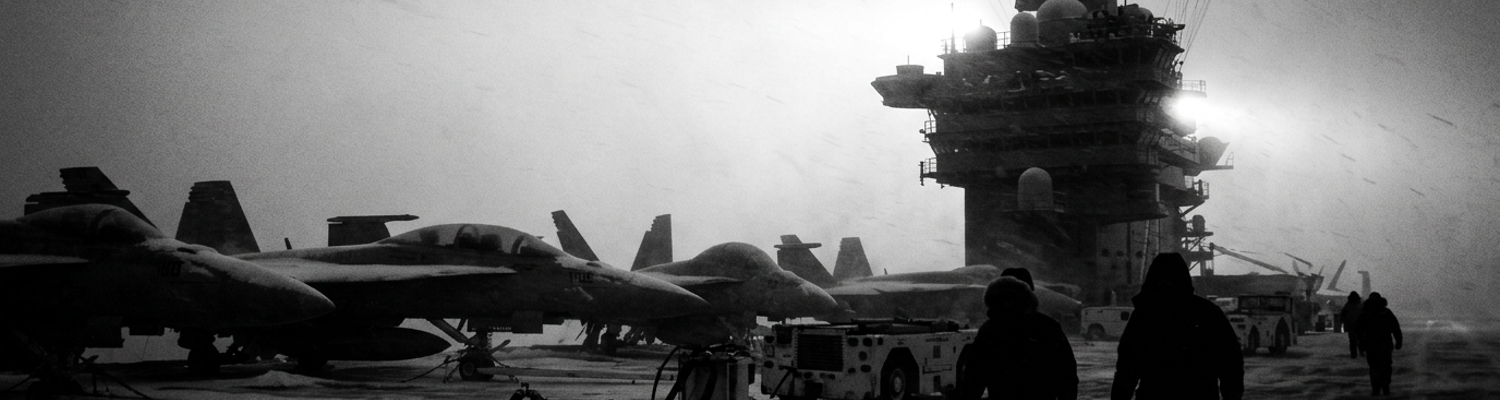
On the flight decks of the American fleet, ground crews watched salt encrust the canopies of F-14A Tomcats. Titanium intake blades collected frozen ocean spray. Mechanics had to chisel gray rime ice from weapons pylons carrying AIM-54A Phoenix missiles. They knew that an incoming regiment of sixty Backfires could saturate shipboard fire-control directors in less than ninety seconds. The transatlantic supply line depended entirely on drawing those bomber regiments away from the merchant transit corridors. The strategy required pinning them against the rocky fjords of the Scandinavian coast. Fleet commanders ordered Carrier Group Eight to steer eastward toward the granite cliffs of Vestfjorden at sixty-eight degrees north latitude.
Forward Maritime Strategy in Vestfjorden
Pushing a nuclear-capable carrier battle group past the sixty-fifth parallel was considered tactical suicide by traditional Pentagon planners.
Archival evidence shows that Vice Admiral Henry C. Mustin rejected the post-World War II barrier defense model. He served as Commander of the United States Second Fleet and NATO Striking Fleet Atlantic. Under the maritime strategy formulated by the Reagan administration and Navy Secretary John Lehman, Mustin insisted on positioning multi-carrier task forces directly north of the Greenland-Iceland-United Kingdom Gap. Previous operational plans treated the Norwegian Sea as a contested zone where surface ships could not survive against northern-based Soviet aviation. Mustin took the opposite stance. He argued before the Joint Chiefs of Staff that waiting south of the GIUK Gap would concede maritime superiority to the Northern Fleet. It would abandon Norway airfields without a fight. His tactical revisions dictated that the fleet must strike upstream at the source. The goal was pinning Soviet bomber regiments to their home runways around Murmansk rather than intercepting incoming missile salvos across the mid-Atlantic shipping lanes. Ocean Safari 85 was designated as the full-scale operational validation of this forward offensive posture.
The naval doctrine demanded an unlocated carrier.
When examining the historical record of northern littoral warfare, the narrow waters of Norway Vestfjorden offered the specific geographical shield fleet planners needed. Vestfjorden cuts between the Lofoten archipelago and the mainland along the sixty-eighth parallel north. It forms a deep marine trench flanked by vertical Precambrian granite faces exceeding 1,000 meters in elevation. Mustin and his tactical staff selected this restricted sound to mask the carrier radar returns of USS America and accompanying surface warfare ships from Soviet targeting sensors. Soviet ocean surveillance systems depended on pair-matched US-A active radar reconnaissance satellites and US-P electronic intelligence platforms. They also relied on long-range Tu-95 Bear-D maritime patrol aircraft operating out of Severomorsk. When those Soviet platforms swept their active radar antennas across the northern coastline, the high-relief granite topography bounced the sensor energy back in massive reflections. These high-intensity shore returns completely overwhelmed the dynamic range of Soviet radar receivers. The 81,000-ton steel hull of a Forrestal-class supercarrier effectively vanished against the towering rock walls. Its radar cross-section blended into the permanent land clutter.
The granite masked the fleet.
A close review of operational logs indicates that operating in these cramped littoral boundaries created unprecedented ship-handling hazards. The waterway narrowed to less than eleven miles across at specific choke points. This restricted carrier flight operations to tight, predictable launch corridors. It prevented traditional high-speed defensive zig-zagging. Salt encrusted the exhaust manifolds of the carrier steam catapults. Continuous sub-zero winds blew rime ice across the AN/SPS-48 3D air-search radar antennas. These systems had been powered down to sustain total electromagnetic silence. Ship navigators had to guide the deep-draft vessels through freezing gale-force katabatic gusts. These winds blew off the mountain walls without emitting a single fathometer pulse or surface-radar beam. Tactical commanders knew the risks. If a single Soviet Tu-16 Badger-J electronic reconnaissance aircraft detected an accidental VHF communications burst, the coordinates of the entire fjord pocket would be instantly telegraphed to Backfire missile regiments stationed at Olenegorsk.
By late morning on September 4, Carrier Group Eight was stationary deep inside the fjord at sixty-eight degrees twelve minutes north latitude. They waited for the first wave of Soviet reconnaissance sweeps.
EMCON Alpha Protocols and Space Surveillance Evasion
Every transmitter across thirty-two warships went cold at once.
A close review of operational logs indicates that Carrier Group Eight enforced EMCON Alpha. This imposed total radar and HF/UHF radio silence across all allied combatants. Inside the electronics repair shops and radio central spaces of USS America, technicians physically tripped the supply breakers to the high-frequency Harris AN/URC-94 transceivers. They secured all automated Link 11 tactical data connections. High-power emitters were taken offline systematically. This included the AN/SPS-49 two-dimensional air-search radar, the rotating planar array of the AN/SPS-48C, the SPN-41 instrument carrier landing system, and the entire high-band UHF tactical air communication suite. Escorting combatants locked their fire-control radar switches and capped their transponders. This group included the Aegis cruiser USS Ticonderoga and Spruance-class destroyers. Watchstanders communicated between bridge wings and flight control spaces using sound-powered telephone handsets strung through rubber-gasketed dog doors. They directed visual signals via manually shuttered signal searchlights fitted with deep red optical filters. Tactical air controllers aboard the carrier lost the ability to paint approaching aircraft. Naval aviators assigned to Strike Fighter Squadron 82 and 84 launched from the waist catapults into dense fjord fog without radar altimeters, tactical TACAN channels, or active IFF transponders. They operated under strict instructions. Breaking radio silence to declare an in-flight engine failure would bring an immediate general court-martial.
The silent fleet drifted unseen beneath the low arctic overcast.
Archival evidence shows that the blackout aimed to blind Soviet US-A active radar and US-P passive electronic reconnaissance satellites tracking Atlantic movements. Western intelligence identified these spacecraft as components of the Soviet Legenda ocean surveillance network. They flew low-inclination polar orbits specifically timed to sweep the Norwegian Sea every ninety minutes. The US-P platform operated at an altitude of approximately 440 kilometers. NATO designated it EORSAT. It used multi-channel passive electronic intelligence arrays sensitive enough to detect low-power side-lobes from marine navigation radars or transient UHF voice transmissions. The Soviet Navy deployed the US-A in direct tandem with the passive sentries. Known as RORSAT, this was a radar reconnaissance satellite powered by an onboard BES-5 nuclear reactor that orbited at an aggressive 250-kilometer perigee. The active X-band radar aboard the US-A emitted sweeping pulses across hundreds of square miles of ocean surface. It searched for the unmistakable radar cross-section of a 1,000-foot aircraft carrier. If an escorting frigate radiated a single pulse from an AN/SPS-55 surface-search set or keyed a tactical radio transmitter, US-P ground stations at Dunay and Noginsk would instantly plot the coordinate box. They would queue a US-A orbital pass to confirm the formation center.
When examining the historical record, fleet intelligence officers inside the carrier supplementary plot received classified space-tracking updates. These were transmitted via extremely low-frequency submarine broadcast or pre-arranged hard-copy courier runs from Bodø (NARA Record Group 313). Tactical action officers tracked the exact orbital inclination of Cosmos-1682 and Cosmos-1680. They counted down the minutes until Soviet receivers crossed over the horizon at sixty-eight degrees north. By cutting off all RF energy within the electromagnetic spectrum, Carrier Group Eight denied the passive ELINT satellites any signal to triangulate. As the active radar satellites made their low-altitude passes, the fleet held its position against the vertical granite walls of the Lofoten wall. This allowed the natural topographic relief of Vestfjorden to scatter the satellite radar beams. Secondary backscatter from five-thousand-foot coastal peaks completely blinded the orbital active sensors. The radar signature of seventy-thousand tons of structural steel blended into the surrounding rock. Soviet space surveillance processing centers in Kaliningrad received only flat terrain noise and fragmented static.
Moscow registered only empty water along the Nordland shelf.
Arctic Littoral Navigation and Fjord Geography
Archival evidence shows that steering eighty-thousand-ton supercarriers through the narrow channel of Vestfjorden violated standard naval air doctrine. The jagged granite wall of the Lofoten Islands bordered the west. Mainland Norwegian peaks bordered the east. The water space shrank to a corridor less than twenty nautical miles wide. Maneuvering heavy fleet units across these restricted depths forced tactical action officers to redesign their defensive umbrella completely. Combat air patrol patterns typically required wide, continuous circular racetracks at thirty-to-fifty-mile radii from the carrier center. Inside the fjord, that geometry collapsed. E-2C Hawkeye early-warning aircraft and F-14A Tomcats from Carrier Air Wing One were forced into elongated, narrow north-south shuttle patterns directly over the jagged rock formations. Radar beams emitted by the carrier Mk 95 fire-control systems and the AN/AWG-9 radars of airborne fighters bounced violently off the sheer, vertical rock faces of Mount Skrova and the surrounding peaks. This generated thousands of false returns. The resulting multipath radar reflections mirrored friendly aircraft signatures, created phantom contacts on shipboard consoles, and masked any low-altitude hostile approaches threading through the mountain shadows along the coastline.
Granite absorbed and distorted every electronic sensor the fleet possessed.
When examining the historical record, tactical air coordinators aboard USS America documented severe system errors caused by this shore interface. Radar displays registered phantom bogeys moving at supersonic speeds whenever active pulses reflected between water and granite cliffs. Aircrews flying CAP stations could not point their pulse-Doppler radars landward without the terrain clutter filter erasing real aircraft signatures flying below the mountain ridgelines. Standard electronic identification arrays could not isolate contacts against the granite background. Naval aviators had to abandon stand-off engagement doctrines. Combat pilots received orders to conduct manual visual confirmations on any fast-moving track breaking over the ridges. Tactical commanders had to accept that an entire strike group of Soviet anti-ship missile carriers could hide beneath the radar dead-zones of the peaks until they were less than ninety seconds away from weapons-release points.
Confined littoral operating boxes limited carrier launch headings to restrictive wind corridors directly influenced by Arctic gale funnels.
A close review of operational logs indicates that launching fully fueled F-14A Tomcats carrying full loads of AIM-54A Phoenix missiles required a minimum of twenty-five to thirty knots of wind over the deck. In open ocean conditions, a carrier simply altered heading directly into prevailing swells to generate optimum launch vectors. Deep inside Vestfjorden, Captain John R. Batzler had no such luxury. Navigators had to constrain USS America to rigid straight-line channels running strictly northeast to southwest along the axis of the fjord trench. Severe Arctic air masses dropped out of the Scandinavian interior. This forced heavy, freezing katabatic winds through high mountain cuts like Ofotfjorden and Tysfjorden. These gales blew directly across the navigation channel rather than down the ship centerline. Cross-deck wind shear regularly exceeded forty knots. This threw crosswinds against the carrier island and threatened to push launching aircraft sideways toward the starboard catwalks before the nose-gear launch bar could clear the catapult shuttle.
Running out of sea room took less than forty-five minutes.
Flight-deck officers timed catapult cycles down to the second. They managed the rapid depletion of usable water space before the carrier reached shallow coastal banks. The ship had to steam at maximum speed along its narrow corridor, fire four aircraft off the waist and bow C-13 steam catapults, and then immediately execute an aggressive, hard-rudder reversal in freezing chop to avoid running aground on the submerged reefs near Tranøy Lighthouse. With the vessel locked into fixed heading corridors, ship handlers could not alter course to soften the impact of freezing Arctic gale funnels hitting the flight deck. Catapult water brakes and bridle arrestors suffered severe metal fatigue as sub-zero spray instantly froze around cylinder packing seals. Sea water froze into solid sheets along the non-skid flight surface between launches. Deck hands had to spray chemical de-icing compound manually onto the catapult tracks while the ship turned across sixty-eight degrees north latitude.
Cold-Weather Degradation of Fleet Aviation Systems
Cold water stripped the mechanical reliability from every airframe on the flight deck.
A close review of operational logs indicates that sustained freezing spray and Arctic gales jammed the flight-deck steam catapult launch valves across USS America as ambient temperatures plummeted past minus ten degrees Celsius. Inside the machinery spaces of the bow and waist catapult troughs, freezing brine mixed with high-pressure steam blowby. This solidified into abrasive crystalline slush along the cylinder tracks. The main rotary launch valves on the C-13-1 steam catapults seized when moisture penetrated the pilot valve housings. Pneumatic actuators froze in the neutral position. Launch officers in the primary flight control tower watched catapult pressures fluctuate erratically. They were unable to guarantee the five-hundred-pound-per-square-inch accumulator charge required to propel an eighty-thousand-pound aircraft off the bow. Simultaneously, ocean waves breaking over the forward sponsons drenched the deck park. Aircraft tie-down hardware underwent rapid, severe corrosion. Salt deposits fouled the ratcheting mechanisms of the TD-1A/B quick-draw tie-down assemblies, locking the tensioning handles. Ground handlers from division V-1 used sledgehammers to free frozen dog-leg release latches from deck pad-eyes. They discovered that heavy oxidation had corroded the high-tensile link pins beneath the ice crust.
Flight-deck crewmen broke shear pins every time they forced a frozen tensioner.
Archival evidence shows that Grumman F-14A Tomcats assigned to VF-33 and VF-102 suffered systematic flight instrument failures caused by rime ice plugging their external sensors. Supercooled cloud droplets struck the forward airframes. This immediately overwhelmed the internal heating coils of the nose-mounted pitot-static probes and the secondary wing-glove total pressure ports. When ice sealed the static reference ports, the CP-1066/A Central Air Data Computer received conflicting pressure differentials. It calculated false indicated airspeeds and corrupted Mach numbers. This computational failure forced the automated variable-geometry wing-sweep program to disengage. It locked the Tomcat wings in their sixty-eight-degree oversweep parking position. Pilots had to switch to emergency manual control linkage during launch climbs. Below the cockpit sills, salt crystallization inside exposed M61A1 Vulcan 20mm ammunition feed chutes rendered the fighters secondary armament inoperable. Freezing sea spray penetrated the open gun-gas purge vents and muzzle fairings. This saturated the flexible, linkless feed tracks that cycled two-ton high-explosive incendiary rounds from the ammunition drum to the weapon revolving rotor. As water evaporated in the high-speed Arctic airstream, dense salt crystals solidified inside the track sprockets and conveyor guide shoes.
The twenty-millimeter rounds jammed inside the transfer tracks before the drum drive motors could engage.
When examining the historical record of Carrier Air Wing One during the exercise, aviation maintenance personnel spent eighteen hours a day using portable diesel-fired heaters to defrost critical mechanical bays. Captain John R. Batzler directed steam engineers to initiate sacrificial steam-blow cycles through the catapult launch valves every fifteen minutes. They blew superheated live steam through open launch slots to melt ice dams forming along the track shuttles. Avionics technicians rotated pre-warmed sensor heads from below-deck avionics shops directly to flight-line aircraft. They wrapped the pitot tubes in thermal blankets right up to the five-minute launch alert. Weapons crews on the hangar deck stripped the ammunition feed systems of eight separate Tomcats. They flushed the corroded feed guides with mineral spirits and applied low-temperature lubricants to eliminate salt residue along the feed sprockets. Maintenance logs recorded that weapon test-fires executed in Vestfjorden suffered twenty-two complete feeder stoppages before ground crews installed improvised canvas baffles over the gun-port vents at sixty-eight degrees north.
Degraded Identification Systems and Friendly Fire Risk
Automated friend-or-foe recognition systems dissolved in sub-zero seawater.
Archival evidence shows that moisture and salt buildup caused intermittent electrical failures in AN/APX-72 IFF transponders aboard screening combatants positioned across the outer approaches to the fjord. Salt-crusted gale spray driven across sixty-eight degrees north penetrated the unsealed weather-deck coaxial junction boxes feeding the AS-2188/APX interrogator antennas. Brine accumulated directly across the ceramic insulation bushings. This induced dielectric breakdown within the high-voltage pulse-forming networks of the transmitter-receiver units. Inside the AN/APX-72 chassis aboard Oliver Hazard Perry-class guided-missile frigates and Spruance-class destroyers, high-impedance short circuits corrupted the internal cavity oscillators that regulated Mode 4 secure cryptographic response replies. Technicians in shipboard electronics repair shops found moisture seeping past the neoprene O-rings of the KIR-1A/TSEC cryptographic computers. This stripped the systems of their daily variable key codes. When air-defense controllers aboard USS America and E-2C Hawkeyes from VAW-123 swept the coastal sectors with RT-588 interrogator pulses, the affected screening vessels dropped out of allied tactical tracking grids. Combat information center displays began tagging friendly forward pickets with flashing yellow unknown symbology or treating them as low-flying surface-skimming cruise missile emitters.
Every electronic interrogation pulse vanished into the water.
A close review of operational logs indicates that F-14 Tomcat aircrews were forced into low-altitude visual intercepts over freezing swells to identify mistracked Royal Navy escorts hidden in sea smoke. Grumman F-14A fighters from VF-33 and VF-102 received emergency vector intercepts from carrier tactical action officers directed against high-speed radar contacts pushing through the southern approaches near the Røst islands. Dense Arctic sea smoke smothered the ocean surface up to an elevation of four hundred feet. This vapor generated when minus twelve-degree air hit relatively warmer four-degree water. Pulse-Doppler processing inside the AN/AWG-9 weapon control systems suffered massive clutter returns caused by heavy eight-meter breaking waves and granite backscatter. This locked the fighter radars onto false geometric angles. Naval aviators dropped out of the overcast at three hundred knots. They disengaged their automated altitude-hold autopilots to hand-fly their aircraft fifty feet above the cresting swells. Flight crews peered through salt-filmed windscreens and oriented the nose-mounted AN/AXX-1 Television Camera Set toward dark silhouettes breaking through the fog. They manually identified the slab-sided funnels of British Type 42 guided-missile destroyers like HMS Manchester and Type 22 frigates before tactical commanders authorized surface-to-air missile releases. Salt encrusted the F-14 canopy frames within seconds of descending into the vapor layer. Radar intercept officers had to wipe the quarter panels with de-icing rags while tracking surface wakes.
Pilots verified pennant numbers with binoculars at two hundred feet.
When examining the historical record of Carrier Air Wing One, this collapse of electronic identification pushed tactical commanders to rewrite their air-intercept rules of engagement in real time. Captain John R. Batzler and his battle group staff barred the automated firing modes of the RIM-67 SM-2ER missile batteries aboard escorting guided-missile cruisers. They knew that an errant radar lock would detonate a warhead against a friendly British frigate whose AN/APX-72 had shorted out forty miles away. Fighter crews maintained continuous combat air patrol shuttle orbits directly over the frigates. They acted as visual relay markers to prevent carrier-borne interceptors from engaging allied units. Aircraft maintenance personnel aboard USS America logged eleven near-miss missile firing sequences. These were aborted solely because an F-14 radar intercept officer called a visual confirm over secure UHF frequencies within three miles of a mistracked escort. Surface gunners on the British combatants were blind to the approaching Tomcats due to their own passive emissions controls. They routinely manned their 4.5-inch Mk 8 gun mounts and Sea Dart launchers before hearing the twin Pratt and Whitney TF30 turbofans passing over their bridge wings at sixty-eight degrees north.
Tactical Outcomes of Exercise Ocean Safari
When examining the historical record, Exercise Ocean Safari 85 proved that offensive carrier operations inside northern Norwegian fjords could survive Soviet reconnaissance-strike complexes. Tactical analysts at Supreme Allied Commander Atlantic reviewed thousands of electronic sensor plots showing that the Soviet ocean surveillance system failed to generate a single launch-quality targeting track against USS America while the carrier stayed anchored within Vestfjorden. Soviet Naval Aviation launched dozens of maritime reconnaissance sorties from Severomorsk-1 and Olenegorsk. They sent Tu-95 Bear-D radar platforms and Tu-16 Badger electronic reconnaissance variants sweeping south along the Norwegian coast. Orbiting Soviet Legenda satellites passed over the Nordland coast without registering the carrier radar cross-section against the vertical granite massifs of the Lofoten wall. This included the Cosmos-1682 radar platform and Cosmos-1680 electronic intelligence array. Anti-ship missile regiments armed with Kh-22 missiles sat on alert status across the Kola Peninsula. They were held on their runways because Soviet ocean tracking stations could not pinpoint the carrier sixty-eight-degree north coordinates through the terrain clutter. Second Fleet demonstrated that operating inside restricted littoral waters completely disrupted the kill chain of the Soviet Northern Fleet. This shielded carrier strike assets that NATO war plans had previously written off as indefensible targets.
The Soviet targeting network went completely blind against the rock.
A close review of operational logs indicates that this tactical gamble validated high-latitude littoral concealment at the cost of severe equipment wear and extreme operational friction. Carrier Group Eight operated inside the twenty-mile-wide trench of Vestfjorden. These conditions broke mechanical flight hardware and crippled basic flight deck throughput. Sub-zero spray and freezing brine solidified across the carrier C-13 steam catapult troughs. This froze pilot launch valves and forced deck crews to strike frozen ice dams with sledgehammers to maintain launching pressures. High-tensile steel pins inside the TD-1A/B aircraft tie-down assemblies sheared under heavy cross-deck wind shear when forty-knot katabatic gales blew out of Ofotfjorden. Salt crystallization fouled the feed chutes of Grumman F-14A twenty-millimeter Vulcan cannons. This caused twenty-two feeder track jams during live-fire testing. Hydraulic lines on aircraft elevator number three ruptured after MIL-H-5606 fluid thickened in the sub-zero draft. This locked the platform at hangar level. Moisture seeped through the weather seals of external AN/APX-72 IFF interrogator antenna couplings on screening destroyers. This induced dielectric breakdown that forced carrier aviators to fly visual verification passes fifty feet above eight-meter swells to avoid shooting down Royal Navy Type 42 destroyers.
Every flight-deck cycle pushed carrier mechanical safety margins to their breaking point.
Archival evidence shows that post-exercise maintenance debriefs conducted at Naval Station Norfolk documented unprecedented airframe degradation across Carrier Air Wing One. Technicians logged three hundred and forty separate unscheduled maintenance actions tied directly to salt encrustation, frozen sensor heads, and hydraulic fluid thickening across the group Grumman A-6E Intruders and F-14A Tomcats. Pratt and Whitney TF30-P-414A turbofan engines suffered eight recorded compressor stalls during low-altitude fjord recoveries. These were caused when erratic crosswinds deflected through mountain cuts into the variable-geometry engine intakes. Landing gear uplock latches froze in the retracted position on five separate recovery approaches. Flight crews had to execute high-G manual extension pull-outs over icy fjord approaches. Naval aviators operated with uncalibrated CP-1066/A Central Air Data Computers after rime ice blocked pitot-static reference tubes. Pilots landed eighty-thousand-pound airframes onto slick non-skid surfaces without automated airspeed readouts. The complete radio blackout prevented flight leaders from reporting in-flight mechanical aborts. Airborne aircraft orbited over uncharted coastal shoals until fuel reserves dropped to minimum trap levels.
Naval Sea Systems Command logged twenty-eight cracked catapult shuttle cylinders before USS America crossed south of the sixty-fifth parallel on September 21.