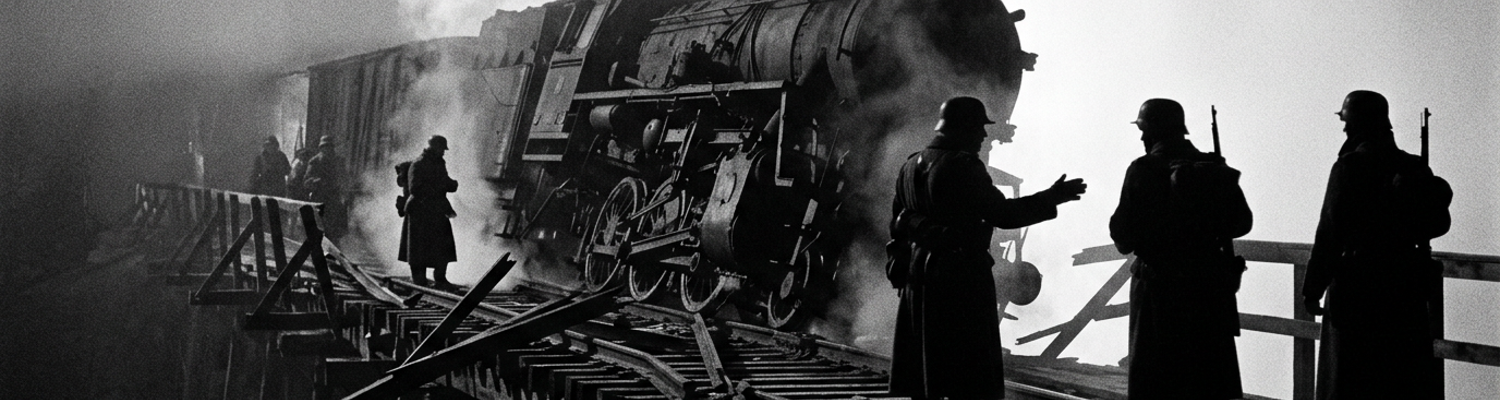

Peiping Mukden Railway Line Deployment
Fifty feet west of the rail switch at Tanggu, a cast bronze exhaust valve inside a Westinghouse steam driven air compressor fractured along its machining seam. High pressure steam blasted through the cracked cylinder housing. Internal brass threads stripped instantly. Reservoir pressure dropped from ninety to twelve pounds per square inch. Without pneumatic pressure holding them back, the emergency triple valves tripped automatically. Cast iron brake shoes slammed violently against the steel wheels of the Mikado locomotive. Metal shavings sprayed across the cross ties. The eight car work train locked onto the single main line.
Control of northern China depended entirely on unbroken steel track.
A close review of operational logs indicates that this localized mechanical breakdown reflected an expanding set of physical difficulties during October 1945. Elements of the 1st Pioneer Battalion and the 7th Marines deployed along the Peiping Mukden Railway. Disembarking from assault transports at Taku Bar under the command of Colonel Edward W. Snedeker, the 7th Marine Regiment received direct orders to spread its three infantry battalions across nearly two hundred miles of exposed rail corridor. This single track line ran from Tanggu north toward Chinwangtao. Behind them came the combat engineers of the 1st Pioneer Battalion. Their orders required keeping deteriorating roadbeds, coal fired water pumps, and switching frogs operational using improvised tools and salvaged Japanese track material (NARA Record Group 127). Squad sized outposts occupied pre fabricated concrete pillboxes every few miles along the raised gravel embankment. Marines slept inside sandbagged cabooses coupled to forward repair trains. They patrolled track ballast on foot. Snipers fired intermittent 6.5mm rifle rounds from dry sorghum fields flanking the right of way.
Civilian life in the coastal cities depended on the daily passage of Tangshan coal.
Archival evidence shows that the railway line functioned as an indispensable supply corridor connecting the Kailan Mining Administration pits at Tangshan directly to the deep water docks of Chinwangtao on the Bohai Sea coast. Thirty freight trains ran this line daily. Without them, municipal power plants in Shanghai, Tianjin, and Beiping faced immediate fuel exhaustion and winter shutdowns. Midway along this route sat the Luan River bridgehead. This expansive steel trestle rested on stone piers over a wide alluvial riverbed near Luanxian. The surrounding floodplain lacked bypass bridges or heavy vehicle fords. The destruction of a single sixty foot steel span over the Luan River would halt all bulk fuel shipments to the coast for months. Chinese Communist Eighth Route Army detachments targeted the bridge approaches repeatedly. They pried up track spikes, cut copper telegraph wires, and loosened bridge rail joints under cover of darkness.
Washington gave the garrison no mandate to fight an open war.
When examining the historical record of Operation Beleaguer, III Amphibious Corps files indicate that Marine units operated under contradictory directives. Command directives ordered the 1st Marine Division to secure civil infrastructure. The same orders strictly forbade American personnel from initiating offensive combat or intervening directly in the expanding civil war between Chinese Nationalist forces and the Chinese Communists. Marines simultaneously had to supervise the processing and disarming of over 300,000 surrendered Japanese soldiers and civilian dependents awaiting repatriation vessels at coastal embarkation ports. This contradiction created bizarre tactical arrangements at the Luan River trestle. Seventh Marine rifle squads found themselves standing perimeter guard alongside armed troops of the Japanese 118th Division. Surrendered Japanese sentries held defensive bunker sectors under Marine observation until Nationalist replacements arrived. Marine bridge guards were positioned directly between hostile Communist raiding parties and armed former enemies.
Inherited Japanese Fortifications and Engineering Deficits
Saturated earth defeated entrenching tools before the frost even arrived.
Archival evidence shows that riflemen from the 1st Battalion, 7th Marines inherited a defensive perimeter designed around crumbling earthworks left behind by departing Japanese units. Surrendered garrison troops had excavated zig zag communication trenches and machine gun pits into the fine alluvial loess flanking the eastern bridge abutments. They reinforced the parapets with sun dried mud revetments and woven sorghum stalks. Heavy autumn rainstorms filled these sunken positions with twenty inches of standing, alkaline groundwater. The impermeable riverbed clay offered no avenue for drainage. Marine work parties spent twelve hour shifts baling out the sludge with punctured five gallon gasoline cans. They watched unsupported trench walls cave inward under their own waterlogged weight. Loess soil sloughed off in massive slabs. Wooden ammunition lockers were buried. Hand dug sumps clogged completely. Efforts to shore up the collapsing positions with canvas sandbags failed. The saturated silt rotted the coarse burlap within seven days. Wet clay spilled back onto the dugout floors.
The bridge could not bear its own traffic.
A close review of operational logs indicates that the primary threat to the rail corridor lay directly beneath the steel rails rather than along the outer wire. Surrendered Japanese railway battalions had previously repaired a blown seventy foot span of the multi girder bridge. They assembled a temporary timber falsework structure composed of unseasoned pine bents. These rough cut vertical timber pilings rested directly on shallow gravel footings in the active river channel. They lacked concrete capstones or deep driven steel piles. A loaded coal train hauled by a 120 ton Mikado locomotive creeping across the span at five miles per hour caused the entire wooden sub structure to flex six inches laterally under the weight. Combat engineers from Company C, 1st Pioneer Battalion stood in waist deep mountain runoff to fight the structural deflection. They used twenty ton mechanical screw jacks to force sagging stringers back into alignment. Between train runs, engineer squads drove three quarter inch steel drift pins through split cross braces. They replaced sheared connection bolts with salvaged wire. Hardwood shims were wedged beneath shifted sill blocks.
Arctic air degraded the perimeter faster than the river currents.
When examining the historical record of northern China during late November 1945, regional meteorological logs show sudden temperature plunges. Thermometers dropped to fifteen degrees below zero Fahrenheit across the Hopeh plain. Moisture rising off the open river channel met these Siberian air masses. Dense freezing fog generated every night. It clung to the iron spans and perimeter earthworks. Internal condensation penetrated hairline cracks in the unreinforced Japanese concrete pillboxes guarding the bridge approaches. Expanding ice split heavy masonry slabs along unbonded aggregate seams. Within the surrounding trench lines, frost heave pushed the rail bed three inches off its gravel ballast. Steel screw pickets were wrenched cleanly out of the frozen topsoil. Heavy coatings of rime ice weighed down defensive concertina wire. Entire barricades collapsed flat against the ground. Trip flares were submerged beneath frozen mud crusts. Sentries stationed along the exposed bridge deck chipped frost from their rifle breeches every twenty minutes. Their line of sight was confined to twenty paces by the icy vapor.
By December, engineer depots in Tangshan had completely exhausted their reserves of replacement three inch timber decking.
Conflicting Intelligence and Guerilla Threat Assessments
Paper dossiers from the Office of Naval Intelligence arrived at regimental headquarters in late November with irreconcilable numbers.
Archival evidence shows that intelligence officers of the 1st Marine Division received conflicting evaluations regarding Chinese Communist Eighth Route Army forces throughout eastern Hopeh Province. One Office of Naval Intelligence operational summary compiled in Chungking asserted that irregular Communist partisans operating around Tangshan numbered fewer than 4,000 poorly supplied local militia. They were reportedly armed with muzzle loading fowling pieces and hand tools. Simultaneous division level G-2 field estimates drew from Nationalist army liaison reports and interrogated Japanese officers of the 118th Division. These reports warned of 35,000 disciplined regular troops belonging to General Nie Rongzhen regional command. They were equipped with captured Japanese Type 92 heavy machine guns and mountain artillery pieces. Marine patrol leaders received these diametrically opposed analyses inside twenty four hours of each other. Forward company commanders at Luanxian had no aerial reconnaissance assets or long range patrols authorized to verify these figures beyond rifle range.
Target coordinates changed faster than couriers could deliver the maps.
A close review of operational logs indicates that this analytical breakdown left Marine outposts along the 120 mile rail segment between Tangshan and Shanhaiguan in total tactical ambiguity. Squads from Company E and Company F, 2nd Battalion, 7th Marines garrisoned isolated brick stationhouses at Changli, Guye, and Luanxian. They watched small groups of unidentified men move along parallel cart roads every afternoon. Railway workers wore dark padded cotton tunics. These garments looked identical to the winter uniforms worn by local Eighth Route Army irregulars. At kilometer marker 248, track maintenance crews would report peaceful conditions at noon. Twenty minutes later, a track inspection handcar would strike a removed rail joint two miles down the embankment. Snipers fired single 6.5mm rounds from dried sorghum fields into Marine concrete switch shanties before melting into regional market crowds. Operational rules strictly barred preemptive engagement or searches of civilian villages. Patrol leaders could not determine whether these incidents were deliberate Eighth Route Army probes or independent sabotage by unpaid local mineworkers.
Every shadow on the ballast became a target.
When examining the historical record of December 1945, company morning reports document severe psychological strain among the twenty man detachments guarding the Luan River perimeter. Battalion orders established round the clock Condition Two readiness. Riflemen were forced to stand alternating four hour watches on open trestle catwalks. Wind chill dropped temperatures to twenty degrees below zero. Ice glazed their wool overcoats and froze the safety catches on their M1 Garands. Sentry outposts were co located in narrow revetments with armed Japanese infantrymen who had been mortal enemies ninety days earlier. They operated in sustained dread of night infiltrators cutting perimeter tripwires. Discarded Japanese trip flares and improvised wire hung ration tins rattled continuously against track ballast under arctic gale winds. Jumpy guards chambered rounds dozens of times each shift. Sleep deprivation dismantled unit discipline. On the night of December 8, three separate outposts along the river approach reported phantom grenade explosions. They opened fire with Browning Automatic Rifles into empty reeds. Four hundred rounds of .30-06 ammunition were expended against river ice floes drifting into bridge pilings.
The following morning, patrol sweeps recovered only spent brass and frozen mud.
Perimeter Trip Flare Angle Modifications
When examining the historical record of mid December 1945, weather logs kept by the 1st Pioneer Battalion at the Luan River trestle record a persistent microclimate that blinded night watch positions. Water temperatures in the open channel hovered near thirty three degrees Fahrenheit. Air rolling across the dry Hebei plain sank to ten degrees below zero. This thermal differential spawned an impenetrable, freezing ground fog every evening at dusk. It pooled inside the riverbed cut and rose exactly four feet above the track ballast. Standard issue M49 surface trip flares had been installed on standard three foot wooden mounting stakes along the perimeter wire. This was per United States Marine Corps doctrinal field manuals. When tripped by test pulls or windblown debris, these flares cast an intense 40,000 candlepower magnesium glare directly into the middle layer of suspended moisture droplets. A thick white wall formed instantly. Sentries manning elevated water tower platforms found themselves staring into blinding white refraction. The ground surface beneath the fog layer stayed pitched in absolute shadow.
Zero visibility favored anyone crawling through the drainage ditches.
A close review of operational logs indicates that combat engineers from Company C took matters into their own hands during the graveyard shift of December 11. They worked without formal work orders from battalion engineers or ordnance officers. Sentries used pliers and ball peen hammers to alter the physical alignment of every flare bracket along a six hundred yard stretch of the western embankment. Sentries bent the stamped sheet metal mounting brackets twenty five to thirty degrees downward. They aimed the flare heads toward the bottom of the gravel grade. Striker pins on the M49 mechanisms were tied off with non regulation telephone wire rather than standard olive drab trip cord. This wire stretched taut four inches above the rail bed across the gravel ties. By lowering the firing angle, the engineers sought to illuminate the boots of approaching infiltrators beneath the fog blanket rather than projecting light upward into the freezing cloud. Individual squads adjusted these angles differently. Some sentries anchored tripwires directly to cast iron tie plates using bent track nails. Adjacent teams lashed flare bodies to loose ballast rocks with electrical tape. This created uneven trip tensions that ranged from three ounces to twelve pounds.
No two sentry posts set their tripwires to the same tension.
Archival evidence shows that these modifications occurred without any communication passing between the Marine perimeter guard and the Kuomintang military railway authorities. Station officials representing the Nationalist Ministry of Communications directed Chinese track inspection teams out of the Luanxian depot. Marine company commanders never forwarded an overlay map showing the altered flare angles to the local Nationalist liaison officer. The Japanese 118th Division infantrymen holding adjacent inner ring pillboxes were similarly kept in the dark. The adjusted flare bodies were tilted sharply downward and buried flush against the crushed stone ballast. Their trip cords ran diagonally across the rail clearance zone rather than hanging parallel to the boundary fence. Track gangs walking the line to replace cracked fishplates at night had no way to identify the low slung, camouflaged wires. Company F watchstanders on the eastern abutment received no briefing regarding the altered firing arcs on the western bank. Two adjacent guard sectors operated under completely contradictory visual warning assumptions.
The Nationalist railway inspectorate dispatched an unscheduled handcar crew from Luanxian at three o clock in the morning on December 13 to check rail expansion gaps. The wheels snagged the re angled trip lines sixty yards west of Pier Four. The angled magnesium flares did not shoot upward into the sky to mark an approaching squad. They discharged horizontal jets of white hot phosphorus across the timber ties at point blank range. Sparks ignited creosote soaked wood stringers immediately beneath the rails. Japanese sentries inside Bunker Three were completely unaware that Marine tripwires had been relocated to track level. They mistook the blinding ground level flash and running trackmen for an Eighth Route Army sapper assault. They opened fire with a Type 96 light machine gun. Marine riflemen thirty yards away heard the automatic burst through the dense fog. They returned fire with their M1 Garands directly toward the muzzle flashes along the ballast.
Altered Clearance Procedures for Armored Rail Traffic
Archival evidence shows that rifle squads from the 2nd Battalion, 7th Marines began altering trackside clearance authorizations along the Luan River approaches entirely on their own initiative. Dense river mist continually masked the standard white kerosene hand lanterns specified by United States Navy railroad protection instructions. Sentries at Outpost Charlie, positioned four hundred yards west of the abutment, scavenged commercial Dietz lanterns from abandoned railway tool sheds. Combat outposts wrapped dark green canvas tape around the glass globes to reduce ambient glare. Only a half inch vertical slit was exposed toward oncoming traffic. Sentries abolished the standard naval procedure of holding a white light steady against the chest to signal an open line. Individual Marine squad leaders instituted an unwritten three pump vertical swing of the hooded green lantern. This demanded that approaching train engineers reduce speed to three miles per hour and display paper movement permits before reaching the timber falsework. Three miles further west at the Guye rail junction, a separate detachment from Company F invented an entirely different protocol. They displayed a stationary red lantern hung from an upright iron pry bar to mandate a full stop on the ballast.
No written technical bulletin recorded these field level changes.
A close review of operational logs indicates that Kuomintang armored train crews approached the Luan River corridor under strict Nationalist Ministry of War railway operating protocols established during the anti Japanese campaigns. Rail operations inside contested guerrilla territory prohibited armored trains from reducing speed below fifteen miles per hour within two miles of major river bridges. Eighth Route Army sappers routinely planted buried black powder mines beneath cross ties in these zones. Nationalist crews operated inside five eighths inch steel boiler plates on Locomotive 52. This was a Japanese built 2-8-2 armored engine pulling three reinforced boxcars armed with water cooled Type 24 Maxim guns. They relied strictly on trackside fire pots and permanent iron semaphore arms mounted to high wooden gantries. Chinese Nationalist operating regulations dictated that an engineer sound two long blasts on the steam chime whistle, look for an elevated fixed white light atop the station gantry, and maintain continuous boiler draft through open track sectors. If a train crew observed erratic, swinging ground lanterns or unlisted colored lights along the right of way, Nationalist standing orders instructed the engineer to increase regulator steam. They were to treat the track as an active ambush zone and ram through any physical obstruction on the rails.
Speed was their only defense against track bed demolition charges.
When examining the historical record of mid December 1945, these incompatible operational practices produced catastrophic identification gaps between Marine bridge garrisons and incoming Nationalist rail convoys. Combat engineers from Company C, 1st Pioneer Battalion worked along the single main line beneath the western bridgehead. They used twenty ton mechanical jacks to shim settling timber stringers twenty minutes before scheduled freight runs. Sentry outposts possessed no radios tuned to Nationalist train frequencies. They relied solely on line of sight hand signals that Nationalist trainmen had never been trained to interpret. Upon rounding the western curve at kilometer marker 246, an unannounced Nationalist armored patrol train pushed an armored flatcar loaded with sandbags. Marine watchstanders interpreted the fifty ton locomotive high speed approach as an unauthorized breach of bridge clearance. Sentries pumped hooded green lanterns rapidly across the gravel grade. They expected the locomotive to halt immediately before the temporary timber span. Inside the steel shuttered cab, the Chinese engineer saw an unlisted dim green flicker oscillating four inches above the ballast. He interpreted the signal as a Communist partisan effort to bait the train into a kill zone. He pulled the throttle wide open to sixty pounds of steam pressure.
Marine engineers standing on the vulnerable falsework heard steel wheels screech against the frost crusted rails. The train accelerated directly toward the weakened sixty foot bridge span. Pioneer work parties scattered across the icy cross ties. They abandoned heavy hydraulic jacks and air hoses across the trackbed. Sentries on the bridge deck chambered armor piercing cartridges into their M1 Garands. They assumed the approaching train was hostile armor running the American checkpoint. Nationalist gunners inside the forward armored gondola racked the bolts on two Type 24 machine guns. They trained water jacketed barrels down the track centerline directly toward the sandbagged Marine guard shack.
The locomotive struck the abandoned hydraulic jacks forty feet short of Pier Two at twenty two miles per hour.
Kuomintang Armored Train Nighttime Engagements
Archival evidence shows that the cowcatcher of Locomotive 52 snagged the lowered field telephone tripwires thirty yards west of the river abutment. Company C engineers had bent the stamped brackets downward against the railbed. The M49 magnesium canisters did not arc into the open night air. Striker pins released simultaneously under seven tons of wheel pressure. They launched two horizontal jets of 40,000 candlepower white phosphorus straight into the forward vision slits of the armored locomotive cab. Burning chemical residue splattered across the narrow glass viewports. It poured through open ventilation louvers. Inside the enclosed steel box, temperatures spiked instantly. Blinding white smoke replaced breathable air. It seared the retinas of both the Chinese Nationalist engineer and his stoker. Blinded and choking, the train operator lost his footing on the iron deckplates. He threw his full body weight against the regulator lever rather than the pneumatic brake handle.
Two thousand degrees of burning chemical paste filled the cab interior.
A close review of operational logs indicates that the sudden sensory deprivation convinced the Nationalist crew they were under an Eighth Route Army ambush. Communist irregulars regularly used satchel charges and blinded train drivers before blowing rail culverts along the Hopeh corridor. Through cracked and soot blackened observation ports, the blinded Nationalist train commander perceived the muffled silhouettes of 1st Pioneer Battalion engineers scrambling across the ballast. He identified them as hostile guerrilla assault teams closing in to board the cars. Nationalist machine gunners positioned inside the secondary armored wagon unlatched their firing ports. Water cooled Type 24 Maxim guns immediately raked the trackbed with sustained bursts of 7.92mm ammunition. Heavy lead projectiles slammed into the crushed gravel embankment. They chewed through telephone line spools, shattered rail ties, and punched through the thin steel siding of the Marine trackside tool shanty.
Riflemen on the perimeter had nowhere to take cover except the open ice.
When examining the historical record of Company C bridge defense, Marine sentries stationed along the timber walkway faced automatic fire at point blank ranges under fifty yards. They believed an unannounced hostile armored train had breached the western perimeter wire to destroy the river crossing. Marine engineer guards returned fire with armor piercing .30-06 ammunition. Riflemen emptied eight round clips from their M1 Garands directly at the engine glowing vision ports. Two sentries manning an elevated sandbag revetment directed Browning Automatic Rifle fire into the open gun slits of the trailing armored cars. Solid core bullets penetrated the thin Japanese cast viewing slits. The Nationalist stoker was killed instantly. The train commander suffered severe wounds to the chest and shoulder. Outside on the ballast, three Marine engineers collapsed with severe gunshot wounds to their lower extremities. Incoming 7.92mm fire tore through the wooden walkway decking.
The runaway engine possessed ninety tons of forward momentum.
Unchecked steam pressure continued driving the driving wheels forward against the fractured rail joints. The dead engineer collapsed across the footplate controls. Locomotive 52 hit the temporary timber bridge approaches at eighteen miles per hour. It dragged four tons of derailed ballast jacks beneath its pilot truck. The left front wheel flange jumped the outer rail where frost heave had loosened the Japanese fishplates. Sixteen cross ties were torn away. The main air brake line sheared off beneath the chassis. Deflected by the skewed timbers, the forty ton locomotive tilted twelve degrees to port. It slammed directly into the vertical pine bents supporting the central seventy foot bridge span. Heavy timber bents splintered under the impact. The front drive wheels dropped six feet through the bridge floor. The armored locomotive lodged directly across both track lines over the frozen river channel.
Strategic Supply Fallout Across Northern China
A single fractured timber bent severed the fuel supply of northern China.
A close review of operational logs indicates that the wreckage of Locomotive 52 pinned three hundred tons of warped steel and broken timber across the central channel of the Luan River trestle. Beneath the weight of the derailed armored tender, two vertical pine pilings fractured down their center grains. The main deck line dropped seven feet below grade. Forty yards of heavy rail twisted into unusable curves. North of the river, rail yards at Tangshan backed up within six hours. The Kailan Mining Administration extracted over twenty thousand tons of bituminous coal daily from deep pits at Chaokochwang, Linsi, and Machiakow. They possessed rail storage for only forty eight hours of output. Empty hopper cars returning west from the ice free port of Chinwangtao halted bumper to bumper along thirty miles of siding between Changli and Luanxian. The single track was entirely blocked. The riverbed ice was too thin to support heavy motorized vehicle bypasses. Coal trains stopped moving in both directions. Loaded hopper cars stood idle on the main line while minehead tipples filled to capacity. Pit foremen were forced to bank their steam boilers and halt subterranean extraction.
Cold settled over the cities within thirty six hours.
Archival evidence shows that municipal infrastructure in Beiping and Tianjin deteriorated immediately as coal reserves evaporated during an arctic cold front. Temperatures across the northern plain dropped to twelve degrees below zero Fahrenheit by December 14. In Tianjin, the municipal power station on the Hai River burned its last four hundred tons of pulverized coal dust. Generator output fell by eighty five percent. The former foreign concessions were blacked out. Water treatment facilities lost electrical power to their intake pumps. Municipal mains froze and burst beneath unpaved city streets. Beiping faced identical breakdowns. The city tramways stopped running when the electrical grid collapsed. Thousands of factory workers were stranded in freezing winds. Regional hospitals exhausted their kerosene and coal allotments. Medical staff burned wooden transport crates and surplus cotton mattresses inside ward stoves to keep surgical wards above freezing. Civilian flour mills and textile plants closed their doors. Over one hundred thousand industrial laborers were left without wages or heating fuel in sub zero weather.
Blame for the paralysis traveled directly up the chain of command.
When examining the historical record of III Amphibious Corps, field dispatches reveal immediate operational fallout from the friendly fire engagement. Major General Keller E. Rockey dispatched division inspectors to Luanxian on December 15. They examined the dead Nationalist crewmen and the bullet riddled cab of Locomotive 52. American leadership acted swiftly to eliminate independent tactical decision making along the tracks. Regimental orders revoked the authority of 7th Marine outposts to improvise signal lanterns, install perimeter trip flares along right of way ballasts, or halt rail convoys with ad hoc warning protocols. Marine leadership established a unified rail coordination command headquartered at Tianjin. They operated a joint dispatch desk that integrated officers from the 1st Marine Division, the Nationalist Ministry of Communications, and the Kuomintang 94th Army. Under the newly mandated standard operating procedure, no train departed Tangshan or Shanhaiguan without synchronized telegraph clearances. These were transmitted simultaneously to American bridge watch posts and train crews in their native languages. Marine rifle squads along the trackbed were restricted to passive perimeter defense. They were forbidden from altering signal lanterns or laying wire across tracks without direct written approval from regimental engineers.
Track gangs took eleven days to clear the iron locomotive from the riverbed.