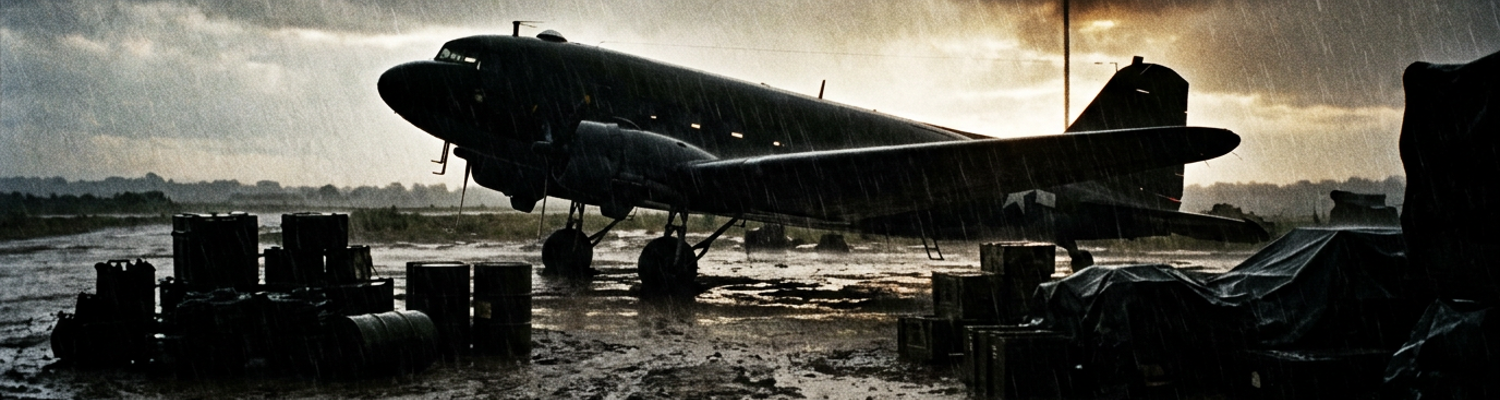

Early Counterinsurgency Doctrine and Farm Gate
Pleiku air traffic control logs recorded the distress transmission at 0214 hours. Farm Gate flight four-one reported total electrical failure. The primary inverter was offline. The magnetic compass spun wildly. The crew executed a blind descent through heavy monsoon cloud at three thousand feet. That brief transmission marked the collapse of an air support mission over the Central Highlands. Archival evidence shows the aircraft was an SC-47 Skytrain (serial number 43-49012). The airframe was built in 1944. Flight crews operating out of Bien Hoa spent weeks battling failing vacuum-tube radios. Tropical moisture short-circuited instrument panels daily.
Washington believed counterinsurgency could be conducted without kinetic engagement.
When examining the historical record of early 1960s tactical doctrine, Air Force planning manuals treated guerrilla warfare as an administrative disruption. Planners at the Tactical Air Command drafted procedures specifying that modified transport aircraft would disperse propaganda leaflets over remote hamlets. The aircraft would broadcast loudspeaker messages using high-output audio systems. They would haul medical personnel into primitive dirt strips. Policy directives dictated that American personnel could not acknowledge an active combat role. Every mission theoretically operated as an advisory flight. An indigenous South Vietnamese crewman had to occupy a seat inside the cockpit to legitimize the sortie as domestic training. Pentagon planners assumed that humanitarian airlifts and loudspeaker appeals would pacify rural populations before armed insurgents could organize. That theoretical doctrine ignored the severe physical friction of the Annamite Range. Low-altitude flights met dense cloud decks and heavy small-arms fire from concealed ridge positions.
Theory failed in the mud of Bien Hoa.
A close review of operational logs indicates that the covert deployment began in November 1961. Detachment 2A of the 4400th Combat Crew Training Squadron arrived at Bien Hoa Air Base under the classified designation Operation Farm Gate. Dispatched from their training base at Eglin Air Force Base Auxiliary Field 9 in Florida, the airmen brought sixteen combat-configured aircraft. The roster included four SC-47 transports, eight T-28 Trojan trainers, and four B-26 Invader bombers. Ground mechanics immediately repainted every airframe. They wiped away United States Air Force markings and applied the national insignia of the Republic of Vietnam Air Force. Bien Hoa presented immediate operational breakdowns. The single 5,500-foot pierced steel plank runway sat bordered by standing water. Rotting ordnance crates and unpaved taxiways turned into red clay sludge during daily monsoon downpours. Maintenance teams lacked basic replacement parts for the Pratt and Whitney R-1830 engines. Ground crews scavenged electrical relays, spark plugs, and flight-control cabling from grounded transports parked along the perimeter wire.
Crews flew sixty missions a week on scavenged wire.
Flight crews stripped their SC-47s of civilian cargo fittings. They installed side-firing flare racks and belly-mounted drop chutes for psychological leaflets. Avionics technicians mounted AN/ARC-27 radio units that continually malfunctioned in ninety-percent jungle humidity. Tactical guidelines written at temperate testing grounds failed to account for high-density altitude over the Central Highlands plateau. Heavy aircraft lost single-engine climb capability within minutes of departure. Mechanics worked sixteen-hour shifts under canvas awnings. They dried out soaked magneto housings with portable blowers before flight crews could attempt ignition. Intelligence reports from Military Assistance Advisory Group Vietnam warned that Viet Cong units along the Cambodian border had deployed heavy machine guns along standard approach corridors into Pleiku and Kontum. Commanders ordered unarmed SC-47 sorties to continue daily civic-action courier runs.
SC-47 Skytrain Psychological Warfare Modifications
Archival evidence shows that field mechanics faced an immediate engineering crisis when converting standard cargo airframes into psychological warfare platforms at Bien Hoa. In late December 1961, ground crews from Detachment 2A retrofitted the squadron transports. They equipped the twin-engine SC-47 Skytrain airframes with high-output audio amplifier systems and directional cabin-mounted loudspeakers. Technicians unbolted the forward port-side cargo door sections. Sheet metal specialists fabricated custom welded steel brackets to anchor a three-thousand-watt University sound projector array angled downward at forty-five degrees. Running heavy cables across the bare ribbed fuselage, the avionics specialists tied the sound system directly into the primary twenty-eight-volt direct-current electrical buses. That continuous ten-ampere draw placed dangerous strain on the stock engine-driven generators. Whenever flight crews tested the audio banks on the apron, the high electrical surge tripped circuit breakers. The draw drained the onboard nickel-cadmium batteries within eighteen minutes.
The airborne equipment overheated constantly under tropical flight conditions.
When examining the historical record of these early sound flights, thermal breakdown occurred almost immediately above the jungle canopy. Operating guidelines (Technical Order 01-1M-3) instructed pilots to fly low-speed orbits at eight hundred feet above ground level across the valleys flanking Highway 19. This allowed pre-recorded Vietnamese and tribal-dialect broadcast tapes to reach ground targets. Inside the uninsulated aluminum fuselage, the high-output tube amplifiers generated temperatures exceeding one hundred and twenty degrees Fahrenheit. Flight engineers wrapped cooling jackets packed with ice around the amplifier chassis to prevent transformer failure. Ground fire presented an equal hazard. Flying low and slow made the twin-engine transports easy acoustic targets for Viet Cong machine gunners concealed along the ridges outside An Khe. Returning aircraft frequently showed seven-point-six-two millimeter bullet holes through the lower speaker cowlings and cabin floorboards.
Aircraft engines sputtered when crewmen pushed sound equipment past rated limits.
A close review of operational logs indicates that the second major airframe alteration involved high-capacity leaflet dispersal systems. Crewmen could not shovel loose bundles out of the open passenger door by hand into severe aerodynamic backwash. Bien Hoa sheet-metal specialists built custom gravity-fed interior chutes. Fabricated from salvaged corrugated zinc roofing panels and angle-iron bracing, each chute measured eight feet in length. The chutes mounted diagonally from the mid-cabin ceiling down through an emergency exit aperture cut beneath the port horizontal stabilizer. Loadmasters dumped cardboard cartons containing sixty thousand paper leaflets directly into the top hopper. The slipstream created an immediate suction venturi. The pressure pulled paper rapidly into the air currents below the empennage. Flight crews targeted these high-volume leaflet distribution sorties across remote Montagnard settlements throughout the Central Highlands. They specifically covered Jarai, Bahnar, and Rhade villages surrounding Pleiku, Cheo Reo, and Kontum.
Static electricity charged the paper inside the cabin.
Operational incident reports from the 4400th Combat Crew Training Squadron record severe mechanical hazards during these drop runs over the Annamite Range. At an altitude of four thousand feet over the Pleiku plateau, high-velocity downdrafts generated turbulent boundary-layer air. This air repeatedly backed up inside the dispersal tubes. Paper leaflets jammed against the interior chute lip. The bundles spilled back into the cargo compartment and blinded the loadmasters with swirling sheets of paper. Hundreds of stray pamphlets slipped past the flight-deck canvas curtain. The paper wrapped around the rudder pedals and trim-tab control cables. Outside the hull, unguided paper plumes blew directly upward into the tail surfaces. On January 14, 1962, a Farm Gate SC-47 returning from an afternoon dispersal run over Mang Yang Pass arrived over Bien Hoa with its elevator hinges choked with compacted paper pulp. The pilot executed a flat, zero-flap approach using differential throttle to maintain pitch.
Deniability Protocols and Cockpit Command Friction
When examining the historical record of Operation Farm Gate command structures, diplomatic subterfuge dictated every tactical movement. State Department directives and early Military Assistance Command Vietnam rules of engagement required South Vietnamese military observers aboard all sorties. This preserved diplomatic deniability under the 1954 Geneva Accords. Washington could not publicly acknowledge direct combat participation by United States Air Force personnel. Every flight clearance filed at Bien Hoa listed a Republic of Vietnam Air Force officer as the designated mission commander. This reduced veteran American pilots from Detachment 2A to advisory passengers on paper. Aircrews carried neither standard military identification tags nor standard flight suits. They wore sterilized civilian work clothing during combat operations over the interior. If an SC-47 went down in the jungle, the presence of a uniformed South Vietnamese officer in the right seat gave the Pentagon plausible cover. They could claim the flight was an internal training flight conducted by Saigon.
American pilots held the control columns while local officers signed the paperwork.
Physical friction inside the narrow Douglas cockpits began before the chocks were pulled. Many assigned Vietnamese observers lacked multi-engine flight ratings. They struggled with basic cockpit procedures in turbulent weather. Severe mountain downdrafts across the Pleiku plateau brought sudden bouts of airsickness. American pilots steered through low-level terrain contours alone while managing engine mixture controls and radio frequencies. Command authority grew blurred whenever missions approached contested drop zones. The rules of engagement (MACV Directive 10-4) dictated that only the South Vietnamese observer possessed the legal authority to approve leaflet drops. They alone could activate audio sound banks or call in defensive ordnance. Language barriers turned routine communications into confusing exchanges over loud engine drone. Pilots relied on hand signals to request weapon release clearances while pulling twenty-year-old airframes through rainsqualls.
Political friction inside the flight deck intensified as sorties moved north toward Pleiku.
Archival evidence shows that ethnic animosities crippled psychological operations across Darlac and Pleiku provinces. In late 1961, American Special Forces teams organized the Civilian Irregular Defense Group at Buon Enao. They recruited indigenous Rhade tribesmen to form village defense networks against Viet Cong infiltration. Tactical planning teams produced magnetic tape recordings featuring village elders speaking native Rhade dialects. These tapes instructed Montagnard communities to resist guerrilla recruitment. South Vietnamese officers assigned to Farm Gate flights carried centuries of deep-seated ethnic prejudice against the highland populations. Saigon officials viewed the highlanders as culturally inferior subjects. These officers repeatedly vetoed airborne psychological appeals recorded in indigenous Rhade dialects. They refused to allow broadcasts that recognized tribal autonomy or bypassed the national Vietnamese language.
The observers shut down the broadcasts mid-flight.
A close review of operational logs indicates that Vietnamese observers routinely pulled the audio patch cables on the amplifier control panels. They did this whenever American crewmen queued Rhade-language broadcast tapes. Flight personnel were ordered to play Vietnamese-language recordings over hamlets where none of the indigenous inhabitants understood the national tongue. This rendered the low-altitude sorties completely useless. Over the Buon Ho valley, SC-47 transports circled at eight hundred feet above ground level. They presented low-speed targets to Viet Cong ground gunners while the aircrew argued over master audio switches. Assigned monitors rejected planned leaflet drops over Jarai and Rhade settlements. They ordered loadmasters to jettison bundles of printed material into uninhabited ravines along the Song Ba river. On February 26, 1962, a Farm Gate transport circled Plei Mrong for forty minutes under heavy small-arms fire. The South Vietnamese observer refused to release four tons of tribal-dialect pamphlets. The pilot returned to base with a damaged port engine and full hoppers.
Forward Staging at the Austere Pleiku Airfield
Archival evidence shows that in February 1962, the 2nd Advanced Echelon directed 4400th Combat Crew Training Squadron commanders to shift operational staging. They moved from Bien Hoa northward to the high plateau of Pleiku Province. Flight crews from Detachment 2A received verbal deployment orders to position twin-engine SC-47 transports forward onto an unimproved dirt strip. This strip was located at specific grid markers (Coordinates 13 58 N, 108 00 E). Positioned two thousand four hundred and twenty-eight feet above sea level, this austere outpost sat flanked by the sharp ridgelines of the Annamite Range. Military Assistance Advisory Group planners required immediate airlift to supply isolated Civilian Irregular Defense Group outposts established across the interior. These included remote garrisons at Plei Mrong and Polei Krong. Special Forces detachment teams had organized indigenous Jarai and Bahnar tribesmen into armed strike forces. They blocked North Vietnamese supply corridors feeding through eastern Cambodia. Sustaining these highland garrisons demanded daily supply shuttles laden with sacks of milled rice, crates of carbine ammunition, radio batteries, and fifty-five-gallon drums of aviation gasoline.
Laterite dust choked the landing gear linkages.
A close review of operational logs indicates that the landing strip itself was three thousand six hundred feet of uncompacted volcanic clay. Engineers scraped it directly out of wild elephant grass. High-density altitude reduced the lifting efficiency of the Douglas wings. Midday temperatures reaching ninety-five degrees Fahrenheit thinned the mountain air. Pilots bringing loaded SC-47s over the boundary fence found their Pratt and Whitney R-1830 engines struggling to generate full rated horsepower during sudden go-around maneuvers. Touchdowns violently rattled the riveted airframes. Soft ruts dug by tailwheels during the morning rains hardened into solid baked furrows under the afternoon sun. These furrows sheared hydraulic brake fittings and blew out main gear tires. Ground crews carried no heavy tow tractors or mechanical jacks. Mechanics used wooden lever poles and indigenous labor crews to manhandle stuck transports out of deep mud wallows bordering the active dirt corridor.
Darkness fell across the plateau without a single electric bulb on the airfield.
When examining the historical record of highland flight facilities, the austere installation possessed zero all-weather navigational aids. Airfield staff operated without an Instrument Landing System. They lacked tactical air navigation transmitters or ground-controlled approach radar stations to guide aircraft down through thick monsoon cloud ceilings. Crews flying inbound over Mang Yang Pass steered exclusively by visual dead reckoning. They occasionally tuned direction-finding needles to a commercial radio station in Kontum that faded during electrical storms. Runways lacked wired threshold lights, edge lamps, or illuminated wind direction indicators. Base personnel attempted night recoveries by placing cut kerosene drums along the dirt edges. High mountain wind gusts blew out the open flames or generated smoke walls that blinded pilots on final approach. Fortified perimeters did not exist around the aircraft parking revetments. Uncoiled strands of rusted barbed wire held by split bamboo stakes left the flight line exposed to infiltration. Local Viet Cong mortar crews established firing positions within four hundred yards of the active apron.
Flight crews slept on canvas cots beneath the wings.
Severe Atmospheric Squalls and HF Relay Failures
A close review of operational logs indicates that the onset of the late-1962 northeast monsoon unleashed violent squall lines across the Central Highlands. These storms crippled airborne and ground-based electronic links. Between October and November 1962, severe electrical storms developed over the Annamite Range every afternoon. They generated continuous cloud-to-ground lightning discharges and massive electrostatic friction across aircraft surfaces. Precipitation static overwhelmed the long-wire antennas mounted along the dorsal spines of the SC-47 transports. Inside the cockpits, the Collins 618T and legacy AN/ARC-58 high-frequency transceivers emitted deafening white noise across the three to thirty megahertz spectrum. This blinded radio operators attempting to establish voice or continuous-wave Morse contact. Standard operating procedures drafted at Langley Air Force Base assumed that high-frequency skywave signals would skip cleanly off the ionospheric F-layer. This skip would link isolated outposts back to base command. Charged storm fronts absorbed medium and high-frequency emissions. Torrential downpours simultaneously short-circuited unsealed antenna coupler units. They blew out plate fuses and burned transmitter power tubes before operators could log operational clearances.
Flight manuals assumed high-frequency skywaves would propagate without atmospheric disruption.
Archival evidence shows that local topography rapidly completed what the atmospheric squalls had initiated. Pleiku sat in an elevated basin ringed by steep volcanic summits. Peaks like Chu Pa rose abruptly past four thousand feet to block low-angle ground-wave radio propagation toward the southern plains. High-frequency skywave skip zones created an electronic dead space stretching between seventy and two hundred miles south of the runway. This was precisely where the relay signals needed to land. Outside the Pleiku operations shack, gale-force wind gusts exceeding fifty knots tore down the detachment field-expedient RC-292 ground-plane antenna masts. Wet red laterite mud loosened the steel guy-wire stakes driven into the soft perimeter berms. Thirty-foot aluminum poles buckled into the razor wire. Moisture saturated the unjacketed coaxial cable splices. This caused catastrophic impedance mismatches that melted the RF output stages of ground-based AN/GRC-19 mobile transmitters. With both long-wire aerials snapped and directional dipoles smashed against the volcanic clay, all electronic contact between Detachment 2A at Pleiku and Farm Gate headquarters at Bien Hoa ceased completely.
The forward airstrip fell into total isolation.
When examining the historical record of the 2nd Advanced Echelon command center at Tan Son Nhut, the sudden silence sparked immediate alarm. Staff officers in Saigon spent thirty-six hours without a single operational signal from the central plateau. They could not verify whether the Pleiku strip had been overrun by the Viet Cong 95th Regiment or simply silenced by weather. At Bien Hoa, flight dispatchers canceled all resupply flights heading north. They stranded five SC-47 airframes loaded with perishable dry rations, medical kits, and five-hundred-pound crates of 7.62-millimeter ammunition. Ground crews at Pleiku attempted to rig emergency field wire across the runway edge to salvage a single receiver. Rain flooded the perimeter trenches and dissolved the paper dielectric inside the terminal junction boxes. The forward detachment had zero radar, zero functioning telegraph channels, and no working voice relay to summon tactical air support. Mechanics stood sentry duty in two-hour shifts around the dispersal area. They cleaned soaked carbine bolts while listening to dead static