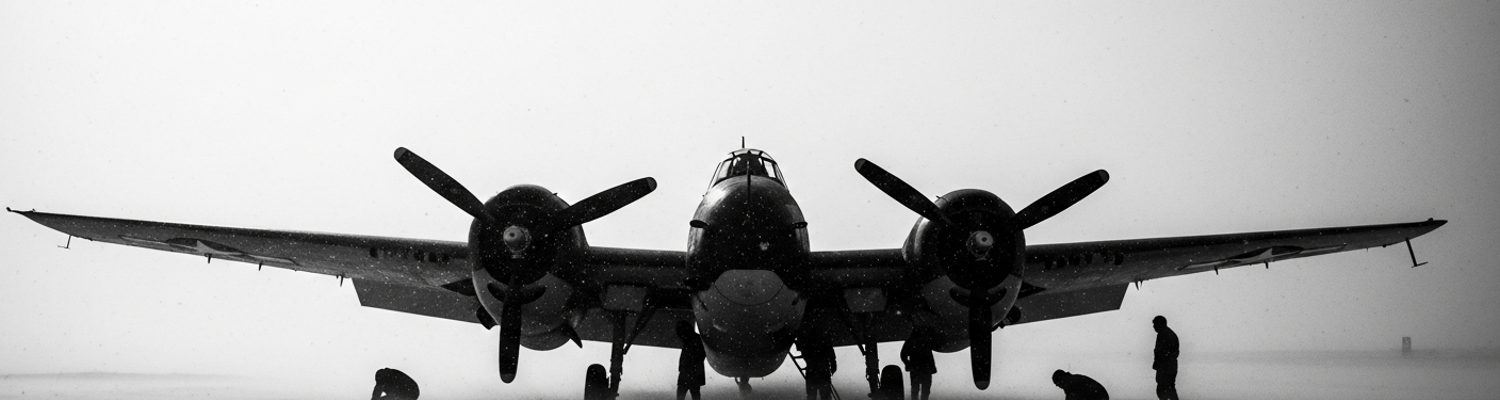

In the Aleutian Islands, the primary antagonist was the environment itself. For both American and Japanese forces, this theater of war was defined by a near-constant state of semi-frozen, waterlogged existence. The islands are battered by winds, cloaked in dense fog, and besieged by a cold that penetrates all layers of clothing. Sudden, violent gusts known as williwaws, often accompanied by rain or snow, could materialize without warning, capable of capsizing boats and tearing aircraft from the sky. For soldiers and airmen, the region was regarded as a form of penal servitude. A typical year could see over 200 days of rain, with summer temperatures often remaining in the low forties. The pervasiveness of cold and dampness led to high rates of non-combat casualties; on Attu, of the 3,829 American casualties, 2,132 were the result of exposure, disease, and trench foot. The very ground was a treacherous enemy. A bog-like mixture of water, decaying vegetation, and volcanic ash called muskeg could swallow vehicles and retard the movement of troops, forcing supplies to be carried on foot. The persistent fog was perhaps the most disruptive element, grounding air missions for days and reducing the effectiveness of naval bombardments. In the first six months of the campaign, the U.S. Eleventh Air Force lost 72 aircraft. Only nine of them were to enemy action; the rest were claimed by the weather. Pilots flying through cloud fronts could emerge encased in ice, and the constant turbulence batted planes around without mercy.
Naval operations during the early Aleutian Campaign were severely challenged by the unique oceanographic conditions of the Bering Sea, particularly the formation of sea ice. The movement of capital ships and supply convoys had to contend with ice floes that could damage hulls and obstruct critical channels. Naval planners were forced to account for these frozen masses, which dictated convoy routes and timelines. In early 1943, Admiral Thomas Kinkaid took command of the effort to retake the islands, facing the immediate challenge of blockading Japanese-held territory in a region where the sea itself was a barrier. The use of submarines like the USS Narwhal and USS Nautilus for troop landings on Attu in May 1943 was a direct adaptation to the hazardous surface conditions. These vessels could navigate beneath the worst of the surface ice and weather to deliver scouts from the 7th Infantry Division. Even routine patrols were perilous. Operational records from this period detail numerous instances where destroyers and cruisers had to alter course or abandon missions due to impassable ice fields. The conditions made sustained, large-scale naval blockades resource-intensive and often ineffective. The Japanese exploited this when they successfully evacuated their 5,183-man garrison from Kiska under the cover of dense fog in July 1943, completely undetected by the blockading American naval force.
The Grumman TBF Avenger, a famously rugged torpedo bomber, found its operational limits tested by the Aleutian climate. Designed as a carrier-based aircraft, its large size and heavy weight, which made it stable in other theaters, became a liability in the extreme cold. Maintenance logs show that hydraulic fluid and oil would congeal, while grease on moving parts would freeze solid. This forced ground crews to undertake the laborious and time-consuming process of pre-heating engines just to get them to turn over. The aircraft’s Wright R-2600 engine, while powerful, was susceptible to these cold-weather issues. The Avenger’s complex systems, including its power-operated rear turret and internal bomb bay doors, were prone to freezing, rendering them inoperable at critical moments. The fog and low cloud ceilings frequently made the aircraft’s primary mission, torpedo or level bombing runs, impossible. While the Avenger could carry a 2,000-pound bomb load or a Mark 13 torpedo, its effectiveness was entirely dependent on visibility that was rarely available. The weather claimed far more Avengers than Japanese fighters; in one six-month period, for every one aircraft lost in combat across the theater, six were lost to weather and mechanical failures.
In these conditions, where visual navigation was impossible, crews became dependent on new and unproven electronic systems. The primary method for aerial navigation remained dead reckoning, an inexact science of calculating position based on course, speed, and time elapsed from a known starting point. In the Aleutians, it was a recipe for disappearance. The region’s unpredictable williwaw winds could throw a navigator’s calculations off by dozens of miles in a single flight, rendering their plotted course on a paper chart a work of fiction. The Civil Aeronautics Authority had begun constructing a sparse network of radio range stations, but these were few and far between. The 270-mile gap between the air facility at Fort Glenn and the next reliable beacon on Atka Island was a vast void of signal silence, forcing crews to fly for hours with no external confirmation of their position.
Technology offered a potential solution: radar. The TBF Avenger was one of the first carrier aircraft to be fitted with this new technology, specifically the ASB, or Air-to-Surface Vessel, radar set. In theory, it was a war-winning device, allowing the crew to detect enemy ships at night or through dense cloud cover. The operational mechanics were rudimentary. A radar operator, typically the radioman, would stare at a small 3-inch cathode-ray tube, attempting to interpret greenish electronic blips against a baseline. A blip meant a surface contact. The problem was that in the North Pacific, everything created a blip. The ASB system was highly susceptible to sea clutter, a phenomenon where radar signals would bounce off the surface of the water, creating a storm of false returns on the operator’s screen. The Bering Sea, rarely calm, would overwhelm the system, with the reflection from a large wave being indistinguishable from that of a Japanese destroyer. This rendered the technology almost useless for its intended purpose in the very environment where it was needed most.
While torpedo squadrons like the famous VT-13 were being formed for the carrier battles of the central Pacific, the work in the Aleutians fell to a collection of composite squadrons operating under the Eleventh Air Force. Units such as Composite Squadron Twenty-Two (VC-22), flying TBF-1s, were tasked with anti-submarine patrols and reconnaissance from rudimentary airfields carved into the muskeg of islands like Umnak and Adak. These crews took the same navigation techniques and the same flawed radar technology and were ordered to apply them in an environment that actively defeated both. The challenge was not to find a small enemy ship in a vast ocean; it was to find that ship while navigating through a chain of identical-looking volcanic islands, all of which provided false returns on radar, and then somehow find their way back to a tiny, fog-shrouded runway. The ASB radar operated on a wavelength that was easily scattered by water, meaning that heavy rain or sea spray could create a condition known as rain clutter, effectively blinding the operator. A crew flying a patrol out of Adak would be contending with multiple layers of signal interference. Their magnetic compass would be unreliable due to localized magnetic disturbances common in the volcanic island chain. Their dead-reckoning was a best-guess estimate. Below them, the radar operator would be trying to find a target on a screen filled with non-target returns from the violent sea state, atmospheric moisture, and the hundreds of jagged, uncharted rocks and islets that littered the coastline. He could not distinguish a picket boat from Ship Rock, a known navigational hazard.
With the campaigns for Attu and Kiska concluded by late 1943, the mission for naval air power transformed from direct assault to the grinding work of securing captured territory. For aircrews, this meant endless patrols over the frigid expanse of the North Pacific and Bering Sea. In a representative incident from this period, a section of Avengers flying west of Attu flew directly into a wall of absolute white. This was not fog or cloud; it was a true whiteout, an optical phenomenon common to polar regions where the overcast sky blends seamlessly with the snow-covered sea ice below. In an instant, the horizon, the sea, and the sky ceased to exist, replaced by a disorienting, luminous void. The pilots, robbed of all external visual references, were forced to transition immediately to instrument flight, a harrowing task in the local turbulence.
Inside the cockpit, this environmental shift was compounded by a cascade of technological failures. The aircraft’s Identification Friend or Foe system, a primitive AN/APX-2 transponder set designed to automatically reply to friendly radar with a specific code, was notoriously unreliable in the extreme cold. Analysis of these sets shows that the delicate vacuum tubes and power supplies were highly susceptible to freezing temperatures, often leading to intermittent function or complete failure without any warning to the aircrew. The IFF simply went silent.
As one Avenger became momentarily separated from the flight leader in the featureless expanse, its faulty IFF failed to respond to the lead aircraft’s challenge. Simultaneously, the lead pilot’s own ASB surface-search radar, already struggling with a screen full of false returns from the chaotic sea state, painted a new, solid pip. It was the radar signature of his wingman, flying low through the whiteout. With no corresponding IFF reply, the blip on the screen was indistinguishable from a hostile surface contact, such as the conning tower of a Japanese submarine. The entire tactical picture was now dangerously skewed, filtered through the twin failures of the environment and the machine.
The final element was a breakdown in communication. The flight leader, battling spatial disorientation and staring at his radar screen, attempted to raise his wingman. The radio, however, crackled with static, a common occurrence in the Aleutians due to atmospheric interference from the aurora borealis and mountainous terrain. A partial, garbled transmission from the wingman, likely a routine position report, was received. In the high-stress environment of the whiteout, with an unidentified contact on the scope, the broken call was misinterpreted as a confirmation of a hostile sighting. Believing his wingman was reporting the same enemy he thought he was tracking, the flight leader acted on the only information he had. The decision was made to attack the radar contact. The sequence, from the initial onset of the whiteout to the final, mistaken command, took less than five minutes.
The attack was brutally efficient. The ordnance from the TBF Avenger, likely one or two 325-pound Mark 17 depth charges set for a shallow detonation, struck a small American patrol craft operating in the area. For a vessel like a 110-foot wooden-hulled Yard Patrol boat (YP), such an explosion was not survivable. The blast would have lifted the small ship from the water, shattering its keel and blowing out a massive section of the hull. Men on deck would have been killed instantly by the concussion or thrown into the near-freezing Bering Sea. Below decks, the effect was even more catastrophic. The overpressure from the underwater detonation would have turned the tight compartments into a death trap, rupturing pipes, fuel lines, and bulkheads. Within seconds, the vessel was a sinking wreck, its surviving crew plunged into a chaos of splintered wood, diesel fuel, and icy water.
For the sailors aboard the YP boat, there was no warning. One moment, they were on a routine patrol in the familiar cold; the next, they were engulfed by an eruption of water and fire from a friendly aircraft. Death came in many forms. Some were killed by the direct blast and fragmentation. Others, thrown into the sea, succumbed almost immediately to cold water shock. Those who survived the initial seconds faced the swift onset of hypothermia. In water hovering just above freezing, a man without a survival suit had perhaps only minutes of meaningful consciousness. Official casualty counts would list them as killed in action, but the reality was a spectrum of horrific deaths: blast trauma, drowning, and freezing, all delivered by their own side.
The rescue effort, mounted by other ships in the patrol, arrived to a field of debris and bodies. The immediate medical challenge was immense and twofold: trauma and exposure. Pharmacist’s Mates, the Navy’s enlisted medics, had to perform triage on the pitching, ice-slicked deck of a destroyer or another patrol craft. They were guided by a grim calculus. The US military’s triage system categorized casualties as immediate, delayed, minimal, or expectant. A sailor with survivable blast injuries might be tagged as immediate. Yet, his life was just as threatened by hypothermia. The corpsmen had to work with speed, cutting away wet clothing and wrapping the men in dry blankets while simultaneously trying to control bleeding. Every medical procedure was complicated by the environment. Administering morphine or applying a splint was a difficult task with frozen fingers. The primary goal for any survivor pulled from the water was rewarming, but field techniques were limited.
A Pharmacist's Mate, likely a Petty Officer Second Class, would have been in charge of this triage. His training was for general nursing and first aid, but in the Aleutians, his primary foe was the cold. For a casualty suffering severe hypothermia, the medic’s options were limited to passive rewarming, insulating them from further heat loss and letting their own body attempt to generate warmth. For a man already in shock from blast injuries, this was often not enough. The corpsman had to make impossible decisions. A man with a faint pulse, barely breathing and unresponsive due to extreme cold, might be categorized as expectant, unlikely to survive. This freed up precious resources, like dry blankets and a warm spot near the engine room exhaust, for a man with a compound fracture who was still shivering violently and had a better chance of living. These decisions, made in minutes amid the wind and freezing spray, represented the final chapter of the friendly fire incident.
The spectacle of Operation COTTAGE in August 1943, where over 34,000 American and Canadian troops stormed Kiska only to find it empty, sent a shockwave through Admiral Nimitz's Pacific command structure. The Japanese garrison of over 5,000 men had been evacuated under the cover of fog two weeks prior, undetected by the Allied naval blockade. A review of CINCPAC’s reaction shows this event directly triggered a deep overhaul of pre-invasion intelligence. The failure at Kiska was one of basic observation; reports from pilots in late July of no enemy activity were discounted. This led to a new emphasis on multi-source, continuous reconnaissance. The practice of relying on sporadic air patrols over a fog-shrouded target was abandoned. For subsequent campaigns, CINCPAC began to systematically deploy assets like fleet submarines specifically for prolonged, covert surveillance of target islands. This operational shift also saw the formal expansion of the Joint Intelligence Center, Pacific Ocean Area (JICPOA), established in September 1943. JICPOA grew from a small staff to nearly 1800 personnel by 1945, tasked with producing exhaustive intelligence bulletins that integrated everything from aerial photography to prisoner interrogations, preventing a repeat of the Kiska fiasco.
The Aleutian campaign forced a change in how American war planners understood the environment as an enemy combatant. The high number of non-battle casualties on Attu was a lesson written in frostbite and trench foot. Before the Aleutians, environmental assessment was a secondary concern. After, it became a core component of operational intelligence. An analysis of JICPOA’s output reveals a new category of intelligence product: comprehensive, multi-volume joint intelligence studies (JIS) for every planned invasion. For the planned invasion of Formosa under Operation Causeway, the studies included detailed analyses of soil composition to determine where airfields could be built, hydrographic surveys of beach approaches, and predictive weather modeling. The experience of muskeg swallowing heavy equipment on Attu and Adak led directly to JICPOA planners including load-bearing capacities of soil in their reports for future operations. The constant fog that grounded air missions and allowed the Japanese to evacuate Kiska demonstrated that weather was a tactical factor to be exploited or mitigated.
The Aleutian campaign also provided the U.S. military with its first difficult experience in managing a displaced American civilian population, the Unangan (Aleut) people. In June 1942, over 880 Unangan were forcibly evacuated from the islands by the U.S. military and interned in squalid camps in southeastern Alaska, where many died from disease and neglect. The chaotic evacuation and the suffering of the internees created a legacy of failure that informed military government planning for the rest of the war. This experience became a foundational case study for the nascent Civil Affairs Division. The hard lessons from the botched Unangan relocation were directly applied to the detailed, though ultimately unexecuted, plans for the administration of Formosa. Archival documents from the planning for Operation Causeway reveal a robust civil affairs component designed to avoid repeating the mistakes of the Aleutians. Planners assumed the United States would establish the initial military government and specifically mandated the use of properly qualified Chinese personnel in administrative and police functions, working under the military administration until sovereignty could be restored. This model, which emphasized cooperation with a designated future government, was a direct response to the top-down, poorly-resourced approach that had produced such disastrous results for the Unangan people.