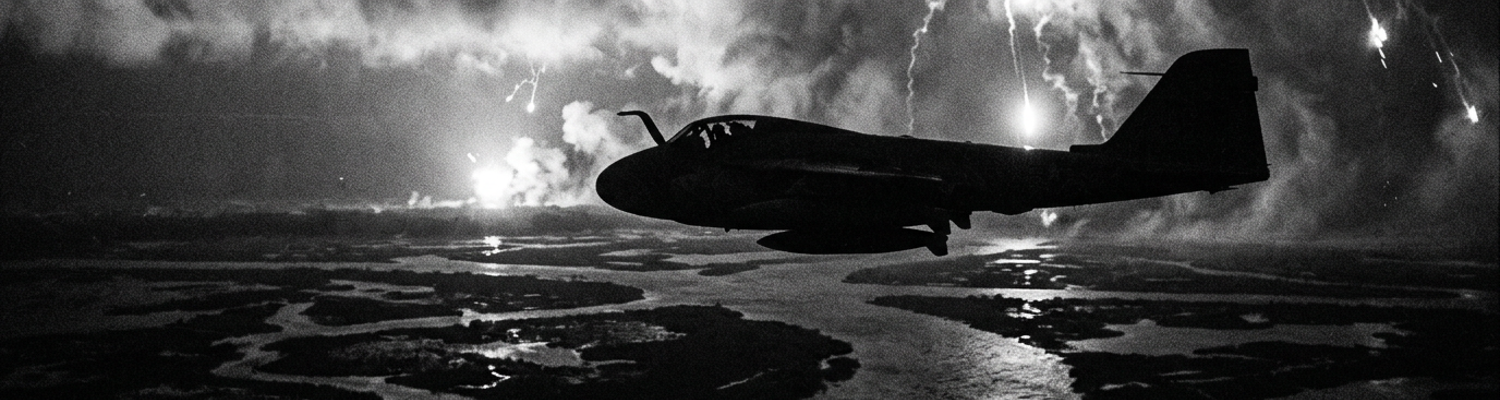

Operation Pocket Money and Low Altitude Tasking
Thirty-six hours of continuous flight operations in the Gulf of Tonkin pushed the aircrews of Attack Squadron 35 to the absolute limits of physical endurance. Inside the unconditioned lower decks of USS America, ambient temperatures routinely pushed past one hundred degrees Fahrenheit. Pilots and bombardier-navigators were drenched in salt sweat. The sweat dried into abrasive white crusts across their necks and shoulders. Sleep came in thirty-minute intervals broken by the concussive slam of arresting gear cables on the flight deck overhead. Men forced down lukewarm combat rations between briefings. They battled persistent gastrointestinal cramps brought on by contaminated shipboard water supplies and adrenaline. Flight crews hauled sixty pounds of survival gear, torso harnesses, and sidearms up eight flights of steel ladders to the flight deck.
Their heart rates hovered near tachycardia before the engines even turned over.
Exhaustion warped their depth perception long before they strapped into the cockpits. Archival evidence shows the tactical directives handed to VA-35 required an exceptional degree of individual exposure. Seventh Fleet tasking orders mandated that crews fly unescorted Grumman A-6A Intruder strike packages directly into North Vietnamese littoral waterways. They operated under complete radar and radio silence. Fleet planners eliminated fighter escorts, electronic warfare jamming aircraft, and surface-to-air missile suppression assets. Additional engine noise and electronic emissions would alert coastal observation posts along the mouth of the Song Ca. Pilots dropped down to two hundred feet above the water. They relied entirely on the AN/APQ-92 search radar and AN/APQ-112 track radar displays. Steering along twisting river channels in zero-illumination conditions pushed the bombardier-navigator to scan the cathode-ray tube display without looking up. They tracked ridgelines rising three hundred feet above their wingtips.
Every course correction was executed blindly off instrument readouts at three hundred and fifty knots.
A two-degree error on the altimeter meant controlled flight directly into the mud banks.
Seventh Fleet ordnance officers prioritized the deployment of Mark 36 Destructor and Mark 52 bottom mines into the shallow delta of the Song Ca. The goal was to choke off shallow-draft waterborne supply traffic moving south toward Vinh. The Mark 36 converted a standard five-hundred-pound Mark 82 low-drag bomb casing into an area-denial weapon. Mechanics replaced the standard nose fuse with a Mark 75 modification kit containing magnetic-influence target-detecting devices. Weapon activation in five to fifteen feet of muddy river water required exact drop parameters. The Intruder released these munitions from an exact altitude of two hundred feet at precise drop intervals. This ensured the fin-retarded Snakeye assemblies opened properly to decelerate the weapon. Crews also loaded the one-thousand-pound Mark 52 Mod 2 mine. This was a dedicated acoustic and magnetic bottom influence weapon designed to detonate when steel-hulled coasters passed within forty yards.
Releasing these heavy weapons required violent nose-up trim adjustments from the pilot.
This prevented the aircraft from sinking into the river upon weapon separation. Coastal thirty-seven-millimeter and fifty-seven-millimeter anti-aircraft batteries tracked their engine signatures from fortified positions at Ben Thuy. A close review of operational logs indicates the physical demand of repeated night minelaying runs produced sharp mental decline across the squadron within seventy-two hours. Bombardier-navigators reported visual hallucinations. They mistook river bends for open sea as continuous staring into green radar scopes induced severe spatial disorientation. Hydrodynamic drag calculations frequently failed when heavy silt altered riverbed depths. This caused several Mark 52 arming vanes to shear prematurely against water impact. Maintenance crews on the hangar deck discovered violent low-level turbulence sheared mounting pins on the Intruder weapon pylons. Emergency welds were required between sorties. Mechanics worked without sleep.
On the night of June 18, 1972, VA-35 aircraft dropped twelve Mark 36 Destructors across coordinates 18 degrees 38 minutes North, 105 degrees 42 minutes East.
Radar Navigation Hazards and Blind Flight Profiles
The technical burden on Attack Squadron 35 centered on the temperamental electronics of the Digital Integrated Attack and Navigation Equipment. Navy technicians referred to this system as DIANE. The Grumman A-6A lacked forward-looking infrared sensors or night-vision imaging systems. Crews were forced into total tactical reliance on two independent radar sets packed into the aircraft bulbous radome. Primary forward scanning fell to the AN/APQ-92 search radar. This Ku-band system was designed to sweep azimuth sectors ahead of the aircraft and generate raw terrain-clearance returns on the bombardier-navigator direct view storage tube. Working alongside it, the AN/APQ-112 track radar functioned as a monopulse tracking unit.
It locked onto discrete geographical landmarks to feed slant-range and velocity corrections into the CP-729A digital computer.
Aboard USS America, salt spray and tropical heat degraded the pressurized waveguides connecting these sets to their antennae. This triggered high-voltage arcing across the klystron transmitter tubes. If either radar dropped synchronization during an ingress run, the synthetic steering cues displayed on the pilot Kaiser vertical display indicator snapped offline. The crew was left blind at Mach 0.6.
Radar failure meant instantaneous disaster.
VA-35 flight leaders routed strike pairs into the Song Ca river corridor at altitudes between two hundred and four hundred feet. This cut well below the five-hundred-foot safety threshold established by Seventh Fleet tactical doctrine. Nocturnal blind flight profiles across this low-altitude regime required the pilot to lock his eyes onto the artificial horizon of the vertical display indicator. The bombardier-navigator buried his face inside the rubber viewing hood of the radar scope. Outside the cockpit canopy, complete darkness obliterated any distinction between river water, silt flats, and shoreline. The Song Ca cut through narrow valleys where vertical limestone karst formations rose eight hundred feet into the overcast sky. This created radar shadows and heavy ground-clutter returns that obscured bends in the channel. Flying at 360 knots, the aircraft traversed a nautical mile every ten seconds. The bombardier-navigator identified river bends through grain-heavy phosphorescent scope sweeps. He issued continuous rudder and roll corrections directly over the interphone. He commanded sixty-degree banking turns between valley walls he could not physically see.
A three-second delay in issuing a heading correction put the aircraft into solid limestone.
Sustained physical strain of low-level blind penetration destroyed an aircrew mental reserve within twenty minutes of landfall. The human inner ear generated false sensations of climbing or rolling. Pilots manually suppressed basic physiological survival instincts. Their bodies urged them to pull back on the control stick to escape the pitch-black riverbed. Cockpit air-conditioning packs struggled against tropical humidity. Moisture condensed on the cathode-ray tube glass. Navigators wiped the display clean with flight gloves while reading rapid terrain returns. In several recorded sorties over the Song Ca delta near Vinh, sudden monsoon rain squalls attenuated the Ku-band radar pulses. This blinded the AN/APQ-92 receiver. The electronic elevation clearance line plunged directly into the river surface. Mechanics aboard USS America repeatedly documented cracked mounting brackets on the AN/APQ-112 radar dishes. This was caused by the violent buffeting of low-level thermal turbulence as aircraft skimmed two hundred feet above the hot mudbanks of Nghe An province.
On July 7, 1972, squadron maintenance logs documented five consecutive night sorties along the Song Ca. Navigators operated with non-functional pitch-stabilization gyros across coordinates 18 degrees 41 minutes North, 105 degrees 39 minutes East.
Integrated Radar Grids and Anti Aircraft Corridors
North Vietnamese Air Defense Command ringed the Song Ca waterway with Soviet-supplied SNR-75 Fan Song fire-control radars. These units belonged to the 238th and 263rd Surface-to-Air Missile Regiments. Operating in the G-band and F-band frequencies, these tracking stations were paired with V-750 liquid-fueled missiles at hardened revetments outside Vinh. Low-altitude flight paths theoretically placed Attack Squadron 35 below the radar horizon. North Vietnamese operators positioned early-warning Spoon Rest stations atop the karst ridges of Mount Quyet. They tilted antenna arrays downward to exploit ground-bounce clutter along the river bends. An A-6A broke cover over the mud flats at coordinates 18 degrees 40 minutes North, 105 degrees 43 minutes East. The Fan Song transitioned from wide-angle search to narrow track mode within six seconds. Tracking beams latched onto aircraft exhaust plumes. This fed target data directly into analog computer vans that calculated continuous intercept vectors for four-ton missiles waiting on concrete pads.
Cockpit warning gear emitted continuous high-frequency alert tones.
The shrill strobe warning of the AN/APR-25 radar detection system caused immediate neurological breakdown among aircrews flying night minelaying sorties. Inside the pitch-black cockpit, pilots experienced sudden muscular tremors and tunnel vision. High-frequency audio tones flooded their headsets. This signaled an active missile lock while the jet skimmed two hundred feet above the water. Heart rates spiked past one hundred and sixty beats per minute. Flight doctrine prevented the pilot from breaking formation to initiate five-g diving turns. Losing altitude meant crashing into river mud. Climbing above five hundred feet exposed the aluminum fuselage to the full lethal engagement envelope of the missile batteries. Navigators fighting nausea vomited inside their oxygen masks. Sweat pooled inside their survival vests. They struggled to wipe condensation off display screens while their fingers shook against the weapons release panel.
Sleep deprivation destroyed their fine motor skills.
The 280th Anti-Aircraft Artillery Regiment constructed pre-sighted interlocking flak corridors using radar-directed 37mm and 57mm anti-aircraft artillery. North Vietnamese battery commanders linked Soviet SON-9 Fire Can tracking radars directly to motorized gun mounts. This created optical and electronic kill boxes spanning coordinates 18 degrees 39 minutes North, 105 degrees 41 minutes East. Gun crews calibrated their weapons to lay down intersecting cones of high-explosive fragmentation fire across known river entry points. They did not attempt individual aircraft tracking in the dark. Twin-barrel 37mm Type 65 cannons fired four hundred rounds per minute of point-detonating shells. The 57mm S-60 guns launched five-pound armor-piercing projectiles fused to detonate automatically at eight hundred feet. Heavy concussive barrages forced shrapnel through aluminum wing roots and severed hydraulic return lines. This vented flammable fluids into engine bays and disabled the flap actuators required for stable low-speed flight.
Falling metal fragments severed alternate flight paths out of the valley.
Post-strike combat damage assessments aboard USS America recorded multiple incidents. Shrapnel impacts severed the electrical buses powering the AN/ALQ-100 ECM transmitters. This left VA-35 aircraft unable to break ground radar locks during egress. Aviation mechanics discovered fifty-seven-millimeter fragments lodged inside the titanium compressor casings of Pratt and Whitney J52-P-8B turbojets. Turbine blade shearing caused catastrophic engine fires within seconds of clearing the coast. On July 14, 1972, maintenance logs confirmed that three consecutive A-6A airframes returned with anti-aircraft fragmentation damage through the trailing-edge control cables. Crews reported complete sensory disorientation as unguided tracer fire illuminated the cockpit canopy at coordinates 18 degrees 38 minutes North, 105 degrees 44 minutes East.
Monsoonal Squalls and Vestibular Disorientation
During the Southwest Monsoon of late summer 1972, sudden convective storm cells over the Gulf of Tonkin and the Annamite Range produced dense downpours. These storms completely wiped out external horizon references within seconds of an A-6A entering coastal airspace. Attack Squadron 35 aircrews descended through two hundred feet toward the Song Ca river mouth. Torrential rain sheeting across the curved acrylic canopy created severe optical refraction. This warped the apparent position of geographic features and ground lights. Water ingestion and dense cloud mass repeatedly choked the pitot-static tubes despite internal heating elements. This caused needle fluctuations across the airspeed indicators and pressure altimeters. Inside the pilots middle ears, the semicircular canals failed to register the gradual bank angles induced by severe updrafts and downdrafts. The fluid inside the horizontal semicircular canals stabilized during prolonged skidding turns.
This produced the classic vestibular illusion known as the leans.
A pilot abruptly leveled the wings using raw instrument data from the Kaiser indicator. His central nervous system reported that the aircraft was violently rolling in the opposite direction. Pilots reflexively fought their own flight control sticks. They attempted to roll the aircraft back into steep banks toward the black water below.
The human inner ear transmitted conflicting spatial data.
The physical sensation of false acceleration routinely gripped VA-35 pilots during low-level penetration runs. Twin Pratt and Whitney J52-P-8B engines spooled up to counteract heavy downdrafts inside rain squalls. The rapid forward acceleration stimulated the otolith organs. This signaled an aggressive pitch-up climb to the pilot brain even while the aircraft remained in level flight or shallow descent. Exhausted pilots pushed the stick forward. They drove the Intruder downward toward the Song Ca mud flats at 360 knots. Moisture trapped within the instrument panels condensed against the glass covers of the attitude gyros. This obscured backup artificial horizons while cockpit defoggers blew humid, lukewarm air across the windscreens. Bombardier-navigators suffered acute Coriolis cross-coupling illusions whenever they raised their heads from the radar hood to scan engine instruments during a banking maneuver. Rapid head movements across multiple rotational planes caused violent sensations of tumbling head over heels. This triggered instantaneous nausea, cold sweats, and involuntary head spasms.
Navigators could not call out radar altitude checks.
Vertigo stripped away an aviator ability to process basic flight instruments. Unexpected tactical illumination deployed by North Vietnamese coastal defense units shattered what little visual adaptation aircrews managed to maintain. Shore batteries from the 280th Anti-Aircraft Artillery Regiment and local militia units fired parachute-retarded star shells from eighty-five-millimeter coastal defense guns and heavy mortars directly over the water. These magnesium flares detonated with zero warning at five hundred feet. They burned at over one million candlepower and washed out the entire forward field of view with blinding white glare. Cockpits shielded under red night-lighting were suddenly drenched in brilliant illumination. This instantaneously bleached the rhodopsin photopigments in the retinas of both crew members. Recovery of visual dark adaptation required up to thirty minutes. The Intruder was traveling six hundred feet every second. Concentrated battery fire from twin-barrel thirty-seven-millimeter and fifty-seven-millimeter installations along coordinates 18 degrees 39 minutes North, 105 degrees 43 minutes East produced continuous fields of high-frequency muzzle flashes.
The rapid strobing effect through the rain-streaked canopy induced flicker vertigo. This neurological state caused disorientation, loss of motor control, and brief seizures among pilots already operating under chronic sleep deprivation. Blinded pilots instinctively closed their eyes or looked down into the cockpit footwells. They lost instrument scan discipline at the exact moment the aircraft crossed pre-planned mine drop points. The bombardier-navigator could no longer distinguish the green sweep lines on the AN/APQ-92 direct view storage tube from the persistent retinal afterimages of exploding star shells. Between June and August 1972, squadron debriefs documented twelve separate instances where VA-35 pilots flying between two hundred and three hundred feet above the Song Ca experienced complete spatial disorientation immediately following star shell detonations. Navigators seized control column linkages to prevent water impact.
On August 19, 1972, maintenance crews aboard USS America inspected airframe Bureau Number 155613. They discovered mud scraping along the lower radome skin and wingtip speed brakes after a blind egress through heavy rain squalls and anti-aircraft fire at coordinates 18 degrees 42 minutes North, 105 degrees 40 minutes East.
Transponder Telemetry Dropouts and Friendly Fire Hazards
Continuous exposure to marine salt spray and violent thermal transitions triggered catastrophic electronic failures within the Mark XII Identification Friend or Foe systems aboard VA-35 aircraft. Technicians on the USS America tracked these disruptions to the AN/APX-72 transponder units mounted in unpressurized avionics bays directly behind the cockpit bulkhead. Airborne salt aerosols entered through moisture weep-holes. This coated gold-plated coaxial connections and silicon pin-diode switches with sodium chloride residue. High humidity caused galvanic corrosion across the chassis grounding points. This generated resistance spikes that distorted the microsecond-interval pulse trains required for secure Mode 4 interrogation replies. Simultaneous mechanical degradation worsened the failure rates. Forty-foot drop launches from steam catapults subjected the transponder KIT-1A cryptographic computer to twenty-g acceleration spikes. Internal solder joints cracked along the pulse-forming networks.
Ceramic delay-line modules shattered under the unrelenting airframe vibration of high-speed penetration at two hundred feet.
An Intruder cleared North Vietnamese air defenses and banked east toward water. The transponder routinely stopped transmitting automated recognition codes. The electronics failed silently while the cockpit displays registered normal voltage. Unverified transponder returns created immediate, lethal escalations aboard Seventh Fleet surface combatants. Guided missile cruisers holding position on the northern Positive Identification Radar Advisory Zone station operated under high-threat intercept postures between coordinates 19 degrees 45 minutes North, 107 degrees 15 minutes East. Tactical action officers monitored AN/SPS-48 three-dimensional search radars for North Vietnamese MiG-17 and MiG-21 fighters attempting littoral ambushes against naval strike groups. A low-flying VA-35 A-6A cleared the coastline near Vinh at 380 knots without a valid Mode 4 reply. Cruiser combat information centers categorized the contact as an unidentified hostile air track.
Surface-to-air missile crews immediately initialized engagement sequences.
They directed AN/SPG-49 tracking and AN/SPG-55 fire-control radars to paint the closing target with continuous-wave illumination. Mark 10 twin-arm missile launchers automatically slewed their guide rails toward the incoming Intruder. They elevated RIM-8 Talos and RIM-67 Standard missiles onto firing bearings before visual verification was physically possible. Friendly target-acquisition beams locked onto the bombers from forty miles out. The psychological impact of friendly missile illumination pushed exhausted VA-35 aircrews past their mental limits. Inside the cockpit, the AN/APR-25 radar warning receiver detected the 3-centimeter and 10-centimeter guidance beams emitted by Seventh Fleet warships. This triggered emergency audio sirens and visual strobe indications identical to land-based Soviet Fan Song batteries. Pilots already disoriented from monsoonal turbulence and flak corridors now faced the prospect of destruction by American surface-to-air missiles over open water.
Doctrine prohibited breaking radio silence until aircraft crossed predetermined identification points. Crews routinely broke transmission discipline to broadcast emergency recognition codes over the fleet common guard frequency at 243.0 megahertz. Bombardier-navigators frantically actuated manual toggle switches to cycle the AN/APX-72 through emergency Mode 3/A codes. They attempted to arrest launcher firing sequences aboard the cruisers. On July 28, 1972, deck logs from USS Sterett recorded an aborted RIM-67 launch sequence against a VA-35 airframe at coordinates 18 degrees 52 minutes North, 106 degrees 18 minutes East. The sequence was terminated eight seconds before missile release when the Intruder executed a frantic fifty-degree identification turn into the ship visual identification sector.
Cumulative Physical Exhaustion Among Intruder Crews
Seventh Fleet air tasking orders deliberately concentrated Attack Squadron 35 flight windows into erratic, nocturnal strike cycles between 2100 and 0430 hours. Carrier Division 5 flight operations officers rotated launch blocks in shifting ninety-minute windows. This prevented the human body from establishing a steady circadian rhythm. Flight crews spent daylight hours attempting to sleep inside berthing compartments situated directly beneath the number one and two steam catapults of USS America. Launch cycles drove continuous ninety-decibel impact shocks through the overhead steel frames. Ambient temperatures in the lower decks hovered between ninety-five and one hundred and two degrees. Sleep was fitful and short. Medical logs recorded that squadron aviators averaged less than three broken hours of rest in every twenty-four-hour period across continuous thirty-day combat operational phases. Aircrews experienced severe chronic desynchronosis. Core body temperatures failed to drop. Adrenal glands pumped cortisol continuously into their bloodstreams.
Chronic insomnia halted normal hormone regulation within forty-eight hours.
Carrier medical department interventions during Operation Linebacker relied on chemical countermeasures to maintain crew availability. Flight surgeons distributed five-milligram dextroamphetamine tablets to pilots during pre-flight briefings at 2200 hours. This forced central nervous system arousal. Medical officers followed this with prescriptions of chloral hydrate or secobarbital once crews cleared post-strike debriefings at dawn. This artificial cycle of amphetamines and chemical sedatives accelerated physiological exhaustion. Aviators reported severe gastric distress, cardiac palpitations, and dry mouth while strapping into the A-6A cockpit. Their resting pulse rates routinely exceeded one hundred beats per minute before catapult hookup. By the fourth consecutive week of night-only operations along the Gulf of Tonkin, the cumulative loss of rapid-eye-movement sleep induced auditory hallucinations. Aircrews heard phantom warning tones over their headsets while walking shipboard passageways.
Exhausted brains could no longer process multiple instrument needles simultaneously.
Sustained nocturnal interdiction caused catastrophic erosion of situational awareness during low-altitude ingress. Low-level penetration through the Song Ca river corridor required simultaneous tracking of the Kaiser vertical display indicator, the APN-141 radar altimeter, and the AN/APQ-92 direct view storage tube. Under deep sleep debt, pilots developed severe mental tunneling. They fixated exclusively on a single flight instrument for ten to fifteen seconds while ignoring primary flight parameters. Low-altitude warning lights preset to flash at one hundred and eighty feet flashed unheeded on instrument cowlings. Pilots stared through their windscreens into total darkness. Bombardier-navigators repeatedly failed to complete basic weapons-release checklists. They forgot to select the correct station switches on the armament control panel. They miscalculated ground-speed corrections fed into the CP-729A digital computer. In multiple recorded sorties over Nghe An province, navigators took up to twenty seconds to acknowledge direct interphone commands from the pilot. They exhibited delayed verbal processing and profound mental blanking while skimming two hundred feet over mud banks.
Uncontrollable muscle tremors began in the hands and calves during the final weapon run.
Extreme somatic stress triggered debilitating physical tremors among aircrews attempting precision ordnance delivery. Flight surgeons documented that prolonged sympathetic nervous system activation caused involuntary muscle spasms across pilots forearms. This made fine tracking adjustments on the flight control stick almost impossible. Pilots developed severe clonus in their lower extremities when lining up on release points along coordinates 18 degrees 39 minutes North, 105 degrees 42 minutes East. Violent shaking of the calf muscles against the rudder pedals destabilized the aircraft during thirty-degree bank angles. Fingers trembled against throttle friction locks. This resulted in unintended engine power fluctuations that altered airspeed by twenty knots during critical mine-release runs. On August 24, 1972, post-flight maintenance inspections on an A-6A airframe discovered that erratic pilot control inputs caused by hand tremors induced excessive g-forces. These forces tore an outer wing pylon sway brace during a low-level mine release at coordinates 18 degrees 41 minutes North, 105 degrees 41 minutes East.