
A political firestorm, born from allegations of corrupt contracting, prompted President Franklin D. Roosevelt to issue Executive Order 6591 on February 9, 1934. The order abruptly canceled all private airmail contracts. It alleged fraud and collusion stemming from the Hoover administration's awards under Postmaster General Walter Folger Brown. Brown had used the Air Mail Act of 1930 to aggressively consolidate routes, allegedly favoring large corporations like United Air Lines, Transcontinental & Western Air, and American Airways at the expense of smaller operators. A Senate investigation, led by Hugo Black, exposed these backroom dealings, creating a political scandal that the new Roosevelt administration felt compelled to act upon with populist force. The solution was politically expedient but operationally reckless. The executive order mandated the United States Army Air Corps to take over the nation’s airmail routes, a task for which it was catastrophically unprepared. The decision was made without formal consultation with Army Chief of Staff General Douglas MacArthur or the Chief of the Air Corps, Major General Benjamin D. Foulois. Foulois, given a mere ten days to prepare for a mission of continental scale, accepted the duty with a public display of confidence that masked grave internal deficiencies and his own private misgivings.
A Command Scrambled Into Existence
Foulois scrambled to organize the monumental effort, designated the Army Air Corps Mail Operation (AACMO). He placed his executive officer, Brigadier General Oscar Westover, in overall command from Washington. The country was divided into three operational zones, each commanded by an officer who would later become a foundational figure in American airpower. The Western Zone, arguably the most hazardous due to its mountainous terrain, was commanded by Lieutenant Colonel Henry H. 'Hap' Arnold, headquartered in Salt Lake City. The Central Zone, which had to contend with the unpredictable blizzards of the Great Plains, was given to Lieutenant Colonel Horace M. Hickam, based in Chicago. The Eastern Zone, covering the storm-prone routes over the Allegheny Mountains, was assigned to Major Byron Q. Jones in Newark. These men were handed a near-impossible task. They had to establish a national mail service in the dead of winter using men and machines fundamentally ill-suited for the mission. The commercial airlines had spent a decade building a specialized infrastructure of lighted airways, radio range stations, and weather reporting networks. The Air Corps was expected to replicate this system in ten days with almost none of the requisite tools.
Flying with Inadequate Machines
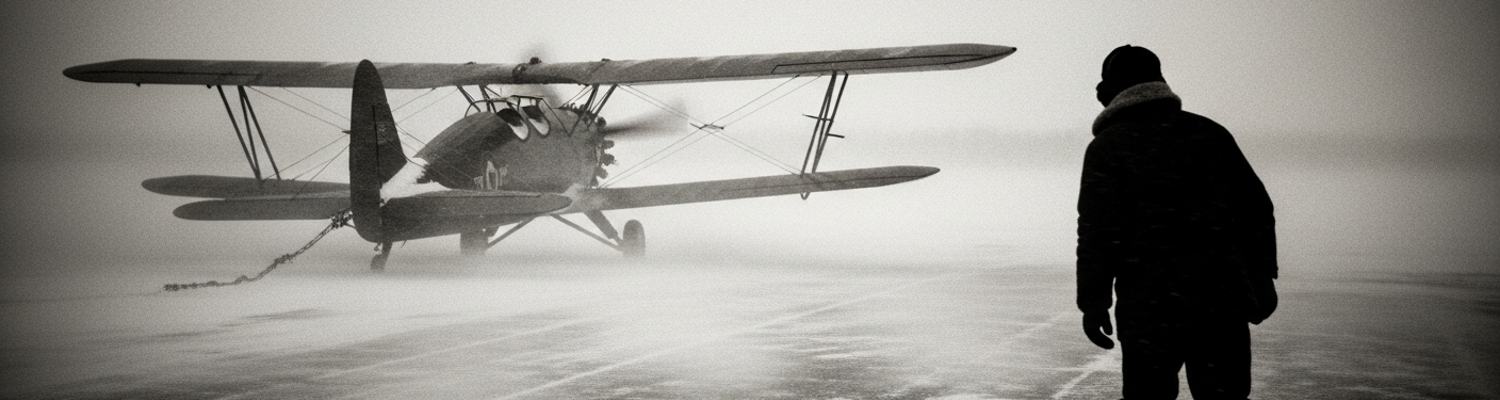
The Air Corps of 1934 was a force designed for daylight combat and visual flight rules, not for the rigors of all-weather, cross-country navigation. Its pilots were trained for formation flying and gunnery, with most having minimal experience in night or instrument flying. Of the 250 pilots initially assigned to AACMO, most were junior lieutenants with less than two years of flight experience and few logged hours in 'blind' conditions. The disparity between the Air Corps' capabilities and the mission’s demands was stark. The equipment situation was even more dire. The Air Corps pressed a motley collection of 14 different aircraft types into service, creating a logistical nightmare for maintenance and spare parts. The majority were open-cockpit biplanes completely exposed to the brutal February weather. Workhorses included the Thomas-Morse O-19 and Douglas O-38 observation planes, slow and stable but never intended for such sustained logistical work. They lacked cabin heat, de-icing equipment, and modern navigation instruments. Even the Boeing P-12 pursuit fighters were initially tried, but they could carry only a 50-pound mail load that made them dangerously tail-heavy. They were withdrawn after the first week. The most capable aircraft available were the new, all-metal Martin B-10 bombers and Curtiss A-12 Shrike attack planes. These were few in number, and the Army had only just begun taking deliveries. While they represented the future, their crews were not yet proficient, and a crash program to install directional gyros and artificial horizons was ordered. Mechanics with little to no experience with such devices rushed to install them, often without proper calibration or training.
The Price of Unreadiness
The operation began at midnight on February 19, 1934, amidst one of the most severe winters on record. The results were immediate and tragic. Within days, the headlines were filled with news of crashes. On the very first day, two fatal incidents occurred. Lieutenant Jean D. Grenier, flying a Curtiss A-12 Shrike, crashed and died near Toledo, Ohio. Lieutenants Edwin D. White and his passenger were killed when their Northrop Gamma crashed in Utah. The combination of treacherous weather, inadequate aircraft, and pilot inexperience proved lethal. By the end of the first week, five pilots were dead. The press, initially supportive of Roosevelt's anti-corruption stance, turned hostile. World War I ace and airline executive Eddie Rickenbacker famously condemned the operation as 'legalized murder.' His criticism, along with that of famed aviator Charles Lindbergh, resonated with a public shocked by the mounting death toll.
The accidents were not just due to weather. Pilots became disoriented in clouds, engines failed in the extreme cold, and landing gear collapsed on frozen, unprepared airfields. The entire operation was bleeding men and machines at an alarming rate. March 9, 1934, became known as 'Black Friday' for the AACMO. In a single 24-hour period, four pilots were killed and several others injured in a series of crashes across the country, bringing the total fatalities to ten in less than a month. The relentless string of accidents exposed the profound gap between the Air Corps' perceived and actual capabilities. The public outcry was immense, and President Roosevelt was forced to act. He called Foulois and MacArthur to the White House for what Foulois later described as the 'worst tongue-lashing I ever received in all my military service.' On March 10, Roosevelt ordered a temporary suspension of the airmail operation. During this ten-day halt, the Air Corps attempted to regroup, grounding pilots with less than two years of experience and rushing to better equip its planes with what few instruments could be found. Operations resumed on March 19 on a reduced, safer schedule, but the damage was done. By the time the Air Corps flew its last mail pouch on June 1, 1934, twelve pilots had lost their lives in 66 accidents. The Army had flown 1.5 million miles with the mail, a mission that cost the government millions and shattered the Air Corps' reputation.
A Catalyst Forged in Failure
Though a public humiliation and a human tragedy, the airmail fiasco served as a brutal but necessary wake-up call. The glaring deficiencies it exposed could no longer be ignored by Congress or the War Department. In April 1934, Secretary of War George Dern convened a special committee, chaired by former Secretary of War Newton D. Baker, to conduct a sweeping review of the Air Corps. The Baker Board’s findings were a watershed moment. It recommended the creation of a General Headquarters (GHQ) Air Force, a centralized, combat-ready command structure that was a significant step toward an independent air service. The board also called for a dramatic increase in aircraft procurement and a complete overhaul of pilot training.
The disaster directly spurred technological and doctrinal revolutions. The urgent need for reliable, all-weather aircraft accelerated the procurement of modern designs. The operation had highlighted the superiority of the few enclosed-cockpit, all-metal monoplanes like the Martin B-10. This experience created an unstoppable demand for aircraft like the Douglas DC-2 and its legendary successor, the DC-3. The military versions of these aircraft, the C-33 and C-47 Skytrain, would become the backbone of Allied airlift capabilities in World War II, a direct result of the lessons paid for in blood in 1934.
Perhaps the most vital lesson was the absolute necessity of instrument flight. The fiasco had proven that pilots could not navigate safely in poor visibility by relying on their senses alone. The Air Corps was forced to make a systemic shift, embracing 'blind flying' as a core competency. This led to the widespread adoption of advanced flight instruments like the artificial horizon and directional gyro, pioneered by figures like Jimmy Doolittle. It also drove the acquisition of flight simulators, most notably the Link Trainer, which allowed pilots to practice instrument procedures safely and economically on the ground. Training syllabi were completely overhauled to make instrument proficiency mandatory, creating a new generation of pilots capable of operating in any weather, day or night. This cadre of skilled aviators and the advanced, all-weather aircraft they flew, were a direct legacy of the tragic lessons learned in the winter of 1934. The 78-day ordeal, while a failure in its immediate objective, ultimately forced the modernization that prepared the Army Air Forces to fight and win in the skies of World War II just a few years later.