
Operation Avalanche began with a fatal miscalculation. The physical geography of the Gulf of Salerno suggested a controlled, almost administrative, landing. Gentle offshore gradients would allow landing craft to beach easily. A narrow strip of sand promised simple construction of exit routes. Behind it, a coastal plain with a ready-made road network appeared perfect for deploying troops and establishing supply depots. This landscape fed a high-level Allied perception that the invasion, commencing on September 9, 1943, would meet little resistance. The Italian government had just surrendered. Planners within Lieutenant General Mark Clark’s U.S. Fifth Army gambled on German disorganization. Clark himself, against the advice of his naval commanders, vetoed any pre-invasion naval or aerial bombardment. He staked everything on the element of surprise.
The gamble failed instantly.
As the first wave of the U.S. 36th Infantry Division neared the beaches at Paestum, a loudspeaker blared from the shore in English, taunting the approaching troops and confirming the landing had been expected. The German 16th Panzer Division, a veteran unit reconstituted after its destruction at Stalingrad, was waiting in prepared positions. Artillery and machine-gun posts opened fire. Despite the shock, the initial waves pushed through the defenses and clawed out a foothold. For the first few days, a fragile sense of progress held. The beachheads were secured and expanded to a depth of six or seven miles. The engineers of the 531st Engineer Shore Regiment, veterans of prior campaigns, began their methodical work. They cut gaps in wire, cleared mines, and laid down steel-mat roadways. To Allied command, it appeared the operational timetable was still viable, even with the bloody reception.
A close review of operational logs shows this belief was a catastrophic error in judgment. While Allied engineers laid roads, Field Marshal Albert Kesselring, the German Commander-in-Chief in Italy, was rushing reinforcements to the front. By September 12, elements from six divisions, including the 26th Panzer, 29th Panzergrenadier, and the Hermann Göring Panzer Division, were converging on Salerno. General Heinrich von Vietinghoff, commanding the German Tenth Army, had identified the Allied weak point. A seven-mile-wide gap had opened between the British X Corps and the American VI Corps in the flat corridor formed by the Sele and Calore rivers. This was the operational seam, and he intended to tear it open. The German objective was direct: drive a wedge through the Allied front, split the beachhead, and destroy each half against the sea.
On September 13, the full weight of the German counterattack fell. The main armored thrust came down the Sele-Calore corridor. German panzers and infantry smashed into American units with overwhelming force. A battalion of the 157th Infantry Regiment was driven from a key defensive position at a large tobacco factory. Another powerful force hit a battalion of the 36th Division, inflicting 508 casualties and forcing it back across the Calore River. The 2nd Battalion of the 143rd Infantry, caught in the corridor, was effectively overrun with the loss of around 500 men. The German advance was so rapid it reached the junction of the two rivers, a point less than five miles from the landing beaches. The illusion of a controlled landing was gone, replaced by a fight for survival on the very edge of the shore. To plug the holes, 4,000 paratroopers of the 82nd Airborne Division were hastily dropped directly onto the beachhead as emergency reinforcements on the nights of September 13 and 14.
The entire Allied enterprise hung by a thread. The speed of the German counter-thrust shattered any remaining Allied assumption of control. The initial assessment of a costly but manageable landing was replaced by the possibility of a complete defeat. The coordinated German assault on September 13th, known as Black Monday, exposed the fundamental flaw in the Allied plan. The two corps, British and American, were too widely separated without sufficient forces to hold the ground between them. A review of Fifth Army headquarters logs (NARA Record Group 407) shows a rapid shift from procedural updates to frantic contingency planning. General Mark Clark faced being thrown back into the sea. Naval commanders were alerted to prepare for mass evacuation. Admiral H. Kent Hewitt, commanding the Western Naval Task Force, pointed out the technical impossibility of retracting fully loaded landing craft from the beaches while under direct fire. Preparatory plans for a withdrawal, designated Plan BLACK and Plan WHITE, were drafted anyway.
This was not a theoretical exercise. Clark and his staff issued preparatory orders to subordinate units for re-embarkation. One variation involved withdrawing the American VI Corps from the southern beaches and concentrating the entire Fifth Army in the northern, British-held sector. Another, more extreme option, considered a full evacuation of the entire beachhead. The operational logic of the invasion was inverted. Engineers from units like the 531st Engineer Shore Regiment, who had spent days building exit roads off the beaches, were now ordered to prepare last-ditch defensive lines. Their mission shifted from enabling an advance to facilitating a fighting withdrawal. They were thrown into the line as infantry, a final reserve to plug the hole ripped open by German armor. The only other forces standing between the panzers and the sea were artillery batteries firing over open sights and makeshift infantry units composed of headquarters staff, drivers, and clerks.
The crisis peaked on the night of September 13th. With his ground forces on the verge of collapse, Clark sent an urgent request for airborne reinforcements. In a hastily conceived plan, pathfinders were dropped onto the beachhead to mark a drop zone with gasoline-filled cans arranged in a flaming T-shape. Within hours, the 1st and 2nd Battalions of the 504th Parachute Infantry Regiment, part of the 82nd Airborne Division, were loaded onto aircraft in Sicily. Over the nights of the 13th and 14th, more than 3,400 paratroopers were dropped directly onto the beachhead, assembling quickly and moving toward the fighting. This action, combined with a massive concentration of naval gunfire from Allied warships and over 2,000 air sorties, finally blunted the German spearhead. By the evening of September 14, thirty German armored vehicles had been knocked out, and the immediate threat of a split had been contained.
The Paestum beaches devolved into a methodical German killing ground. From the commanding heights of the surrounding hills, observers from the 16th Panzer Division directed a storm of artillery and mortar fire with chilling precision. This was not indiscriminate shelling. It was a targeted effort to sever the beachhead from its maritime lifeline. Every Landing Craft, Tank (LST) beached on the sand and every cluster of supplies became a pre-registered target. Into this maelstrom of high-explosive shells and shrapnel plunged the men of the US Army’s engineer units, primarily the veteran 531st Engineer Shore Regiment and elements of the 36th Engineer Combat Regiment. Their mission was to clear mines, breach wire obstacles, and lay down steel mat roadways to get vehicles off the sand. The operational plan had not fully accounted for performing these complex tasks while being systematically hunted.
It was an impossible calculus. A Caterpillar D-7 bulldozer, essential for carving out beach exits, was an immediate and high-value target for German gunners. Multiple drivers were killed as they attempted to build ramps and clear paths. The engineers’ primary task was defeating the extensive German minefields sown with Teller mines, powerful anti-tank devices designed to cripple vehicles. Under ideal conditions, clearing them was a slow, deliberate process. At Salerno, there were no ideal conditions. Engineers from the 36th Combat Engineers and the 531st attempted to clear lanes while crawling on the sand, the distinctive sound of incoming 88mm shells a constant presence. When a detector operator was hit, another man had to take his place. Improvisation became standard procedure. When methodical sweeping proved too slow, engineers resorted to using Bangalore torpedoes, long pipes filled with explosives, to blast paths through wire and minefields in single, violent detonations. Men from the 3rd Battalion, 531st Engineer Shore Regiment, were observed moving up the beach carrying sections of these torpedoes, fully exposed to enemy fire.
Every action was a race against time and German ordnance. The survival of the entire beachhead depended on the flow of supplies, and the engineers were the gatekeepers. A single disabled truck or a crater from an artillery shell could block a newly created beach exit, creating a bottleneck. This forced engineers to work constantly, not just clearing enemy obstacles but also clearing wrecked American equipment. The beaches became a chaotic jumble of burning vehicles, damaged landing craft, and growing piles of ammunition and fuel, all of which attracted more German fire. The engineers had to maintain pathways for the steady stream of DUKW amphibious trucks that were bringing artillery pieces and ammunition directly from ships offshore. These vehicles were essential for the rapid buildup of combat power, but they required stable exit routes across the soft sand, which the engineers provided by laying down interlocking steel mats, often while under direct observation. By September 13th, the situation grew so dire that engineers from the 36th and 531st Regiments were pulled from their technical tasks and thrown into the front line as infantry to help plug the gaps torn open by the main German counterattack.
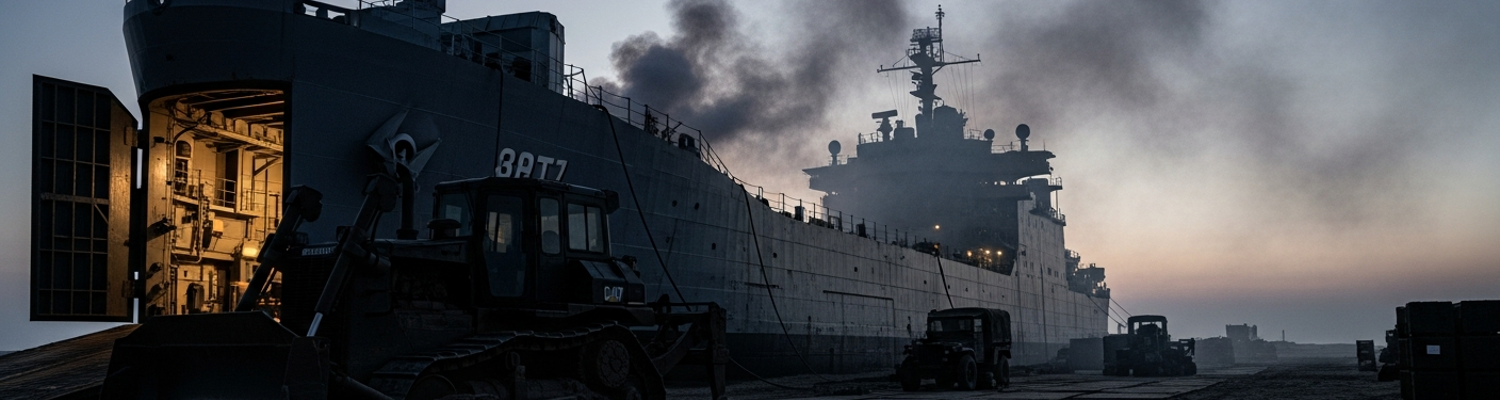
The primary supply route provided by the fleet of Landing Ship, Tanks (LSTs) became a particular focus of German artillery observers. These massive, slow-moving vessels were forced to beach themselves for extended periods to discharge their cargo, making them stationary targets. A review of Western Naval Task Force logs shows a recurring pattern of damage. German 88mm and 105mm shells, fired from well-concealed inland positions, repeatedly struck the unarmored hulls and, most frequently, the bow door mechanisms. A direct hit on the complex winch and cable systems that operated the large clamshell doors and drop-down ramp could render an LST useless, trapping its cargo inside or preventing it from retracting from the beach. Naval repair parties and Army engineers from the 531st Engineer Shore Regiment worked in a state of triage at the water’s edge. They were often submerged in the surf as they struggled to cut away damaged plating and free jammed ramps with acetylene torches, all while under observed fire. More than one LST found itself broached, turned sideways by the waves and stuck fast in the sand, a helpless target that drew an ever-increasing concentration of enemy shelling.
Official doctrine failed on the sand. This battlefield chaos forced an immediate reliance on improvised technical solutions by ordnance and engineering crews. With the beachhead compressed and supply lines stretching only a few thousand yards to a violently contested front, there was no rear area for orderly repair. Mechanics from units like the 3497th Ordnance Medium Automotive Maintenance Company, attached to the 1st Engineer Special Brigade, became frontline assets. They established makeshift motor pools just behind the dunes, often using the wreckage of one vehicle to shield their work on another. The practice of cannibalization became standard. A GMC truck with a shattered axle would be stripped of its carburetor, fuel pump, and tires to get two other damaged trucks moving. A bulldozer disabled by a Teller mine would have its hydraulic lines and blade assembly scavenged to repair another. Archival evidence describes welders working in open sand, patching shrapnel holes in engine blocks and radiators while infantrymen provided covering fire. These were not elegant repairs; they were crude fixes designed to keep a vehicle running for just a few more hours or a few more miles.
No single piece of equipment exemplified the cycle of damage, repair, and operational importance more than the DUKW amphibious truck. These 2.5-ton vehicles were the indispensable link, capable of driving directly from the holds of transport ships, swimming to shore, and delivering their cargo directly to the gun pits. But they were mechanically fragile. Saltwater spray relentlessly fouled their ignition systems, and their propellers were easily damaged by underwater obstacles. German machine gunners and mortarmen specifically targeted the DUKWs as they emerged from the surf. Small, mobile teams of ordnance mechanics worked at the transition point between water and sand, a zone under constant threat. They became experts in field-expedient repairs, changing spark plugs on water-logged engines, patching punctured hulls with scavenged sheet metal, and clearing fouled propellers, often while wading in chest-deep water. Keeping the DUKW fleet operational was a direct factor in the survival of the beachhead; their loads of 105mm shells enabled the Allied artillery to finally blunt the German panzer counterattacks.
The work of carving exit routes into the hostile shore fell to combat engineers, principally from the 531st Engineer Shore Regiment and the 36th Engineer Combat Regiment. Theirs was a task of creating stable, trafficable roads out of soft sand while under direct and observed fire. A close review of operational logs shows that every piece of heavy equipment was an immediate magnet for shellfire from the 16th Panzer Division’s guns. Caterpillar D-7 bulldozers were especially high-value targets. More than one was hit by 88mm shells, their operators killed while attempting to cut the initial ramps from the water’s edge through the dunes. On Red Beach, Technician 5th Grade Nolan D. Green and Private First Class Clarence F. Taylor were killed when their bulldozer took a direct hit. On Blue Beach, where German fire was so intense the positions were abandoned a day later, engineers managed to complete one exit route under direct fire from tanks less than 200 yards away before being forced to pull back.
The terrain itself was a weapon. Initially, the problem was suffocating dust. The fine, volcanic soil of the Paestum plain, churned by thousands of men and hundreds of vehicles, rose in dense, choking clouds. This abrasive powder blinded vehicle operators and clogged the air filters of truck and bulldozer engines to the point of failure. Then the weather turned. Heavy autumn rains began on September 26th, transforming the dust into a thick, viscous mud. This presented an entirely new set of technical challenges. The primary tool for surfacing the beach exits was pierced steel planking (PSP), also known as Marston Mat. These ten-foot-long, sixty-six-pound sections of perforated steel were designed to interlock, creating a solid surface. Under the rain and the weight of constant traffic, entire sections of this steel matting would simply disappear, pressed down into the mire. This forced the engineers into a relentless cycle of labor: excavating the sunken mats, attempting to build up a new subsurface with whatever rock or rubble could be found, and relaying the road, only for it to be shelled or swallowed by mud again.
Ensuring these fragile routes remained open was a direct factor in the survival of the beachhead. The entire operational plan depended on the rapid movement of supplies from the landing craft to the frontline units. Archival evidence shows a direct correlation between the status of these exit roads and the ability of artillery batteries to fire. The DUKW amphibious trucks, which brought 105mm howitzer shells directly from ships to the gun pits, were entirely dependent on these engineer-laid paths. A single blocked exit could create an immediate ammunition shortage in a sector under attack. Engineer troops were forced to become traffic managers under fire, directing convoys, clearing wrecked or bogged-down vehicles, and performing hasty repairs on the road surfaces. They prioritized the flow of ammunition and fuel, recognizing that the ability of the 36th Division’s infantry to hold back German panzers depended on the supplies that crawled across these improvised, constantly failing roadways.
The official record of the Salerno crisis was written in silver halide and graphite. U.S. Army Signal Corps photographers, moving with the assault waves, captured images that defied the initial, optimistic communiqués. Their photographs document a chaotic scene of burning landing craft, men hugging the sand for cover, and the ubiquitous wreckage of machinery. One series of images shows men of the 143rd Infantry Regiment running onto the beach, not in a triumphant charge, but in a desperate, low crouch. Another, taken from the USS Ancon, shows the night sky over the beachhead cross-hatched by tracer fire and the glow of burning ships. Accompanying these frozen moments were the raw accounts of correspondents who bypassed grand strategy to document the exhaustion, fear, and small human details of the soldiers on the ground, providing a counter-narrative to the clean lines of operational maps.
The physical and mental toll on commanders was extreme. Fifth Army logs and personal accounts show Lieutenant General Mark Clark operating in a state of escalating crisis. The Fifth Army command post itself was nearly overrun; by the evening of September 13th, German tanks were within two miles of the beaches, and Clark’s headquarters was a mere few hundred yards behind the last-ditch defensive line. Preparations were made for evacuation on ten minutes’ notice. The strain on Clark was visible. One archival photograph shows him conferring with a British officer, his face a mask of fatigue and anxiety. His urgent, near-panicked requests for the emergency airborne drop of the 82nd Airborne were not the product of calm strategic calculation, but the desperate gambit of a commander watching his army teeter on the brink of annihilation.
The battle had devolved into a slugging match. On September 13th, “Black Monday,” the German Tenth Army’s counterattack achieved its terrifying purpose. Panzers and Panzergrenadiers slammed into the Sele-Calore corridor. The 2nd Battalion of the 143rd Infantry was smashed, and the 1st Battalion of the 157th was driven from the tactically significant Tobacco Factory after a seesaw battle that saw the complex change hands multiple times. The only thing standing between the German armor and the beaches were artillery battalions firing over open sights, a last-resort measure where cannons are aimed directly at a visible target like a rifle. Men from the 158th and 189th Field Artillery battalions poured over 4,000 rounds into the advancing German columns, their gun barrels depressed to fire at point-blank range. Cooks, clerks, and drivers were handed rifles and formed a final, thin line of defense. The 36th Division alone suffered 1,900 casualties in the initial days of the landing.