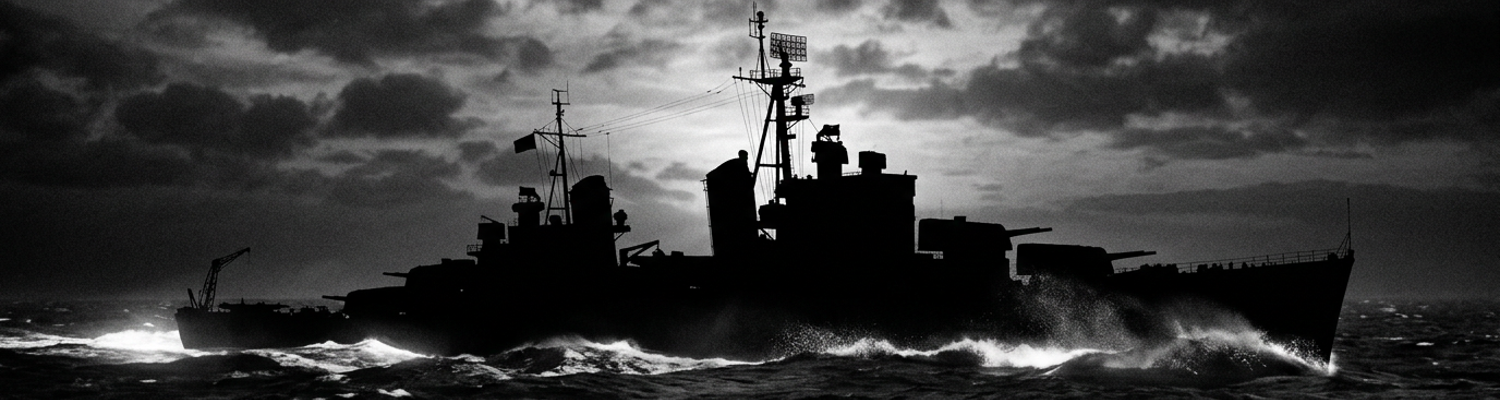

Task Force 64 Battle Doctrine and Fleet Disposition
When examining the historical record of October 11, 1942, Task Force 64 operated under direct orders to shield a reinforcement effort unfolding thirty miles southeast. Two naval transports rode at anchor off Lunga Point. The vessels operated at coordinates 9 degrees 25 minutes South by 160 degrees 03 minutes East. They labored through the surf to land 2,852 men of the Americal Division 164th Infantry Regiment. Marine units holding the perimeter around Henderson Field had depleted their ammunition stocks. They lacked diesel reserves after weeks of constant Japanese shelling. Japanese Vice Admiral Gunichi Mikawa had organized an inbound run down New Georgia Sound. He dispatched Rear Admiral Aritomo Goto with three heavy cruisers and two destroyers to bombard the airstrip. A separate transport group put heavy artillery ashore at Tassafaronga. Rear Admiral Norman Scott received orders from Vice Admiral Robert Ghormley to patrol the waters north of Cape Esperance. Scott positioned his surface combatants directly across the sea corridor. He intended to intercept Goto before the Japanese gunners could reach effective firing range of the transports.
Task Force 64 assembled to stop the bombardment force.
Archival evidence shows Scott organized his nine combat vessels into an unyielding single file battle line. The formation stretched nearly four thousand yards across the dark water. Three destroyers led the vanguard. These included Farenholt, Duncan, and Laffey. Behind them steamed the main gun line. San Francisco served as the heavy cruiser flagship. Boise followed directly astern. Salt Lake City and Helena completed the cruiser division. Two additional destroyers brought up the rear. Buchanan and McCalla guarded the column against trailing torpedo attacks. Operational plans mandated five hundred yards of open water between each destroyer. The larger cruisers maintained intervals of seven hundred yards. Every vessel received strict orders to hold its place in the wake of the ship ahead. They steered matching courses. They held a uniform speed of twenty knots. By locking nine distinct warships into a continuous straight line, Scott sought to eliminate the chance of friendly fire in the blind conditions off the northwest coast of Guadalcanal.
Scott wanted no independent maneuvers breaking the coherence of his formation.
A close review of operational logs indicates that Scott stripped his destroyer commanders of their standard prewar tactical autonomy. Standard doctrine allowed destroyer divisions to sprint ahead. They could choose independent angles of approach. They could fire spread torpedo salvos without direct orders from the force commander. Scott revoked this freedom completely. Destroyers were prohibited from launching torpedoes. They could not fire main batteries or activate their searchlights without explicit voice radio confirmation from the bridge of San Francisco. This centralized mandate created friction within the fire control apparatus of the fleet. San Francisco relied on an older meter wave SC radar set. This hardware struggled with surface clutter. It failed to resolve targets close to landmasses. Helena and Boise carried the newer SG centimetric microwave radar. These sets plotted surface contacts with exact bearing and distance telemetry. Scott concentrated all decision making authority on his own flagship. San Francisco stayed blind to contact reports rapidly accumulating on the radar plot of Helena. Five forward destroyers remained locked into passive formation steaming. The Japanese force closed at twenty nine knots.
Discrepancies Between SG and SC Surface Search Radar
The primary source of confusion aboard the flagship stemmed from hardware limitations on the mast of San Francisco. The heavy cruiser entered the night action relying on an early generation SC meter wave air and surface search set. Operating on a 1.5 meter wavelength at roughly 220 megacycles, this system projected a wide electromagnetic beam. The signal flooded back to the receiver with heavy backscatter off the high ridges of Cape Esperance and Savo Island. Display consoles in the radar compartment provided only an A-scope presentation. This showed an oscilloscope baseline where echoes appeared merely as spikes along a linear range axis. Operators possessed no overhead map representation to distinguish between Japanese hulls, American destroyers, and land masses. Surface clutter repeatedly masked contacts beyond five thousand yards. Target coordinates had to be read off dials. They were plotted manually onto paper grease boards. Men telephoned the data up to the navigation bridge through sound powered lines that suffered periodic voltage drops. Rear Admiral Norman Scott and Captain Cassin Young evaluated raw range spikes with persistent skepticism. They were uncertain whether their operators were tracking warships or the mountainous topography of Guadalcanal.
Radar technology split the battle line into two technically mismatched halves.
Archival evidence shows that Helena and Boise operated with far superior situational awareness down the column. Both light cruisers had received the recently developed SG centimetric surface search radar. This was a 10 centimeter microwave system driven by a cavity magnetron (Bureau of Ships Document 44-A). Instead of an A-scope trace, the SG set projected target returns directly onto a cathode ray Plan Position Indicator. This gave radar operators a circular real time map displaying true bearing and distance. A narrow 5.6 degree beam sliced between landmasses. It tracked low riding steel hulls across the water with a range precision of one hundred yards. At 2325, the radar crew on Helena picked up the incoming Japanese bombardment group under Rear Admiral Aritomo Goto. The range was 27,700 yards. The bearing was 315 degrees true. Boise locked onto the same formation at 13,500 yards. Japanese heavy cruisers Aoba, Furutaka, and Kinugasa advanced alongside destroyers Fubuki and Hatsuyuki. They moved at twenty nine knots on course 125 degrees directly into the path of Task Force 64. Fire control directors on both American light cruisers matched their Mark 8 optical rangefinders to the SG plots. They tracked the center of mass of the Japanese formation as the range collapsed by one thousand yards every forty seconds.
The flagship remained blind to the incoming warships.
A close review of operational logs indicates that the technological edge held by Helena failed to reach the flagship due to communication bottlenecks. Tactical voice transmissions relied on the VHF Talk Between Ships network. The TBS operated on fixed crystal frequencies vulnerable to static interference and signal dropouts (frequency 72.1 megahertz). Naval operational doctrine enforced rigid transmission protocols. Operators were required to exchange encoded ship call signs. They had to transmit formal transmission preambles. They waited for verbal acknowledgment before sending tactical plots. These procedural steps introduced gaps of up to two minutes for a single exchange. Captain Robert Hoover on Helena attempted to inform Scott of the contacts closing on the port bow. Radio traffic clogged the frequency. Communications watchstanders on San Francisco struggled to log incoming transmissions while tracking reports from their own SC operators. Scott received the radar warning late. He assumed the returns represented his three vanguard destroyers. Farenholt, Duncan, and Laffey had lost their assigned stations during a recent column turn to course 230 degrees. Hoover asked Scott for permission to open fire using the standardized radio code confirming radar lock. Scott misinterpreted the message as a simple receipt of his previous maneuvering command. He acknowledged the transmission without releasing the battery.
Four minutes slipped away.
The two formations closed at a combined speed of forty nine knots. Steaming on conflicting tactical assumptions, the American line drifted toward an unintended engagement. The SC radar on San Francisco registered a contact at 2342 at a range of five thousand yards. Scott held the heavy cruiser main battery silent to prevent hitting the missing American destroyers. Believing that Scott had granted clearance to engage, the gunnery officer on Helena ordered all fifteen 6-inch guns in the main battery to fire at 2346. Boise and Salt Lake City immediately followed suit. They discharged full broadsides into the darkness before the flagship had positively identified a single Japanese vessel.
The Midnight Countermarch and Column Fragmentation
When examining the historical record of 2332, the physical cohesion of Task Force 64 ruptured because of a misunderstood tactical command transmitted from the flagship. Steaming at twenty knots through the darkness between Savo Island and Cape Esperance, Rear Admiral Norman Scott decided to reverse his patrol line. He issued an order over the TBS voice radio for a countermarch from course 050 degrees to course 230 degrees. Tactical signaling doctrine dictated a turn in succession. The three vanguard destroyers should have steered through the maneuver first. The trailing cruisers would then follow through the exact same pivot point in the water. Bridge officers on San Francisco misapplied the order. Captain Cassin Young swung the heavy cruiser helm over immediately. He cut inside the arc instead of following the lead destroyers through their looping turn to port. Boise wheeled directly into the wake of San Francisco. Salt Lake City and Helena followed in line. This premature turn carved the cruiser formation directly across the turning radius of the van. The American battle line severed into disconnected fragments.
The maneuver sheared the vanguard destroyers out of position within sixty seconds.
Archival evidence shows that Farenholt and Duncan found themselves cast onto the disengaged offshore side of the cruisers. They lacked situational awareness of the flagship intentions. Captain Eugene Seavey aboard Farenholt and Lieutenant Commander Edmund B. Taylor on Duncan had received no tactical briefing indicating that Japanese warships were closing within radar range. Scott strictly centralized tactical authority on San Francisco. He issued no follow up transmissions clarifying the botched column turn. The destroyer captains could only guess at the reason for their sudden displacement. Dense furnace gas from the cruiser boilers drifted across the water. This masked visual contact with the main gun line. It hid the cruiser hulls against the black backdrop of Guadalcanal. Both destroyers increased boiler pressure to push speed to thirty knots. They attempted to surge along the cruiser column to reclaim their assigned van positions. Scott stared at rudimentary range spikes on his SC radar scope. He believed these radar echoes were friendly vessels regaining station. Gunnery officers on Helena and Boise were already locking six inch director optics onto targets emerging from the northwest.
Radio silence left both destroyer bridges completely cut off from fleet intelligence.
A close review of operational logs indicates that Duncan departed from fleet alignment at 2335. The destroyer surface search radar registered an inbound contact five miles off the starboard bow. Lieutenant Commander Taylor tracked Japanese heavy cruiser Aoba closing at twenty nine knots on a reciprocal course. Taylor believed the flagship was preparing a synchronized torpedo assault. He pushed the engine telegraph to flank speed. He swung his helm to close the enemy. He broke away from Farenholt without voice radio clearance. This solo dash placed Duncan directly between the opposing gun lines. Seconds later, the rapid fire battery on Helena fired into the darkness. This triggered simultaneous broadsides from Boise and Salt Lake City. Japanese gunners on Aoba and Furutaka discharged their forward turrets. Duncan took hits from both directions. Japanese eight inch projectiles detonated against the forward handling room. Friendly six inch cruiser shells tore through the machinery spaces. They severed high pressure steam mains. They destroyed the forward boiler room. A direct hit jammed the rudder thirty degrees to port. The burning hull locked into an uncontrolled circle at coordinates 9 degrees 06 minutes South by 159 degrees 39 minutes East.
Friendly Fire Incidents and the Crossfire on USS Duncan
When examining the historical record of 2346, the breakdown in fleet recognition began the moment Captain Robert Hoover aboard Helena requested battery release. He used the transmission phrase asking if his target lock had been confirmed. Rear Admiral Norman Scott believed Hoover was merely acknowledging an order to hold course. Scott answered affirmatively over the Talk Between Ships radio. Helena immediately unleashed fifteen rapid fire six inch guns into the darkness. Boise, Salt Lake City, and San Francisco opened fire in rapid succession without designated target assignments. Gunnery officers across the American cruiser line aimed at the nearest optical silhouettes and surface radar blips on their scopes. They failed to recognize that their own vanguard destroyers were still crossing the cruiser line of advance. Five forward turrets aboard San Francisco hurled eight inch high capacity explosive shells directly into the path where Farenholt, Duncan, and Laffey were attempting to regain column formation. Gun crews tracking muzzle flashes through optical sights mistook the high speed wakes of the displaced destroyers for Japanese escorts. Farenholt took three direct shell hits from American cruisers. The impacts punctured her hull plates above the waterline. They flooded a fuel bunker. They cut high pressure steam conduits to the engine room.
Friendly gun directors could not separate Japanese superstructures from American destroyer masts in the darkness.
A close review of operational logs indicates that Duncan took the brunt of this converging gunfire after maneuvering within one mile of Japanese heavy cruiser Aoba. Caught between the two opposing battle lines, the destroyer became an illuminated target for gunners on both sides. Japanese eight inch salvos from Aoba and Furutaka smashed into the forward handling room of Duncan. The blasts detonated ready ammunition. They ignited the chart house. They killed bridge personnel. American six inch shells from Helena and Boise slammed into the port side of the destroyer at the water line. Heavy eight inch rounds from Salt Lake City followed. One friendly projectile ripped through the forward fireroom. It ruptured main steam feeds. It scalded the watch crew to death. Secondary explosions disabled the forward four inch ammunition hoist. Fires sparked and cut all electrical power to the main bilge pumps. Lieutenant Commander Edmund B. Taylor ordered his men to abandon ship at 0015. Uncontainable fires reached the magazine bulkheads. The listing hull began settling by the head. Wounded sailors slipped into the fuel coated water. The unmanned vessel continued to turn in slow circles under residual steam.
Shell splinters severed the internal telephone network of the destroyer within four minutes of the opening salvo.
Archival evidence shows that the slaughter unfolding across the van forced Rear Admiral Scott to halt his battle line at 2347. Scott stared across the port bridge wing of San Francisco. He watched explosive flashes striking low profile hulls less than four thousand yards ahead. His vanguard destroyers had vanished there minutes earlier. Acute doubt paralyzed the flagship. Scott seized the TBS radio microphone. He broadcast an immediate order for all Task Force 64 combat units to cease firing. Captain Hoover aboard Helena received the directive. He silenced his batteries. Gunnery officers on Boise and Salt Lake City did the same. Flagship signals personnel demanded that all American destroyers flash their colored recognition lights to verify positions on the water. Captain Seavey on Farenholt complied. He showed red and green recognition lamps while taking water into his lower compartments. The cruisers under Goto kept firing during this broadcast pause. They exploited the four minute cessation to turn their batteries on Duncan and Boise. Scott observed returning fire striking the American cruisers from targets positioned beyond his destroyers. He confirmed that the opposing formation was hostile. He released his gun batteries to fire again at 2351.
Search parties aboard McCalla located the charred drifting hull of Duncan the following morning at coordinates 9 degrees 00 minutes South by 159 degrees 23 minutes East. The wreck foundered at 1200 after salvage efforts failed to arrest the flooding.
Magazine Damage Control and Seawater Flooding on USS Boise
When examining the historical record of 2352, the critical danger to Boise began when Captain Edward Moran switched on the starboard 36-inch carbon arc searchlights. He intended to illuminate a vessel three thousand yards away. The beam fixed upon the burning hull of Japanese destroyer Fubuki. The high intensity illumination instantly silhouetted Boise against the dark horizon for Japanese heavy cruiser Kinugasa. Operating four miles off the American port bow, gunnery officers on Kinugasa laid their ten 20-centimeter guns onto the light source. They fired rapid optical salvos using Type 91 armor piercing projectiles. Two 8-inch shells punched through the five inch side armor belt of Boise at frame 28. They struck nine feet below the waterline. Another 203-millimeter projectile sliced cleanly through the unarmored forecastle plating. It penetrated the barbette structure of Turret I before detonating inside the lower handling flats. Hot shell fragments sheared through hydraulic control lines. They ruptured pneumatic ammunition hoists. They ignited exposed canvas bags of smokeless nitrocellulose powder staged on the lower loading trays.
Kinugasa put six heavy shells into the American light cruiser in sixty seconds.
Archival evidence shows that the resulting deflagration triggered a flash fire that swept upward through the ammunition hoist tubes. The ignition of dozens of thirty pound powder charges produced an overpressurized wall of fire exceeding two thousand degrees Fahrenheit. This blew past mechanical flash doors that had warped under the initial blast impact. Flames erupted inside the enclosed gun chambers of Turret I and Turret II. Both sixteen man gun crews incinerated instantly. The heat and expanding carbon monoxide gases traveled aft through the central ventilation trunking. They entered the lower shell handling spaces beneath Turret III. Thick smoke and burning gases choked the ammunition handlers and hoist operators before any emergency ventilation dampeners could be tripped by hand. A total of 107 officers and enlisted men died in their battle stations within three seconds. Loose powder burning along the deck plates threatened a sympathetic explosion of the main forward magazines. These compartments held several tons of high explosives and propellant charges directly beneath the burning handling flats.
Open hoists turned three turrets into chimneys.
A close review of operational logs indicates that the ship survived because the hull breach opened by the waterline hit from Kinugasa counteracted the magazine fire. Sea pressure drove thousands of gallons of water per minute through the eight inch entry hole at frame 28. The water ruptured thin internal bulkheads. It inundated the lower powder flats. The incoming sea torrent reached the burning powder handling room before the deflagration could heat the steel bulkheads of the primary powder stowage compartments to auto-ignition temperatures. Seawater submerged the lower hoists. It drowned burning powder grains that were skittering across the deck plates. It buried the forward 6-inch magazine spaces under eleven feet of brine. Toxic gas generation halted abruptly as the smoldering debris sank below the rising waterline.
Damage control personnel under Lieutenant Commander Thomas Wolverton established secondary containment boundaries at bulkhead 35. This prevented progressive flooding into the forward machinery rooms. Moran pulled Boise out of the battle line to starboard. He dropped speed to fifteen knots to relieve water pressure on the damaged forward hull. By 0020, damage control teams rigged portable submersible pumps across the mess decks. Boise listed two degrees to port. The cruiser headed south toward Espiritu Santo with a burned out forward gun battery.