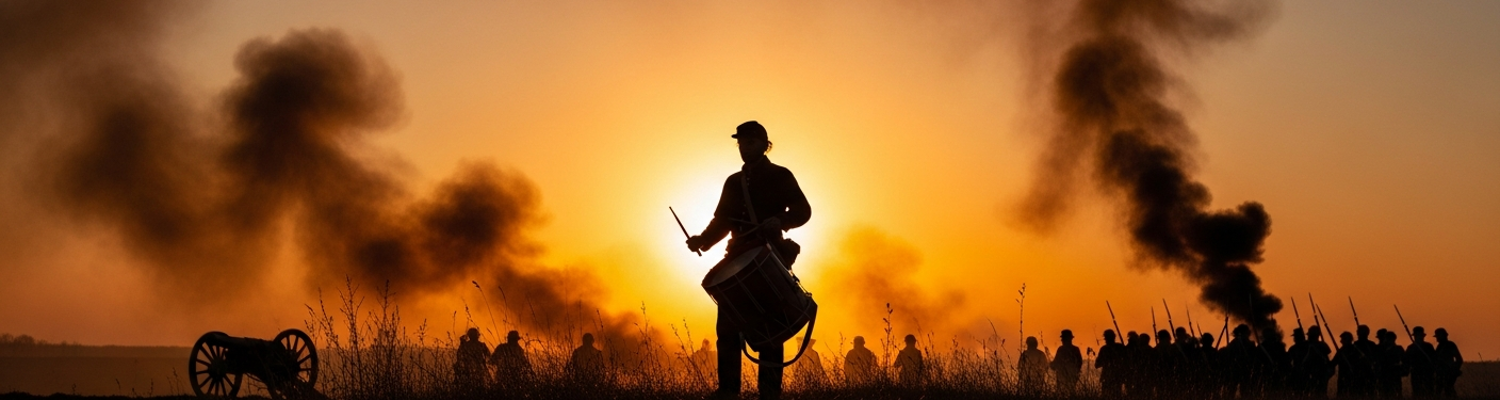

The foundational reality of a Civil War battlefield was overwhelming sensory chaos. Black powder smoke choked the air, reducing visibility to mere yards. The roar of artillery and the sharp crack of thousands of rifles created a continuous, deafening wall of sound. In this environment, the human voice, the traditional instrument of command, was useless. Regimental officers could shout themselves hoarse, yet their orders would be swallowed by the din before reaching the men on the skirmish line. This operational paralysis demanded a different solution, a communication network that could cut through the noise and fog. The answer was found in the tight, rattling report of the snare drum and the clear, piercing call of the bugle. Field musicians, specifically drummers, became the central nervous system of the infantry regiment, the link between a commander’s intent and the coordinated action of a thousand men. They were, in the practical words of Union bugler Oliver Norton, the “mouthpiece for the general.”
The Auditory Command Network
Every soldier, from the newest recruit to the seasoned veteran, learned to comprehend the language of the drum. This was not music for entertainment, it was a lexicon of survival and tactical direction. Each company, typically comprising around 100 men, was assigned at least two musicians. These individuals underwent rigorous training, not in melody, but in the precise rhythmic patterns that constituted the auditory vocabulary of the army. Training depots, such as the one at Fort Columbus on Governors Island, New York, were established specifically to school these field musicians. They studied manuals like the U.S. Army’s authorized “Drummer’s and Fifer’s Guide,” published in 1862 by George B. Bruce and Daniel D. Emmett, which standardized the calls across the Union forces. Confederate forces used a similar system, though it was less centralized and often relied on manuals like the “Drum and Fife Instructor” by a “Professor of Music” printed in Richmond. The physical instruments themselves were tools of war. The drums, with their calfskin heads tensioned by a system of ropes and leather ears, were susceptible to moisture. A wet drumhead would lose its tension and produce a dull thud instead of a sharp report, rendering it useless for signaling. Drummers learned to protect their instruments as a rifleman would protect his musket.
The system of calls was a complex language. A commander would issue a verbal order to his drummer, who stood near him in the battle line. The drummer, under the watch of the regimental Drum Major, would then beat the associated call. This signal would be picked up and repeated by the other company drummers down the line, creating a chain of command that rippled through the regiment almost instantaneously. The sharp, staccato beats were designed for maximum auditory penetration. The “Long Roll” was the urgent, escalating signal to attack or to prepare for an imminent enemy assault. Its insistent, accelerating rhythm was a sound that made a soldier’s heart pound. “The Assembly” ordered troops to form up on the colors. “The Retreat” signaled a withdrawal from contact. A tactical advance could be directed through a sequence of calls: the Drum Major might signal “Form column of companies,” followed by the drummers beating the cadence for “Forward, march.” Upon reaching the desired position, a call to “By company into line” would direct the unit to deploy from its marching column into a line of battle, ready to deliver a volley on the next call, “Commence Firing.” Another distinct rhythm for “Cease Firing” allowed a commander to control the expenditure of ammunition and direct the focus of his unit’s volleys. The drum’s report was the invisible hand guiding the unit through the maelstrom.
The Perilous Post of Youth
This battlefield function was placed, to a degree that shocks modern sensibilities, upon the shoulders of children. While the official minimum enlistment age for a soldier was 18, regulations permitted boys as young as 12 to enlist as musicians. In practice, with recruiters under pressure to fill quotas, many boys far younger found their way into the ranks. It is estimated that up to ten percent of the Union forces may have been underage soldiers. Drummers were often the youngest of all. Their smaller stature was even accommodated by a change in equipment. Pre-war drums were often 18 inches deep, but they were shortened to between 12 and 14 inches to be manageable for shorter, younger boys. The story of John Clem, the “Drummer Boy of Chickamauga,” exemplifies the phenomenon. He attempted to join the 3rd Ohio Infantry in 1861 at the age of nine and was rejected. Undeterred, he tagged along with the 22nd Michigan, whose officers eventually adopted him as a mascot and unofficial drummer, even chipping in to pay his $13 monthly salary before he was officially allowed to enlist in 1863. At the Battle of Chickamauga, the now 12-year-old Clem was in the thick of the fighting. Armed with a musket sawn down to fit his frame, he became separated from his unit during a retreat. When a Confederate colonel demanded his surrender, Clem raised his weapon, shot the officer, and escaped back to Union lines. For this action, he was promoted to sergeant, becoming the youngest noncommissioned officer in U.S. Army history.
Clem's story was not unique. William “Willie” Johnston of the 3rd Vermont Infantry was awarded the Medal of Honor at age 13 for his conduct during the Seven Days Battles in 1862. During the chaotic retreat on the Peninsula, Johnston was the only drummer in his division to bring his instrument off the field. Orion P. Howe, a 14-year-old musician with the 55th Illinois, also received the Medal of Honor for his actions at Vicksburg. Under heavy fire, he was sent to get more ammunition for his faltering line. Wounded, he still reached General William T. Sherman and delivered the urgent request. While many musicians were understood to have non-combatant status, their position near the commanding officer on the front lines made them exceptionally vulnerable. When not beating calls, their duties often shifted to the grim task of acting as stretcher-bearers. They would move the wounded from the field to the surgeon’s station, a journey through a landscape of death and dismemberment. This work exposed them directly to the carnage and placed them in the line of fire without a weapon. The ethical dilemma is stark. An army that relied on children to function as its primary battlefield communication network was deploying them into roles of extreme hazard. The societal acceptance of child labor, common in the 19th century's factories and farms, combined with the desperate need for manpower, created a reality where boys who should have been in school were instead facing enemy fire.
Imposing Order Beyond the Firing Line
Beyond the battlefield, the drummer’s rhythm was the organizing principle of military life. From dawn until dark, every aspect of a soldier’s day was governed by drum or bugle calls. These musicians were among the first to rise, so they could sound “Reveille,” a series of tunes that served as the army’s alarm clock. The day unfolded to their beat. “Breakfast Call,” often the tune “Peas Upon a Trencher,” summoned men to their morning meal. “Fatigue Call” sent designated work parties to police the camp or dig latrines. “Drill Call” brought the companies out for hours of practice in the manual of arms and battlefield maneuvers. The day concluded with “Retreat,” signaling the end of the duty day, and finally “Tattoo,” which ordered soldiers back to their quarters and ended with the extinguishing of lights. This constant, predictable cadence provided a psychological anchor in an existence defined by uncertainty and hardship. The drumbeats imposed order on the potential chaos of a camp of thousands of men, ensuring discipline and the efficient execution of daily tasks. The music also served a punitive function. A soldier convicted of cowardice or theft could be “drummed out” of the army. He would have his head shaved, be branded, and then marched through camp to a discordant drumbeat known as the “Rogue’s March” before being literally kicked out. For soldiers torn from civilian life, the rhythmic structure of the military day was a new reality, one that fostered a collective identity. On the march, drummers kept the column in step, their lively cadences helping to boost morale over long, arduous miles. During parades and inspections, the assembled fife and drum corps of a regiment or brigade provided a display of military precision and pride that reinforced esprit de corps. In the evenings, they played popular tunes like “The Girl I Left Behind Me,” providing a link to home and a brief respite from the grim business of war.
Legacy of the Long Roll
The role of the Civil War drummer boy represents a stark intersection of operational necessity and profound ethical compromise. The reliance on children for command and control functions highlights a military reality shaped by the limits of technology. The absence of portable radio systems necessitated a solution that was audible, portable, and reliable amidst the din of battle, a role the drum filled. Yet, this solution came at the cost of placing minors in extreme peril, a practice now universally condemned by international law and modern military ethics. The story of the battlefield drummer offers a cautionary lesson. It demonstrates that the means by which a war is fought carry deep ethical weight. The evolution of military technology has since rendered the drummer boy obsolete, replacing him with encrypted radio signals and digital data links. This technological progression has, as a consequence, allowed for a corresponding ethical progression. Modern armed forces are no longer forced into the grim calculus of using children as a communication network. The ghosts of the young drummers of the Civil War serve as a powerful reminder of the ethical progress made. They also underscore the continuing responsibility to ensure that the burdens of conflict are never again placed on the shoulders of children, a principle that remains a benchmark for judging the conduct of armed forces worldwide.