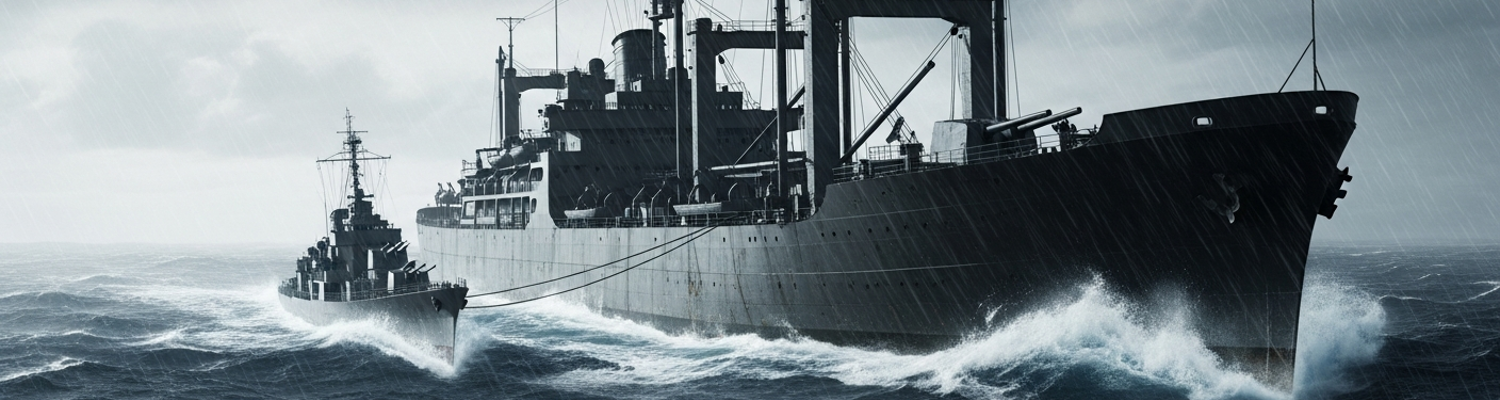

A radio message cut through the static at 14:32 local time. The transmission from the USS Bellamy was frantic, technical, and dire. A crewman had a suspected case of acute appendicitis. The patient, a fire controlman, required immediate surgery, an intervention far beyond the capacity of the destroyer’s small sickbay. This single message set a sequence of events into motion under the worst possible conditions. The transfer would have to happen during an underway replenishment in the Philippine Sea. The barometer was falling. The long, oily swells of a nascent typhoon were beginning to assert their authority. The fleet oiler USNS Platte (AO-24), a massive Cimarron-class vessel, was the only ship in the formation with a surgeon and the necessary facilities. The crisis was not one of combat, but of physics, medicine, and the sea itself.
A close review of operational logs (NARA Record Group 38) indicates the replenishment was already dangerous. The ships of Task Group 38.3 were low on fuel after an extended period launching strikes against enemy positions. This tactical necessity overrode initial weather warnings from Fleet Weather Central. The Platte, heavy with fuel, and the Fletcher-class destroyer Bellamy (DD-518) struggled to maintain a constant distance of approximately 80 feet while steaming at a matched speed of 12 knots. Archival evidence shows the sea state shifting dramatically. Long-period swells, generated by the distant storm, grew from a manageable eight feet to a treacherous fifteen. These waves, arriving ahead of the typhoon's full force, caused the two ships to roll out of phase. The 376-foot destroyer would rise on a crest as the 25,000-ton oiler slid into a trough. Then the roles would reverse, subjecting the fuel hoses and tensioned lines connecting the vessels to immense, unpredictable strain. The commanding officer of the Platte made the decision to press on, a choice driven by the inflexible operational schedule of the Pacific Campaign. Refueling the escorts was an absolute requirement.
The patient’s condition was deteriorating rapidly. The transfer was the only option.
The standard procedure for such a maneuver involved a highline rig, a heavy rope suspended between the two ships’ superstructures. From this line, a boatswain’s chair or a Stokes litter could be hauled across. In calm seas, it was a routine evolution. In the building typhoon, it was a nightmare. A review of the Bellamy’s after-action report details the mechanics. Boatswain’s mates on both vessels fought to rig the transfer line as the ships plunged and corkscrewed. The first attempt to pass the lighter messenger line across failed twice; the weighted end whipped back violently in the wind. Once the highline was finally connected, the true challenge began. The violent, asynchronous rolling of the destroyer and the oiler meant the line would slacken dangerously, dropping the litter towards the waves, then snap taut with thousands of pounds of force. The transfer of the injured sailor, strapped into the wire-mesh Stokes litter, took an agonizing 27 minutes. At one point, a severe roll of the Platte swung the litter like a pendulum, nearly smashing it against the steel bulkhead of the oiler’s hangar bay before the line handlers on the Bellamy could haul it clear. The transfer was a physically demanding affair executed by sailors exposed to the full force of the wind and spray.
Just moments after the injured sailor was safely aboard the Platte, the first catastrophic failure occurred. A rogue wave, documented in the Bellamy’s log as being substantially larger than the already mountainous seas, broke green over the destroyer’s forward superstructure. The impact violently shook the entire vessel and sent a torrent of corrosive saltwater cascading over the open bridge and into the adjacent radio room. The effect on the ship’s electronics was immediate and total. A post-incident analysis determined that the primary Model TBS-6 VHF radio-telephone, the workhorse for tactical ship-to-ship voice communication, suffered a complete and unrecoverable short circuit. Simultaneously, saltwater intrusion into the primary and backup HF radio antenna trunks and porcelain insulators caused a dead short, grounding out any potential transmission. On the bridge of the Platte, the squawk of the Bellamy’s last transmission was replaced by an unnerving hiss of static. Repeated calls from the oiler on all standard voice and continuous wave (CW) frequencies went unanswered.
The two ships were now electronically deaf and dumb.
The blackout was not confined to the radio spectrum. Almost immediately following the wave strike, the typhoon’s forward rain bands swept over the two ships. Visibility dropped to less than a ship’s length. The deluge was a horizontal blast of sea spray and water that made visual signaling impossible. Standard Navy 5-inch signal lamps, which relied on a focused beam of light, were rendered useless. The intense precipitation scattered the light, making any attempt to flash Morse code an unreadable blur. The sheer violence of the wind, now gusting well over 80 knots, precluded the use of signal flags. Semaphore was not an option. The crew of the Platte could hear the destroyer, the groan of its hull and the thrash of its screws, but they could not see it. The only physical connection remaining between the two vessels, now invisible to one another, was the set of heavy rubber fuel hoses and the straining highline cables.
A review of the Platte’s medical log reveals the immediate dilemma following the transfer. The destroyer Bellamy had delivered the fire controlman, but the oiler’s surgeon, Lieutenant Commander McCall, made an urgent request for additional supplies. His initial examination suggested a high probability of a ruptured appendix. This complication would demand more than just surgery; it required a significant volume of whole blood and specific antibiotics not held in the oiler’s sickbay. The only ship in the immediate vicinity carrying these assets was the Bellamy itself, having received them during a recent reprovisioning at Ulithi. The very highline that had just delivered the patient now had to be repurposed for a reverse transfer, this time carrying fragile glass bottles of blood and packaged penicillin into the teeth of the worsening storm.
This was not a standard transfer of robust cargo. The movement of specialized medical supplies between the two pitching vessels presented a unique and severe set of risks. Unlike ammunition crates, the glass Baxter blood bottles and vials of medicine were exceptionally fragile. Archival analysis of underway replenishment techniques of the era shows the systems were simple and difficult to use in rough seas. The highline rig lacked the sophisticated ram tensioners that would become standard in later decades. This meant that as the Bellamy and Platte rolled away from each other, the line would stretch and vibrate under thousands of pounds of force; as they rolled back together, the line would go slack, causing the payload to drop and then jerk violently. The Bellamy’s crew had to improvise. Deck logs show they packed the blood bottles and penicillin into a standard canvas sea bag, padding them with kapok life vests and spare blankets. This makeshift container was then secured to the highline trolley. The risk of the bag snagging or the bottles shattering from the violent G-forces was extraordinarily high.
The transfer of the medical bag began at 15:10 local time. The wind was now gusting over 60 knots, and the asynchronous roll of the two ships was at its worst. A team of the Bellamy’s most experienced boatswain’s mates manned the outhaul and inhaul lines, attempting to guide the bag across the 80-foot gap of churning water. A post-incident report filed by the Bellamy’s executive officer documents a near-catastrophic failure. Halfway across, a sudden lurch of the Platte caused the highline to sag precipitously. The sea bag dropped, disappearing into a wall of spray, and the line handlers felt the sickening jolt as it struck the water. For a moment, it was believed lost. An equally violent roll from the Bellamy snapped the line taut again, whipping the soaked bag out of the water and sending it careening towards the Platte’s superstructure. Only the quick action of the oiler’s deck crew, who managed to grab the trailing lines, prevented the bag from smashing against a steel bulkhead. They hauled it aboard, soaked but miraculously intact.
The moment the Stokes litter clattered onto the steel deck of the USNS Platte, the ship’s surgeon and his small team moved with frantic purpose. The oiler’s medical log indicates there was no time to move the patient to the ship’s formal sickbay. The sickbay on a Cimarron-class oiler was positioned deep within the vessel’s superstructure, accessible only through a series of narrow passageways and steep ladder wells. It was completely impractical for a litter-bound patient. Instead, Lieutenant Commander McCall had designated the officer’s wardroom as the primary triage and surgical center. It was the only space that offered a degree of relative stability near the ship’s center of gravity and possessed large tables that could be lashed together to create an operating surface. The patient, Fire Controlman Daniels, was carried into this makeshift facility, his face pale and beaded with a mixture of sweat and sea spray. McCall’s two pharmacist’s mates, neither of whom were surgical technicians, immediately cut away the patient’s soaked clothing while the surgeon began his physical assessment, his hands palpating the sailor’s abdomen amidst the violent lurches of the ship.
Stabilization was a desperate race against a cascade of systemic failures within the patient’s body, performed with almost no concrete data. The Bellamy had managed to signal the patient’s core symptoms before the blackout, but his complete medical record was unavailable, trapped on the destroyer now lost in the storm. McCall had to rely entirely on his physical examination. Archival accounts from similar at-sea medical emergencies during the war show this was a common, and dangerous, scenario. The surgeon identified the unmistakable abdominal muscle rigidity, a sign of acute peritonitis. The patient’s breathing was shallow, his pulse thready and rapid. McCall’s working diagnosis was a ruptured appendix, a condition that, if left untreated, was nearly 100 percent fatal. He had minutes, not hours. One pharmacist’s mate struggled to insert an IV line, the needle jerking with every roll of the deck, to begin pushing saline solution. The second prepared the recently delivered supplies. The glass bottles of whole blood, chilled from their journey through the storm, were carefully unboxed. Penicillin, still a relatively new drug in the fleet, was prepared for injection.
The environment itself was the primary enemy. A Cimarron-class oiler was a logistical workhorse, not a hospital. Its medical department was equipped for routine illnesses, not complex abdominal surgery in a typhoon. The officer’s wardroom, now draped with sterilized sheets, was a scene of controlled chaos. The ship’s motion was relentless. A violent roll to starboard sent an unsecured tray of sterilized instruments sliding across the deck, forcing a pharmacist’s mate to scramble after it, re-sterilizing each piece in boiling water on a small electric stove jury-rigged to the bulkhead. Personnel were the next limitation. McCall was the only surgeon. His assistants were pharmacist’s mates, trained in first aid and dispensing medication, not in assisting in a major laparotomy. They had to be taught on the spot how to manage retractors, pass instruments, and monitor the ether anesthetic, administered using a crude gauze-and-funnel apparatus. To augment the team, McCall conscripted two mess cooks, chosen for their steady hands, to help hold the patient and equipment in place against the pitching of the ship. Preparations for the incision began as sailors used spare mooring lines to physically lash the operating table, and the patient on it, directly to welded fixtures on the deck and bulkhead.
McCall’s diagnosis of a ruptured appendix and peritonitis was derived almost entirely from a physical examination on a heaving deck. This reliance on physical assessment was a necessity dictated by the complete absence of advanced diagnostic equipment. A Cimarron-class oiler was not equipped with an X-ray machine; such heavy and sensitive apparatus was reserved for capital ships or dedicated hospital ships. There was no way to radiographically confirm a bowel obstruction or identify free air in the abdomen, a definitive sign of a perforation. Without the ability to perform any imaging, the surgeon’s primary diagnostic tools were his hands, his eyes, and his experience. The sounds of the straining hull and the storm outside made even the use of a stethoscope to listen for bowel sounds an exercise in frustration.
The diagnostic process was reduced to informed guesswork.
Even the most basic laboratory equipment aboard the oiler was rendered useless by the violent sea state. McCall’s sickbay contained a small electric centrifuge for assessing hematocrit. In the typhoon, however, the machine was inoperable. A centrifuge relies on perfect balance to spin samples at high revolutions; the unpredictable rolling of the Platte would have caused the device to vibrate uncontrollably, destroying the machine and the blood samples. Likewise, the ship’s microscope was of no value. Attempting to examine a blood smear for signs of infection was impossible when the focal plane was constantly shifting. Even the steam-pressure autoclave, used for sterilizing instruments, became a hazard. The sloshing of boiling water inside the pressurized chamber during a severe roll posed a significant risk of a steam explosion or scalding accident.
This complete failure of diagnostic hardware left McCall with no way to confirm his suspicions or rule out alternative diagnoses. An inflamed pancreas or a perforated ulcer could present with similar symptoms. In a shore-based hospital, a series of blood tests and imaging would have provided a clear path forward. Aboard the Platte, every potential diagnosis other than appendicitis required a different course of treatment. Committing to surgery was a monumental gamble. An unnecessary operation on a patient in shock was likely to be fatal. Yet, delaying surgery on a ruptured appendix was also a death sentence. The only way to be certain of what was happening inside the fire controlman’s abdomen was to perform an exploratory laparotomy. To cut him open and look.
An examination of mid-century naval doctrine reveals a startling absence of uniform protocols for transferring patient medical data between ships. The entire system relied on a paper trail that was perilously fragile. When a sailor was injured or fell ill, a corpsman would fill out a Form 52b, an Emergency Medical Tag. This cardstock tag, designed to be tied to a casualty’s clothing, had fields for identity, a preliminary diagnosis, and any initial treatment administered. In the chaos of the transfer between the Bellamy and the Platte, this tag represented the entirety of the fire controlman’s medical history. The information it contained was dangerously incomplete. A review of similar incidents shows these tags were often filled out in haste, with pencil on wet paper, by a lone corpsman working in poor lighting. The sailor’s full medical jacket, a thick file containing his entire health history from enlistment, remained locked in a filing cabinet in the Bellamy’s sickbay. Without it, the surgeon on the Platte had no knowledge of the patient’s baseline health. The transfer of the man was prioritized; the transfer of his data was an afterthought.
The communication blackout transformed this data gap into a chasm. Lieutenant Commander McCall was now operating in a total information vacuum. He could not ask about a history of abdominal issues, nor could he confirm the patient’s blood type, forcing the use of precious O-negative universal donor blood. The administration of penicillin became a blind gamble without knowing if the patient had a prior allergic reaction. The inability to transmit even the most basic facts forced the surgeon to rely exclusively on the physical signs present in the wardroom. This lack of history had profound implications. With no way to rule out other conditions, he was driven toward the most invasive option: exploratory surgery. The missing record from the Bellamy forced a medieval choice, compelling the surgeon to physically cut into the patient’s abdomen simply to confirm what a simple records transfer would have told him.
The after-action reports filed by the commanding officers of the USS Bellamy and USNS Platte were forwarded to the Bureau of Medicine and Surgery. They focused with severe clarity on the near-total failure of ship-to-ship transfer methods under duress. The improvised 27-minute passage of the fire controlman, followed by the near-loss of medical supplies, became a case study in systemic inadequacy. In response, naval engineers were directed to accelerate development of what would become the Standard Tensioned Replenishment Alongside Method (STREAM). The core problem of the simple highline was addressed by designing ram tensioners, hydraulic systems that automatically maintained constant tension between two ships, regardless of their motion. Post-war analysis led to the redesign of the transfer litters themselves, moving away from the open wire-mesh Stokes design to more enclosed and weatherproof models. The second major finding from the crisis centered on the diagnostic blindness forced upon Lieutenant Commander McCall. Directives issued by the Bureau of Medicine and Surgery in the years following the war mandated a new standard for fleet auxiliaries. This included requirements for more robust, shock-mounted laboratory equipment designed to function in higher sea states. There was a push to equip a greater number of large non-combatant ships with at least basic X-ray capabilities, specifically machines with heavily gimballed mounts to offset a ship’s roll and pitch. Finally, the most critical reforms addressed the catastrophic information failure. In the wake of the Platte incident and others like it, new protocols were developed. A standardized “Medical Transfer Summary” form was mandated, a single-page document designed to be completed by a corpsman and attached to the patient in a waterproof pouch. It contained fields for vital signs, known allergies, blood type, and a chronological account of symptoms and treatments. For radio transmissions, a new brevity code format was introduced, allowing a ship’s radioman to quickly transmit this essential data block in a compressed, standardized message, ensuring the receiving surgeon had a working history of the patient before they ever arrived on deck.