
An Arsenal Born of Necessity
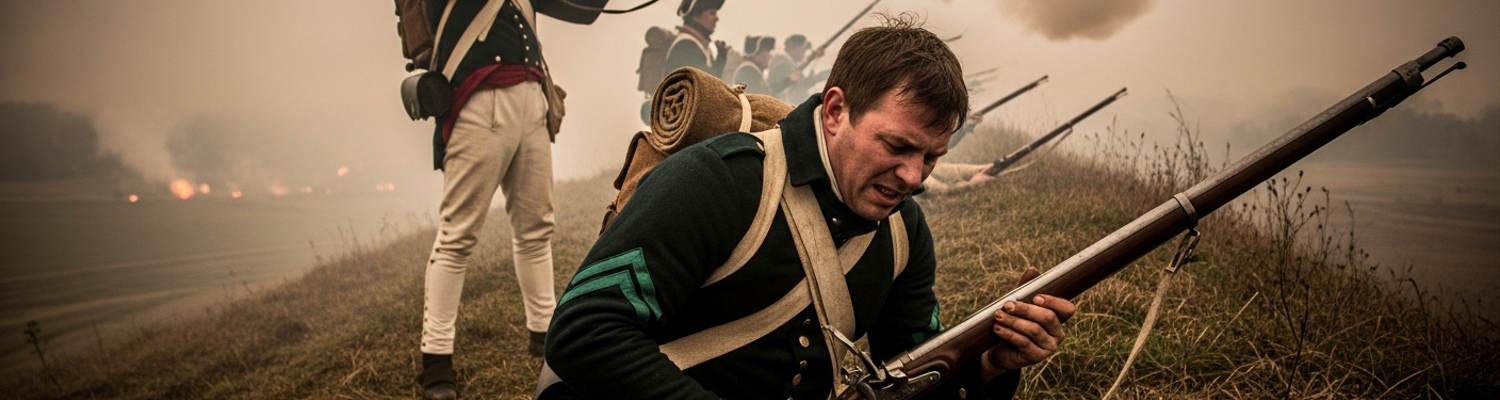
The Continental Army formed in 1775 less as a coherent fighting force and more as a defiant aggregation of colonial militias. It possessed a cause and a commander in George Washington. It lacked nearly everything else. Before the first major shipments of French arms transformed its capabilities, the army was a study in material desperation. Soldiers arrived for duty carrying whatever they owned or whatever local Committees of Safety could procure. This practice created a dangerously eclectic arsenal. The primary infantry weapon, the smoothbore flintlock musket, existed in a bewildering array of models, calibers, and conditions.
A company on the line might field British-made “Brown Bess” muskets next to privately purchased hunting fowlers and locally made weapons of varied quality. The iconic Brown Bess, a robust and reliable .75 caliber musket, was the standard arm of the British Army. Many colonial armories were stocked with them prior to the conflict, but these were often older, worn models. Alongside these were Dutch muskets, Spanish arms, and the products of colonial gunsmiths. These American-made weapons, often called “Committee of Safety” muskets, were generally patterned after the Brown Bess but varied widely in specification. Gunsmiths in places like Lancaster, Pennsylvania, assembled them from a mix of imported and domestic parts, often leaving them unmarked to avoid charges of treason from the Crown.
This initial reliance on a patchwork of arms was not a choice but a necessity born from a complete void of centralized manufacturing and a non-existent supply chain. The colonies had no national armories. They had no established system for mass producing weapons, ammunition, or spare parts. Every musket, every cartridge, and every flint was a precious commodity, sourced through capture, local seizure, or tenuous overseas contracts. This reality created a cascade of logistical problems that would haunt the Continental Army for years. It provided hard-learned lessons for the future of American military development.
The Tyranny of Mixed Calibers
The lack of weapon standardization imposed a severe and persistent strain on the Continental Army’s nascent logistical system. The problem extended far beyond simply having enough muskets. It was a crisis of incompatibility at every level. The two most common military-grade muskets, the British Brown Bess and the later-arriving French Charleville, highlighted the core issue. The Brown Bess was a .75 caliber weapon, while the Charleville, supplied in vast numbers by France starting in 1777, was a .69 caliber. This seemingly small difference of six-hundredths of an inch had immense tactical consequences.
A soldier with a .69 caliber Charleville could not use a cartridge made for a .75 caliber Brown Bess. The ball was simply too large to ram down the barrel. While a .69 caliber ball could, in an emergency, be fired from a .75 caliber barrel, the loose fit, known as windage, caused a severe loss of gas pressure. This resulted in a significant drop in velocity and a complete degradation of accuracy beyond a few dozen yards. This meant that even within the same regiment, soldiers could not always share ammunition. Virginian officer ‘Light Horse’ Harry Lee noted the operational friction this caused, stating that at the Battle of Brandywine in September 1777, no single brigade possessed muskets of a uniform caliber. The exchange of ammunition in combat was nearly impossible.
The ammunition problem began at the very start of the war. During the Siege of Boston in 1775, Washington discovered to his alarm that the army’s gunpowder reserve was a fraction of what he believed, amounting to perhaps only nine cartridges per man. This shortage was compounded by the fact that cartridges had to be produced for multiple calibers. The process of making a paper cartridge, which combined the lead ball with a pre-measured powder charge, was labor-intensive. Producing them for a dozen different bore sizes multiplied the complexity. These “cartridge laboratories” were often staffed by women and children, working long hours to keep the army supplied. The slightest error in sorting could send a box of the wrong caliber ammunition to a desperate regiment in the field.
Beyond caliber, the weapons were not interchangeable in any other way. Bayonets were fitted to specific models. A bayonet for a Charleville, which attached via a socket and a stud under the barrel, would not properly fit a Brown Bess, which used a top-mounted bayonet lug. Lock components like the frizzen, flint, or mainspring were hand-fitted and unique not just to the model, but often to the individual gun. A soldier whose flintlock mechanism failed in battle could not simply cannibalize a part from a fallen comrade’s broken musket. The lack of interchangeable parts meant every repair was a custom job, demanding skilled labor that was in perilously short supply. This logistical nightmare fell upon the Quartermaster General's Department, a body that struggled under leaders like Thomas Mifflin before Nathanael Greene took command in 1778 and began the monumental task of bringing order to the chaos.
Artificers Against Material Collapse
The survival of the Continental Army’s fighting ability rested heavily on the skills of its armorers and the network of local blacksmiths pressed into military service. These artisans, known as artificers, formed specialized companies and eventually a full regiment under the command of Colonel Jeduthan Baldwin. Tasked with keeping the patchwork arsenal functional, the Corps of Artificers operated under the Quartermaster General’s Department. Companies of carpenters, blacksmiths, and saddlers worked tirelessly in field workshops and temporary forges. They operated under extreme pressure, often with limited tools and raw materials, to perform repairs that were critical to operational readiness.
The task facing these men was immense. A dire shortage of repair capability was identified as a primary reason for the constant demand for new muskets. Instead of minor repairs, slightly damaged weapons were often turned in and written off, a wasteful practice driven by the lack of skilled armorers at the unit level. The artificers in the field fought against this trend. They re-stocked shattered muskets, forged new trigger guards, and fabricated replacement lock parts from scrap metal. If a tool was needed for a specific job, they often had to make it themselves first. A common, difficult repair was re-bushing a musket's touchhole, the small hole that allowed the spark from the pan to ignite the main charge. Repeated firing eroded the hole, making the weapon unreliable. Artificers had to drill out the worn area and thread in a new, properly sized plug, a delicate operation in a field setting.
General Washington, acutely aware of the problem, pushed for the creation of a central arsenal. In 1777, he and General Henry Knox ordered the establishment of a facility at Springfield, Massachusetts. Chosen for its inland location away from the threat of British naval attack and its access to water power from the Connecticut River, Springfield initially served as a depot for storing munitions and equipment. Its mission quickly evolved. The skilled workforce in the region allowed it to begin manufacturing musket carriages and, eventually, complete firearms. While the first official, standardized U.S. Musket, the Model 1795, would not be produced until after the war, Springfield’s establishment was a foundational step. It represented the institutional learning process taking place. The chaos of the early war years, with its jumble of calibers and parts, directly led to the understanding that a national army required a national source of standardized arms. Other facilities, like the magazine at Carlisle, Pennsylvania, also became vital hubs for repair and supply, forming a network that kept the army armed.
A Blueprint Forged by Crisis
The Continental Army’s struggle with its mixed arsenal provides a clear and powerful case study on the strategic importance of military standardization. The daily challenges of supplying incompatible ammunition, flints, and spare parts were not minor inconveniences. They were fundamental weaknesses that impacted combat power, complicated logistics, and threatened the viability of the entire revolutionary cause. The British military, while facing its own transatlantic logistical hurdles, benefited immensely from having a standardized infantry weapon in the Brown Bess.
The American experience during the Revolution directly informed the development of the U.S. military’s procurement and logistical doctrine. The post-war decision to create the Springfield Armory and adopt the Model 1795 musket, heavily based on the well-regarded French Charleville Model 1766, was a deliberate move to prevent a future recurrence of the same crisis. It was an explicit acknowledgment that a national army cannot be effectively supplied if it is armed with a random assortment of weapons.
This lesson echoes through modern military history. The drive for commonality in parts and ammunition is a core principle of military logistics. The adoption of Standardization Agreements, or STANAGs, within alliances like NATO is the direct descendant of the problems faced by Washington’s quartermasters. The chaos of supplying .69 caliber and .75 caliber cartridges in the 1770s is the direct ancestor of the modern logistical imperative to ensure a 5.56mm round from one allied nation will chamber in a rifle from another. The principle is identical. Interoperability streamlines supply, enhances operational flexibility, and increases collective combat effectiveness.
The Revolutionary War demonstrated that victory depends on more than battlefield bravery. It requires the institutional capacity to arm, supply, and maintain a force in the field. The patchwork arsenal of the Continental Army, a product of necessity and desperation, served as the nation’s first, and most important, lesson in building a professional military. It proved that a standardized, domestically produced, and easily repaired arsenal is not a luxury. It is a fundamental requirement for projecting and sustaining military power.