
Postwar Pacific Repatriation and Demobilized Shipping Demands
Boiler tubes ruptured inside the forward machinery space of an aging Japanese freighter, blasting scalding steam across the lower deck plates. Engine crews lunged for the emergency shut-off valves, wrapping canvas around their burned forearms as seawater sloshed over sprung hull rivets and contaminated the bilge pumps. This sudden mechanical failure disabled another transport ship in coastal waters, exposing the ruined condition of the remaining commercial fleet at the end of hostilities. Allied naval commanders faced the massive logistical challenge of moving over six million displaced Japanese military personnel and civilians across the Pacific Basin in late 1945. Wartime submarine blockades, air strikes, and naval minefields had destroyed more than eighty percent of the Japanese merchant marine, leaving few functional ships capable of navigating open ocean routes. Demobilization authorities watched their initial repatriation schedules collapse as broken freighters piled up in harbor repair slips across Uraga and Kure, leaving hundreds of overseas garrisons stranded without transport.
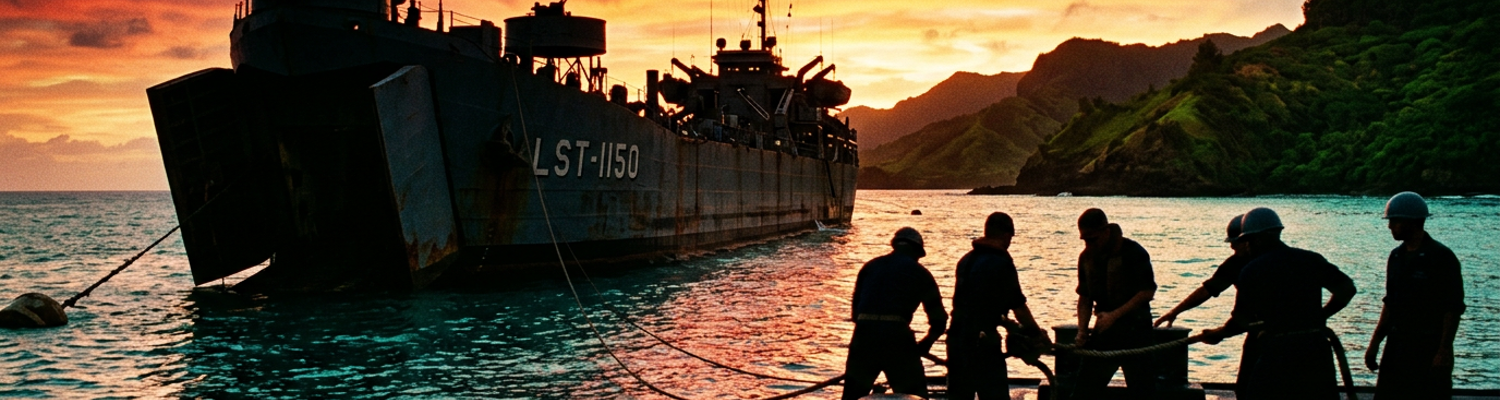
Soldiers and civilian dependents in these stranded garrisons languished in makeshift camps across China, Southeast Asia, and the central Pacific while planners searched for usable tonnage. Naval officers recognized that conventional cargo ships were too scarce to retrieve millions of people before winter weather and tropical diseases overwhelmed the camps. United States Navy officials authorized the loan of eighty-five surplus LST-542-class landing ships in December 1945 to bridge acute merchant marine deficits. Tank landing ships offered an ideal solution because their flat bottoms, shallow drafts, and forward bow doors allowed them to beach directly on undeveloped shorelines without working piers or harbor tugs. Navy depots pulled dozens of these mass-produced amphibious vessels out of forward anchorages in the Philippines and the Marianas, directing them toward Japanese home ports under priority transfer orders. Tugboats towed the decommissioned hulls across rough winter seas, delivering the vessels directly into crowded mainland naval yards for rapid overhaul.
Shipwrights swarmed over the berthed landing ships to strip away their wartime combat hardware and convert the cavernous vehicle decks into crowded passenger compartments. Construction crews tore out forty-millimeter antiaircraft mounts and welded multi-tiered wooden platforms along the length of each cargo bay, creating tight sleeping berths for over one thousand passengers per vessel. Administrative authority over the vessels fell under the newly created Shipping Control Authority for the Japanese Merchant Marine. This joint administrative organization, directed by American naval officers and staffed by Japanese maritime officials, assigned demobilized Japanese merchant officers and former Imperial Navy sailors to operate the American-built ships. Japanese engineering crews descended into the engine rooms to study English instruction manuals, tracing fuel lines and learning the maintenance routines for twin twelve-cylinder diesel power plants. Allied inspectors examined the watertight bulkheads and verified that Japanese navigators could handle the twin-screw rudder controls before certifying each hull for active sea duty.
Helmsmen steered the first converted landing ships through swept channels in the Inland Sea, watching for surface mines while taking bearings off coastal headlands. Deck crews hoisted blue and red SCAJAP pennants over the forward superstructures, signaling the transition of these former assault transports into unarmed humanitarian carriers. Supply parties loaded tons of dry provisions, emergency medical kits, and drummed diesel oil into the lower storage holds to sustain crews across thousands of miles of open water. Port authorities cleared the first wave of modified landing ships to steam toward distant pick-up points on the Asian mainland and across the southwest Pacific. Skippers rang up half-speed on the engine room telegraphs, guiding their blunt-bowed vessels past sunken harbor wreckage and out into the open waters of Tokyo Bay.
Conversion of LST-542 Hulls at Yokosuka and Kure
Tugboats shoved incoming divisions of unmodified landing ships past that same harbor wreckage and directly into the granite drydocks of Yokosuka and Kure to begin full conversion. Naval dockyards stripped tank deck vehicle tie-down points and combat fittings to convert amphibious assault ships into passenger carriers. Shipfitters fired up oxyacetylene torches along the steel floorplates, burning through rows of cloverleaf lashing sockets and heavy turnbuckle pad-eyes that had once secured tanks and artillery during wartime landings. Riggers slung wire chokers around forty-millimeter antiaircraft tubs, splinter shields, and ammunition ready-boxes, signaling yard cranes to hoist the armor plate onto the stone quays. Demobilization laborers attacked the blackened deck plates with wire brushes and caustic soda, scouring away diesel grease, carbon residue, and rust scale to leave broad, hollow cargo spaces ready for structural timber work.
Carpenters carried heavy loads of dimensional lumber into these empty cargo spaces to frame the internal berthing compartments. Yard workers constructed multi-tiered wooden sleeping platforms and installed crude salt-water wash racks along the enclosed vehicle decks. Japanese shipwrights framed long rows of timber uprights and cedar planks along both hull bulkheads, stacking narrow sleeping bays two and three levels high to fill the vertical space. Foremen ensured that every platform had sufficient overhead clearance so a grown man could sit upright without striking the crossbeams or steel frames above. Riggers tied off safety handrails and ladder runs along the framing, leaving a clear pathway for plumbers to finish connecting water pipes.
Pipefitters moved along this central deck pathway to hook the wash racks directly into the ship auxiliary fire mains. Iron pipe manifolds carried raw ocean water down the length of the hold to supply the open sheet-metal troughs where passengers washed. Welders burned drain holes through the outer hull plating just above the water line, installing gravity scuppers to dump used wash water and raw sewage directly overboard. Electricians slung wide canvas ventilation trunks from the overhead deck girders, coupling them to high-speed centrifugal blowers to force fresh outside air into the stifling, windowless holds. Generator crews tested the blower circuits under full power, ensuring constant air circulation across every berthing level.
Inspectors boarded the newly ventilated hulls with measuring chains and tally boards to determine total passenger capacity. Conversions expanded individual hull capacity to transport between one thousand and fifteen hundred repatriates per voyage. Naval authorities divided the massive open deck into numbered berthing sections, assigning specific family groups, demobilized soldiers, and civilian nurses to separate platforms to preserve order. Medical officers marked off small forward compartments near the bow ramps as dedicated quarantine spaces, outfitting them with sulfur ointments and cholera treatment kits to isolate sick passengers away from the main bunk tiers. Japanese supply details stacked thousands of woven rice sacks and steel drums of fresh drinking water into the lower ballast voids to sustain the massive passenger loads across rough sea routes. Dockmasters turned the sluice valves to flood the drydocks, lifting the refitted landing ships off their keel blocks to begin sea trials.
Eighth Army Quarantine Protocols and Epidemic Control
Engineers completed these sea trials and steered the converted landing ships across the East China Sea to embark thousands of Japanese soldiers and civilian refugees from mainland ports. Cramped shipboard quarters and limited fresh-water distillers created severe sanitation strains during prolonged quarantine delays. Japanese repatriates crowded by the hundreds onto tiered wooden bunks framed inside the windowless tank decks, quickly exhausting the limited capacity of the onboard piping and ventilation blowers. Shipboard evaporators designed for a wartime combat crew of barely one hundred sailors produced only two to three gallons of potable water per person each day, forcing engineering officers to ration drinking supplies while shutoff valves cut off flow to the salt-encrusted wash troughs. Stagnant heat and foul air accumulated inside the uninsulated steel holds as ships swung at anchor for days awaiting entry clearance, accelerating the spread of lice, dysentery, and skin infections across the passenger platforms. Deck hands hauled buckets of raw sea water below to scrub down the fouled bilge floorboards and carried soiled canvas bedding up to the weather deck for burning.
Doctors watched this smoke drift across the water and immediately clamped strict health cordons around every arriving vessel. Strict dockside health inspections and isolation procedures prevented major cholera outbreaks originating in mainland Chinese ports. Boarding parties composed of American military physicians and Japanese quarantine technicians motored out to the anchored landing ships in wooden picket boats, climbing debarkation nets to inspect every passenger and crewman before anyone set foot on shore. Medical teams conducted systematic physical examinations on the open decks, taking rectal swab specimens from every traveler exhibiting fever and recording body temperatures in logbooks to detect early stages of intestinal infection. Health officers ordered any transport carrying active or suspected cholera cases to remain anchored in remote isolation basins for a full seven-day incubation period, cutting the ship off from shore traffic while laboratory technicians examined stool cultures under microscopes. Coxswains maneuvered shallow-draft lighters alongside infected hulls to evacuate critically dehydrated patients directly to isolated island field hospitals, where medical staff administered continuous intravenous saline infusions while armed sentries guarded the perimeter against unauthorized landings.
Barges transported these cleared repatriates from the guarded offshore anchorages straight to the debarkation wharves of Uraga, Sasebo, and Hakata. Eighth Army medical personnel set up staging areas with mandatory DDT powder dusting stations to eliminate typhus-bearing body lice. Demobilization technicians guided thousands of men, women, and children through long open-sided processing warehouses, directing each person to loosen their collars, belts, and trouser cuffs. Dusting details used motorized air compressors and hand-pumped spray nozzles to shoot heavy blasts of ten-percent DDT chemical powder down collars, up sleeves, and into trouser legs. Thick white clouds coated garments, scalp hair, and armpits to kill body lice before the parasites could transmit lethal typhus germs into the crowded refugee transit camps and nearby civilian neighborhoods. Supply clerks issued clean garments, transit meal packs, and stamped health clearance certificates only after inspectors verified that every individual showed a thorough dusting of white powder, clearing them to board outbound passenger trains for the home provinces.
Demobilized Japanese Crews and SCAJAP Command Structure
Sailors from the demobilized Imperial Japanese Navy scrubbed the vacated passenger platforms with disinfectant and restowed safety lines while preparing the vessels for their next outbound voyages. Loaned landing ships operated under demobilized Imperial Japanese Navy crews monitored by United States Navy administrative and naval liaison teams stationed directly aboard each vessel or at regional port centers. American naval liaison officers tracked daily cargo manifests, verified fuel consumption logs, and ensured that the former wartime adversaries strictly obeyed Allied sailing directives. Senior Japanese officers retained direct functional control over their former subordinates, enforcing shipboard routines, damage control watches, and technical discipline across the sprawling vehicle decks. Communication between the liaison officers and the Japanese captains relied on shared nautical terminology and bilingual signalmen who translated daily operational orders inside the pilot houses. American inspectors walked the compartments alongside the Japanese skippers each morning to confirm engine readiness, food rations, and crew health before clearing the ships to cast off from port.
Halyards at the masthead hoisted a distinct visual marker as each cleared transport cast off its mooring lines and turned toward the open sea. Vessels displayed a modified red-and-blue swallowtail pennant in place of the Japanese national ensign to signify occupation registry. Allied occupation authorities strictly prohibited the flight of the traditional naval flag or the national Hinomaru, establishing the two-color swallowtail banner as the sole legal identifier for Japanese-manned hulls in international waters. Lookout watches on Allied warships and patrol aircraft recognized the red-and-blue swallowtail from miles away, identifying the former assault ships as authorized repatriation carriers rather than contraband runners or hostile targets. Japanese riggers kept the pennant flying at the main truck through heavy gales, splicing frayed cordage and securing the lines directly to bridge wing cleats before the ships met the rolling swells of open coastal water.
Channels bristling with unexploded wartime ordnance required precise navigation the moment the vessels entered the open coastal water. Japanese mariners navigated mine-strewn coastal channels while maintaining aging diesel powerplants with salvaged equipment and spare parts. Swept passages through the Shimonoseki Strait and the Inland Sea remained littered with magnetic and acoustic bottom mines dropped by American bombers during the final months of the war. Navigators worked under strict instructions to hold their vessels inside narrow cleared lanes marked by wooden spar buoys, checking visual bearings against headland lighthouses every few minutes to prevent hull drift. Helmsmen gripped the steering wheels with steady hands while forward lookouts scanned the surface chop for moored contact mines that had snapped their anchor cables and floated free.
Engineers inside the sweltering lower machinery spaces fought continuous mechanical breakdowns to prevent the twin diesel engines from stalling during these critical passages. Factory-made spare parts were rarely available through occupation logistics channels, forcing Japanese engine crews to improvise repairs with whatever materials they could scavenge from stripped naval hulks and bombed-out workshops. Machinists fabricated replacement piston rings from salvage steel, filed down pitted injector needles by hand, and patched cracked cooling water jackets with lead solder and bolted copper plates. Oil wipers and fuel lines regularly clogged with carbon residue, requiring mechanics to crawl into tight bilge spaces with wrenches and scrapers while the propeller shafts turned inches from their shoulders. Oilers carried hand pumps and recycled lubricating oil through fine cloth strainers to keep the crankpins cool as the vessels pushed through heavy currents. Continuous repair efforts kept the aging powerplants running through hundreds of dangerous coastal transits, delivering the landing ships safely to designated pick-up anchorages across the western Pacific.
Repatriation Transit Corridors from Huludao and Shanghai
Transports dropped anchor in designated pick-up zones across the western Pacific, serving as primary maritime carriers evacuating hundreds of thousands of Japanese nationals through the Manchurian port of Huludao. Crowds of civilian families and disarmed soldiers gathered along the concrete quays after traveling hundreds of miles across territory contested by Chinese Nationalist and Communist forces. Japanese deckhands swung open the massive steel bow doors and winched down the loading ramps, directing more than one thousand travelers at a time onto the wooden bunk platforms built inside each hull. Medical corpsmen checked every boarding passenger for obvious signs of typhus and frostbite, while supply handlers passed out hard ship biscuits and fresh water rations to mothers carrying infants wrapped in heavy quilts. Winch operators hauled the thick ramp cables taut against the rubber hull seals as soon as each transport reached passenger capacity, locking the forward compartments before the vessels backed into the ice-flecked waters of Liaodong Bay.
Propellers churned the frigid coastal shallows as skippers turned their heavily laden vessels south toward the open waters of the Yellow Sea. Turnaround timetables forced ships into uninterrupted cycles across the Yellow Sea and East China Sea throughout 1946. Winter storms and summer gales hammered the flat-bottomed hulls, rolling the shallow-draft vessels through heavy cross-swells that triggered widespread seasickness among the passengers packed below deck. Watchstanders stood cold bridge rotations around the clock, tracking drift rates and scanning the horizon for unmoored naval mines while navigators kept the ships within narrow cleared transit channels. Engineers down in the engine rooms nurtured the twin diesel powerplants through continuous operational cycles, replacing fuel filters, tightening loose water fittings, and servicing lubrication systems while the shafts kept turning. Allied port dispatchers allowed the landing craft minimal layover time in port, scheduling immediate refuelings so each transport could begin its next transit without delay.
Piers along the Huangpu River in Shanghai and the anchorages of Formosa funneled additional hundreds of thousands of travelers into these nonstop transit runs. Continuous shuttle routes ran from Shanghai and Formosa directly into home island reception ports including Sasebo and Hakata. Japanese mariners embarked military personnel, civilian colonial officials, and local Japanese residents at crowded dockside staging points, filling every square foot of the lower platforms and setting up canvas tarpaulins over the weather decks to shield passengers from wind and rain. Navigators steered these loaded transports past the mud banks of the Yangtze River estuary and through the choppy waters of the East China Sea, avoiding charted minefields before sighting the rocky headlands of western Kyushu. Line handlers on the piers of Sasebo and Hakata caught the heavy mooring hawsers thrown from the deck, securing the ships to the wharves so debarkation details could lower the bow ramps and march the passengers directly into demobilization warehouses. Japanese supply crews immediately dragged fuel hoses and water lines across the gangways, replenishing the depleted tanks so the empty ships could cast off for their next outbound crossing within hours.
Mechanical Attrition Bureaucratic Turnover and Fleet Disposal
Fuel injectors sputtered and scored cylinder liners throughout the lower machinery spaces as ships pushed through these relentless turnaround schedules without routine yard overhauls. Relentless operational tempo and deferred maintenance caused critical wear and tear across the converted LST-542 flotilla by late 1947. Continuous open-ocean transit runs weakened the welded hull seams, allowing seawater to seep through hairline fractures into the lower ballast voids and bilge sumps. Japanese mechanics struggled to replace stripped valve stems and burned-out bearings, stripping parts from non-operational landing craft anchored in reserve basins to salvage usable engine components. Thick layers of mineral scale coated the auxiliary evaporators, reducing fresh water production while diesel exhaust manifolds cracked under persistent heat and vibration. Yard workers at Yokosuka and Sasebo patched leaking sea chests with wooden soft plugs and quick-setting cement boxes, barely keeping the battered vessels buoyant enough to clear their final repatriation assignments.
Dockmasters directed these returning transports to tie up along designated demobilization berths as overseas passenger numbers dwindled to a halt. Occupation authorities dismantled the emergency merchant fleet structure and phased out leased vessels as mass repatriation missions concluded. American naval officers terminated the temporary operating charters, releasing thousands of demobilized Japanese crewmen back into civilian life and striking the red-and-blue swallowtail pennants from the mastheads. Work crews boarded the idle landing craft with pry bars and sledgehammers, knocking apart the tiered wooden sleeping platforms and ripping out the crude salt-water wash racks that had lined the tank decks for two years. Crane operators hoisted truckloads of splintered lumber, temporary ventilation ductwork, and rusted galvanized piping out through the open bow doors onto the concrete quays.
Inspectors from the United States Navy walked through the emptied cargo spaces with thickness gauges and logbooks to evaluate structural fatigue and assign each vessel to its final disposition. Surviving landing ships were returned to United States Navy inventory, transferred to foreign navies, or broken up for scrap by late 1948. Fleet tugboats took the soundest hulls under tow toward American naval repair stations in the Philippines and Guam, where technicians prepared some for preservation in the reserve fleet while readying others for delivery to allied governments. Foreign naval crews took command of dozens of these former repatriation transports, hoisting new national flags and sailing them toward military supply duties in Asia and Europe. Salvage contractors moved the most severely damaged and corroded hulls into shallow breaker slips at Yokosuka and Kure, rigging cutting equipment and haulage cables along the tidal flats. Oxyacetylene torches sliced through the rusted bow ramp hinges and double-bottom steel plates, dropping the severed bulkhead sections onto salvage barges for transport to domestic steel mills.