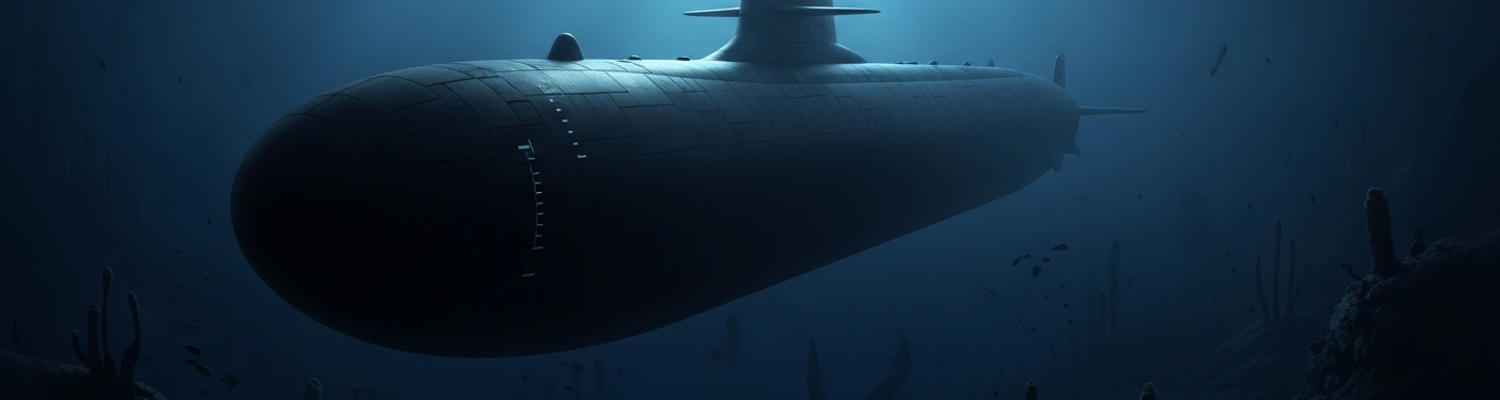

A close review of declassified operational logs from the Cold War reveals the high stakes of undersea espionage. The Sturgeon-class nuclear attack submarines were the era's masters of covert operations. These boats were a direct progression from the earlier Skipjack and Permit classes. They were not the fastest submarines in the U.S. Navy. Nor could they dive the deepest. Their singular, defining advantage was quietness. The entire design ethos of the Sturgeon class centered on acoustic stealth. This was achieved through a complex rafting system for heavy machinery that isolated vibrations from the hull and a meticulous approach to propeller design. For covert intelligence missions, this was the only attribute that mattered. The specific boat tasked for a spring 1977 operation, the USS Gurnard (SSN-662), was further modified. Archival evidence shows it was fitted with a dorsal saddle-mount. This non-pressure hull attachment housed a specialized multi-spectral imaging pod and a suite of bathythermograph sensors designed for fine-grain seabed mapping. This external modification, however, subtly altered the boat’s hydrodynamic profile. It created a faint but detectable flow-noise signature at speeds above eight knots, a vulnerability the crew had to manage constantly.
The Eastern Mediterranean in the spring of 1977 was a cauldron of geopolitical tension. The Soviet Navy’s 5th Operational Squadron, a powerful surface and submarine force, maintained a constant and aggressive presence. It challenged NATO’s U.S. Sixth Fleet for dominance. The Soviet squadron used anchorages near Kithera Island and east of Crete. It also had access to the Syrian port of Tartus, effectively turning the region into a naval chessboard. The Gurnard was deployed directly into this contested environment. Departing from New London, the submarine’s transit was a silent, submerged passage through the Greenland-Iceland-UK gap. This chokepoint was heavily monitored by Soviet SOSUS-style hydrophone arrays and long-range aviation. The mission directive was explicit. Proceed to a designated patrol box in the Ionian Sea, conduct baseline acoustic and thermal layer analysis, and then execute a covert transit to the waters off the Syrian coast. This was the operational area for Project ARCHAEUS, a highly classified intelligence effort aimed directly at the capabilities of the Soviet Mediterranean fleet. The presence of so many Soviet naval assets, from diesel-electric submarines to modern cruisers, meant the Gurnard’s crew was under constant threat of detection.
Project ARCHAEUS was a dual-pronged intelligence-gathering directive. It focused on Geospatial Intelligence (GEOINT) and Imagery Intelligence (IMINT). The GEOINT portion of the mission required the Gurnard to map a specific sector of the seabed near Tartus. U.S. intelligence suspected the Soviets were laying a new generation of acoustic and magnetic sensors to monitor submarine traffic leaving the Suez Canal. Using its specialized bathythermograph suite, the Gurnard was to creep at less than four knots. The submarine collected precise data on water temperature, salinity, and magnetic anomalies to identify the underwater arrays. This was a painstaking and dangerous process. It required the submarine to operate within Soviet-claimed waters for extended periods. The IMINT objective was even more audacious. A new Soviet submarine tender had been observed at Tartus. Project ARCHAEUS tasked the Gurnard with obtaining high-resolution photographs of its unique mooring and resupply systems. Standard satellite imagery could not provide the required level of detail. This forced the submarine’s commander to make a series of daring shallow-water approaches. He raised a specialized high-powered periscope for only seconds at a time to capture images. Each periscope exposure was a calculated risk, a fleeting moment where the submarine was most vulnerable to radar or visual detection from the ever-present Soviet anti-submarine warfare patrols. The operation was a severe test of the Sturgeon platform’s stealth and the crew’s nerve, pushing both to their absolute limits.
The mechanical backbone for the GEOINT phase of Project ARCHAEUS was a new piece of experimental hardware. A post-mission analysis identified it as the CryoDyne XCA-2. It was a cryogenic signal amplifier occupying three full racks in the aft section of the Gurnard’s radio room. Its function was to supercool a delicate array of niobium-tin alloy sensors to a temperature of 4.2 Kelvin, just above absolute zero. This was achieved via a closed-loop liquid helium system. This complex and notoriously fragile assembly of compressors, heat exchangers, and insulated transfer lines had never before been deployed on a submarine. The extreme cold reduced thermal noise in the circuits to near zero. This theoretically allowed the XCA-2 to detect and amplify radio signals far too weak for any conventional receiver. Onboard diagnostic logs (Log Entry 77-4-11-A) show the unit required a 72-hour cold-soak period before reaching operational stability. This power-intensive process placed a significant strain on the submarine’s electrical grid. The system was so new that the two civilian technicians who installed it at New London were the only personnel in the Navy who fully understood its architecture. The ship’s electronics technicians had received only a week of condensed training. Official reports would later cite this as a major contributing factor to the events that followed.
This amplifier was not an optional upgrade. It was the single component that made the entire gambit possible. U.S. intelligence planned to use a low-orbit signals intelligence satellite, designated KH-9B HEXAGON, to perform a high-speed data dump to the Gurnard. The satellite would collect fresh telemetry from Soviet naval exercises in the Black Sea, compress it, and transmit it in a tight, encrypted burst lasting less than 2.5 seconds. The transmission used a frequency-hopping spread spectrum technique. This made it almost indistinguishable from background cosmic radiation for any standard antenna. Only the XCA-2, with its near-absolute zero sensor array, could lock onto such a faint and fleeting signal. The decryption of this data was time-sensitive. The information contained the exact patrol routes and acoustic signatures of the Soviet Victor-class submarines expected to transit from the Black Sea into the Mediterranean. Receiving and processing this data package in real-time was the central objective of the mission. It would give the Gurnard an unprecedented tactical advantage.
The failure occurred at 02:17 local time on April 12, 1977. The Gurnard was holding a steady depth of 18 meters in its designated patrol box east of Crete. Only its induction mast and communications antenna were above the surface. The downlink window was open. The radio room was a space of intense, quiet focus. Initial telemetry showed the XCA-2 had achieved a clean signal lock on the KH-9B’s preliminary handshake beacon. Data began to stream to the decryption processor. Forty percent of the data packet was received successfully. Then, a single amber light began flashing on the XCA-2’s control panel: HE LOOP PSI FAULT. A pressure drop in the helium return line. Seconds later, a cascade of alarms followed. The temperature of the sensor array began to climb catastrophically, rising from 4.2 Kelvin to over 50 Kelvin in under a minute. The incoming data stream dissolved into unintelligible static on the monitor. The electronics technician, a Petty Officer Second Class, attempted a manual override to bypass the faulty pressure sensor. This procedure was outlined on page 147 of the preliminary technical manual. The override failed. A frantic inspection of the unit itself revealed a fine mist venting from a hairline fracture in a brazed joint on the primary helium compressor. The escaping gas was freezing the surrounding components. It created a rapidly expanding crust of ice inside the electronics rack. At 02:21, with the satellite moving out of range and the amplifier’s core temperature exceeding its operational limits, Commander Poirier gave the order to secure the system and abort the download.
The loss of the XCA-2 amplifier rendered the primary intelligence objective unattainable. Commander Poirier, however, was not yet prepared to abort the entire mission. Secondary GEOINT taskings remained. Specifically, the bathymetric mapping of the suspected Soviet sensor field near the Syrian coast. At 04:30 local time, the Gurnard left its holding position and began a slow descent to its operational depth of 400 meters. The boat proceeded south through the Ionian Basin. It was at this point that sonar technicians began to register a new and deeply unsettling acoustic signature. It was not a contact. It was a low, powerful vibration, a structural thrumming that seemed to emanate from the submarine’s own stern. Initial analysis logged it as a 12-hertz shudder. It was too low to be heard by the ear but felt through the deck plates as a persistent, jarring oscillation. The engineering department launched a full diagnostic investigation. Checks on the S5W reactor plant, the steam turbines, and the main reduction gears all returned negative. The vibration was not coming from the propulsion train. It only manifested at depths below 350 meters and at speeds between three and five knots. The investigation shifted to the control surfaces.
A close review of operational logs from the incident reveals the environmental trap the Gurnard had entered. The submarine was transiting through a deep underwater canyon system. This system acts as a funnel for dense, cold water flowing south from the Adriatic. This phenomenon, known to oceanographers as the North Adriatic Dense Water outflow, creates a powerful, river-like undercurrent in the Ionian Sea. Hydrographic data shows this current moves at a near-constant three knots through the submerged canyons. As the Gurnard moved into this current, the flow dynamics around its hull changed dramatically. Specifically, the water moving past the large, non-streamlined dorsal saddle-mount housing the Project ARCHAEUS sensor pod began to produce a powerful vortex shedding effect. This is a known hydrodynamic principle where fluid flowing past a bluff body creates alternating low-pressure zones, resulting in periodic forces on the structure. The specific geometry of the saddle-mount and the speed of the undercurrent combined to produce vortices that detached at a frequency that matched the natural resonant frequency of the submarine’s stern plane assembly. This was calculated to be almost exactly 12 hertz. The deep-ocean current was inducing a powerful, rhythmic vibration throughout the submarine's aft structure.
This externally induced resonance was exciting a latent, catastrophic flaw deep within the submarine’s structure. The post-incident investigation, conducted at the Electric Boat facility in Groton (NARA Record Group 19), focused on the port-side stern plane actuator housing. This component, a complex assembly of high-yield HY-100 steel, was responsible for translating hydraulic pressure into movement for the large control surface. The investigation discovered that a series of electron-beam welds securing the housing to the pressure hull were faulty. Analysis of the weld material, a specialized titanium alloy used as a joining interface, showed evidence of microscopic porosity. These were tiny gas-filled voids created during a rushed and improperly controlled welding process at the shipyard. These voids acted as stress concentrators. Under normal operational pressures, the flaw was undetectable. But under the sustained, rhythmic 12-hertz vibration generated by the vortex shedding, these microscopic voids began to connect. They formed hairline cracks. This process is known as material fatigue. Onboard strain gauges placed on the actuator housing by the engineering crew confirmed the terrifying diagnosis. The cracks were propagating with every pulse of the vibration. The structural integrity of the port stern plane was actively failing.
The damage control report from the engineering department confirmed Commander Poirier’s fears. A review of the strain gauge data showed that the microscopic cracks in the port stern plane actuator housing were propagating with every pulse of the 12-hertz vibration. The structural integrity of a primary flight-control surface was actively and irreversibly failing. Continued operation under these conditions presented an unacceptable risk of catastrophic failure and the loss of the ship. At 05:10 local time, Poirier made the only decision possible. He ordered the complete abort of Project ARCHAEUS. The submarine reversed course. It began a slow, cautious transit west, away from the Syrian coast. This single command decision, though necessary for survival, triggered an immediate and total intelligence blackout. The failure of the XCA-2 amplifier had already severed the link to the KH-9B satellite. The abortion of the mission now erased the secondary GEOINT and IMINT objectives. There would be no mapping of the suspected Soviet sensor field. The information vacuum was now complete.
The abrupt loss of the mission’s imagery component was a particularly sharp blow. The IMINT portion of Project ARCHAEUS, which called for a series of high-risk periscope observations of the new Soviet submarine tender at Tartus, was now an operational impossibility. A submarine with a compromised stern plane is fundamentally unstable. The stern planes, analogous to the elevators on an aircraft, control the boat’s pitch. Any attempt at the required shallow-water maneuvers, with their delicate changes in depth and trim, risked an unrecoverable depth excursion or a sudden broach to the surface directly in the line of sight of Soviet shore patrols. An after-action analysis confirmed that a failure of the actuator housing at periscope depth would have been fatal. As a result, the capabilities of this new Soviet tender remained a complete mystery to NATO naval intelligence. Its capacity for at-sea replenishment, its systems for re-arming Soviet submarines with anti-ship cruise missiles, and its role in the logistical support of the 5th Operational Squadron were all left to speculation.
The failures aboard the Gurnard created a dangerous strategic deficit. Without the data from the KH-9B satellite, the patrol routes of the newest Soviet Victor-class hunter-killer submarines, which were transiting from the Black Sea, remained unknown. This left American carrier groups significantly more exposed. The suspected Soviet seabed sensor array near the Suez Canal, having gone unmapped, now posed an unquantified but persistent threat to all allied submarine traffic in the region. The failure to gather any intelligence on the Tartus tender left a major blind spot in NATO’s understanding of the Soviet Navy’s operational endurance. Instead of gaining an intelligence advantage, the U.S. was left navigating a sea of unknowns. For the next eleven days, the Gurnard crept west at a depth of 200 meters. Its compromised stern made every course correction a calculated risk.
The sequential failures aboard the USS Gurnard exposed a fundamental disconnect between established U.S. Navy submarine doctrine and the specific demands of hybrid intelligence missions like Poirier’s Gambit. A review of training directives from the period shows that submarine command qualification was overwhelmingly focused on open-ocean, blue-water combat scenarios. Doctrine drilled commanders on acoustic warfare and battle maneuvers against known Soviet fleet formations in deep water. It was a doctrine of predictable physics. Success depended on mastering sonar, stealth, and torpedo mechanics in a well-understood environment. Project ARCHAEUS, however, took place in the chaotic, shallow, and sensor-saturated littoral zone. The operational area was not a clean acoustic environment but a complex mix of civilian traffic, variable water conditions, and aggressive enemy patrols. U.S. submarine doctrine of the 1970s had not yet fully adapted to the unique challenges of coastal operations. Factors like powerful undercurrents, shifting thermal layers, and the hydrodynamic effects of non-standard equipment could create mission-ending threats that were entirely absent from training manuals. The 12-hertz resonant vibration was a direct result of this doctrinal gap. The crew was prepared for a Soviet hunter-killer submarine but was nearly destroyed by a localized oceanographic phenomenon interacting with their own unproven hardware.
This was a mission defined by its reliance on a single, unproven piece of hardware. The CryoDyne XCA-2 amplifier was not a supplementary tool. It was the fragile heart of the entire operation. Post-mission analysis reveals a flaw in operational planning: the complete absence of a viable contingency for the XCA-2’s failure. Standard military procedure would call for redundant systems or, at minimum, a pre-planned alternative objective that could be accomplished with existing, reliable equipment. Planners, however, were so focused on the extraordinary potential of receiving a real-time satellite data burst that they structured the entire gambit around this one capability. When the amplifier’s helium compressor failed, it did not just degrade the mission. It erased its primary purpose. The lack of a backup plan represented a significant departure from established risk management protocols. The decision to field a one-of-a-kind experimental system on a front-line intelligence platform operating in hostile waters reflected a growing institutional belief that technological superiority could override operational risk. The failure of the XCA-2 proved that even the most advanced hardware is useless without accounting for the possibility of its collapse.
The fallout from the Gurnard’s aborted mission forced a painful re-evaluation of intelligence gaps created by fragile technology. The dual failure of the XCA-2 amplifier and the submarine’s structural integrity created a total intelligence blackout. The primary satellite data was lost. The secondary objectives were also scrubbed. This left U.S. Naval Intelligence completely blind on multiple fronts. The patrol routes of new Soviet Victor-class submarines remained unknown. The threat from the underwater sensor grid was unquantified. The capabilities of a key Soviet logistics vessel were a mystery. The incident served as a powerful case study in how over-reliance on emerging, unhardened technologies could create a false sense of security and lead to a sudden and catastrophic loss of situational awareness. A close examination of internal Navy directives following the incident shows a subsequent shift in thinking. New requirements began to emphasize system redundancy, field serviceability, and rigorous environmental testing before any new electronic warfare or SIGINT suite was approved for deployment on a submarine. The allure of a single, revolutionary piece of hardware was replaced by a more sober appreciation for robust, layered intelligence systems that could degrade gracefully rather than fail completely. This was codified in NAVSEA Instruction 9210.4B, mandating full-spectrum environmental stress testing for all Tier-1 experimental electronics packages.