
On paper, the U.S. battle fleet’s striking power in 1928 was theoretical. War Plan Orange dictated a westward offensive across the Pacific to relieve the Philippines. The fleet's main battle line, built around modern standards like the Colorado and Tennessee classes, possessed the gun range and armor to engage any contemporary rival.
This capability was shackled by a geographical and mechanical fact. A Northampton-class cruiser laid down in 1928 had a stated maximum range of 10,000 nautical miles at 15 knots, but this was a fantasy number for a fleet under combat conditions. The true operational reach was determined by the logistics train trailing behind it.
The fleet could only steam as far as its slowest, most vulnerable auxiliaries could support it. The vast expanse between Pearl Harbor and Manila was, for all practical purposes, an impassable stretch of ocean. Exercises held in 1928, specifically Fleet Problem VIII, pitted forces against each other between California and Hawaii, highlighting the immense difficulty of even this comparatively short transit.
The problem was not a lack of fighting ships, but a fundamental failure to grasp the scale of the Pacific and the resources needed to cross it under arms.
The fleet was chained to its logistical tail.
This chain was forged from a profoundly fragile fuel supply network. A handful of aging oilers, like the pre-World War I Kanawha-class, formed the core of the mobile supply force. These ships, with capacities around 4,000 tons of fuel oil and maximum speeds of 14 knots, could not keep pace with a 33-knot aircraft carrier like USS Saratoga. The very concept of underway replenishment was in its infancy. Most refueling had to be done at a standstill, a dangerously static operation.
The fixed infrastructure was no better. Beyond the primary depots in California, the entire American strategic posture in the Pacific depended on a single, major naval base at Pearl Harbor, Hawaii. A secondary, much smaller facility existed at Cavite in the Philippines, but it was understood to be indefensible. There were no other significant American-controlled deep-water ports with the requisite fuel bunkers, workshops, and dry docks. The entire supply chain relied on this thin, easily disrupted artery, with a near-total dependence on civilian-owned tankers that might be unavailable in a crisis.
Where permanent bases did not exist, naval planners intended to create them on the fly. The accepted solution was the establishment of temporary advanced bases. This doctrine, formalized in Marine Corps orders as early as 1921, envisioned seizing an undefended atoll and rapidly constructing a forward operating base. Marine Corps units were tasked with landing and providing security while naval construction crews followed on to build the necessary infrastructure.
The plans were ambitious. The hardware was not. In 1928, the specialized equipment and dedicated vessels to execute this complex task did not exist in any meaningful quantity. There were no purpose-built amphibious assault ships or large numbers of landing craft. The entire operation would have to be improvised, using standard commercial cargo ships.
Fleet exercises repeatedly demonstrated the vulnerability of the fleet’s core bases. Fleet Problem VIII involved a simulated raid on Pearl Harbor, driving home how a single, well-placed attack could cripple the entire Pacific strategy.
The hard lesson, learned over and over in naval war games, was that the U.S. Navy’s battle line, for all its firepower, could not fight a war that its logistics could not support.
The weather arrived with unnerving swiftness. A review of operational logs from ships anchored in Kwajalein’s lagoon shows the fleet was caught unprepared for the ferocity of the late-season typhoon that struck the atoll in October 1928. Barometric pressure plummeted. Sustained winds quickly escalated to over 90 knots, with gusts exceeding 120 knots, driving a mountainous swell through the atoll’s deepwater channels.
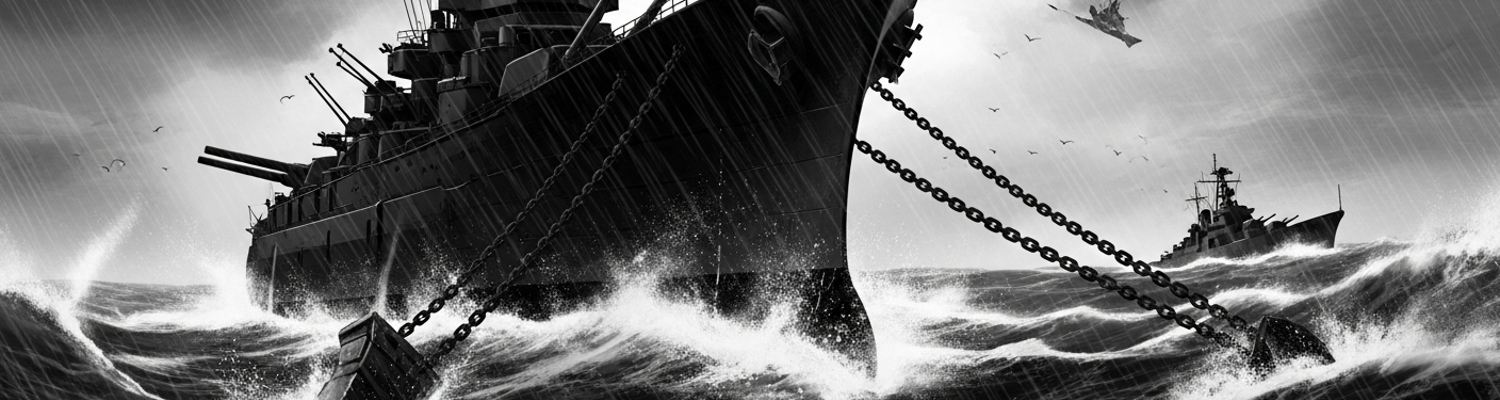
For the capital ships of the battle line, the primary danger was their own mass. Straining against their anchor chains, these 32,000-ton vessels were subjected to forces that threatened to snap the thick steel links holding them in place. The wind created a high-pitched shriek as it tore across rigging and superstructure. Thick sheets of salt spray, ripped from the tops of waves inside the lagoon, sandblasted paint from funnels and masts.
Aboard the smaller destroyers and auxiliaries, the situation was more dangerous. The shallow-draft Kanawha-class oilers, riding high and empty, were thrown about violently. The sheer acoustic violence of the storm, a constant, deafening roar of wind and crashing water, made voice communication on open decks impossible. The storm isolated every ship.
Prior to the typhoon’s arrival, the fleet had been engaged in the difficult process of broadside replenishment. Archival evidence shows that the oiler USS Cuyama was alongside the destroyer USS William B. Preston, preparing to pass its heavy rubber fuel hoses, when the rapidly deteriorating sea state forced an emergency abort. The swell caused the two ships to roll violently. The strain parted a three-inch manila mooring line with a sound like a rifle shot. A six-inch fuel hose, not yet fully connected, was whipped loose by the motion, striking a depth charge rack on the destroyer’s fantail before tearing free from its fitting on the Cuyama.
The decision was made instantly across the fleet’s command structure. All refueling operations were to cease. With no ability to transfer fuel, the destroyers and cruisers tasked with screening the battle line were now on strict fuel conservation.
The entire timetable for the fleet’s westward movement was rendered obsolete. Every gallon of fuel oil was now a strategic asset.
Just as the typhoon crippled the fleet’s mobility, it also blinded it. The eyes of the 1928 battle fleet were its catapult-launched observation floatplanes, typically Vought O2U Corsairs. As the typhoon’s outer bands lashed the anchorage, two separate attempts to maintain an air patrol ended in failure.
Aboard the USS Maryland, a Vought O2U-2 was readied on the compressed-air-powered Type A Mark I turntable catapult. Just as the catapult fired, a violent wind shear caught the aircraft’s port wing, causing it to roll sharply. The pilot could not gain sufficient airspeed and the aircraft stalled, dropping into the churning water.
A worse fate befell the recovery attempt by the cruiser USS Trenton. Its crane was attempting to hoist a returned O2U from the water when the ship executed a violent 25-degree roll. The sudden lateral force on the crane’s boom exceeded its structural limits, snapping the main lifting cable. The 3,600-pound aircraft plunged back into the sea, where the waves quickly broke its wooden wing structure. With no ability to launch or recover aircraft safely, the fleet lost its only long-range reconnaissance capability.
The critical five-minute window opened at 14:05 local time. At the height of the typhoon’s fury, the civilian tramp steamer SS Manila Trader parted its final anchor chain. Weighed down by a cargo of copra and timber, but with a high profile that caught the wind, the ship began an uncontrolled drift directly through the packed naval anchorage. Its path put it on a collision course with the battleship USS West Virginia (BB-48) and the fleet oiler USS Ramapo (AO-12). The two naval vessels were in the process of disengaging from an aborted refueling, their proximity already a major hazard. The Manila Trader, with no visible crew on deck, bore down on them at nearly eight knots.
Responsibility for interception fell to the Clemson-class destroyer USS Paul Jones (DD-230). Archival records of its bridge communications show a frantic series of orders. With visibility reduced to less than 300 yards by sheeting rain and spray, the destroyer’s commander made a decision that was not in any tactical manual. He ordered a shouldering maneuver.
At 14:07, the Paul Jones rang up emergency speed. The plan was to use the destroyer’s own hull as a fender, making controlled, glancing contact with the Manila Trader’s stern to push its bow away. At 14:09, the two ships met. The 1,200-ton destroyer shuddered violently as its bow and starboard shoulder slammed into the merchantman’s rusted hull, the sound of grinding steel audible even over the typhoon.
The maneuver worked. The impact altered the Manila Trader’s course just enough for it to pass harmlessly between the West Virginia and the destroyer USS Farragut, missing the battleship’s stern by less than 50 yards.
The immediate crisis was averted, but the operational consequences were significant. The entire replenishment schedule was thrown into chaos. The near-collision forced the USS Ramapo to execute an emergency cast-off, severing a 50-foot section of its six-inch fuel hose which could not be recovered. The loss of this single piece of equipment made further attempts at broadside refueling impossible for at least 24 hours. The Paul Jones suffered buckled hull plates and damage to its forward frames, reducing its seaworthiness and removing a key screening vessel from the fleet’s defensive perimeter. This single incident, born from the simple failure of a civilian vessel’s anchor chain, cascaded through the fleet.
After-action reports from the annual Fleet Problems of the 1920s reveal a persistent gap in planning: the lack of standardized protocols for interaction between naval vessels and civilian maritime traffic. This created constant risk during exercises.
A telling series of events occurred during blind-navigation drills by destroyer squadrons off Southern California. Deck logs from the USS John D. Edwards record a near-collision with its sister ship, the USS Whipple. While executing a planned zig-zag pattern at 20 knots in thick fog, a known precession error in the Whipple’s Sperry Mark VI gyrocompass, compounded by miscalculation, caused it to deviate from its plot. The two 1,200-ton warships, operating without running lights, suddenly emerged on a converging course, their bows separated by fewer than 40 yards. Only an emergency full astern order prevented a collision.
In 1928, there was no unified maritime communication system. Naval warships operated with high-frequency radio telegraphs and a system of signal flags and Aldis lamps. A typical civilian steamer might possess only a rudimentary, low-power spark-gap transmitter. Voice radio was not yet standard on commercial vessels. This technological chasm meant that in a scenario requiring radio silence, a naval commander had no reliable way to warn an approaching freighter.
An incident during Fleet Problem IX in 1929 illustrates the breakdown. A formation of battleships simulating a covert approach to the Panama Canal encountered a United Fruit Company steamer. The lead destroyer flashed a classified naval signal. The merchant captain, seeing only an unidentifiable blinking light, correctly maintained his course. The destroyer was forced to break radio silence, transmitting a plain-language Morse code message to divert the freighter, thereby compromising the formation’s notional position.
The most acute conflicts occurred when naval exercises intersected with dense fishing fleets. The waters off San Pedro, California, were both active fishing grounds and primary training areas. A squadron of Omaha-class light cruisers conducting night-firing exercises in 1928 had to abort after steaming at 25 knots into the middle of a purse seiner fleet. The sudden appearance of the blacked-out warships created chaos. The cruisers were forced into a series of emergency avoidance maneuvers, their wakes swamping several smaller boats. The incident exposed a complete void in operational doctrine for interacting with civilian populations at sea.
The immediate post-exercise debriefing convened by the Commander, Battle Fleet, aboard the flagship USS California, focused with forensic intensity on the failures the typhoon had exposed. The board’s findings, submitted as Report 28-11, cataloged the specific points of failure.
The anchor chain of the SS Manila Trader showed evidence of advanced corrosion fatigue. This prompted a recommendation for a fleet-wide review of all anchor gear, with a proposal to investigate the adoption of higher tensile strength chrome-vanadium steel alloys.
The emergency maneuver by the USS Paul Jones was commended but condemned as an act of desperation. The debriefing recorded the loss of three Vought O2U observation aircraft, leading to a directive for the Bureau of Aeronautics to develop all-metal float structures and test reinforced crane booms.
The most operationally significant finding centered on the severed fuel hose from the USS Ramapo. This led directly to urgent proposals for improving the Navy's meteorological capabilities. Analysis showed that the fleet’s meteorologists had misjudged the typhoon’s speed and intensity by a factor of nearly two.
The CNO’s Special Board on Fleet Readiness subsequently proposed the creation of a dedicated Weather Picket system. The plan called for assigning a squadron of long-range destroyers to patrol 200 to 300 nautical miles ahead of the main fleet’s axis of advance, transmitting continuous weather data. A second proposal advocated for permanent U.S. Navy weather stations on Johnston and Wake Islands.
The chaotic interaction with the SS Manila Trader forced an equally critical re-evaluation of maritime protocols. The debriefing panel found no established procedures for dealing with an incapacitated civilian vessel within a military formation.
In response, the board recommended the drafting of General Order 1929-B, titled Rules for the Governance of Naval Anchorages and Operating Areas. This new regulation granted fleet commanders explicit authority to declare temporary Military Exclusion Zones. Within these zones, all civilian traffic would be required to yield right-of-way and maintain a listening watch on a newly designated common radio frequency. The order also standardized a new set of visual signals, including a specific flag hoist, consisting of the November and Charlie flags, to signify a compulsory order to alter course.