
Caloric Deficits and Bilibid Epidemiological Registers
Hospital Apprentice First Class Eugene Evans scraped verdigris off a brass counterweight with a dental scaler. He steadied the balance arm before the 0600 muster bell sounded across Old Bilibid Prison. The counterweight sat on a wooden plank between two cracked stoneware jars inside the north ward annex. This structure was originally built to house Spanish colonial infantry in the nineteenth century. Its thick stone walls trapped the humid tropical heat.
Starvation in Manila was tracked in half-gram increments.
When examining the historical record, administrative survival inside the facility depended on covert data collection organized by Commander Thomas H. Hayes. Hayes had served as chief of surgery at Canacao Naval Hospital on the Cavite peninsula. He ran surgical theaters until Japanese air wings flattened the naval station in December 1941. Following the surrender of Corregidor, Hayes redirected his surgical background toward epidemiology and biochemical accounting. Daily ration weights were inscribed onto stolen sheets of Manila paper. Hayes concealed duplicate ledgers inside hollowed wooden ceiling joists above the operating shack. Japanese supply authorities systematically reduced the caloric intake for Allied prisoners of war throughout 1944. Rice allocations fell from four hundred grams of dry grain to less than two hundred grams of floor sweepings contaminated with weevil larvae and dirt. His tallies proved that food intake fell beneath an 850-calorie daily baseline for over two thousand active inpatients. Basic human resting metabolism requires roughly sixteen hundred calories to sustain cellular function. Ledger entries balanced gross weight drops against the physical energy demanded by Japanese labor details.
Archival evidence shows captive personnel were losing three to five pounds of body mass each week.
A close review of operational logs indicates that the medical staff turned the wards into a continuous biological monitoring laboratory. Clinical tracking sheets recorded the biometric progression of wet beriberi, severe nutritional edema, and pellagra across thousands of imprisoned naval, military, and civilian personnel. When thiamine levels collapsed in the human body, pyruvic acid accumulated in the bloodstream. This triggered widespread vascular dilation and acute circulatory failure. Hayes monitored pitting edema by depressing his thumb into the pretibial skin of patients for ten seconds. He measured indentations that exceeded two centimeters in depth. Fluid accumulated in peritoneal cavities and expanded the lower extremities until skin split along the calf lines. Orderlies used linen measurement strips to log ankle and thigh circumferences twice every twenty-four hours. They noted when swelling migrated upward into the groin. Pellagra spread across the compound under the same nutritional conditions. Tracking sheets listed the progression of bilateral dermatosis. They documented thick, black crusts that formed across the necks and forearms of men assigned to outdoor revetment digging. Intractable diarrhea followed. This stripped the intestinal lining and prevented the absorption of what little rice starch remained. Final clinical entries charted the neurological decay as niacin starvation dissolved cognitive function. Medical staff recorded the dates when patients lost orientation to time, developed persistent tremors, and suffered fatal cardiac arrhythmias.
On September 12, 1944, the daily ration delivered to Ward 3 measured 710 calories per man (Bureau of Medicine and Surgery File 44-B).
Surgical Improvisation and Severe Pharmaceutical Rationing
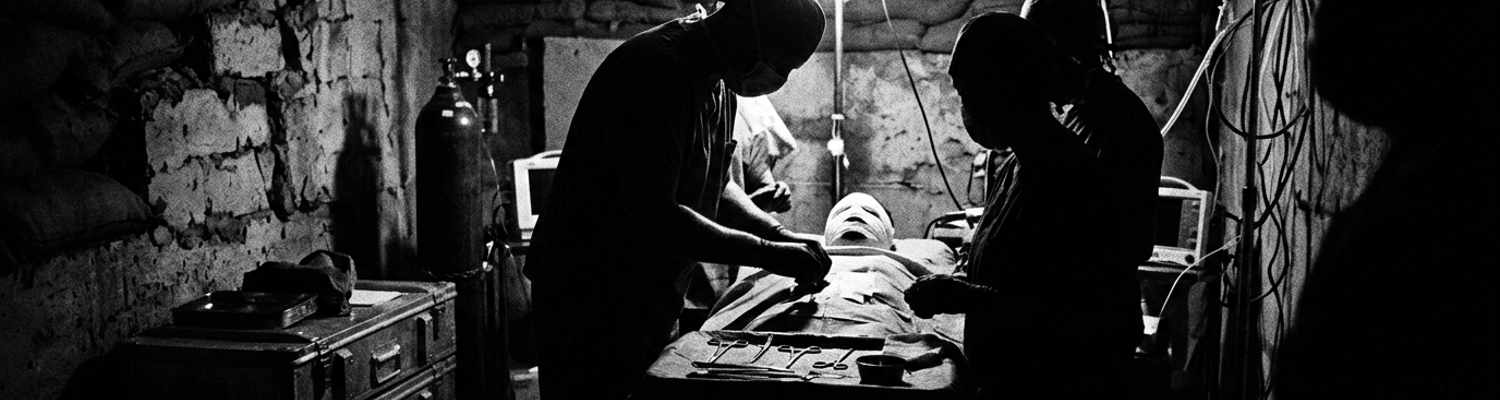
Emergency operations inside Bilibid took place behind blackout curtains sewn from moldering canvas truck tarps. Japanese guards enforced total light discipline across Manila during the autumn of 1944. They threatened immediate execution if a single beam leaked into the prison yard. Medical officers worked inside an abandoned dispensary annex. They leaned over wooden benches rigged as operating tables. These benches were previously used by Japanese guards for weapon maintenance. Illumination came exclusively from handheld carbide mining lamps salvaged from pre-war Philippine iron works. Operating these devices required mixing water with calcium carbide pellets in a sealed lower chamber. This generated acetylene gas that fed an unshielded burner tip with a sharp, hissing white flame. The burners threw deep shadows across exposed visceral cavities. Acetylene exhaust mixed with the stench of gangrenous tissue and human waste in the unventilated room. Surgical teams operated through frequent flame failures when water nozzles clogged with lime residue. Surgeons finished bowel resections or limb debridements by the ember of a smoldering wick while Japanese anti-aircraft batteries fired at carrier aircraft overhead.
Acetylene soot settled directly into open abdominal incisions.
When examining the historical record, mechanical instruments suffered equal degradation. Scalpel blades were resharpened on concrete floor slabs until the steel ground down to narrow needles. Sponges consisted of unraveled cotton uniform remnants boiled in brine drums. Staff rinsed and dried these on corrugated tin sheets between air raids. Japanese heavy machine guns on the prison perimeter opened fire on low-flying Grumman Hellcats. Shockwaves shook dust down from the dry ceiling timbers into sterile trays. Navy surgeons clamped bleeding mesenteric vessels with rusted automotive pliers when standard hemostatic forceps snapped at the box lock. Retractors were bent by hand from heavy telephone wire scavenged from demolished administrative offices. Suture material ran out entirely by October. The surgical staff stripped individual strands of unbleached cotton thread from discarded canvas cot bindings.
A close review of operational logs indicates that Commander Hayes established a rigid pharmaceutical triage formula. He used this to manage the compound collapsing cache of sulfathiazole. The remaining supply numbered under four hundred tablets hidden inside a hollowed timber beneath the pharmacy floorboards. This inventory could not cover the hundreds of men presenting with secondary bacterial infections, infected tropical ulcers, and perforating dysentery. Hayes instituted a mathematical scoring system based on baseline physical viability. If a patient exhibited third-degree nutritional edema extending above the mid-thigh, medical staff denied him all antibacterial drugs. A body weight below eighty-five pounds triggered the same denial. Clinical signs of wet beriberi cardiac failure also disqualified patients. The protocol concentrated full, therapeutic courses of twenty to thirty grams exclusively on individuals who retained adequate cardiac reserve and functional kidney output.
Men disqualified by the triage matrix received only boiled water flushes and clean bandages.
Ward logs recorded the immediate consequence of these pharmaceutical allocations across the surgical compound. Patients excluded from sulfathiazole developed uninhibited hemolytic streptococcal invasions and spreading clostridial infections within forty-eight hours of soft-tissue trauma. Corpsmen documented the advancement of tissue necrosis with pencil lines drawn directly onto patients skin. They charted the hourly expansion of dark, crepitant tissue up the abdominal wall or thigh. When gas gangrene took hold, surgical staff had no systemic countermeasures left to deploy. Amputations were performed without anesthesia to spare minimal ether stocks for salvageable younger personnel. Surgical records from late October 1944 show that eighty-two percent of prisoners denied sulfathiazole died within five days of initial clinical triage. Midnight burial details removed their bodies to the trench lines outside the northern wall.
Task Force 38 Raids and Underground Trenches
On September 21, 1944, Vice Admiral Marc Mitscher launched three hundred aircraft against Japanese shipping and airfields across Manila Bay (Task Force 38 Action Report 11-44). The strikes targeted the primary logistical hubs supplying the Japanese 14th Area Army.
Archival evidence shows that the initial wave of Curtiss SB2C Helldivers and Grumman Hellcats struck Nichols Field and the South Harbor docks less than three miles from Old Bilibid Prison. Shockwaves from five-hundred-pound general-purpose bombs fractured the compound perimeter foundations. Pulverized lime rained across the sick bays. Prison records show that Commander Hayes directed navy corpsmen and ambulatory patients into the central courtyard. They excavated subterranean slit trenches directly through the facility nineteenth-century Spanish bedrock. Built in 1865, Bilibid rested on dense volcanic tuff, sun-baked brick courses, and hydraulic lime mortar. This material resisted standard steel entrenching tools. Corpsmen blunted salvaged iron crowbars against the compacted masonry strata. They pried loose twelve-inch blocks of basalt and coral stone to carve six-foot-deep ditches between the radial cell blocks. Wall collapses occurred twice daily as secondary concussions from burning Japanese ammunition dumps in the port zone rippled through the subsoil. Staff shored up the trench flanks using rotted teak floor joists pulled from ruined administrative offices. They secured the revetments with bands of twisted baling wire and rusted corrugated iron roofing panels.
Masonry fragments turned open trenches into secondary fragmentation zones.
When examining the historical record, anti-aircraft batteries positioned by the Japanese 31st Naval Special Base Force along Rizal Avenue repeatedly dropped unexploded 25mm explosive shells and shrapnel into the POW hospital enclosure. Concussion waves tore through the open-air ward annexes. This caused severe compound blast trauma, open skull fractures, and jagged lacerations that severed major brachial and femoral vessels. Commercial dried blood plasma had been exhausted eighteen months earlier. Without circulating colloidal expanders to maintain oncotic pressure, casualties entering the surgical bunker suffered immediate hypovolemic shock. Systolic blood pressure plummeted below fifty millimeters of mercury. Peripheral vasoconstriction and severe metabolic acidosis followed.
A close review of operational logs indicates that Hayes and his surgical officers instituted an experimental intravenous fluid replacement protocol utilizing green coconut water. Orderlies harvested unripe coconuts from the few surviving palms standing near the prison dead zone along the southern parapet. Medical personnel pierced the fibrous husk at the germinal pore using flame-sterilized awls. They drew off the clear liquid endosperm before airborne bacteria could contaminate the sugar-rich fluid. Chemical assays performed by the naval pharmacists confirmed that unripe coconut fluid contained roughly five percent glucose and fructose. Potassium and chloride concentrations proved sufficient to sustain cellular membrane potentials in depleted circulatory systems. Corpsmen strained the raw fluid through four layers of boiled uniform cotton. They funneled it directly into salvaged glass Murphy drip bulbs. Gravity-fed lines assembled from brittle rubber catheter hoses delivered five hundred to one thousand cubic centimeters of the raw fluid directly into the median cubital veins of dying casualties through hand-honed sixteen-gauge metal needles.
Records from October 1944 document thirty-four separate intravenous infusions of coconut water administered during active carrier strikes.
Twelve patients developed localized thrombophlebitis where the unbuffered, acidic coconut fluid irritated the venous endothelium. Chills and acute pyrogenic reactions shook men on the operating benches as traces of coconut protein entered their central circulation. Hayes ordered the infusion rate dialed back to forty drops per minute. This prevented lethal potassium toxicity in patients already suffering from beriberi-induced renal dysfunction. Urine volume charts maintained in the surgical trench recorded whether renal filtration resumed within six hours of fluid administration. For sixteen casualties suffering from multiple fragment penetrations, the improvised fluid sustained peripheral circulation long enough for surgeons to ligate bleeding deep femoral branches without whole blood reserves. On October 15, the surgical unit exhausted its rubber tubing when sulfur-laden bomb smoke deteriorated the vulcanized gum beyond use.
Hidden Floorboard Archives of Pathology and Mortality
Japanese military authorities from the 14th Area Army entered Old Bilibid Prison on the morning of December 12, 1944. They presented Commander Hayes with an immediate clearance order for 1,619 Allied officers and medical personnel. The guards carried Arisaka Type 99 rifles and wore full combat webbing. Imperial Japanese Army embarkation manifests designated this cohort for sea transport to the Japanese home islands aboard the armed freighter Oryoku Maru. Hayes understood the lethal implications of the order. Japanese transit search teams routinely stripped prisoners of all paper. They burned personal effects and administrative documentation during pre-boarding inspections at Manila South Harbor Pier 7. Across the preceding thirty months, Hayes and his surgical staff had compiled an exhaustive clinical paper trail. This detailed systemic starvation, untreated tropical disease, and post-mortem anatomical findings across three thousand POW deaths. Medical staff initiated a rapid, systematic breakdown of the clinical registry during the thirty-six hours before the December 13 departure muster. Navy corpsmen extracted hundreds of standardized case files from heavy bound administrative binders. They separated daily ward logs from official Japanese death certificates. Hospital pharmacists used single-edge razor blades to slice buckram cloth bindings off mortality registers. They sorted loose folio leaves into chronological packets according to specific diagnostic categories.
Paper was systematically reduced to bare leaves.
Archival evidence shows that the surgical staff focused their concealment efforts on four hundred detailed autopsy protocols written by naval pathologists between June 1942 and late autumn 1944. These technical post-mortem records documented microscopic organ weights, cardiac wall thinning caused by dry beriberi, and intestinal ulcerations from amoebic dysentery. To shield this forensic record from fire and confiscation, staff transported the disbound folios into the subfloor space beneath the hospital isolation ward. Pharmacist mates lifted the six-inch tongue-and-groove Philippine mahogany floor planks using sharpened iron rebar. They took care not to splinter the dry tongue joints. Personnel packed the autopsy records, diagnostic indices, and daily death ledgers into empty five-gallon steel kerosene tins salvaged from Japanese supply dumps. Each tin container was wrapped in layers of bitumen-soaked canvas and vulcanized rubber sheeting stripped from dead automotive electrical cables. The corpsmen lowered the sealed containers into the dead space between the structural floor joists. They set them directly atop the dry coral stone foundation footings eighteen inches below the floorboards.
Seventeen separate metal containers disappeared beneath the hospital deck.
When examining the historical record, the hidden sheets preserved exact biometric measurements for 1,068 prisoners who died under Hayes surgical jurisdiction. The diagnostic manifests included biochemical urine analyses and daily caloric tracking sheets showing rations plummeting to 710 calories. Specific clinical notes logged the exact dates when Japanese ward inspections confiscated plasma supplies. Corpsmen re-seated the mahogany planks using original square-cut iron nails. They dulled the heads with grease and charcoal soot so the wood appeared undisturbed to Imperial Japanese Army search details. Japanese guards formed the departure columns at 1700 on December 13 to march the prisoners out of the Bilibid gates toward Manila Pier 7. The medical staff carried only blank requisition pads and basic field dressings in their canvas haversacks. Commander Hayes fell in at the head of the medical officers rank. Hayes left the entire institutional paper trail sealed beneath the ward floorboards. The records sat eighteen inches beneath the tread of Japanese perimeter sentries.
Six days later, the Oryoku Maru was bombed and sunk in Subic Bay.
Allied Liberation and the Bilibid Clinical Record
The liberation of Old Bilibid Prison began on the morning of February 4, 1945. Lead patrols of the 148th Infantry Regiment, 37th Infantry Division, advanced south along the cratered pavement of Rizal Avenue. The infantrymen moved behind the cover of M4 Sherman tanks. Major General Robert S. Beightler had ordered the Ohio National Guardsmen into northern Manila to secure municipal infrastructure and locate suspected prisoner concentrations before retreating Japanese naval forces could execute demolition orders. Urban combat slowed the regimental advance across the Tuliahan River basin. The troops engaged in yard-by-yard building clearances against entrenched machine-gun nests and sniper positions concealed inside reinforced concrete storefronts. Approaching the intersection of Quezon Boulevard and Oroquieta Street, Second Battalion reconnaissance squads encountered the twenty-foot perimeter masonry walls of the Bilibid compound. Japanese guards had abruptly abandoned the facility hours earlier after locking over eight hundred military POWs and five hundred civilian internees behind iron barred gates. American riflemen breached the facility northern vehicular gate at 1900 hours. They secured the inner compound while fires ignited by Japanese demolition squads swept through the adjacent Santa Cruz district.
Manila burned around the prison walls.
A close review of operational logs indicates that surviving naval corpsmen directed 37th Division intelligence officers directly to the isolation ward floorboards before smoke from burning perimeter warehouses could compromise the main hospital wing. Pharmacist mates used scavenged entrenching mattocks and bayonets to lever up the Philippine mahogany decking that had been nailed down over the joists seven weeks prior. Operating in total darkness beneath the subfloor beams, recovery teams hauled out seventeen bitumen-wrapped kerosene tins. Their vulcanized rubber seals remained intact despite persistent moisture accumulation along the foundation masonry. Staff peeled back the rubber insulation to reveal thousands of unblemished folio sheets, pathology forms, and ledger pages packed between dry wood shavings. Medical intelligence officers sorted the recovered paperwork into five distinct diagnostic crates. They immediately routed the biometric ledgers to Sixth Army headquarters for clinical and operational evaluation.
The paper survived undamaged.
Archival evidence shows that Commander Hayes never lived to see the recovery of his forensic records. Embarked on December 13, 1944, aboard the armed Japanese transport Oryoku Maru, Hayes was crammed alongside more than sixteen hundred Allied officers into suffocating cargo holds. These spaces lacked ventilation, drinking water, and sanitation facilities. American carrier aircraft from Task Force 38 repeatedly bombed the unmarked vessel in Subic Bay across December 14 and 15. The strikes destroyed its steering gear and ruptured the hull plates before it ran aground off Olongapo. Surviving the air attacks and swimming ashore under rifle fire, Hayes was herded with remnants of the draft northward to San Fernando. He was then crammed into the hold of the Enoura Maru for transport toward Takao Harbor on the southwest coast of Formosa. On January 9, 1945, another flight of dive-bombers from USS Hornet struck the Enoura Maru as it lay anchored in Takao outer roads. A five-hundred-pound bomb dropped directly into the forward hold where medical officers were concentrated. Hayes was killed instantly by high-explosive blast trauma and collapsing steel framing.
Only 403 of the original 1,619 prisoners survived the voyage to Japan.
When examining the historical record, the registry Commander Hayes left behind served as an empirical baseline for analyzing long-term institutional starvation. Allied military tribunals and naval epidemiologists possessed a day-by-day record of human biological collapse compiled under controlled laboratory discipline. The folios documented exactly how organ systems degraded once daily caloric allocations dropped beneath eight hundred calories. They charted specific correlations between zero-fat carbohydrate diets, vascular collapse, and terminal cardiac failure. Post-war clinical researchers used the preserved autopsy protocols to establish exact therapeutic refeeding protocols for liberated prisoners throughout the Pacific theater. They eliminated high-carbohydrate recovery meals that routinely induced fatal refeeding syndrome in starved personnel. Forensic specialists matched Hayes daily caloric graphs against Japanese warehouse requisitions. They entered 1,068 verified autopsy protocols directly into the official trial evidentiary record at Manila and Tokyo (NARA Record Group 338).