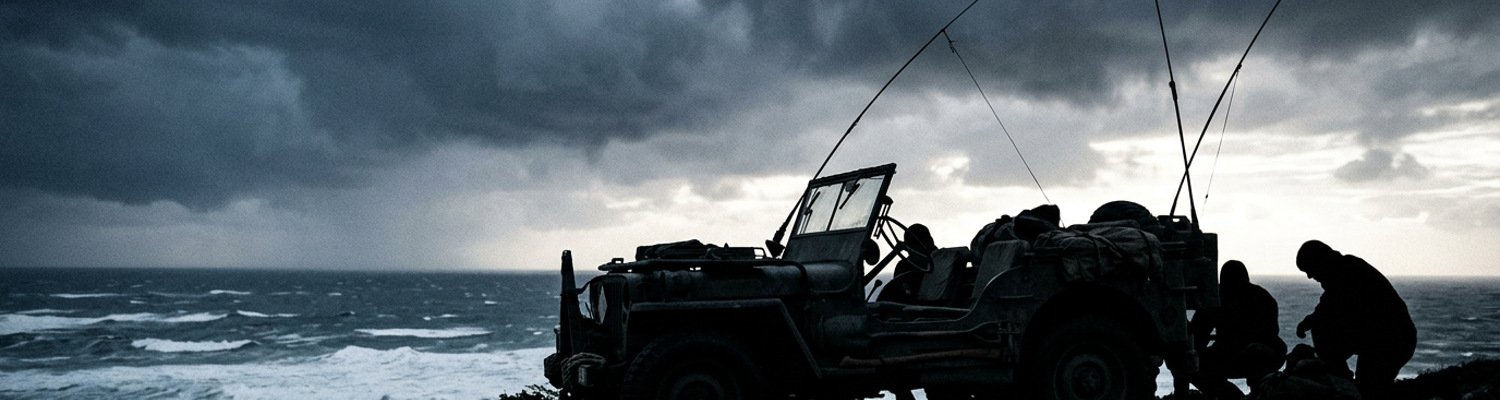

Initial TACP Deployments Along Route 7
Five-hundred-pound AN-M64 general-purpose bombs carrying 262 pounds of cast TNT dominated the supply dumps along the southeastern coast of Korea. Fighter-bombers operating from Pusan and Pohang Airfield carried these munitions daily. The Fifth Air Force directed this explosive tonnage directly onto the narrow coastal strip flanking the East Sea.
Directing this tonnage onto frontline targets fell entirely upon small teams operating in unarmored trucks.
Archival evidence shows that when the United Nations Command launched the general breakout in late September 1950, Tactical Air Control Parties from the 6147th Tactical Control Squadron moved into the frontline trace. They advanced alongside the Republic of Korea 3rd Infantry Division and elements of US Task Force Bradley. The operational objective required clearing Route 7. This unpaved coastal road pressed tightly between the steep slopes of the Taebaek Range and the shoreline. North Korean 5th Division infantry units occupied the dominating ridgelines. They utilized heavy artillery and dug-in automatic weapons to seal defiles north of Pohang-dong near Hunghae.
Forward Air Controllers found themselves physically integrated into the leading infantry platoons.
Enlisted radio mechanics rode in the passenger seats. Tactical coordination collapsed rapidly under frontline conditions. Language barriers between Korean infantry commanders and American air liaisons created immediate delays during close-support requests. Ground parties had to manually pinpoint camouflaged North Korean trench lines on paper maps. They did this while under continuous mortar fire. They relayed coordinates back through scratchy radio links to F-51D Mustangs circling above.
The terrain offered zero alternate bypass routes.
When examining the historical record of these initial combat operations, equipment vulnerabilities determined survival. Forward observers operated from standard quarter-ton Willys MB jeeps. These vehicles possessed zero armor plating. The driver and the radio operator were shielded by nothing thicker than eighteen-gauge sheet steel. Technicians bolted AN/ARC-27 very-high-frequency transmitter-receivers directly into the rear cargo bed. They modified BC-659 radio sets and mounted them behind the front seats.
These heavy electronic packages demanded continuous electrical power.
Secondary power generation systems frequently threw pulleys under heavy dust conditions. Generator burnouts occurred daily. Ten-foot whip antennas mounted on the rear bumper identified the vehicle to enemy positions hundreds of yards away. North Korean snipers directed their fire specifically at these tall steel antennas. Lead projectiles punched clean through windshield glass. They penetrated thin engine cowlings and unshielded fuel tanks. North Korean 7.62mm Maxim fire opened up from hillside bunkers. Enlisted radiomen had to stay upright in the passenger seat. They worked heavy brass tuning dials with bare hands to maintain radio frequencies. Vacuum tubes shook loose from the chassis over rutted tracks.
A punctured cooling radiator disabled the forward air control mission instantly.
A close review of operational logs indicates that during the advance through the Hyeongsan River basin, three control teams lost vehicular communication before noon. Lead-acid batteries boiled dry under the heavy load of continuous transmission cycles. Shrapnel from 82mm mortar airbursts severed external antenna leads. The metal fragments fractured glass vacuum tubes inside the radio housings. Ground controllers had to abandon their vehicles. They scrambled into roadside irrigation ditches. They attempted to guide inbound flights using handheld flares and emergency smoke grenades.
Danger-Close Fifth Air Force Mustang Strikes
A pilot diving at three hundred miles per hour could not tell an allied ditch from an enemy foxhole.
Archival evidence shows that north of Hunghae, retreating North Korean 5th Division elements threw up fortified roadblocks. They used felled telephone poles, crushed granite aggregate, and overturned transport trucks to bottleneck Route 7. Enlisted radio operators had to solve target designation without radar or laser rangefinders. Enlisted airmen from the 6147th Tactical Control Squadron stood exposed on ridgelines above the road. They directed incoming F-51D Mustangs of the 18th Fighter-Bomber Wing using direct line-of-sight visual cues.
Handheld M18 red and violet smoke grenades were thrown forward into gullies.
Wind sweeping off the East Sea quickly dispersed the colored clouds across the scrub pine. Observers adapted by firing M2 .50-caliber tracer rounds directly into log bunkers. This gave pilots a burning reference point. Radiomen held their BC-659 handsets with bloodied fingers. They shouted verbal corrections based on physical terrain markers. They used stone bridges, dry riverbeds, and terraced rice paddies as reference points. The radio controllers tracked the low-wing silhouette of each diving Mustang. They calculated run-in headings while North Korean 12.7mm DShK heavy machine guns swept the forward dirt mounds.
The safety margins established at training bases in Texas ceased to exist along the coast.
A close review of operational logs indicates that during the September 22 fighting along the coastal corridor, flight leaders released ordnance within eighty to one hundred yards of friendly forward foxholes. Standard Fifth Air Force flight doctrine mandated a minimum drop distance of five hundred yards for high explosives. The dense geography of the Taebaek foothills forced emergency danger-close drops. Pilots released unguided 110-gallon aluminum drop tanks. These tanks were filled with jellied gasoline mixed with polystyrene and benzene.
The canisters tumbled end-over-end without stabilizing fins.
They ruptured on impact. The chemical ignition created temperatures exceeding one thousand degrees Celsius. Enlisted observers huddled at the bottom of unreinforced trenches. They felt the blast wave peel the skin on their forearms. The combustion stripped the oxygen from their lungs. Seconds later, F-51Ds swept in at treetop level to release AN-M64 500-pound general-purpose bombs. Each casing packed 262 pounds of Composition B or amatol. They detonated on instantaneous M103 nose fuzes. The explosive shockwave generated ground displacement. This collapsed earthen revetments and buried radio equipment under feet of gravel.
When examining the historical record of Task Force Bradley advancing past Point 201, mechanical dispersion errors compounded the danger. The F-51D Mustang suffered from high-speed elevator trim sensitivity during steep pullouts. This caused dive angles to steepen unpredictably when entering narrow mountain valleys. Bomb shackles on external wing pylons regularly failed to release simultaneously. This resulted in asymmetric drops. The malfunction threw 500-pound munitions thirty to seventy yards off the intended flight line.
Enlisted controllers crouched behind stone dikes.
They watched bomb casings wobble through the air directly toward their positions. The munitions struck the gravel berm less than ninety yards away. Flying metal fragments weighing up to twelve pounds sheared off roadside telephone poles at ground level. They shredded vehicle tires. Controllers held their helmets down against their skulls. Burning chemical residue from the napalm ignition splashed across the outer rims of their foxholes. The heat extinguished their radio batteries by melting the lead solder.
By nightfall, two tactical control teams had burned through four spare transmitters without advancing five hundred meters.
Radio Signal Attenuation on Coastal Cliffs
Granite cliffs along the Sea of Japan killed radio transmissions before the signals cleared the surf line.
Archival evidence shows that north of Pohang, the eastern ridgelines of the Taebaek Mountains drop directly into the Sea of Japan near Yeongdeok. Sheer granitic scarps created physical dead zones for radio propagation. Forward air controllers operated modified SCR-522 and AN/ARC-27 very-high-frequency transmitter-receivers. They required clear line of sight to reach loitering F-51D Mustangs operating at three to five thousand feet. Aircraft circled offshore or dipped below the cliff tops to acquire bombing runs. Vertical granite headlands rising three hundred meters above Route 7 blocked line-of-sight amplitude-modulated signals completely.
Radio waves at 100 to 156 megahertz reflected erratically off the mineralized rock faces.
They degraded into severe multipath phase cancellation. High-frequency backchannels on BC-659 FM sets suffered equally harsh signal loss. The sharp conductivity difference between the saltwater coastline and the dry igneous rock broke ground-wave transmission paths within two miles. Flight leaders circling three miles out to sea heard only carrier hum and broken squelch breaks. Ground observers attempted to transmit target elevation data through the static. Mustang pilots had to pull out of low-altitude orbits. They climbed past five thousand feet to re-establish broken contact. This caused them to lose visual tracking of enemy trench positions below.
A single stone ridge severed direct voice communication for forty minutes at a stretch.
A close review of operational logs indicates that during combat engagements around Point 217, salt fog and fine silica dust compounded the physical obstruction of the bluffs. Sea spray carried inland by onshore winds deposited conductive sodium chloride films across ceramic insulator posts. The salt coated unsealed antenna jacks on the jeep-mounted radio sets. Technicians pushed transmitter outputs to overcome granite attenuation. The salt residue caused high-voltage arcing across the antenna feed horns. This burned out the final power amplifier tubes in the transmitter chassis.
Tuning crystals in the SCR-522 transceivers were exposed to extreme temperature variations.
They shifted between sunlit rock faces and damp coastal shadows. The crystals drifted off their assigned frequencies by several kilocycles. Enlisted radiomen had to crack open the pressurized metal casings with screwdrivers under frontline conditions. They used thumb pressure to reseat loose vacuum tubes. They hand-cranked dynamotors to test plate voltages. Every five-degree turn of the unpaved roadway into a shadowed granite re-entrant cut off tactical reception. Calls for immediate air cover dropped into dead silence mid-sentence. Infantry platoons were left pinned beneath North Korean machine guns without close-support ordnance.
When examining the historical record of Tactical Air Control Parties attached to the Republic of Korea 3rd Division, operational doctrine offered only one remedy for line-of-sight failure. Ground controllers had to dismount from their vehicles. They hauled thirty-eight-pound radio units, wet-cell storage batteries, and spare field wire directly up exposed coastal promontories on foot. Teams from the 6147th Tactical Control Squadron scaled four-hundred-foot rock chimneys. They did this under direct observation from North Korean artillery observers positioned across the valleys.
To broadcast coordinates clearly to overhead fighter-bombers, radiomen had to erect twelve-foot sectional whip antennas right on the bald crests of granite outcrops.
This projected dark metal silhouettes against the open ocean horizon. North Korean mortar crews zeroed their Type 31 60mm and Type 53 82mm weapons on these promontories within seconds of antenna erection. High-explosive mortar rounds exploded against bare bedrock. They produced no soil craters. They sprayed jagged rock splinters that severed radio cables and slashed through canvas field uniforms. Observers lay flat against stone ledges. They pressed heavy carbon microphone handsets against their mouths with one hand. They held severed ground wires against cold granite with the other.
North Korean gunners corrected their fire on the flash of antenna wire.
Operational reports from the September 26 assault along the coastal cliffs north of Kigye record that two forward air controllers remained pinned on an unsheltered granite shelf. They stayed there for three consecutive hours under continuous mortar bombardment. Mortar fragments cracked the Bakelite handset of their primary BC-659 transmitter. The enlisted operator spliced bare copper wires directly into the battery terminals with his teeth. Shrapnel chipped the stone five inches above his helmet. The team continued keying the transmitter. They visually walked inbound F-51Ds down the cliff lines to strike the mortar pits dug into the reverse slopes.
Air Force radio operators counted forty-seven mortar detonations across a forty-yard perimeter.
A direct concussive blast cracked the ceramic tube sockets of the backup receiver. The same blast killed the forward observer.
Littoral Resupply by Seventh Fleet Amphibious Lighters
Tire tracks ended where the asphalt stopped at fractured bedrock.
Archival evidence shows that by late September 1950, the joint advance of the ROK 3rd Division and Task Force Bradley up Route 7 exceeded twenty-five miles in a single twenty-four-hour period. This completely severed frontline contact with overland supply lines. Combat engineers could not haul heavy steel Bailey bridging fast enough to span the blown ravines flanking the coast. North Korean demolition squads had dropped every concrete bridge span and stone box culvert between Pohang and Yeongdeok. They packed bridge abutments with Soviet-manufactured TM-46 anti-tank mines and unexploded naval shells.
Quartermaster convoys attempting to push north from the Eighth Army depots at Pusan backed up along one-lane dirt shelves carved into the cliffs.
Heavy GMC CCKW two-and-a-half-ton trucks slid off wet clay shoulders. They cracked their drive shafts in boulder-filled bypass fords. Disabled trucks blocked entire supply columns for twelve hours at a stretch. Forward air control elements of the 6147th Tactical Control Squadron operated with lead infantry point companies. They depleted their operational supplies within three days. Airmen siphoned low-octane fuel from abandoned North Korean GAZ-67 trucks. They patched split radiator hoses with friction tape. They strained ditch water through wool blankets to keep overheated Willys jeep engines running.
The overland supply line was dead.
A close review of operational logs indicates that Seventh Fleet command assigned amphibious craft from Task Force 90 to open a direct maritime supply pipeline along the rocky shoreline of the East Sea. Operating off the coast of Chuksan-ni and Yeongdeok, Navy landing craft LCM-3s and LCVPs detached from transport hulls. They ferried cargo across the open surf. Coxswains ran thirty-six-foot craft straight through heavy three-to-five-foot ocean breakers. They fought wicked offshore rip currents. The water shoved flat-bottomed steel hulls sideways onto hidden gravel reefs.
Craft cargo bays carried wooden crates containing BA-38, BA-48, and BA-70 dry-cell battery blocks wrapped in wax-impregnated paper.
They also hauled cartons of C-rations, cases of SAE-30 engine oil, and steel five-gallon jerrycans of 80-octane gasoline. Breakers repeatedly broke over lowered bow ramps during surf landings. Coarse beach sand clogged the bilge pump impellers. Gray Marine diesel engines stalled as coxswains gunned throttles in reverse to prevent broaching in the heavy wash.
Saltwater ruined dry-cell batteries on contact.
When examining the historical record of operations around Chuksan-ni, enlisted airmen had to wade out into chest-deep ocean chop. They hauled supplies off the landing ramps by hand under scattered enemy sniper fire from nearby headlands. Air Force radio mechanics linked arms in the frigid foam. They passed ninety-pound crates of heavy radio dry cells from shoulder to shoulder above the churning sea. Coarse beach grit contaminated grease fittings. It fouled threads on fuel drum bungs. The sand abraded skin raw through sodden fatigue trousers.
Seawater seeping through punctured wax seals on the battery cartons caused rapid internal short-circuits.
This reduced ninety-volt terminal potentials to dead zero within minutes of saturation. Controllers rushed surviving dry cells up steep beach paths on packboards. They reached forward radio jeeps in time to restore power to silent BC-659 transmitters. They completed this thirty minutes before inbound strikes hit enemy ridge bunkers near Chuksan-ni.
Mechanical Failures of Forward Communications Gear
Salt and silica ground down every moving part along the shoreline within forty-eight hours.
Archival evidence shows that tactical air control detachments operating north of Yeongdeok relied on two-stroke Homelite and Onan gasoline-powered auxiliary generator units. These generators maintained plate voltage on vehicular AN/ARC-27 transceivers. These open-frame mechanical sets were primarily five-hundred-watt to one-kilowatt plants running continuous cycles behind unarmored jeeps. They possessed zero hermetic protection against the immediate coastal atmosphere. Onshore winds blowing off the East Sea drove airborne silica across the gravel shelves of Route 7.
Fine quartz grains bypassed oil-wetted gauze air filters directly into Zenith and Carter single-barrel carburetors.
Sand mixed with fuel-oil blends inside the crankcases. This created an abrasive paste that scored aluminum piston skirts. The grit stripped bronze governor gears and seized cast-iron cylinder sleeves within six to eight operational hours. Airborne saltwater brine settled across high-voltage ignition systems. Salt crusts bridged the gaps across exposed spark plug porcelains. This caused continuous ground faults that killed primary ignition sparks under load.
Mechanics in the 6147th Tactical Control Squadron worked with pocket knives.
They scraped green copper oxide corrosion off external magneto points and commutator slip rings. Pitted commutator bars threw heavy electrical arcs. This melted solder connections at the brush rigging. It dropped line output below the twenty-eight volts direct current required to run vehicular dynamotors.
Piston rings welded to cylinder walls under full throttle.
A close review of operational logs indicates that the failure of combustion generators threw frontline forward air controllers onto rapidly diminishing stocks of BA-70 and BA-48 dry-cell battery packs. Replacement shipments ferried across the surf at Chuksan-ni arrived with over sixty percent of dry-cell stocks chemically dead. They were ruined by saltwater intrusion through damp packaging or exhausted by shelf-life decay in tropical Pusan warehouses. Enlisted communications technicians found that ambient terminal potential on seventy-five-volt B-battery sections dropped to thirty volts before units were ever unboxed.
A single BC-659 transmitter required nearly half an ampere of filament current during continuous voice broadcasting.
Operators burned through a fresh dry-cell pack within four hours of sustained tactical work. Squadron leaders issued strict orders prohibiting routine frequency alignment checks, diagnostic tuning, and casual operational updates. Frontline air liaisons attached to the ROK 3rd Division were restricted to sending emergency close-support strikes only when enemy infantry breached within three hundred yards of friendly perimeter wire. Observers could not keep tube filaments warmed on standby. Controllers switched receivers off completely between scheduled visual recon flyovers. They relied on physical wristwatch synchronization to power transceivers on for forty-five-second transmission windows.
Air support requests were denied simply to keep the batteries alive for dusk.
When examining the historical record of the 6147th Tactical Control Squadron during combat engagements south of Utchin on September 29, field technicians had to cannibalize civilian wet-cell batteries. They pulled them from abandoned farming machinery to run power inverter circuits. Radio operators stripped copper ground wire from telephone poles. They ran direct jumpers from Jeep six-volt ignition systems to power BC-1306 transmitters. This often fried sensitive receiving coils when charging dynamos spiked.
Enlisted specialists boiled exhausted BA-38 dry cells in steel mess kits.
They filled the kits with water over open gasoline fires. This was an expedient attempt to temporarily reconstitute spent ammonium chloride electrolyte through thermal expansion. The resulting thermal swell yielded between eight and twelve minutes of marginal plate voltage. This provided just enough power to push target coordinates for one flight of Mustangs before internal cell seals ruptured with a dry hiss.
Mortar Ambushes and Shrapnel Trauma
A ten-foot steel antenna bouncing above a coastal ditch gave enemy spotters an exact target coordinate.
Archival evidence shows that north of Yeongdeok, North Korean 82mm mortar crews belonging to the 5th Division deployed their Soviet-supplied Model 1937 tubes. They set up in concealed reverse-slope defilades along the rocky ridges commanding Route 7. Forward air control teams operated stripped-down Willys MB jeeps carrying AN/ARC-27 transceivers. These radios were paired with MS-116-A through MS-118 sectional whip antennas anchored to heavy MP-48 spring bases on the rear fender. Traversing boulder-strewn defiles at speeds under ten miles per hour caused these flexible steel masts to sway continuously in broad vertical arcs.
Against the scrub pine and pale granite of the shoreline bluffs, the whipping metal rods stood out as stark visual indicators of high-value command vehicles.
North Korean forward observers positioned on Point 181 utilized optical trench periscopes to track these swaying tips over earthen embankments. Mortar crews adjusted their cast-iron bipod elevation screws to drop initial ranging rounds within thirty yards of the vehicles. Gun teams then fired five-round rapid-fire volleys of high-explosive fragmentation shells directly into the narrow bottlenecks. These 82mm cast-iron casings detonated with instantaneous fuzes upon contact with road gravel. They sprayed supersonic metal splinters that severed the mast elements and pierced thin steel engine blocks.
Trapped vehicles could not reverse out of the rock cuts.
A close review of operational logs indicates that on September 27, two tactical control vehicles were pinned inside a sheer four-hundred-yard rock defile two miles south of Chuksan-ni. Bracketed mortar impacts shredded their non-directional tread tires and cracked both cast-aluminum transfer cases. Enlisted radio operators from the 6147th Tactical Control Squadron dismounted under grazing machine gun fire. They defended the disabled vehicles with issue M1 carbines and .45-caliber M3 submachine guns. Cast-iron mortar casings bursting against vertical granite walls produced irregular, jagged shrapnel fragments traveling at three thousand feet per second.
Thousands of high-velocity stone splinters accompanied the metal shrapnel.
Airmen sustained severe penetrating trauma to unprotected thighs, lower abdomens, and necks. The fragments tore through cotton herringbone twill uniforms. Shrapnel sliced through exposed femoral arteries and fractured tibia bones while airmen crouched behind unarmored rear wheel hubs. Exploding shrapnel tore through the sheet-metal radio housings. The blasts drove shattered glass shards from hot vacuum tubes directly into the arms and faces of operators. These men were attempting to strip the primary crystal oscillators from the burning chassis.
Two wounded radiomen maintained defensive fire from drainage ditches for twenty minutes.
They did this to prevent North Korean combat engineers from advancing with satchel charges.
Field dressings could not stem arterial bleeding over fractured bone.
When examining the historical record of Task Force Bradley advancing toward the 38th parallel, casualty evacuation routes along the coastal corridor were completely severed by persistent mortar interdiction. The steep walls of the littoral cut prevented drivers from pushing disabled vehicles off the center line. This forced trailing ROK infantry columns to halt in open registration zones. Enlisted radio operators lost blood from untreated shrapnel wounds. They lacked direct morphine supplies after external first-aid pouches were sheared away by blast concussion.
Air Force personnel dragged immobilized casualties into rock overhangs using canvas equipment straps.
Secondary explosions from punctured six-volt vehicle batteries threw burning acid across the roadway. Frontline airmen used rifle cleaning rods as makeshift tourniquets around mangled limbs. They awaited naval gunfire support that was delayed by three hours due to severed radio links.
Archival Citations and Forward Observer Commendations
Paper files in storage vaults hold the mechanical record of coastal forward air control.
Archival evidence shows that National Archives Air Force award cards processed through December 1963 documented heroism under heavy fire along the eastern coastline. Clerks at the Air Reserve Records Center and the Military Personnel Records Center in St. Louis took over a decade to systematically review retroactively submitted recommendations. They verified and cross-indexed files for enlisted personnel attached to the 6147th Tactical Control Squadron. The original combat files were compiled during the breakout past Pohang-dong and Yeongdeok in late September 1950.
These documents had been misplaced in field chests.
They were contaminated by sea mud. Many were caught in conflicting administrative channels between Eighth Army command and Fifth Air Force headquarters. These processed award cards confirmed individual Silver Star and Bronze Star decorations for enlisted radio operators who maintained exposed listening posts north of Chuksan-ni. The index cards recorded specific coordinate grids along the Taebaek coastal shelf. Airmen absorbed shrapnel at these grids while holding ground positions under direct battery fire from North Korean 76mm divisional guns.
Administrative officers cross-referenced radio transmission logs with flight lead reports.
They confirmed that controllers continued calling in danger-close airstrikes while their forward observation trenches were being overrun by hostile infantry.
Thirteen years elapsed before personnel clerks closed the final casualty and decoration folders.
When examining the historical record, official valor citations confirmed extensive battlefield repairs of destroyed radio rigs executed under direct enemy fire. Citation texts described specific mechanical interventions performed on damaged communications equipment inside open-topped Willys MB jeeps. North Korean 12.7mm machine gun rounds tore through the sheet metal during these repairs. Enlisted communications technicians confronted shattered glass vacuum tubes, sheared dynamotor output wires, and severed coaxial antenna cables caused by 82mm mortar airbursts.
Radio operators cracked open burning transmitter cases with bayonets.
They extracted fractured 832A power amplifier tubes with bare fingers. They seated replacement parts while lying flat on gravel roadbeds. Citations specifically detailed instances where airmen spliced severed low-voltage power harnesses using friction tape and stripped copper field telephone wire. Solder joints shattered by concussive blasts were reconstituted using copper wire heated directly in the exhaust manifolds of idling engines. Technicians bypassed destroyed internal relays by bridging terminal blocks with screwdriver blades.
This forced direct current into backup transmitters.
It allowed operators to broadcast targeting coordinates to overhead F-51D Mustangs twenty seconds before North Korean ground units closed within hand-grenade range of the vehicle.
Burned vacuum tubes were replaced while machine gun bullets punched through the radiator cowlings.
A close review of operational logs indicates that Fifth Air Force decoration boards required corroborating technical evaluations before approving medals for actions along Route 7. Squadron maintenance officers had to submit recovered transceiver chassis to depot inspection teams at Pusan to substantiate battlefield repair claims. Ordnance inspectors logged bullet penetrations through cast-aluminum tuning heads. They verified the heat deformation of field-spliced wiring assemblies. They filed forensic tallies of shrapnel punctures across BC-659 chassis boxes.
Pilot flight debriefs from the 18th Fighter-Bomber Wing confirmed these technical findings.
They recorded exact minutes when radio dead-silence over the Yeongdeok coastal bluffs was broken by improvised carrier waves from ground jeeps. This restored target guidance for 500-pound bomb releases against entrenched artillery positions. Individual award cards filed under Record Group 341 cataloged twenty-four separate instances of field-repaired AN/ARC-27 and SCR-522 transceivers along the eastern shoreline between September 18 and October 3, 1950.
The St. Louis records branch marked the final Pohang coastal citation file approved on December 18, 1963.
Tactical Evolution of Frontline Air Coordination
Sheet metal provided no ballistic defense against Soviet-designed 12.7mm armor-piercing rounds.
Archival evidence shows that combat losses sustained by the 6147th Tactical Control Squadron along the Route 7 corridor exposed systemic design flaws in unarmored vehicular control detachments. Operating standard quarter-ton Willys MB jeeps, tactical air control parties traveled directly behind lead infantry scouts without ballistic skirts or floor armor. North Korean machine gunners dug into granite bluffs at Point 181 and Point 217 regularly targeted these vehicles at ranges under three hundred yards. Copper-jacketed 7.62mm and 12.7mm rounds punched through unhardened stamped steel hoods.
The projectiles punctured copper core radiators and fractured engine cast-iron cylinder heads within seconds.
Enlisted drivers and radio operators absorbed direct torso strikes because low canvas door cutouts offered zero lateral deflection. In several combat reports filed during the advance toward Yeongdeok, sniper fire passed through windshield frames. The bullets severed the high-voltage rubber cabling feeding rear-mounted AN/ARC-27 transceivers. Concussive blasts from roadside 82mm mortar bursts tore off exhaust mufflers. The explosions ignited exposed spare fuel jerrycans. The blasts warped the unreinforced chassis frames so severely that drive shafts sheared at the transfer case joints.
Radios bolted into open cargo beds became shrapnel traps.
A close review of operational logs indicates that by October 1, 1950, vehicular attrition among forward detachments attached to Task Force Bradley and the ROK 3rd Division reached fifty-five percent. North Korean forces sprang ambushes along narrow rock ledges. Unarmored jeeps could neither absorb kinetic impacts nor maneuver backward along the single-lane road. The loss of vehicular electrical generators disabled primary VHF transceivers instantly. This cut forward ground troops off from Fifth Air Force fighter-bombers loitering overhead.
Controllers attempting to work exposed tuning dials were killed or maimed by metal splinters thrown from their own vehicle cowlings.
Fifth Air Force field surveys concluded that relying on soft-skinned transport for close frontline air direction within rifle range was no longer tactically viable.
Doctrine collapsed when the vehicles burned.
When examining the historical record of Far East Air Forces doctrine revisions, the operational failures north of Pohang compelled staff officers in Tokyo and Taegu to completely reconstruct combined-arms procedures for frontline tactical air parties. Air Force Lieutenant General George E. Stratemeyer and Eighth Army commanders recognized that ground controllers could not direct high-speed fighter strikes while physically pinned beneath direct small-arms fire. Far East Air Forces initiated immediate tactical reforms to sever the forward observer dependence on unarmored wheeled vehicles. Directives issued in October 1950 mandated the procurement of tracked, armored chassis.
Planners specifically requisitioned M39 armored utility vehicles and M8 light armored cars.
These vehicles shielded tactical air party personnel and sensitive radio dynamotors from fragmentation munitions during frontline operations. Staff officers established formal joint ground-air coordination centers at corps level. This prevented ad hoc target designations between foreign-language infantry commands and orbiting pilots. Operational planners fundamentally altered how forward observers operated at the actual line of contact. They stopped maintaining primary radio control from the forward bumper of a frontline jeep.
Standard operating procedure divided tactical air control parties into two distinct echelons.
A dismounted two-man observation team moved into forward infantry foxholes on foot. They carried lightweight field equipment and dry-cell packs. The heavier vehicular radio rig remained in a defiladed relay position five hundred to eight hundred yards behind the friendly front trace. Far East Air Forces shifted the primary target-marking responsibility from vulnerable ground vehicles to airborne forward air controllers flying specialized North American T-6 Mosquito aircraft.
These low-speed airborne spotters assumed the role of visual line-of-sight tracking and target designation.
They received broad enemy coordinates from dismounted ground observers via field wire or low-power FM radio. They then guided fighter-bombers down with smoke rockets. On October 14, 1950, Far East Air Forces headquarters codified these procedural modifications into Joint Standard Operating Procedures for Close Air Support. This permanently prohibited unarmored vehicular tactical air parties from operating forward of friendly battalion command posts.