
A Line Drawn in Sand
In the predawn hours of March 9, 1916, Francisco “Pancho” Villa’s forces descended upon the small border town of Columbus, New Mexico. The raid was a violent act of retaliation after the Wilson administration recognized the government of his rival, Venustiano Carranza. The attack left American soldiers and civilians dead and parts of the town smoldering. The political outrage in Washington was immediate, forcing a response. President Woodrow Wilson ordered a punitive expedition into Mexico with a singular objective, capture Villa. At its head was Brigadier General John J. Pershing, a commander whose experience was rooted in the traditional constabulary actions of a small, frontier-focused army.
The U.S. Army of 1916 was an institution in transition, caught between two centuries. It was an army of horse and mule, its logistics still tethered to the pace of animal power, a doctrine largely unchanged since the Civil War. The internal combustion engine was a noisy, foul-smelling novelty, viewed with deep suspicion by a conservative officer corps weaned on cavalry charges and the reliability of animal transport. Forage was a known quantity, gasoline an exotic one. As Pershing’s columns prepared to push south into the vast, unforgiving expanse of Chihuahua, they did so with the familiar tools of the past. The initial plan relied on pack mules and horse-drawn wagons, the proven method for sustaining forces in austere environments. Yet the scale of the task ahead was immense. Pershing’s force would eventually grow to over 10,000 men, pushing hundreds of miles into a foreign country with no reliable rail access and a hostile, if nominally neutral, government. The Carranza government had expressly forbidden the U.S. Army from using the Mexico Northwestern Railway system for supply, a move that crippled traditional logistical planning.
This prohibition forced the Army’s hand. The Quartermaster Corps, under immense pressure to sustain a deep and rapid penetration of enemy territory, turned to a new and largely untested technology. On March 14, 1916, the Quartermaster General began the hurried purchase of commercial motor trucks. There was no standardization, no military specification, no time for thoughtful procurement. The Army bought what it could get, fast. A menagerie of makes and models flooded the dusty assembly point at Columbus. There were Jeffery Quads, with their innovative four-wheel-drive systems, alongside conventional rear-drive trucks from the White Motor Company, Packard, Velie, FWD, and Mack. These were not purpose-built military vehicles. They were commercial designs, some with flimsy chain drives and solid rubber tires, conscripted into service and thrown into one of the harshest operating environments imaginable. The Punitive Expedition, conceived as a cavalry pursuit, was about to become the U.S. Army’s first, unplanned, and brutal large-scale test of motorized logistics.
The Tyranny of Distance and Dust
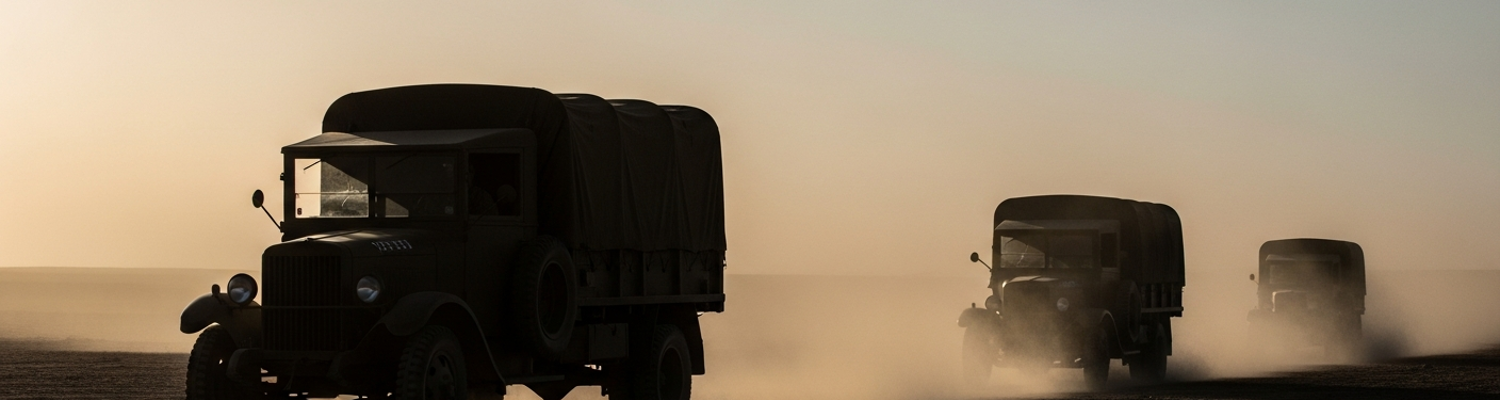
Pershing’s columns advanced over 400 miles into Mexico, a logistical feat that stretched the nascent motorized supply chain to its breaking point. The maps of Chihuahua were deceptive, showing roads that were often little more than primitive trails, dry riverbeds, or sandy wastes. For the first time, the U.S. Army was learning the hard lessons of mechanical warfare. The environment was a relentless enemy. Fine, abrasive alkali dust penetrated everything. It clogged the primitive air intakes, which were often just open pipes. It contaminated lubricants, turning oil into a grinding paste that destroyed bearings and pistons. It ground down engine components with ruinous efficiency. The constant vibration from the rough terrain shook bolts loose, cracked wooden frames, and broke leaf springs. The high altitude of the Mexican plateau, often over 6,000 feet, robbed the low-compression engines of precious horsepower.
The trucks themselves, procured from at least eight different manufacturers, were a logistical nightmare. The lack of interchangeable parts meant that a simple mechanical failure, a broken axle on a Velie, could not be fixed with a spare from a Packard. There were no dedicated military mechanics, only civilian tradesmen hastily recruited for the task, many with little experience on the specific models they were asked to repair. Cannibalization became standard operating procedure, with disabled trucks stripped for parts to keep others running. Solid rubber tires, common at the time, were shredded by sharp rocks and offered no traction in deep sand. Overloaded frames, rated for one or two tons but often carrying double that, cracked under the strain. Engines, designed for the temperate climates of the United States, constantly overheated in the desert sun, boiling away precious water that was as vital for the machines as it was for the men. Many trucks were simply abandoned after getting stuck in sand or mud, monuments to a new kind of failure.
The Jeffery Quad, with its 1.5-ton rating and pioneering four-wheel-drive and four-wheel-steer design, proved more capable than its rear-wheel-drive counterparts but was not immune to the operational realities. Even these advanced machines suffered under the strain. The expedition quickly revealed that the promise of motorized transport was far from the reality. Convoys broke down, supply schedules slipped, and forward combat units often found themselves waiting for critical food and ammunition. In a telling admission of the new technology’s limitations, Pershing frequently had to rely on traditional mule trains to deliver supplies to the most forward elements or to rescue stranded motorized columns. The mule, slow and steady, remained the most reliable asset in the most difficult terrain, a humbling reality check for proponents of motorization. The experience was a crucible, exposing every flaw in equipment, organization, and doctrine with unforgiving clarity. Even a young Lieutenant George S. Patton, who famously used three Dodge touring cars in a raid on a Villista headquarters, experienced the fragility of the new machines when one of his cars was hit and disabled by gunfire.
Lessons Paid for in Steel and Sweat
The Punitive Expedition failed to capture Pancho Villa. Pershing’s forces withdrew from Mexico in February 1917, just two months before the United States entered World War I. While the primary mission was a failure, the logistical ordeal in the Chihuahuan Desert proved to be an invaluable, if painful, education. The chaos of maintaining a fleet of disparate commercial trucks underscored a critical lesson, standardization was not a luxury, but a necessity for modern military logistics. This realization directly spurred the creation of the Army’s Standardized Military Truck program.
Drawing on the hard-won experience from Mexico, the Quartermaster Corps, in cooperation with the Society of Automotive Engineers (SAE), set out to design a family of trucks specifically for military service. The most famous result of this effort was the Class B Standardized Military Truck, better known as the “Liberty Truck”. The design philosophy of the Liberty was a direct response to the failures of 1916. It prioritized durability, simplicity, and complete interchangeability of parts. The truck featured a robust 52-horsepower engine, a simple but strong 4x2 drivetrain with a worm gear final drive, and was designed so that components from one manufacturer would fit any other Liberty Truck. This was a revolutionary concept that solved the maintenance nightmare of the Punitive Expedition. By the end of WWI, over 9,300 Liberty Trucks had been built by a consortium of 15 different companies, forming the backbone of the American Expeditionary Forces' supply chain in France.
The lessons were not just technical. The Army recognized the need for a dedicated organization to manage its growing fleet of vehicles. On August 15, 1918, the Motor Transport Corps (MTC) was officially formed as a separate branch, taking over responsibilities that had been haphazardly managed by the Quartermaster Corps. The first director of the MTC was Brigadier General Meriwether Lewis Walker, who had served as the chief engineer for the Punitive Expedition and had witnessed the logistical challenges firsthand. Formal schools were established to train drivers and mechanics, replacing the ad-hoc system of using civilian contractors and creating a professional military specialty. A systematic approach to logistical planning emerged, with established depots for fuel and spare parts, a far cry from the desperate improvisation that characterized the pursuit of Villa. The gasoline-powered supply lines of the Meuse-Argonne Offensive, which sustained over a million American soldiers in the final push of the war, were built upon the foundation of failure and adaptation forged in the desert dust and heat of Mexico.