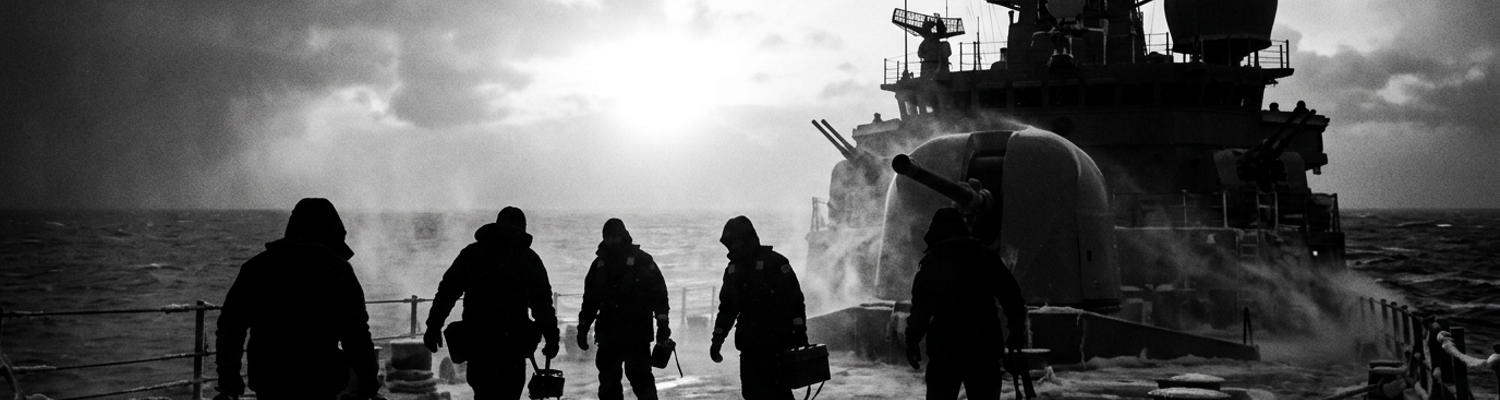

May 1966 Embarkation and Transport Conditions
0418 HOURS LOCAL, 14 MAY 1966.
COORDINATES 52 14 N 174 08 W.
The low hum of propulsion diesels reverberated through the steel deck plates. The sound was swallowed by the dead silence of troops packed into dark troop compartments. Enlisted Marines sat braced against bare structural ribs in pitch-black hold spaces. They waited through the heavy pauses between violent hull rolls. Breath condensed into gray plumes in the unheated air.
Metal contracted in the subarctic environment.
A close review of operational logs indicates that the May 1966 Command Chronology logged the 1st Antitank Battalion embarking aboard naval amphibious transports. These vessels were bound for the northern transit corridor. Company commanders processed movement directives through amphibious transport echelons at staging ports. Cargo manifests reassigned mechanized armor out of internal vehicle decks. Dry container stowage took priority below. Deck officers selected naval transports with narrow internal clearance. Combat hulls were forced onto exposed staging positions.
The convoy cleared coastal breakwaters shortly after.
When examining the historical record, company manifests reveal that enlisted crews spent thirty-six hours chaining down heavy equipment under continuous sea spray. Deck logs detail how the transit corridor pushed vessels directly along sub-polar boundary currents. Ambient temperatures plunged toward twenty-five degrees Fahrenheit within hours of clearing littoral lanes.
Salt crust sealed the hinges.
Archival evidence shows that M50A1 Ontos tracked vehicles and secondary armament were lashed down on weather decks. They faced severe maritime salt spray and sub-zero temperatures. Heavy steel turnbuckles secured the six-ton tracked vehicles over open hatch coamings. Ocean wash stripped petroleum-based grease from exposed fittings within forty-eight hours of sea-keeping.
Salt crystals caked across the mounting collars and elevation tubes of the six 106mm M40A1C recoilless rifles.
The traversing mechanisms locked into rigid immobility. The coaxial .50-caliber M8C spotting rifles froze solid. Brine infiltrated the firing pins, buffer assemblies, and sear notches.
Crewmen armed with scrapers and solvent rags chipped away three-inch sheets of brine ice. The ice encased the rubber-bushed track pads. Cross-drive transmissions had stiffened severely. Manual starter engagement sheared internal flywheel teeth. Freezing deck winches failed during routine retention inspections. Two-inch wire cables snapped. Unsecured tools skittered over ice-coated deck plates.
Hydraulic fluid within the traversing cylinders thickened into an unyielding gel.
Crews could not rotate weapon mounts into travel locks.
The protective grease washed away into the sea.
Enlisted armor mechanics worked four-hour shifts on open catwalks without thermal coveralls. They applied heated diesel fuel to free seizing hydraulic spans and corroded electrical junction boxes. Secondary armament suffered identical failure rates. Pintle-mounted .30-caliber M1919A4 machine guns developed cracked receiver groups. Ocean wash froze inside the bolt assemblies. Armory sergeants struck operating handles with copper mallets.
Battery compartments on the Ontos hulls accumulated corrosive residue.
Twelve-volt electrical circuits shorted out. Reserve power drained down to zero. Maintenance records confirm that eight of ten tracked vehicles lashed to the forward deck racks were classified mechanically non-operational by the fifth day of the northern transit. Frozen fuel lines and seized suspension bogies caused the failures.
Mechanical Wear on M50A1 Ontos Weaponry
Corrosion degraded the weapon mounts first.
Archival evidence shows that the multi-barrel arrangements on the M50A1 Ontos suffered severe mechanical degradation within seventy-two hours of entering sub-polar waters. Continuous freezing salt spray stripped standard ordnance grease. The breechblocks and traverse mechanisms of 106mm M40A1C recoilless rifles seized completely. Cresting swells broke over the vehicle tie-down points. Sea water drove across the three-gun clusters mounted on each side of the central turret pedestal.
Sub-zero brine washed away the thin films of automotive and artillery lubricant.
This compound (MIL-G-10924 specification) protected the finely machined steel components. The interrupted-thread breechblocks accumulated thick rime without grease. The locking lugs bonded to the chamber sleeves. Elevation gearboxes froze solid. Salt crystals hardened between the worm shafts and gear sectors.
Gun captains found that operating handles refused to budge even under direct body weight.
The six recoilless tubes locked in fixed horizontal alignments. Sea spray seeped into the four coaxial M8C .50-caliber spotting rifles. Brine ice glued their firing pin housings and operating springs together.
Steel bonded directly to steel.
Battalion armorers conducted continuous manual de-icing and cycling of deck winches and hydraulic assemblies. A close review of operational logs indicates that maintenance teams from Headquarters and Service Company initiated rotating two-man watches on the pitching cargo deck. Armorers scraped the accumulated ice using brass chisels, flat scrapers, and wire brushes. They doused the bare metal with heated mixtures of cleaning solvent and light lubricating oil.
Salt deposits and frost blocked the drum clutches of the deck winches.
Mechanics freed the binding cable guides by hand. Heavy tie-down chains had to remain taut against the hull rolls.
Enlisted personnel connected manual lever pumps to the turret hydraulic spans every two hours. Congealing fluid was forced through the lines. This prevented the neoprene seals from tearing. Leaving an assembly stationary for more than sixty minutes allowed brine to freeze the traverse piston rods directly to their packing glands. Armorers cleared iced pivot points by driving copper drift pins with four-pound sledgehammers. Frost was cleared from the gear rings. Crews manually ran the mounts through their complete physical range of motion.
Routine maintenance turned into continuous physical labor.
When examining the historical record, ordnance logs show that armorers expended seventy gallons of dry-cleaning solvent and forty gallons of light preservative oil before the transport cleared the western Aleutian chain. Salt crust ground directly into the sleeve bearings. Crews forced the weapon arms across their stops. The softer bronze bushings wore down. Three-thousandths of an inch of mechanical slack was produced across the main pivot assemblies.
Mechanics discovered fine pit marks along the inner lands of the 106mm rifling.
Trapped salt brine etched into bare bore steel beneath dissolved oil films. Ordnance sergeants abandoned field-stripping procedures on the open deck. Cold brittle-fractures sheared five firing pin retaining pins during routine clearing cycles.
Every recoilless rifle required sixteen hours of complete depot overhaul to pass basic headspace and timing gauges by the time the ship reached mid-voyage coordinates.
Subarctic Underway Replenishment Hazards
Tension stretched across seventy yards of open ocean.
A close review of operational logs indicates that the convoy encountered drifting peripheral pack ice along the northern edge of the Aleutian Trench. Coordinates 53 28 N 168 15 W. Tactical commanders ordered the amphibious transport to pull alongside the fleet replenishment oiler USS Cimarron. The transport needed diesel fuel and boiler water.
Station-keeping between two forty-thousand-ton displacement hulls required helmsmen to maintain lateral separation between one hundred forty and one hundred eighty feet.
The ships ran at twelve knots into four-foot sea swells. Drifting multi-year ice floes measured up to six feet in thickness. They accumulated in the hydrodynamic channel formed between the parallel hulls.
The Venturi effect pulled these jagged ice blocks into the ships pressure waves.
They smashed repeatedly against the hull plating of both vessels. Submerged ice shelves tore away hull-mounted speed logs.
Watchstanders on the forward bridge wings tracked drifting growlers visually through dense sea smoke. Floating ice struck the steerage planes and propeller blades. Erratic rudder responses were reported. Shipboard rudders required twenty degrees of continuous compensatory trim. This countered the uneven hydrodynamic suction pulling the amphibious transport toward the oiler port quarter.
Bridge personnel monitored distance lines marked with colored cloth flags every twenty feet.
A three-degree heading drift would trigger a catastrophic steel-on-steel collision within forty-five seconds.
Ice blocked the sea chest intakes below the waterline.
Archival evidence shows that temperatures plunging to fourteen degrees Fahrenheit transformed every exposed surface into a continuous ice sheet during the four-hour fueling evolution. Riggers shot messenger lines across the gap using line-throwing guns. They hauled over heavy seven-eighths-inch high-tension steel span-wires. These cables supported the four-inch rubber fuel hoses.
Freezing sea spray coated the suspended cables.
A solid crust of rime ice deposited on the lines. The effective weight of the high-tension rig doubled to over six thousand pounds. Winch drums on the replenishment deck seized. Salt rime froze between the brake bands and drive sprockets.
Excessive mechanical load caused the tensioning winches to shudder and surge under uneven strain. The span-wires pulled taut past their rated yield stress. Deck crews from the deck division took cover behind steel kingposts and splinter shields. An overloaded cable would snap back with enough kinetic force to sever human limbs and slice through bulkheads.
Fuel transfer couplings accumulated three inches of hard ice across their locking pawls.
The specific units were quick-release NATO-standard probe receivers. Deck crews engaged the fuel probe. The frozen spring-loaded dogs failed to seat into the receiver bells. Pressurized naval distillate fuel sprayed out under ninety pounds per square inch of line pressure across the ice-sheathed deck.
Riggers struck the coupling latches with lead mauls.
The mechanical pins locked into place before cold embrittlement induced micro-fractures across the cast-bronze fittings.
One snapped wire whipped across the forecastle and sheared an iron stanchion clean off.
When examining the historical record, transfer logs detail how deck officers aborted the fueling run twice. Floating bergy bits forced the oiler to alter course by eight degrees. Each emergency disengagement forced the rig crews to activate mechanical quick-release levers. Hundreds of feet of iced wire dropped directly into the freezing sea. This prevented the parting cables from tearing the replenishment rigs out of their structural deck mounts.
Enlisted personnel worked on open sponsons without safety tethers.
They cleared slush and salt rime from the snatch blocks with steam lances. Sub-zero seawater washed across their boots. The steam lines developed thermal cracks. Condensation froze inside the exhaust valves. Crews were left with only pneumatic scrapers and brass hammers to clear the frozen winch drums.
Deck logs recorded three distinct structural ruptures along the starboard gunwale.
Iced fairlead chocks buckled inward under the shock load of surging span-wires. Two enlisted riggers suffered severe blunt-force trauma. A pressurized hose connection broke loose from its bridle. It struck the armored deckhouse before the replenishment pumps could be secured.
The convoy broke away from the oiler at 1840 hours.
The transport had taken on only forty percent of its scheduled fuel load. The propulsion plant ran on minimum operational reserves while heading deeper into the sub-polar transit corridor.
Cold War Anti Submarine Screening and Acoustic Anomalies
Active pings returned nothing but dead reverberation.
Archival evidence shows that destroyer escorts USS Nicholas and USS OBannon maintained continuous screen formations. They held position five thousand yards ahead of the troop transports along the northern arc of the Great Circle route. Combat Information Center personnel logged intermittent low-frequency narrowband transients. These matched the five-bladed screw signatures of Soviet Project 659 nuclear submarines operating out of Petropavlovsk.
Watch officers placed the escorts on Condition III ASW readiness.
They ran AN SQS-23 active search sonars while trailing passive hydrophone arrays through twenty-foot subarctic swells. Bridge lookouts observed periscope feather sightings three nautical miles off the convoy port quarter. Coordinates 51 42 N 176 11 E. Screen commanders initiated repeated creeping attack maneuvers.
Escort captains altered screening stations in sixty-minute cycles.
They burned heavy fuel oil to surge outward at eighteen knots. They prosecuted intermittent contacts before slowing to eight knots for passive listening periods.
Hydrophone operators inside the sound rooms tracked persistent machinery noise and transient hydrodynamic surges between seventy and one hundred ten hertz. Tactical commanders dispatched two Mark 44 acoustic homing torpedoes to standby status on deck-mounted Mark 32 triple tubes. The contacts consistently slipped into baffled zones behind the transports wake turbulence before weapons lock could be established.
Cold water warped every acoustic bearing.
A close review of operational logs indicates that rapid thermal shifts across the sub-polar boundary destroyed the predictable propagation of active sound waves. Escort technicians dropped bathythermograph probes over the side every ninety minutes. They recorded a steep negative temperature gradient. It plunged from thirty-eight degrees Fahrenheit at the surface to twenty-nine degrees at a depth of ninety feet.
Melting peripheral ice fields deposited a thin layer of low-salinity freshwater over the dense oceanic brine.
This generated a severe acoustic refraction layer. Outgoing active sonar beams bent straight down toward the seabed. Active pings from the AN SQS-23 arrays refracted downward at angles exceeding fifteen degrees. An expanding shadow zone began twelve hundred yards from the ship hull.
Any submarine running at periscope depth beneath this acoustic barrier stayed physically invisible to active search modes.
Passive hydrophone operators struggled against broad reverberation spikes. Bottom bounce off the jagged volcanic ridges of the Aleutian Trench caused these spikes. Sound energy scattered into ambient noise across the lower frequency bands. Sonar crews watched oscilloscope displays register false returns. Ocean currents sheared through internal wave interfaces. Watch officers dismissed sixty percent of recorded contacts as thermal echoes.
When examining the historical record, maintenance reports detail how sub-zero maritime conditions disabled the mechanical components of the bow-mounted transducers.
Pitching head seas exposed the forward bulbous sonar housings to twenty-degree air temperatures. The fiberglass and rubber domes were then driven back beneath the surface.
Brine slush and frazil ice accumulated across the CW-359 rubber sonar windows.
It froze into a three-inch irregular rime coat. This altered the acoustic impedance of the dome material. Active sound pulses reflected off the inner surface of the ice crust rather than transmitting into the water column. Sensitivity circuits blew out. Intense backscatter blinded the receiving elements.
Ice chunks sheared off the hull and struck the forward sonar housings.
The outer acoustic window seals cracked. Freezing seawater penetrated the pressurized transducer oil baths. Clean mechanical coupling between the piezoelectric ceramic elements and the surrounding ocean was lost. Signal transmission efficiency dropped by eighty percent.
Escort engineers had no steam lines routed into the flooded bow bulb compartments to clear the ice.
Ships slowed to steerageway. Maintenance details attempted to circulate heated glycol through surrounding ballast tanks to melt the frozen buildup.
Sonar gain fell to twelve percent across the entire escort screen before the convoy cleared Attu Island.
Enlisted Crew Strain and Final Readiness
Rime ice welded the steel turnbuckles to the deck pad-eyes.
A close review of operational logs indicates that enlisted deck parties endured rotating four-hour shifts in fifty-knot gale-force winds. They chipped rime ice from vehicle tiedowns and combat gear. Armor crewmen from Alpha and Bravo Companies worked in pairs along the forward cargo sponsons. They cleared accumulating sea ice with bronze scaling hammers, flat cold chisels, and wire brushes.
Wind-chill values plummeted to twenty-two degrees below zero Fahrenheit.
Sea spray broke over the gunwales. It instantly froze across the tie-down turnbuckles securing fifteen M50A1 Ontos hulls to the weather deck.
Every individual vehicle required eight heavy three-quarter-inch chain assemblies.
These tensioned against cloverleaf deck sockets. Ocean water surged over the sponsons. Frozen brine built up into four-inch rime collars. The threaded tensioners locked. The pelican hooks jammed.
Armorers soaked frozen turnbuckles in kerosene.
They hammered the barrel bodies with lead mauls to break the surface glaze. Exposed skin froze to bare steel if work gloves tore on the jagged ice crusts. Sub-zero drafts forced deck gangs to rotate through the unheated winch machinery flats every forty-five minutes to avoid hypothermia. Deck parties stripped ice from the elevation stops, sight brackets, and coaxial spotting rifle linkages across sixty individual recoilless rifles. They manually scraped brine off every exposed pintle.
Klaxons sounded general quarters at irregular four-hour intervals throughout the transit.
Archival evidence shows that the battalion preserved operational readiness through rapid-fire response drills. These were conducted under constant threat of underwater interception. Escort vessels repeatedly detected unidentified submerged sonar contacts along the convoy perimeter near Amchitka Pass. Transport deck officers initiated unscheduled defensive action stations day and night.
Marine gun crews rushed up icy ladders from troop compartments into twenty-degree head-seas.
They manned the lashed-down Ontos mounts. Simulated manual fire missions against surface-breaching threats were practiced within ninety seconds of the alarm. Weapon squads loaded inert dummy rounds into the top two 106mm barrels. They fought stiff traversing gears and icy breech mechanisms to achieve mechanical lock.
Gun captains dry-fired the M8C spotting rifles using cocking cables stiffened by frozen grease.
They tracked simulated surface targets across rolling twenty-foot swells. Destroyers dropped depth-charge patterns four thousand yards astern. Command personnel timed each battery section with stopwatches. Crews executed weapon clearing, secondary misfire drills, and manual battery reset before releasing the mounts back to their travel locks.
Cold seawater flooded the open crew hatches whenever green water broke across the bow.
When examining the historical record, battalion training records confirm that ordnance crews completed forty-two rapid-fire drills while steaming through the acoustic shadow zones of the western Aleutians. Armorers kept fifteen grease guns loaded with low-temperature synthetic lubricants inside the engine compartments of active diesel generators. This prevented the compound from solidifying before application to weapon slides.
Fire control officers monitored stopwatch metrics.
Gun crews lowered weapon response times from three minutes down to seventy-eight seconds despite sub-zero deck conditions. Sleet storms repeatedly blinded the loaders as they handled forty-pound drill projectiles on the pitching steel deck. Missing a foot-hold meant sliding directly into the chain binders or overboard into thirty-degree water.
The amphibious transport altered course toward the southern transit sector on May 21.
Enlisted armor mechanics had expended two hundred pounds of cleaning rags and thirty gallons of solvent. Thirty-six 106mm recoilless tubes were cleared of salt rime and ready for live firing.
The 1st Antitank Battalion arrived at their forward staging area with zero operational losses. Maintenance logs recorded seven hundred forty-two hours of manual de-icing labor performed over nine days. Every recoilless rifle passed the subsequent live-fire qualification on the first attempt.