
Henderson Field Bombardment and Fuel Depletion
Nine hundred and eighteen rounds of 14-inch naval armor-piercing and incendiary ordnance. Thousands of 20-millimeter anti-aircraft rounds. Four hundred Mark 12 500-pound high-explosive bombs. Tens of thousands of 55-gallon drums containing 100-octane aviation fuel. A million linked cartridges of .50-caliber ball ammunition. These payloads defined the defensive ledger of the Lunga perimeter in October 1942. The physical contest for Guadalcanal reduced war to the raw consumption rate of volatile liquids and steel casings.
At 0133 on October 14, 1942, Vice Admiral Takeo Kurita brought the Kongo-class battleships Kongo and Haruna to within sixteen thousand yards of the northern coastline of Guadalcanal. Both dreadnoughts unmasked their main batteries from firing positions off Savo Island. Over the course of eighty-three minutes, the two warships fired over 900 fourteen-inch shells directly into the perimeter around Henderson Field. They alternated between Type 91 armor-piercing rounds and Type 3 San Shiki incendiary shrapnel projectiles designed specifically for area destruction.
The bombardment obliterated the forward fuel dumps.
Archival evidence (NARA Record Group 38) shows that the high-explosive blast waves tore open dispersed metal fuel drums stacked along the jungle margins near the Pagoda command post and the Lunga River banks. Burning fuel seeped into the porous coral subsoil. Splintered steel fragments shredded rubberized storage bladders. This ignited the main forward aviation gasoline reserves and incinerated forty-eight planes on the ground. When the naval gunfire ceased, Henderson Field was reduced to an expanse of craters twelve feet deep. The primary runway was unusable. Marine mechanics from First Marine Aircraft Wing surveyed the smoldering revetments at dawn to discover that nearly all ready-use stores of 100-octane aviation gasoline had vanished.
A close review of operational logs indicates that available fuel supplies dropped from over sixty thousand gallons to under four hundred gallons of uncontaminated gasoline within hours. Flight operations for the surviving aircraft of Marine Aircraft Group 23 faced immediate suspension. Grumman F4F-4 Wildcats belonging to VMF-223 and VMF-224 sat grounded in their revetments with empty fuel cells. Douglas SBD-3 Dauntlesses of VMSB-231 could not fly search arcs or interdict Japanese troop convoys moving down New Georgia Sound. Ground crews used rubber hand hoses to siphon unburned fuel from the wing tanks of ruined B-17 Flying Fortresses abandoned along the secondary fighter strip known as Fighter One. Mechanics drained fuel filters and collected fuel-line remnants into five-gallon jerry cans to patch together enough fuel for three-plane combat air patrols.
Without fuel in their tanks, the aircraft were static metal targets.
Major General Alexander Vandegrift sent urgent, plain-text cables to Vice Admiral Robert L. Ghormley at South Pacific Area headquarters in Noumea. He warned that the loss of air superiority would forfeit the entire Marine perimeter to the Imperial Japanese Army. Vandegrift made clear to theater command that if naval surface forces could not protect the airfield from nightly bombardment, the First Marine Division would be overrun by Lieutenant General Harukichi Hyakutake's 17th Army. A bitter divide opened between the ground echelon and the naval staff. Navy commanders held aircraft carriers back to preserve capital hulls. The Marines ashore saw this posture as bureaucratic abandonment. The division had twenty-four hours of combat fuel remaining. Vandegrift warned headquarters that without air defense, Japanese transports would land heavy artillery directly on the beaches at Kokumbona.
Inter-Service Friction and Supply Deadlock
When examining the historical record, the institutional fault lines dividing the services stemmed directly from pre-war planning manuals. The Joint Army and Navy Board had drafted amphibious doctrine under the rigid assumption that landing assaults operated in linear, uncontested phases. This was codified in Joint Action of the Army and Navy and Fleet Training Publication 167. Doctrinal writers assumed that once assault battalions secured a coastal strip, naval supply ships would discharge cargo into benign, administratively managed anchorages. No operational framework existed for continuous, contested replenishment across separate military branches under persistent enemy air and surface attack. War Department planners in Washington treated inter-service distribution as a secondary clerical problem rather than an active combat requirement. Navy regulations ended service responsibility once cargo cleared shipboard winches at the water's edge. Marine ground commanders relied completely on fleet vessels for daily tactical sustainment. Authority over theater shipping remained divided between independent Navy and Marine echelons with no unifying joint operational manual.
Bureaucratic ambiguity paralyzed forward supply lines.
Archival evidence shows that operational exchanges between Vice Admiral Robert Ghormley's South Pacific Area command in Noumea and Major General Alexander Vandegrift's headquarters at Lunga Point degenerated into open friction over vessel movements and cargo manifests. Ghormley's staff aboard the repair ship USS Argonne prioritized fleet preservation and the construction of rear support facilities at Espiritu Santo. The Argonne was positioned eight hundred miles southeast in New Caledonia. Vandegrift sent urgent dispatches demanding fuel drums, 105-millimeter artillery ammunition, and barbed wire to repel impending infantry counterattacks. Rear headquarters repeatedly altered these supply manifests. They loaded auxiliary hulls with crated heavy vehicles, office files, and tentage suited for garrison administration rather than immediate combat survival. Naval transport commanders insisted on clearing the anchorages before nightfall. This cut cargo cycles short and withdrew ships with seventy percent of their loads still in the holds. Marine work parties stood stranded on the beaches with hand barrows, watching transport hulls steam south with the division's heavy equipment still aboard.
Empty cargo nets dangled above barren lighters.
A close review of operational logs indicates that the loss of four Allied heavy cruisers at the Battle of Savo Island had induced near-total tactical paralysis regarding fleet transport deployments into Ironbottom Sound. Naval commanders refused to commit slow attack cargo ships or civilian-crewed hulls to the narrow waters between Guadalcanal and Florida Island without heavy warship screening. Imperial Japanese Navy destroyers of the Tokyo Express dominated the channel nightly from dusk to dawn. This severed the maritime bridge to Lunga Point. Ghormley halted convoy operations into the sound, paralyzing sea-based replenishment at the precise moment Lieutenant General Harukichi Hyakutake concentrated the 2nd Sendai Division along the upper Matanikau River. Marine infantry dug into waterlogged foxholes with fixed bayonets. They were down to two daily meals of captured Japanese rice, their heavy weapon ammunition stockpiles nearly exhausted.
On October 16, 1942, exactly two operational fleet transports were assigned to run supplies into the entire Solomon Islands combat sector.
Conversion of USS Amberjack for Supply Duty
Espiritu Santo offered no dedicated submarine supply berths in October 1942.
When examining the historical record, the directive issued by Commander, South Pacific Force bypassed standard fleet doctrine to draft an offensive attack boat into an improvised cargo carrier. ComSoPac ordered Lieutenant Commander John A. Bole Jr. to strip USS Amberjack of reserve forward torpedoes to accommodate dry cargo. Bole berthed the 311-foot Gato-class submarine alongside the tender USS Sperry inside the Segond Channel. Ordnance crews rigged chain hoists through the forward torpedo hatch. Sailors spent fifteen hours dragging ten Mark 14 steam-driven torpedoes out of their brass storage racks. They winched each three-thousand-pound weapon up a thirty-degree wooden skid through the narrow upper deck scuttle. The removal stripped Amberjack of sixty percent of her forward striking power. Only the six pre-loaded tubes remained armed. Submarine officers raised fierce procedural objections against gutting a frontline combat vessel for freight transport. Headquarters overrode every complaint. Working parties unbolted the steel handling skids, removed securing straps, and lined the steel bilges with heavy dunnage lumber to protect the delicate deck piping from shifting deadweight.
Tender cranes swung continuously through the humid night.
Archival evidence shows that ordnance parties immediately converted the cleared space into a forward ammunition magazine. Submarine crews loaded fifty-four 100-pound aerial bombs into the cleared forward torpedo handling room at Espiritu Santo. Sailors manhandled the AN-M30 general-purpose ordnance through the pressure hull opening. They worked under dim blackout fixtures to avoid attracting Japanese reconnaissance flying boats. They passed the seventy-pound explosive-filled steel casings hand to hand down the ladder rungs. Machinists lashed the bombs against the vacant torpedo deck tracks using hemp rope and salvaged wire cables. They wedged rough pine blocking between the bomb fins to stop friction sparks during depth-charge attacks. Every available foot of the compartment filled with auxiliary cargo. Enlisted men stacked fifteen tons of .50-caliber aircraft ammunition in zinc-lined wooden crates along the walking flats. This blocked access to the internal escape trunk and the forward battery compartment hatch. Bole inspected the lashings himself. He knew a single fractured clamp in heavy swells would send free-rolling steel cases slamming into delicate high-pressure air manifolds.
Fuel fumes drifted through the crew berthing spaces.
A close review of operational logs indicates that the most hazardous engineering modification occurred beneath the living quarters. Technicians pumped 9,000 gallons of high-octane aviation fuel directly into Amberjack's freshwater and auxiliary ballast tanks. Mechanics from the base repair unit ran flexible rubber delivery hoses from shore-side supply barges directly into the boat's external piping manifolds. This bypassed normal fueling valves to access the internal reserve sanitary and trim systems. This decision ruined the drinking water supply for the crew. The seventy-five enlisted men and eight officers had to rely on a single auxiliary distillation evaporator for their entire operational patrol. The 100-octane avgas exerted intense vapor pressure against steel bulkheads designed solely for unpressurized liquids. Toxic fumes seeped into the bilges through gasket seals. Electricians disconnected all non-essential forward circuits to eliminate electrical arcing risks. Crewmen wiped down bulkhead seams with damp rags, monitoring sniffers for flammable fumes as the submarine took on twenty-nine long tons of liquid weight that radically altered her submerged stability curves and diving trim.
On October 19, Bole ordered the pressure hatches dogged down and set a course northwest toward the lower Solomons.
Submerged Transits Across Contested Solomons Waters
Archival evidence shows that USS Amberjack departed Espiritu Santo on October 19, 1942. The boat entered open waters under conditions that filled the interior pressure hull with combustible gas. Nine thousand gallons of leaded 100-octane aviation fuel exerted continuous vapor pressure against standard plumbing fittings. This fuel was loaded directly into converted freshwater and auxiliary ballast tanks. Gaskets and packing glands designed solely for non-potable water degraded under the chemical action of the high-octane distillates. Fuel escaped past the threaded pipe flanges of the forward distribution manifold. It collected in the stagnant bilges beneath the torpedo room walking flats. Fumes pooled across the battery wells, pushing hydrocarbon concentrations toward the lower explosive limit of 1.4 percent. Bole ordered the ship's ventilation fans secured because the copper brush gear inside the standard electric blower motors posed a direct electrical sparking hazard. Watchstanders wore rubber sound-powered telephone headsets with damp rags tied over their mouths. Their eyes burned and skin peeled from contact with raw fuel residues. All use of electric galleys, portable lanterns, and steel hand tools was prohibited forward of the control room. Machinists wrapped every metal valve wheel in layers of canvas friction tape.
A single stray spark would have ignited the entire forward compartment.
When examining the historical record, the submerged passage through the southern approaches of Indispensable Strait and Sealark Channel stripped the crew of any operational margin. Bole brought the submarine west of Malaita on October 24. He approached the narrow maritime bottleneck between Florida Island and Taivu Point. Imperial Japanese Navy floatplanes from the seaplane tender Chitose flew visual search sectors over the shallow coastal ledges. They coordinated with land-based Mitsubishi G4M bombers flying out of Rabaul. Hydrophone operators on Amberjack tracked the high-speed propeller cadences of Japanese destroyers executing anti-submarine sweeps across the eastern entrance to Ironbottom Sound. Bole submerged the boat to eighty feet and ran the electric propulsion motors at two knots to break acoustic contact. Liquid fuel shifted heavily within the internal tanks. This altered the submarine's center of gravity and forced the diving-plane operators to correct for persistent fifteen-degree bubble inclinations. Bole altered heading six times to avoid active sonar cones. He used cold freshwater discharge layers flowing out of the Tenaru River mouth to refract Japanese acoustic pinging.
Submerged trim fluctuated continuously as seawater leaked past the temporary manifold valves.
A close review of operational logs indicates that the final approach toward the Tulagi littoral stalled under heavy surface combat. Bole brought Amberjack to periscope depth off Gavutu Island on the morning of October 25. He discovered the approaches blocked by enemy warship maneuvers. Japanese destroyers of the 4th Destroyer Squadron were conducting daylight bombardment runs against Marine positions at Lunga Point. They shelled the shorelines and engaged Allied patrol craft across the sound. Bole could not surface to establish visual recognition signals with the motor torpedo boat base at Tulagi. His machinists could not run the noisy bilge pumps without exposing their acoustic position to Japanese sonar. The submarine settled onto the coral seabed off Tulagi in ninety feet of water. It remained stationary on the bottom for eighteen continuous hours. Internal hull temperatures rose to one hundred and twelve degrees Fahrenheit. Carbon dioxide levels climbed past three percent as the air purification canisters decayed. Torpedo crews lay semi-conscious among the crated aerial bombs. Bole kept the periscope sheathed throughout the afternoon. He tracked the shockwaves of 127-millimeter naval shell detonations until dusk drove the Japanese destroyers westward past Savo Island.
Blackout Offloading Operations at Tulagi Harbor
At 2115 on October 25, 1942, USS Amberjack surfaced into the pitch-black waters off Sasapi Point.
When examining the historical record, the arrival revealed an immediate operational breakdown between naval command and forces ashore. Commander Bole cleared the bridge cockpit in absolute blackout conditions. He used shielded red lenses to scan the darkened shoreline of Tulagi Harbor. Headquarters in Noumea had sent no advance tactical manifest or timetable to the local Marine boat pool. Instead of finding an organized receiving detachment, Bole found an empty, silent anchorage. Enlisted men from the 1st Marine Raider Battalion and mechanics from the forward naval operating base were assembled on the fly. They hurriedly rowed out in wooden skiffs and Higgins boats after sentries spotted the submarine's silhouette against the black backdrop of Florida Island. Marine officers stepped onto the casing completely unprepared for the toxic cargo awaiting them. Rear-echelon naval bureaucracy had dispatched nine thousand gallons of volatile fuel inside a combat submarine without coordinating who would empty it.
Nobody had brought proper equipment.
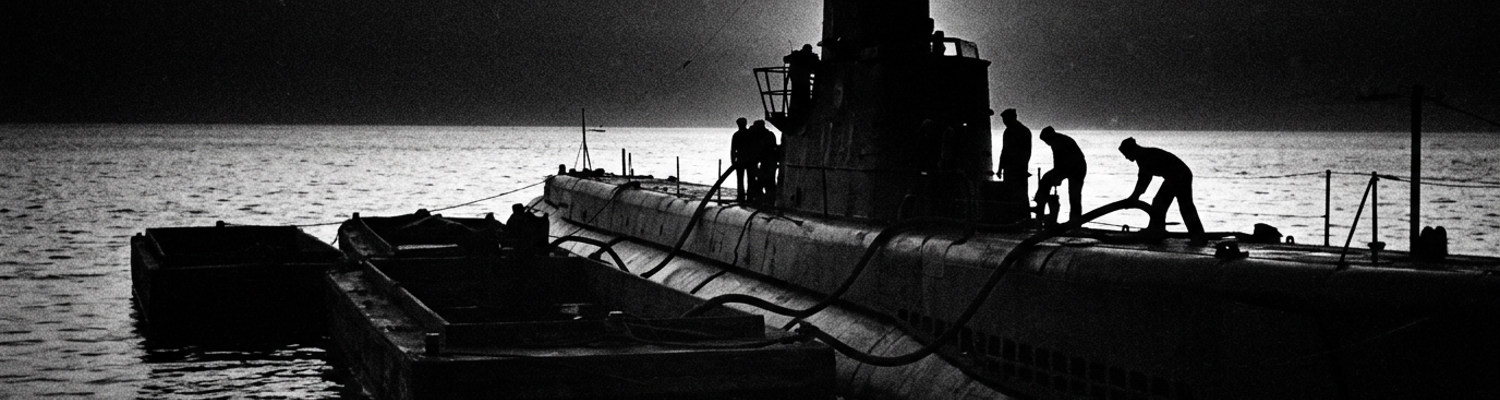
Archival evidence shows that offloading the fuel devolved into an improvised mechanical scramble across the slippery wooden deck slats. Machinists opened the exterior deck manifold caps. This exposed the auxiliary freshwater tanks where the 100-octane aviation fuel churned under residual pressure. With no specialized fuel-discharge fittings available, sailors and Marines rigged standard rubber garden hoses and salvage suction lines directly to the hull flanges. They wrapped worn pipe joints in lead wire and raw canvas to stem the steady leakage. Men took turns manually siphoning the fluid. They tasted leaded high-octane gasoline that blistered their lips and throats before the liquid drained into crude, rusted drum barges moored against the saddle tanks. Simultaneously, forward torpedo crews began wrestling fifty-four AN-M30 general-purpose aerial bombs up through the forward weapons hatch. Sailors passed the seventy-pound explosive steel casings upward hand-to-hand along the narrow ladder rungs. They worked blind without white light. Their palms were slick with fuel condensation. A dropped bomb casing striking the steel scuttle coaming would have detonated the explosive vapor clouds enveloping the forward deck.
The submarine sat immobilized.
A close review of operational logs indicates that the lack of pre-coordinated naval lighterage and spark-proof fuel transfer pumps stretched the manual transfer across five agonizing hours. Fleet planners had failed to provide power lighters or self-propelled pump scows to Tulagi. The joint working party had to rely on hand-cranked wobble pumps and gravity feeds to empty the deep internal tanks. Every gallon had to be hand-pumped into open steel barrels resting on unpowered wood lighters that listed precariously against the hull. Overhead, Japanese reconnaissance floatplanes from the seaplane tender Kamikawa Maru circled the sound. They dropped magnesium flares that illuminated the water in pale, chemical light. Bole kept his anti-aircraft gun crews at their stations beside the unshielded deck guns. He knew that diving the boat was impossible. The forward hatch was chained open. Cargo lines tangled across the casing. Rubber hoses snaked deep into the internal pressure compartments. Had Japanese bombers spotted the low silhouette, Amberjack could neither submerge nor return effective fire.
At 0240, Marine boat crews pushed the last filled lighter away toward the shore.
Distribution and the Cactus Air Force Sorties
Mud choked the perimeter roads.
Archival evidence shows that once lighters hauled the fuel containers across the sound from Tulagi to the Kukum beachhead, the distribution fell to the 1st Motor Transport Battalion. Marine drivers manned GMC CCKW two-and-a-half-ton trucks and International Harvester M-5H-6 haulers. They steered through unpaved trails gouged by fourteen-inch naval shell craters and torrential tropical downpours. Blackout restrictions barred the use of headlights. Drivers edged through axle-deep muck in granny low gear. They relied on wing-walkers who tapped front fenders with bamboo sticks to steer vehicles clear of washed-out culverts along the Lunga River. Coral grit and standing sludge ground through differential seals, shearing drive shafts and burning out dry transfer cases. When roads dissolved completely into quagmires near the edge of the Ilu River, work parties manhandled fifty-five-gallon metal drums directly out of truck beds. Marines rolled the four-hundred-pound steel cylinders end-over-end across splintered corduroy logs. They wrestled them up earthen revetments to replenish the dispersal pens at Fighter One and Henderson Field.
Hand pumps siphoned the fuel into waiting wing tanks.
A close review of operational logs indicates that the delivery of nine thousand gallons of 100-octane avgas and fifty-four AN-M30 general-purpose bombs revived the striking capacity of Marine Aircraft Group 23 at the exact turning point of the ground defense. During the night of October 25, Lieutenant General Masao Maruyama's 2nd Sendai Division mounted mass infantry assaults against Lieutenant Colonel Chesty Puller's 1st Battalion, 7th Marines along the southern ridge. At dawn on October 26, ground crews working with chamois-lined funnels poured the fresh fuel into the empty self-sealing tanks of Grumman F4F-4 Wildcats from VMF-121 and Bell P-400 Airacobras of the 67th Fighter Squadron. Ordnance men bolted the seventy-pound bombs onto the external wing racks of Douglas SBD-3 Dauntless dive bombers belonging to VMSB-141. Cactus Air Force pilots launched immediate combat air patrols that broke up incoming waves of Mitsubishi G4M bombers over Savo Island. Dauntless crews flew low-altitude strike sorties directly into Japanese troop concentrations along the Matanikau River.
A front-line fleet submarine had been turned into a tanker.
When examining the historical record, this ad hoc submarine run exposed systemic breakdowns within pre-war joint supply doctrine. Field manuals issued by the Joint Army and Navy Board contained no procedural blueprints for inter-service distribution under air and sea blockade. Front-line Marine aviation depended entirely on desperate improvisations arranged through local submarine squadrons. Vice Admiral Robert L. Ghormley's rear-echelon headquarters at Noumea had proved incapable of coordinating maritime transport or adapting surface replenishment to active combat conditions. Fleet distribution had stalled completely. Admiral Chester W. Nimitz intervened, judging Ghormley's administrative hesitation as an immediate threat to the South Pacific Area. The supply failure precipitated Ghormley's removal. Nimitz assigned Vice Admiral William F. Halsey to theater command with explicit orders to bypass bureaucratic channels and push combat supplies directly into the Lunga beachhead. Halsey assumed command at Noumea on October 18. He immediately established emergency supply priority for Vandegrift's perimeter. The first regular surface convoys carrying bulk aviation fuel did not reach Lunga Point until November.