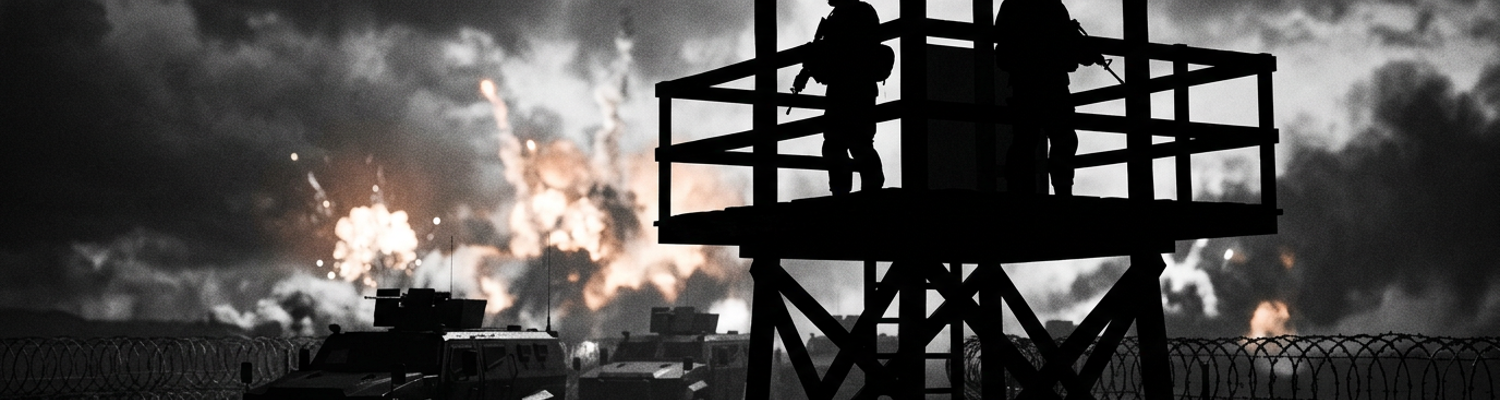

Detonation of Ammunition Supply Point 3
At 0300 hours on January 31, 1968, copper field telephone trunk lines snapped. The blast wave of incoming 82mm mortar rounds severed voice communications across the eastern perimeter bunkers linked to the 53rd General Support Group tactical operations center. Frontline sentries with the 720th Military Police Battalion found themselves isolated in darkness. Tactical radio frequencies jammed under heavy static and mutual interference. Seconds later, satchel charges breached the earthen revetments of Ammunition Supply Point 3. Forward storage pad 51 ignited.
Archival evidence shows roughly sixteen thousand tons of Class V munitions occupied the depot that night. Technicians had stacked the ordnance on timber dunnage directly exposed to the night air. High-explosive 105mm howitzer cartridges and 155mm M107 artillery projectiles detonated in rapid succession. Pallets of five-hundred-pound general-purpose aerial bombs exploded moments later. Shockwaves flattened corrugated aluminum roofs across the Long Binh cantonment. Reinforced glass shattered at Bien Hoa Air Base four miles to the north. An elliptical crater thirty feet deep was gouged into the red clay subsoil. Over three thousand tons of ordnance disintegrated during the initial three-minute blast sequence. The immediate inventory of the 185th Maintenance Battalion was erased.
The primary storage sector ceased to exist.
A close review of operational logs indicates that secondary detonations ripped through the perimeter for fourteen continuous hours. Blast walls constructed of unreinforced dirt failed to contain the outward trajectory of exploding shells. Sand-filled fuel drums ruptured under the thermal pressure. Burning white phosphorus canisters launched into the sky. Fuzed 155mm fragmentation rounds landed squarely on neighboring outdoor ammunition bays. Pads 40 through 62 detonated in a continuous series of cook-offs. Fire crews from the 29th Transportation Compound attempted to approach the burning access roads with dry-chemical pumpers. Flying steel fragments and exploding delay fuzes forced them to withdraw behind the railway embankment. Base ordnance safety guidelines had permitted the staging of high explosives on open asphalt to accelerate truck loading cycles. Separation distances mandated in field service manuals were ignored. Thousands of exposed palletized charges sat unprotected from flying shrapnel. Unexploded M48 point-detonating fuzes showered the installation until late afternoon. Explosive ordnance disposal teams could not clear access lanes to the depot core.
Uncontrolled secondary explosions turned the base interior into an impassable danger zone.
When examining the historical record, this localized loss paralyzed ammunition distribution across Military Region III. Supply disruptions plagued the opening thirty-six hours of the Tet Offensive. Long Binh operated as the primary supply distribution point for II Field Force. It directly sustained combat operations for the 1st Infantry Division at Lai Khe. The 25th Infantry Division around Cu Chi depended entirely on these stockpiles. The 199th Light Infantry Brigade lost immediate access to pre-positioned artillery reloads while securing the eastern approaches to Saigon. Regular North Vietnamese and Viet Cong battalions simultaneously attacked major urban centers. Convoys slated to deliver 105mm high-explosive rounds down National Route 1 were halted. Blast debris blocked the main outbound vehicle gates. Supply officers initiated emergency airlifts of artillery ammunition from the coastal depot at Vung Tau. By 1800 hours, battery commanders at remote fire support bases throughout Bien Hoa Province were instructed to reduce their defensive firing rates by fifty percent. Incoming mortar fire continued to hit their perimeters.
Logistical Sprawl of Long Binh Post
Long Binh was built to process tonnage.
Archival evidence shows that between late 1965 and mid-1967, the United States Army stripped thousands of acres of Michelin rubber trees across Bien Hoa Province. Heavy equipment operators from the 18th Engineer Brigade leveled red laterite hills across coordinates XT 980 120. Continuous arterial asphalt tracks linked the interior sectors with National Route 1. General William Westmoreland relocated the operational headquarters of United States Army Vietnam from downtown Saigon into the newly constructed Plantation compound inside Long Binh. The tactical command center of II Field Force sat directly adjacent. Over sixty thousand military personnel and civilian contractors inhabited the post by January 1968. The complex swallowed dozens of separate tenant units. The 24th Evacuation Hospital shared space with massive maintenance motor pools operated by the 185th Maintenance Battalion. Standardized steel structures and open-air storage pads extended for miles.
Speed drove every architectural choice.
A close review of operational logs indicates that staff officers at 1st Logistical Command prioritized turnaround times for deep-draft shipping at Newport terminal above basic tactical survivability measures. Supply throughput ruled daily operations. Logistics planners converted open parcels inside Long Binh into high-density transit yards to clear dockside bottlenecks along the Saigon River. Palletized artillery charges and small-arms ammunition crates were dropped directly onto uncovered dirt pads. Commercial rough-terrain forklifts loaded twenty-ton flatbed tractor-trailers within twenty minutes. Engineers eliminated protective berms between ammunition storage bays to widen access lanes for dual-axle transport trucks. Hardened perimeter bunkers and anti-tank ditches were deferred from construction work orders. Heavy earthmoving plant was conserved strictly for pad expansion. Planners assumed combat formations deployed forward along the Cambodian border would intercept regular North Vietnamese regiments long before enemy combat units reached Bien Hoa. Protective barbed-wire aprons around storage clusters were frequently dismantled by warehouse officers seeking direct shortcut access for cargo cranes.
The fence line was an open sieve.
When examining the historical record, the perimeter of Long Binh Post formed an irregular loop stretching across twenty-five linear miles of contested terrain. Civilian settlements pressed flush against tactical boundary fences. The dense village of Tam Hiep bordered the wire. Commercial quarry sites and gravel pits fragmented the exterior perimeter into isolated pockets. Securing this boundary required an estimated three full infantry battalions. Base defense fell primarily to rear-echelon support personnel and three understrength patrol companies from the 720th Military Police Battalion. Sentries strung defensive wires across ravines and swampy tributaries of the Dong Nai River. Deep timber tree lines blocked visual observation from static wooden watchtowers. Patrolling units operated four-man squads aboard lightly armored V-100 Commando cars. They attempted to cover multiple linear miles of disconnected fencing with zero continuous physical contact between posts. Gaps between manned observation positions frequently stretched beyond eight hundred yards. Low scrub brush and gullies offered concealment in these extensive blind spots. Viet Cong reconnaissance units from the 275th Regiment routinely exploited these unguarded dead zones. They traced gaps around the municipal water pumping stations without tripping a single tripflare.
Perimeter Security and the 720th Military Police
The 720th Military Police Battalion held primary responsibility for securing the outer perimeter.
Archival evidence shows that Battalion headquarters stationed three organic military police companies across an irregular operational boundary. The attached 615th Military Police Company assisted across forty miles of barbed-wire concertina. Subordinate commanders divided the base boundary into four physical sectors. Company areas of responsibility spanned grid coordinates XT 970 090 to YT 050 140. Military police personnel manned isolated timber guard bunkers spaced up to eight hundred yards apart. This separation distance created open avenues of approach for Viet Cong reconnaissance squads. Local insurgent units belonging to the Bien Hoa Province Headquarters systematically probed the defensive wire after dusk. Enemy sapper teams bypassed tripflares by crawling through drainage ditches feeding into the Dong Nai River. They cut through outer cattle-fencing without alerting static watch posts. Each MP company maintained only a single mobile reaction squad on fifteen-minute standby inside cantonment motor pools. Miles of perimeter were exposed whenever watchtowers faced diversionary small-arms fire.
Mobility across the red laterite roads depended on untested armor.
When examining the historical record, patrols fielded newly introduced Cadillac Gage V-100 Commando armored cars. These vehicles were equipped with twin .30-caliber machine guns for perimeter mobile reaction. Four-man crews operated these four-wheel-drive amphibians along narrow perimeter trace roads. They relied on the vehicle quarter-inch Cadloy steel plating to deflect 7.62mm Kalashnikov rounds. Inside the manual rotating turret, gunners aimed two linked .30-caliber machine guns fed by thousand-round ammunition bins. Mechanical faults undermined this reaction capability. Operating the heavy seven-ton vehicles on steep unpaved laterite embankments caused frequent axle fractures. The liquid-cooled Chrysler 361 CID V8 gasoline engines routinely suffered vapor lock. They boiled over under sustained low-gear patrol idling in tropical heat. Water-filled roadside ditches caused multiple top-heavy V-100s to overturn during night maneuvers. Crews were pinned inside until heavy recovery wreckers from the 185th Maintenance Battalion arrived to right the overturned hulls.
Radar technicians struggled to separate enemy infiltrators from jungle clutter.
A close review of operational logs indicates that experimental AN/TPS-25 ground surveillance radar units were deployed along key perimeter sectors. Electronics specialists mounted these pulsed X-band radar sets atop fifty-foot steel towers. The towers were positioned along the high ground near Hill 112 and the eastern boundaries fronting Highway 15. The radar swept a twenty-five-mile arc. Detected target movement was converted into characteristic audio tones. Trained operators monitored these tones through headsets to differentiate walking personnel from wheeled vehicles. Dense humidity and high-volume monsoonal downpours produced continuous false-alarm doppler returns. Tall elephant grass saturated the receiver consoles. Heavy transport trucks grinding down adjacent arterial roads generated vibrational ground clutter. This mechanical noise drowned out genuine foot-movement signals. Viet Cong 122mm rocket crews exploited these electronic blind spots. They erected bamboo launch rails in shallow stream valleys outside the radar line of sight. Standoff barrages were fired into depot storage bays before operators could distinguish incoming salvos from atmospheric interference.
Civilian Zoning and Restrictive Engagement Rules
American firepower stopped at the perimeter fence.
Archival evidence shows that bilateral political agreements barred depot commanders from clearing a defensive buffer zone. Military Assistance Command Vietnam and the Republic of Vietnam Joint General Staff signed these restrictive accords. Base engineers possessed the D7 bulldozers and heavy Rome plows required to flatten a standard one-thousand-meter standoff perimeter. Provincial authorities in Bien Hoa repeatedly rejected clearing permits. South Vietnamese civilian zoning codes classified tracts directly abutting the southern and western wire as protected private holdings. These areas included small-scale rubber plots and commercial farmland. Thousands of displaced refugees and merchants built dense squatter communities directly against the external cyclone fencing. The settlement of Tam Hiep and sprawling ribbon markets along Highway 1 pressed against the wire. MACV directives prohibited the forced eviction of these civilians to avoid diplomatic friction with the Saigon government. Guard personnel in elevated wooden watchtowers looked straight down into tin-roofed shanties constructed less than ten feet from tactical tripwires. Local National Liberation Front cadres mapped military police patrol schedules from inside these uncontrolled settlements. They marked dead spaces between bunker firing slits and cached arms shipments beneath floorboards.
Base commanders possessed guns they were forbidden to shoot.
When examining the historical record, restrictive rules of engagement disarmed the installation defensive artillery batteries whenever hostile incoming fire originated off-post. II Field Force artillery units deployed 105mm M102 howitzers and 155mm howitzers across cantonment firing points. Battery commanders operated under strict prohibitions against firing counter-battery missions into populated civilian zones. Base defense protocols dictated that any artillery mission directed outside depot boundaries required prior authorization from the Bien Hoa Province Chief. Securing that fire clearance required American target-acquisition officers to pass coordinates over landline telephone circuits to South Vietnamese liaison officers. These liaison officers routinely took up to forty-five minutes to process the request. Clearance was rejected in numerous recorded instances because incoming launch flashes were plotted inside rural hamlets or Buddhist pagoda grounds around Long Binh Tan. Viet Cong 82mm mortar crews exploited this procedural delay. They positioned steel baseplates between civilian brick dwellings and launched ten-round barrages into Ammunition Supply Point 3. The crews disassembled their weapons long before allied batteries received clearance to return a single high-explosive round.
A close review of operational logs indicates that commercial agricultural agreements compromised physical observation along the eastern perimeter. Foreign-owned French rubber holdings extended directly to the edge of Sector 4 near grid coordinates YT 030 110. MACV zoning regulations strictly forbade American units from using chemical defoliants or bulldozers to eliminate these revenue-producing commercial trees. Hundreds of acres of mature Hevea brasiliensis rubber trees grew in rigid fifteen-foot intervals. This created a dense elevated canopy that blocked aerial observation from O-1 Bird Dog observation aircraft. Unpruned secondary scrub and deep drainage channels shielded ground movements from observation posts along the perimeter berm. Reconnaissance squads from the Viet Cong 275th Regiment used the plantation layout as a concealed staging approach. Infiltration teams transported bangalore torpedoes and shaped satchel charges along the rubber-tree rows. Heavy breaching equipment was positioned within thirty yards of the concertina coils without entering an open field of fire.
Rubber trees touched the perimeter wire.
Communications Breakdown and Transceiver Mismatches
The airwaves failed before the perimeter fell.
Archival evidence shows that tactical military police patrols and the Base Defense Operations Command attempted to manage the assault on completely incompatible radio hardware. Motorized elements of the 720th Military Police Battalion mounted AN/VRC-46 transceivers and carried portable AN/PRC-25 manpack sets. The consolidated operations bunker at Long Binh Post relied on fixed-frequency base stations fitted with pre-cut quartz crystal oscillators. These crystals locked base station receivers to exact frequency channels that drifted significantly under high operating temperatures. The base stations fell out of alignment with the continuous-tuning dials of tactical field sets. MP patrol squads along the eastern perimeter attempted to broadcast contact reports regarding sapper infiltration near Bunker 31. Their transmissions registered as unintelligible clicks and dead carrier waves on the command console. Base dispatchers repeatedly keyed their microphones over the tactical chatter. This action inadvertently suppressed the weaker signals of units under fire. Duty officers inside the operations center spent thirty minutes swapping crystal modules in their RT-524 receiver units. They attempted to acquire the frequency spacing used by Company B forward squads. Patrol teams were left completely cut off from operational coordination.
Signals vanished into dead space.
A close review of operational logs indicates that administrative net allocations created an unbridgeable communication chasm during the critical initial breach. Armored cavalry reaction elements from the 11th Armored Cavalry Regiment were assigned to separate tactical operations nets controlled by II Field Force. These nets operated across frequency bands between 46.00 and 52.00 megahertz. The Military Police base defense network occupied a low-band allocation between 30.00 and 38.00 megahertz. This lower band was assigned strictly to rear-echelon cantonment security. Neither formation possessed authorization or equipment presets to cross-patch these frequencies. Base defense coordinators could not speak directly to tank commanders idling at the assembly areas near Highway 15. Emergency requests for armored support required manual voice relays across three independent switchboards. The request passed from the military police duty sergeant to the 89th Military Police Group desk. It then moved through the II Field Force tactical operations center before reaching the armor motor park. This procedural relay delayed the dispatch of M113 armored personnel carriers by forty-five minutes. North Vietnamese sappers gained unhindered access to the inner revetments of pad 51.
Paperwork had segregated the radio spectrum.
When examining the historical record, physical gear discrepancies crippled the link between static perimeter observation towers and mobile reaction forces. Sentries stationed forty feet above the ground in wooden guard towers along Sector 3 relied almost exclusively on TA-312 field telephones. These phones were connected by unshielded twisted-pair WD-1 wire to local manual switchboards. The mobile reaction squads patrolling the trace roads directly underneath moved in Cadillac Gage V-100 armored vehicles. These vehicles were equipped with high-frequency vehicular radios lacking wired phone drops or patch-cord hookups to plug into the tower lines. Tower sentries observing Viet Cong sappers severing concertina wire five hundred yards out had no mechanism to transmit target coordinates directly to the armored cars idling down the berm. Observers cranked generator handles on the TA-312 boxes to alert an operator at the central sector switchboard. The switchboard operator then had to locate a radio operator with an AN/PRC-25 manpack to broadcast voice corrections to the patrol vehicle. Azimuth readings and range estimates traveled across this circuitous wire-to-radio relay. Enemy breaching teams slipped into low-lying elephant grass and out of the gunners field of view before the coordinates arrived.
Mortar fragments severed the field wire three minutes later.
Viet Cong Sapper Infiltration Tactics
Archival evidence shows that specialized assault groups from the U1 Sapper Battalion and the 275th Regiment synchronized their approach with heavy standoff bombardment. At 0245 hours, forward artillery observers from the Viet Cong 84A Rocket Regiment directed salvoes of 122mm Soviet-manufactured single-tube rockets into the defensive strongpoints of Sectors 3 and 4. High-explosive 82mm mortar rounds followed immediately. Fragmentation munitions struck the sandbag aprons and exposed timber cabs of forty-foot observation towers. Corrugated metal roofs were punctured. External electrical wiring was severed. Blast waves from the 122mm rockets shattered perimeter floodlight fixtures. The eastern trace plunged into complete darkness. Sentries inside Tower 17 attempted to fire illumination flares from hand projectors. The cartridges misfired after absorbing moisture in storage lockers. Guard personnel manning pedestal-mounted M60 machine guns were forced down onto the floorboards to escape airburst shrapnel. They could not depress their barrels toward the outer perimeter wire without receiving direct fire. Four-man breaching teams wearing only loincloths crept across the cleared outer ditch under this suppression. Point sappers snipped the bottom strands of triple-standard concertina wire using hand-held mechanical wire snips padded with burlap to muffle acoustic signatures. Infiltrators placed split bamboo canes over loose barbs to hold open crawl passages eighteen inches high. Five separate belts of perimeter wire were cleared in under twelve minutes.
Incoming artillery fire neutralized base observation posts.
When examining the historical record, reconnaissance elements had pre-mapped every dead space across the undulating terrain east of the depot. Fixed concrete and timber bunkers manned by the 720th Military Police Battalion sat up to eight hundred yards apart. Broad swaths of the perimeter remained entirely outside the grazing fire of defensive small arms. Sapper scouts capitalized on thick stands of wild bamboo and six-foot-tall elephant grass that blanketed the drainage depressions near coordinates YT 032 118. Base engineers had neglected to clear these gullies. Seasonal monsoon runoff routinely washed away tactical concertina and buried mechanical tripflares under deep mud deposits. Thermal and acoustic signatures were minimized by stripping off web gear and coating exposed limbs in dark mud mixed with charcoal. Infiltration groups advanced in thirty-second bounds between defensive searchlight sweeps. The natural shadows cast by French rubber trees masked their movement across the laterite tracks. North Vietnamese troops avoided the direct line of sight from Bunker 34 and Bunker 35 by crawling in pairs along dry stream beds and unpaved culverts. Tripwires attached to M18A1 Claymore mines hung slack or buried beneath accumulated soil. The primary infiltration avenues were left devoid of active perimeter defenses. Sappers used wooden probes to check for taut tripwires before guiding carrying parties armed with demolition blocks through the defilade hollows.
Unmonitored ravines led directly into the depot core.
A close review of operational logs indicates that the inner storage compound offered zero physical resistance once the boundary berms were breached. Infiltrators bypassed outer dirt ramparts by moving through wide tractor-trailer access cuts that logistics personnel had carved out to speed up fork-truck traffic. Sappers fanned out across Ammunition Supply Point 3. They carried canvas rucksacks containing ten-pound block charges of cast TNT and Soviet-supplied plastic explosive. Storage bays in this sector held exposed pallets of 105mm artillery cartridges and 155mm howitzer shells elevated off the wet dirt on untreated oak dunnage. Waist-high sandbag dikes provided no overhead protection. Unprotected ammunition bays contained no blast curtains, deluge sprinkler systems, or reinforced partition walls. Technicians had positioned rows of M107 high-explosive projectiles less than twelve feet from exposed cardboard containers of propelling charges. Any localized flash would induce immediate sympathetic detonations across adjacent pads. Breaching teams crawled between the pallet stacks and wedged shaped satchel charges beneath the timber platforms. They inserted friction igniters fitted with five-minute chemical delay fuzes. Motor pool reaction teams failed to reach the area before burning ignition trains activated the primary booster assemblies of storage pad 51.
Six demolition blocks detonated simultaneously beneath eighteen pallet stacks.
Post-Mortem Reforms in Base Defense Doctrine
Bureaucratic complacency died with Ammunition Supply Point 3.
Archival evidence shows that the destruction of storage pad 51 forced United States Army Vietnam headquarters to dismantle fragmented base security arrangements across the theater. Depot cantonments prior to February 1968 relied on a decentralized patchwork of tenant unit details and independent guard companies. Uncoordinated military police patrols answered to competing chains of command. Combat commanders resolved this administrative division by creating unified Base Defense Operations Centers to direct all defensive operations on major installations. A designated Base Defense Coordinator exercised immediate operational control over organic military police companies from the 720th Battalion. Attached provisional security platoons drawn from rear-echelon logistics battalions and ARVN liaison detachments fell under this unified command. Watch officers inside the hardened operations bunker monitored continuous perimeter plots. Designated quick-reaction platoons were dispatched within three minutes of perimeter tripwire interruptions.
Internal base defense ceased to function as an afterthought managed by supply clerks.
A close review of operational logs indicates that communications doctrine underwent an immediate technical overhaul to synchronize mismatched transceiver frequencies across defensive units. Signal officers recalled unstable crystal-controlled base stations. Drifted quartz oscillators were replaced with temperature-stabilized components that matched the continuous FM bands of portable AN/PRC-25 manpack radios and vehicular AN/VRC-46 transceivers. Revised Signal Operating Instructions established dedicated base defense radio nets operating between 30.00 and 75.95 megahertz. These protocols bridged static observation towers, Cadillac Gage V-100 armored patrols, and armored cavalry reaction squadrons on a shared primary frequency. Cantonment bunkers were wired with dedicated ground-to-air transceiver drops. Base defense controllers could speak directly to overhead O-1 Bird Dog forward air controllers and orbiting AC-47 gunships without passing clearance requests through intermediate corps switchboards. Direct tactical radio links cut the air-strike response window along the perimeter from forty-five minutes down to four.
Unreinforced laterite berms had transformed localized fires into regional disasters.
When examining the historical record, subsequent logistics depot construction across South Vietnam required complete structural hardening and aggressive terrain clearing. Military Assistance Command directives issued in the spring of 1968 banned the staging of Class V munitions on exposed wooden dunnage or open dirt pads. Construction battalions from the 18th Engineer Brigade poured reinforced concrete revetment walls around every newly built ammunition cell at logistical hubs like Cam Ranh Bay and Qui Nhon. These vertical dividing barriers stood twelve feet high. They were engineered with angled blast lips that redirected high-explosive concussions skyward to prevent sympathetic detonations in neighboring bays. Strict quantity-distance separation tables were enforced. Pallet volume per cell was restricted to prevent chain reactions. Depot perimeters were simultaneously cleared of visual obstruction. Engineer units deployed heavy Rome plows and D7 bulldozers to clear a mandatory one-thousand-meter security zone around external fences. Mature Michelin rubber groves and drainage gullies were leveled despite objections from provincial zoning councils. Acoustic ground-vibration geophone sensors and trip-activated flares were embedded along cleared lateral lanes. Sappers were denied concealed approach corridors into supply sectors.