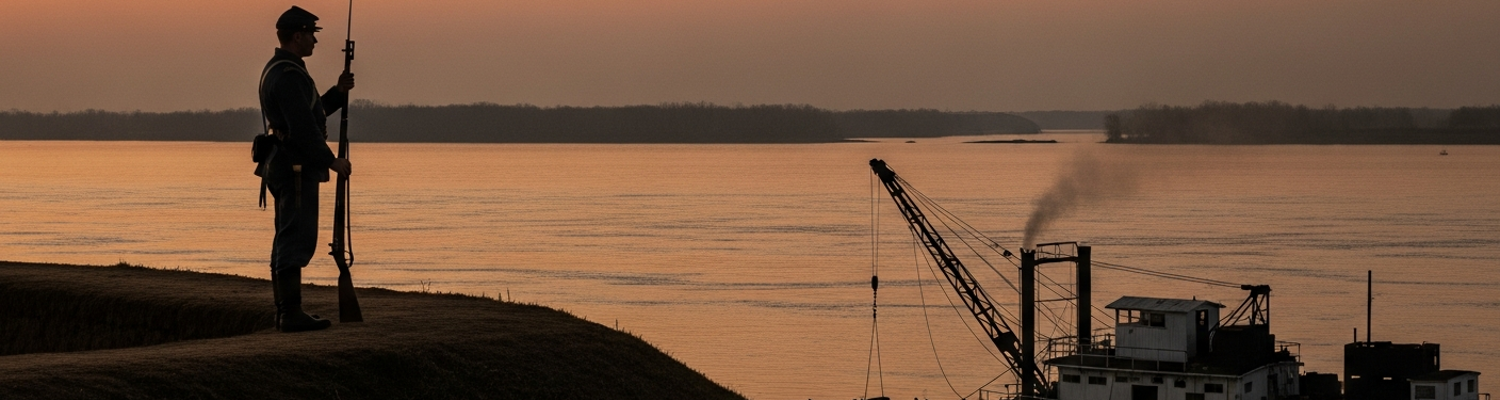

The surrender of Vicksburg on July 4, 1863, did not end the war for the Mississippi River. It began a new, more grueling phase. With the Confederate bastion's fall, followed shortly by Port Hudson, the Union nominally controlled the river's entire length. This fulfilled a central tenet of the Anaconda Plan to bisect the Confederacy. President Abraham Lincoln famously declared, "The Father of Waters again goes unvexed to the sea." This pronouncement, however, was aspirational, not factual. The river, now a strategic artery for the Union, immediately became a vast, vulnerable flank stretching over a thousand miles. Securing it as a reliable logistical highway required a sustained, complex, and often brutal campaign of occupation, engineering, and enforcement waged primarily by the Union Army. The river was far from secure. Confederate forces, though deprived of major garrisons, adapted with lethal speed. They unleashed cavalry raids, intensified partisan warfare, and executed clandestine operations to sever this new Union lifeline. For the Union Army, the mission pivoted sharply from conquest to control. This gritty, two-year struggle aimed to transform a contested waterway into the logistical backbone required for ultimate victory. The fight for the Mississippi was a war of attrition against distance, terrain, and a determined, irregular enemy.
Garrisoning the Waterline
Immediately after Vicksburg’s fall, the Department of the Tennessee, under Major General Ulysses S. Grant and later Major General James B. McPherson, initiated a massive program to fortify the riverbanks. This was not a passive occupation. It was an active defense against a persistent, multi-faceted threat. The Union Army established a chain of fortified garrisons at strategic points from Cairo, Illinois, down to the Gulf of Mexico. Major hubs like Columbus, Kentucky, Memphis, Tennessee, Helena, Arkansas, and the captured strongholds of Vicksburg and Port Hudson became complex logistical centers. Their defenses included extensive earthworks, redoubts, and artillery positions designed to protect wharves, supply depots, and repair facilities from landward assault. Smaller outposts, often little more than a fortified blockhouse and trenches, guarded critical wood yards, telegraph stations, and potential crossing points.
These garrisons faced constant threats. Confederate cavalry, particularly under the command of Major General Nathan Bedford Forrest, posed a significant danger to supply depots and isolated garrisons. Irregular forces and local guerrilla bands, operating from the swamps and dense forests of the river bottoms, continually harassed river traffic. These partisans ambushed steamers, burned wood yards essential for fuel, and attempted to interdict supplies destined for Union armies in the field.
A significant portion of this arduous garrison duty fell to the United States Colored Troops (USCT). By the spring of 1864, USCT regiments constituted a majority of the troops garrisoning posts along the Mississippi. At Vicksburg, over half of the 10,000-man garrison consisted of Black soldiers. Regiments like the 49th U.S. Colored Infantry and the 51st U.S. Colored Infantry performed the hard, daily work of building fortifications, patrolling the levees, and conducting anti-guerrilla sweeps into the hinterland. They engaged in frequent, sharp skirmishes, proving their mettle and providing the essential manpower that made sustained river control possible.
The threat was starkly illustrated in November 1864 during Forrest's 23-day raid targeting the Tennessee River, a key tributary. His forces attacked the massive Union supply depot at Johnsonville, Tennessee. On November 4, Forrest's artillery, skillfully positioned on the opposite riverbank, unleashed a devastating bombardment. The attack destroyed four Union gunboats, 14 transports, and 20 barges. Panicked Union personnel set fire to their own vessels to prevent capture, adding to the inferno that consumed millions of dollars in supplies. The Johnsonville Raid exposed the profound vulnerability of the Union’s riverine supply chain and validated the Army’s massive, costly garrisoning effort.
The Unseen War of Engineers and Quartermasters
The U.S. Army’s technical branches, the Quartermaster Department and the Corps of Engineers, fought a parallel war against both man-made and natural obstacles. The river, after years of neglect and active conflict, was a navigational nightmare. Its channels were choked with the sunken hulks of steamers, debris from destroyed bridges, and Confederate mines, then called "torpedoes." These mines were often crudely made, consisting of beer kegs or metal canisters packed with powder and fitted with a contact fuse, but they were deadly to the thin-hulled river transports. Natural hazards, like immense submerged trees known as snags, posed a constant, indiscriminate threat. The Army Corps of Engineers, which had a long history of river improvement work, was tasked with clearing and maintaining the waterway. They deployed specialized, steam-powered snag boats, powerful vessels equipped with heavy-duty cranes, winches, and saws, to hoist and dismantle thousands of obstructions. Engineers also conducted dangerous sweeping operations to locate and neutralize Confederate torpedoes. Dredging operations worked ceaselessly to maintain a navigable nine-foot channel, a constant battle against the river’s shifting silt and sandbars. This was dirty, dangerous, and unrelenting work, essential for keeping the river open to traffic.
The Quartermaster Corps, under the methodical direction of Quartermaster General Montgomery C. Meigs, orchestrated the immense logistical enterprise that the river supported. This organization built and maintained a sprawling network of supply depots, wharves, coaling stations, and repair yards. These hubs, like the one destroyed at Johnsonville, were the critical nodes connecting Northern factories to Union armies operating deep in the South. They received, stored, and distributed staggering quantities of supplies. A single army corps required hundreds of tons of material per day, including hardtack, salt pork, coffee, forage for thousands of animals, ammunition, and medical supplies. The logistical effort to sustain Major General William T. Sherman’s armies during the Atlanta Campaign and the subsequent March to the Sea relied heavily on the Ohio-Mississippi-Tennessee river system as its primary supply conduit. The efficiency of the Quartermaster Corps in managing this flow of material was a decisive factor in the Union’s ability to project and sustain power deep within the Confederate heartland.
Cooperation and Conflict on the River
The mission to secure the Mississippi depended on the operational relationship between the Union Army and the Navy’s Mississippi River Squadron. This brown-water navy, initially an Army-controlled entity known as the Western Gunboat Flotilla, consisted of a powerful fleet of Eads-class ironclads, lighter tinclads, and converted rams. After October 1862, it operated as a U.S. Navy command under Rear Admiral David Dixon Porter. The squadron was indispensable for river control.
Cooperation was often seamless and effective. Navy gunboats escorted Army transport convoys, their cannons providing mobile firepower to deter ambushes from the riverbanks. When Army garrisons came under attack from Confederate forces, naval gunfire support was often the deciding factor in their defense. Grant himself acknowledged the essential nature of this partnership, stating after the Vicksburg Campaign, "The most perfect harmony reigned between the two arms of the service." This harmony, however, was not universal.
Friction arose over command and control, resources, and differing priorities. The Army’s Mississippi Marine Brigade, an amphibious force of infantry and cavalry operating from its own transports under the command of Alfred W. Ellet, was a particular source of confusion. The brigade answered directly to the Secretary of War and often operated independently of both local Army and Navy commanders, leading to disjointed efforts and command friction.
Resources, particularly coal, were a frequent point of contention. Naval vessels and the hundreds of Army-chartered transports drew from the same limited supplies at riverside depots, leading to competition and occasional disputes over allocation.
The relationship with civilian rivermen, who piloted most of the Army’s chartered transports, added another layer of complexity. These pilots and captains were skilled professionals who knew the river intimately, but they were motivated by profit and operated under contract. Their high pay and civilian status sometimes put them at odds with the military chain of command, particularly when faced with enemy fire.
Despite these frictions, the joint Army-Navy effort successfully kept the river open. The Army provided the static defense, the garrisons, and the logistical infrastructure. The Navy provided the mobile offensive and defensive power, patrolling the waters and projecting force where needed. It was this combined-arms approach, a complex and sometimes tense partnership, that ultimately transformed the Mississippi from a contested frontier into the Union’s strategic lifeline, hastening the collapse of the Confederacy.