
The rain in the Mekong Delta in late 1968 did not begin as a drizzle. It arrived as a physical wall of water, descending with a force that transformed the landscape of baked earth and green foliage into a seamless expanse of brown, churning liquid. Unpaved roads dissolved into impassable troughs of mud, arresting supply lines. Helicopters, the primary instrument of troop mobility and air support, were rendered useless. They were grounded by zero-visibility squalls that appeared without warning. A close review of operational logs from the period indicates American forces were frequently blinded, unable to conduct reconnaissance or resupply missions for days at a time. North Vietnamese and Viet Cong strategists timed major troop movements to coincide with the monsoon’s peak, knowing the skies would be empty of American air power. The environment itself became an active combatant. American planners responded with a classified program, Operation Popeye, seeding clouds with silver iodide to artificially extend the monsoon and impede enemy movement along the Ho Chi Minh Trail.
This was the battlespace inherited by the 1st Combined Action Group.
Archival evidence shows the monsoon of 1968-1969 was exceptionally severe. For ground troops, the conflict became a war against the water as much as the enemy. Base camps flooded regularly, short-circuiting radios and corroding weapons. Keeping a rifle functional became a constant struggle against grit and rust. Medically, the conditions were disastrous, leading to widespread casualties from immersion foot, malaria, and aggressive fungal infections that thrived in the perpetual damp. The water was a soup of agricultural and human waste, increasing the risk of disease with every step through a flooded paddy. Viet Cong forces, intimately familiar with the terrain, exploited this environmental shutdown. They used the waterways to reposition personnel and supplies ahead of the Tet Offensive with near impunity. U.S. Navy patrols were overstretched and could not maintain constant surveillance over the delta’s 700-plus miles of major waterways, allowing enemy traffic to pass undetected in foul weather.
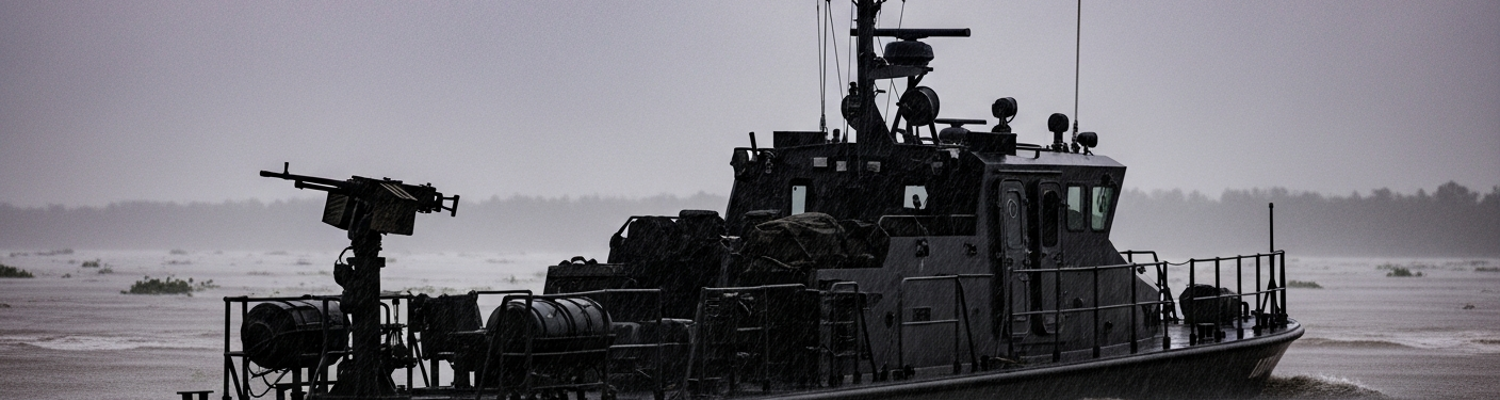
Naval Special Warfare forces found their aquatic expertise tested to its limit. SEAL Team ONE detachments, deploying to the region since 1966, were accustomed to waterborne operations, but the monsoon introduced a different level of hostility. Their mission was to interdict enemy supply lines moving down the network of rivers and canals, operating from Patrol Boats, River (PBRs) as part of the “Brown-Water Navy.” The late 1968 initiative known as SEALORDS, or Southeast Asia Lake, Ocean, River, and Delta Strategy, was a direct attempt by Vice Admiral Elmo R. Zumwalt, Jr. to choke these supply routes from Cambodia. The strategy involved establishing a series of naval barriers and conducting aggressive disruption operations. SEAL platoons became a core component of this strategy, striking deep into previously held Viet Cong sanctuaries.
Their operational areas included the Rung Sat Special Zone, a mangrove swamp south of Saigon, and extended deep into the Ca Mau Peninsula and the U Minh Forest. During the monsoon, these zones became more treacherous. The sheer volume of rainwater erased the distinctions between riverbank and floodplain, making navigation difficult and providing enemy forces with new avenues for ambush. Patrols that were already hazardous became grueling tests of endurance. The constant exposure degraded equipment and morale, while the murky water concealed booby traps and enemy swimmers. SEALs, supported by riverine assault craft and the “Black Ponies” of Attack Squadron Light (VAL) 4, found themselves fighting an enemy who used the blinding rain and flooded terrain as a shield.
An examination of SEAL Team ONE and TWO after-action reports (AARs) from 1969 reveals a force grappling with systemic equipment failure that directly impacted mission outcomes. These were not random malfunctions; the documents show a clear pattern of certain gear failing under the extreme environmental pressures. The Stoner 63 light machine gun, a weapon favored by SEALs for its high volume of fire, is frequently cited as a point of failure. SEAL Team ONE’s own command history noted the Stoner system malfunctioned frequently. Reports from platoons in the Ca Mau Peninsula detail how the weapon’s complex gas system would become fouled by fine, pervasive mud, leading to jams during firefights. One AAR from an April 1969 ambush mission (NARA Record Group 472, Entry A1 1545) notes that a squad’s primary automatic weapon became inoperable after a thirty-minute patrol through knee-deep water. Detonators for Claymore mines and other explosives suffered from moisture contamination, leading to a high dud rate. A report from a July 1969 mining operation on a key Viet Cong canal route describes how two of four specially prepared explosive charges failed to detonate, rendering the ambush only partially effective.
On the water, the Patrol Boats, River (PBRs) that served as insertion platforms and fire support bases were frequently crippled. The Mark I PBRs, in particular, were plagued by Jacuzzi-style water-jet propulsion systems that constantly fouled with river grass and debris churned up by the floodwaters. This left boats dead in the water and vulnerable. Even the improved pumps on the Mark II boats struggled against the sheer volume of vegetation.
Communications were just as fragile.
A deep review of radio logs from the period paints a picture of profound and dangerous isolation for SEAL patrols. The standard AN/PRC-77 man-portable radio, while considered rugged, was not immune to the jungle. Introduced in 1968 as a solid-state successor to the older AN/PRC-25, the radio was the lifeline for teams in the field. Logs from forward operating bases are filled with entries describing garbled, intermittent, or completely lost contact with patrols, especially during torrential downpours. The dense foliage, combined with the atmospheric interference of a tropical storm, could reduce the radio’s effective range from five miles to less than one. A log entry from Detachment ECHO, SEAL Team TWO, dated September 1969, records over two hours of failed attempts to raise a six-man reconnaissance squad that had reported enemy contact. The log shows frantic call and response attempts with only unreadable transmissions received. The patrol was eventually able to break contact on its own. The incident highlights a vulnerability: a team could be wiped out long before commanders miles away knew they were in an engagement.
These cascading equipment failures led directly to missions being aborted or severely compromised. The operational tempo of the SEALORDS campaign demanded constant deep-penetration patrols, but the environment and the gear were often unequal to the task. One AAR from X-Ray Platoon, SEAL Team One, documents a planned raid on a suspected Viet Cong supply cache in the U Minh Forest that was aborted before the team was even inserted. The PBR insertion craft suffered a fouled water-jet intake from river debris, leaving the boat underpowered and unable to reach the designated drop-off point without risking detection. Another report from late 1969 details a night ambush that was compromised from the start. After a quiet insertion, the squad moved to its hide site overlooking a canal, only to discover that two of their AN/PRC-77 radios had been rendered inoperable by water immersion. Unable to establish reliable communication with either their primary or alternate command net, the squad leader made the decision to scrub the mission. The risk of engaging the enemy without a guaranteed link to extraction or fire support was deemed too high. The patrol exfiltrated without making contact.
The mission was a failure, defeated not by the Viet Cong, but by water in the wrong place.
Delays in ordnance resupply became the default condition. A SEAL platoon engaged in a heavy firefight deep inside the Ca Mau Peninsula would find its ammunition expenditure rates far exceeding the supply chain’s ability to respond. A request for an emergency resupply of 7.62mm linked ammunition for the M60 machine guns or 40mm grenades for the M79 launchers would travel up a delayed and fragmented command chain. Even if the request was received and approved instantly, the weather itself formed an impenetrable barrier. Helicopter Attack Squadron (Light) 3, the “Seawolves,” were frequently grounded by impenetrable sheets of rain and low cloud ceilings, making air support or aerial resupply physically impossible. Riverine assets were no better off. A journey that took three hours in the dry season could take twelve in the monsoon, if it could be made at all. Flash floods altered the underwater topography of canals overnight, creating new sandbars that could trap a PBR for hours. Enemy forces understood this and actively exploited it, initiating contact with SEAL patrols knowing that American reinforcements and supplies would be slow or nonexistent. Operational reports from the period document multiple instances of platoons having to disengage from combat and conduct fighting withdrawals simply because they were running out of ammunition.
The problem extended beyond just bullets. The standard field ration was the canned Meal, Combat, Individual, or C-ration. These were heavy and bulky. On long-range patrols where every ounce mattered, operators often had to choose between carrying more food or more ammunition. While the lighter, dehydrated Long Range Patrol (LRP) rations were introduced, they required potable water to reconstitute, a scarce commodity in the contaminated floodplains of the delta. Operational logs detail multiple patrols forced to disengage and withdraw, not because of enemy action, but because they were running out of food and ammunition.
Nowhere was the logistical failure more acute than in medical support. A soldier wounded in Vietnam had a high chance of survival if they reached treatment within the first hour. During the monsoon, that window closed. A call for a “Dustoff” helicopter was frequently met with the news that all aircraft were grounded due to weather. This left the fate of a critically wounded operator in the hands of his platoon’s Hospital Corpsman. Navy Hospital Corpsmen who served with SEALs were among the most highly trained enlisted medics in the armed forces, capable of performing advanced life-saving procedures on the battlefield. Their skills could only delay the inevitable. A casualty with massive trauma required surgery, blood transfusions, and sterile facilities. The teams were forced to transport their own wounded, sometimes for days, through enemy-held territory to a pickup zone that might not be accessible. Archival medical data from the conflict shows a direct correlation between periods of intense rain and increased “died of wounds” statistics for injuries that were otherwise survivable.
The perpetual dampness made wound care difficult. Sterile dressings would be soaked in contaminated water within minutes. The risk of aggressive bacterial infections and gas gangrene was constant. The delays meant that a wounded man’s fate was often sealed on the battlefield, long before he ever reached a field hospital.
For SEALs operating deep within the Mekong Delta, the psychological strain of combat was magnified by a persistent sense of being alone. This was not the chosen isolation of a reconnaissance patrol; it was the corrosive feeling of systemic abandonment. A close review of after-action reports from SEAL Team ONE and TWO reveals this anxiety was rooted in the tangible, repeated failures of the logistical chain. An operator’s trust in his equipment and support structure is absolute. In the monsoon-drenched delta, that trust was broken. The tools of their trade became liabilities. An automatic weapon could jam in the opening seconds of an ambush. Communications were just as fragile. A patrol could be locked in a firefight for their lives, calling for support, while commanders miles away heard only static. This created a unique form of battlefield stress: the knowledge that even if you did everything right, your gear might fail, and no one would be able to hear you.
This sense of isolation was not imagined. It was a direct consequence of a supply system choked by the environment. The monsoon grounded the Seawolves. A SEAL squad, pinned down and running low on 40mm grenades for their M79s, could not count on an aerial resupply. Riverine craft were no more reliable. Flash floods could render a canal impassable overnight. Viet Cong and NVA forces understood this paralysis perfectly. They timed their attacks to coincide with the worst weather, knowing their targets would be cut off. This forced platoon leaders to make impossible choices.
Nothing cemented the feeling of abandonment more than the breakdown of the MEDEVAC system. The critical window to get a severely wounded man to a surgical facility was a concept that did not apply during the monsoon. This reality placed a horrific burden on the platoon’s Hospital Corpsman. They could pack a sucking chest wound or apply a tourniquet to a severed limb, but they could not perform surgery in the mud. The fate of a grievously wounded SEAL was often sealed the moment he was hit. For the operators, this was the ultimate psychological blow: watching a teammate die from a treatable injury, knowing that the helicopters and boats that represented the full might of the American military were just a few miles away, but might as well have been on another planet.
An examination of internal communications from Naval Special Warfare Group commands reveals a system fractured by distance and distorted by delay. The command chain for a SEAL platoon in the field was long and fragile. A six-man squad making contact deep in the Ca Mau Peninsula would transmit a report via their AN/PRC-77 radio. That signal, already weakened by the triple-canopy jungle and rain, would be picked up by a supporting PBR or a forward operating base. From there, the message was relayed up to a detachment headquarters at a larger base like Nha Be or Binh Thuy, before finally reaching Commander, Naval Forces Vietnam (COMNAVFORV). The entire process was defined by latency. A tactical report could be hours old by the time it was plotted on a map in a distant command bunker, rendering it nearly useless for real-time decision-making.
The information itself was often incomplete. Archival radio logs are filled with entries showing garbled or unreadable transmissions from field units. This meant commanders were often operating blind, relying on intelligence that was dangerously out of date. They might have access to high-altitude aerial reconnaissance or signals intelligence, but the granular, life-or-death details from the squad on the ground were frequently lost in static. A request for emergency fire support or MEDEVAC would be passed up this broken chain. Any orders coming back down would be based on a picture of the battlefield that no longer existed.
This combination of incomplete intelligence and severe communication latency fostered a “headquarters bubble.” Senior officers at Naval Support Activity hubs like Binh Thuy or Can Tho, tasked with executing the broader SEALORDS campaign, made strategic decisions based on sanitized data and outdated maps. The objective of SEALORDS seemed logical: to choke Viet Cong supply lines from Cambodia by establishing naval blockades and aggressive patrols. This strategy demanded a high operational tempo from the SEAL platoons. From the perspective of a command post, ordering continuous, deep-penetration missions into enemy sanctuaries seemed like a logical way to apply pressure and generate favorable reports for the high command at Military Assistance Command, Vietnam (MACV).
The view from the mud was different. Strategic directives flowing down from the command bubble consistently overlooked the realities of supply and morale on the front lines. A command decision to maintain a high tempo of operations failed to account for the rate of equipment failure. Planners would issue orders for patrols without a true understanding that the PBRs needed for insertion were non-operational due to fouled water jets or that the platoon’s primary machine guns were jamming from constant exposure to mud. Operational records detail missions being planned around air support from the Seawolves when those very helicopters were grounded by weather. This disconnect created a cycle of futility. SEALs were sent on missions with compromised gear and unreliable support, leading to aborted operations and a decline in morale. The men in the field came to understand that the planners directing their movements were fundamentally detached from the struggle defined by weapon malfunctions, ammunition shortages, and the silence that followed a failed MEDEVAC call in a storm.