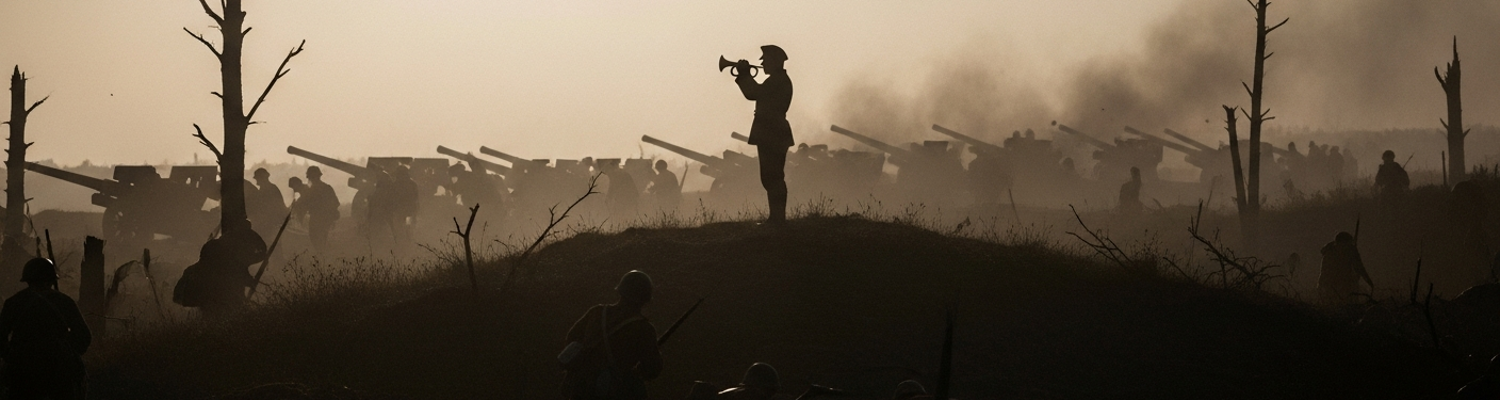

In the swirling chaos of an American Civil War engagement, where black powder smoke choked the senses and the roar of artillery and musketry deafened commanders, the primary instrument of tactical control was not the shouted word, but the penetrating sound of a brass bugle. This was the world of the army bugler, a soldier whose instrument served as the auditory nervous system for a regiment. He translated a commander’s intent into musical phrases that could direct the complex maneuvers of thousands of men across a smoke-obscured landscape. Doctrine placed these musicians at the nexus of command and combat, a position of immense responsibility and acute personal danger. Their story is one of unique training, doctrinal necessity, and individual fortitude under the most extreme pressures of 19th-century warfare.
Acoustic Command in a Black Powder War
Before the widespread use of field telegraphy or man-portable radios, battlefield communication was a rudimentary and often frustrated affair. A colonel’s voice could not carry over the din of a full-scale firefight, and runners were slow and vulnerable. The solution, inherited and adapted from European military tradition, was a standardized system of bugle calls. These were not mere signals for camp routine. They were discrete, audible commands that every soldier was trained to recognize and obey instantly. The bugle, typically a copper or brass horn in the key of C or B-flat without valves, became the indispensable tool for maneuvering regiments and brigades. Its sound possessed the necessary acoustic properties to cut through the low-frequency rumble of battle, providing a clear, sharp signal that could be heard over hundreds of yards. The specific instrument mattered. While various models existed, the regulation field bugle, often based on French designs, was specified to project sound effectively. Its limitations, however, were also a factor. Different keys could carry differently in various weather conditions, and even the strongest bugler could be drowned out by the percussive blast of a nearby battery of 12-pounder Napoleons.
Doctrinally, the bugler was an extension of the commander himself. A regimental or brigade chief bugler was positioned near the commanding officer, often acting as an orderly and a signalman in one. From this central point, a commander would give a verbal order, which the bugler would then sound. This initial call was then often echoed by company-level buglers, ensuring the order propagated throughout the formation. This placement meant the bugler shared the same risks as the senior leadership. Snipers and artillery often targeted these command clusters, identified by the group of officers, flag bearers, and the accompanying musician. To neutralize a commander was effective. To neutralize his ability to communicate was to paralyze the unit entirely. The bugler, with his distinctive instrument, was an obvious and high-value target.
Mastering the Language of the Horn
The soldier designated as a bugler underwent a demanding regimen of memorization that went far beyond musical aptitude. Army regulations specified that a natural talent for music was a prerequisite for enlistment as a musician, but the true test was cognitive. A bugler in an infantry unit was expected to have at his instant recall dozens of signals. An infantryman might need to know over twenty-five general calls for camp and marching, plus another twenty-four specialized calls for skirmish duty. Cavalry and artillery buglers had their own extensive and distinct sets of calls related to managing horses, unlimbering guns, and servicing the pieces. This training was not formalized in dedicated schools but fell to the Regimental Chief Musician, who drilled the field musicians relentlessly.
This knowledge had to be ingrained to the point of automaticity. There was no time to consult a manual in the heat of battle. Manuals like William J. Hardee’s Rifle and Light Infantry Tactics or Silas Casey’s Infantry Tactics provided the written foundation, and officers were themselves required to be perfectly acquainted with the signals. It was the bugler, however, who had to produce them flawlessly under fire. To aid in memorization, soldiers often attached simple, sometimes crude, lyrical ditties to the tunes. The call for “Assembly of the Buglers” was sometimes remembered with the phrase, “Darn those rotten stinking little buglers!” The call for sick call, “Soupy, soupy, soupy, without a single bean,” was another well-known example that linked a tune to a function. This oral tradition was a critical mnemonic device.
Daily life in camp was a constant reinforcement of this musical language. The day was punctuated by bugle calls from dawn until dark. Reveille woke the troops, followed by calls for assembly, mess, sick call, water, and fatigue details. Drills were conducted to the sound of the bugle, conditioning soldiers to react without hesitation. The day ended with Tattoo and finally Taps, the call to extinguish lights. This constant repetition was the bedrock of the bugler’s training, building the muscle memory and mental recall necessary for the chaos of the field. Beyond their musical duties, buglers were still soldiers. They often served as messengers, assisted surgeons with the wounded, guarded the colors, or worked on ambulance crews. Most also carried a sidearm and were expected to fight alongside their comrades when their signaling duties were complete or impossible.
Sounding the Charge at the Forward Edge
The abstract doctrine of battlefield command found its ultimate expression in the actions of individual buglers. Their personal accounts reveal the immense pressure and personal risk inherent in their role. Three figures, John Cook, Oliver Willcox Norton, and Charles W. Reed, provide compelling vignettes of the bugler’s ordeal.
At the Battle of Antietam on September 17, 1862, John Cook, a bugler for Battery B, 4th U.S. Artillery, was just 15 years old. During the intense fighting in the West Woods, his artillery battery came under a furious Confederate infantry assault. The unit suffered devastating losses in men and horses. Seeing the cannoneers around him fall, Cook, on his own initiative, put down his bugle and took up the duties of a cannoneer. He unstrapped an ammunition pouch from a dead soldier and began servicing a gun, continuing to work the piece under a relentless fire that brought enemy soldiers within a few feet of the battery’s position. For these actions, Cook was later awarded the Medal of Honor. His transition from musician to combatant illustrates the fluid and dangerous reality of the bugler’s position. He performed his primary duty until the tactical situation demanded he become an infantryman in all but name.
Oliver Willcox Norton offers a different perspective, that of a brigade-level musician at the heart of a critical defensive action. As the chief bugler for Colonel Strong Vincent’s brigade of the V Corps, Norton was at his commander’s side during the Battle of Gettysburg. On July 2, 1863, as Confederate forces prepared to assault the Union left flank, it was Vincent who recognized the undefended tactical importance of the rocky hill known as Little Round Top. Acting on his own initiative, Vincent rushed his brigade to occupy the hill. Norton, as his “mouthpiece,” sounded the calls that directed the 83rd Pennsylvania, 20th Maine, and other regiments into their defensive positions just as the attack began. Norton’s book, The Attack and Defense of Little Round Top, provides a detailed eyewitness account of this pivotal moment, highlighting the bugler’s role in the rapid execution of tactical orders under extreme duress. His bugle calls were the invisible threads that stitched together the desperate defense of the Union flank. Norton also collaborated with General Daniel Butterfield in the summer of 1862 to revise an old French call into the famous 24 notes of Taps.
Another Medal of Honor action at Gettysburg highlights the bugler's proximity to command and combat. Charles W. Reed served as a bugler with the 9th Massachusetts Battery. During the heavy fighting on July 2nd, his battery commander was wounded and fell in an exposed position between the firing lines. Reed, without orders, rode into the storm of fire, located his captain, and brought him back to safety. He then returned to the battery, assisted in rallying the men, and helped direct the withdrawal of the unit's remaining guns. Reed’s actions, far outside the normal duties of a musician, show how the chaos of battle forced these men into roles of direct combat and leadership.
The Fading Notes of Tactical Control
The Civil War represented the apex of the bugle’s tactical importance. The entire command-and-control doctrine of the era was built around the functional range of a man’s voice and the much greater range of a brass instrument. It dictated the size of tactical formations and the speed at which they could react to a commander’s will. The system’s vulnerabilities, however, were stark. The dependence on a single man, the bugler, created a critical point of failure. A bugler killed or wounded at the wrong moment could leave a unit directionless, unable to advance, withdraw, or respond to a changing threat. Furthermore, the enemy could also hear the calls, and savvy commanders could anticipate their opponent’s moves if they recognized the signals.
The evolution of military technology in the decades following the war gradually rendered the tactical bugler obsolete. This process began during the war itself. The wig-wag flag system, developed by Albert J. Myer, offered a method for silent, long-distance communication during daylight, competing directly with the bugle for certain tasks. The U.S. Military Telegraph Corps strung thousands of miles of wire, allowing near real-time communication between headquarters units far from the front, changing the strategic landscape. After the war, military reformers like Emory Upton analyzed the conflict's lessons, pushing for doctrines that emphasized small-unit initiative over centralized bugle commands. By the late 19th and early 20th centuries, the development of field telephones allowed commanders to speak directly to subordinate units, replacing the need for musical signals entirely. The arrival of radio technology completed this doctrinal shift. While the bugle remained a part of military life for camp duties and ceremonies, its role as the primary instrument of battlefield command faded. The gritty ordeal of the Civil War bugler, a soldier who wielded sound as a weapon and a tool, passed from tactical necessity into military history.