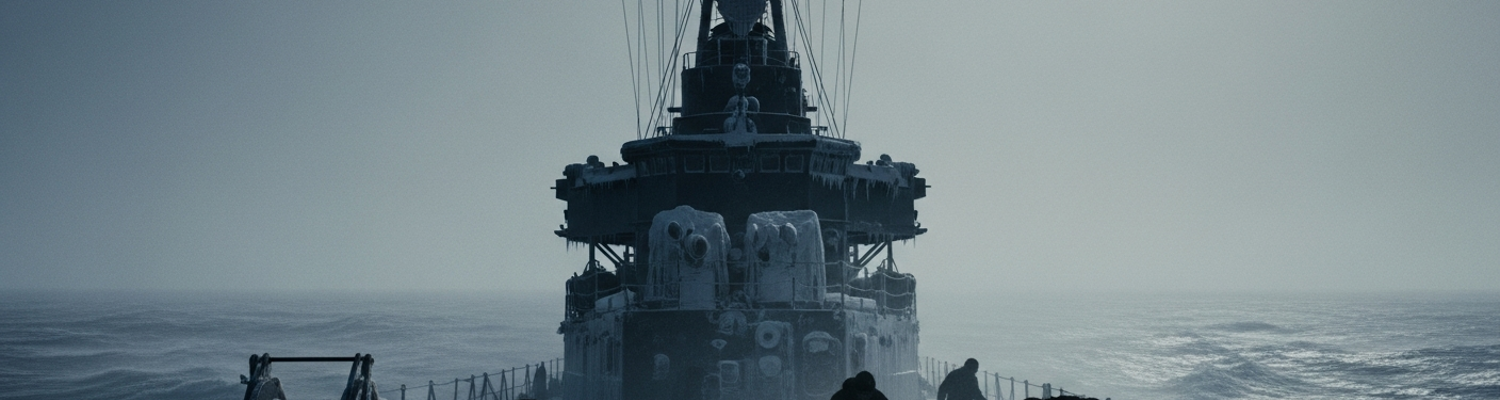

Fleet Problem XVI Arctic Objectives
The sea north of the Aleutian Islands was a churning mix of gray-green water and slush ice. Air and water temperatures hovered just above freezing, creating a perpetual state of damp, penetrating cold more punishing than a hard, dry freeze. Below the surface, the pressure of shifting ice floes produced a constant, low-frequency groan. This was the chosen theater for a naval exercise, a mock battlefield selected for its unforgiving nature.
From its inception, Fleet Problem XVI was designed as a large-scale stress test. Planners at the Naval War College conceived a simulated deployment into this environment to probe the fleet's absolute boundaries. Task Group 7.3, centered on the heavy cruisers USS Astoria and USS Indianapolis, with a screen of new Farragut-class destroyers including the Dewey and Macdonough, was dispatched into the designated Northern Transit Zone. These were not standard vessels. Archival requisitions show modifications for enhanced crew quarter insulation, experimental heating elements for fuel lines, and reinforced plating along the bow waterline. The plan was to simulate an opposed transit against a Red Force of submarines and patrol bombers, forcing high-speed maneuvers in seas no pre-war American warship was designed to navigate. The exercise intended to find what would break first under the combined strain of combat and environment.
The answer came within 48 hours.
Interwar naval engineering was pushed past its limits. Physics became the primary adversary. On the USS Astoria, the standard SAE-40 lubricant in the main reduction gears began to congeal. Its viscosity increased as temperatures dropped below -5° Celsius, placing massive strain on the machinery connecting turbines to propeller shafts. The retrofitted steam-heating coils for the lubrication reservoirs proved inadequate. Ice buildup on deck-mounted electrical conduits caused short circuits, rendering the heating system useless. The Astoria's chief engineer reduced speed to a mere 8 knots to prevent the gears from seizing. This action removed the cruiser from any high-speed tactical role. A similar fate befell the destroyers' advanced electronics. New radio direction-finding (RDF) antennas became coated in rime ice, which altered their resonant frequency and made accurate bearings impossible.
The machines failed first.
This cascade of mechanical issues sabotaged the test of new strategic doctrines. The core concept under evaluation was forward active screening, where destroyers and cruisers would push hundreds of miles ahead of a theoretical carrier group. They were to use ELINT equipment to passively detect enemy emissions, providing the main battle fleet with an intelligence picture without revealing its own position. With RDF systems inoperable and cruisers unable to maintain speed, the doctrine collapsed. On the flagship USS Indianapolis, Rear Admiral K.C. Bronson was operating blind. His communications were a tangle of static and delayed, garbled reports. Acting on a three-hour-old, partial RDF fix, one of the last to get through before the antennas iced over, he ordered the destroyers Dewey and Macdonough to pursue a suspected Red Force submarine. Operational logs show this decision was made without knowledge that the destroyers' forward fuel lines were freezing and their engine performance was degrading. Bronson directed his screen into a sector exercise umpires had designated as a dense, simulated minefield. The final exercise report noted the simulated loss of two destroyers and the crippling of a heavy cruiser before the main fleet element entered the primary combat zone.
Nascent ELINT Technology Challenges
Operational logs for Fleet Problem XVI reveal a foundational flaw. The experimental electronic intelligence arrays were not ready for deployment. The SE-2 High-Frequency Direction-Finding (HF/DF) suites retrofitted onto the destroyers Dewey and Macdonough were a leap in theory but a failure in practice. These systems were not integrated into the ships’ designs. They were bolted onto superstructures as aftermarket additions. Archival evidence shows the circular RDF loop antennas were mounted on platforms welded directly to the main mast. This exposed their delicate components and unshielded coaxial cabling to the full force of the Arctic environment. Freezing spray immediately coated the antenna housings and rotator mechanisms in thick rime ice. The ice buildup rendered directional adjustments impossible by freezing the motors solid. It also altered the electrical properties of the antennas, detuning them from their designated frequencies. Power conduits, run externally along frigid steel bulkheads, became brittle and cracked, leading to intermittent power failures that plagued the vacuum-tube-based receivers with constant resets.
Inside the radio rooms, the technology of signal interception was in its infancy. The SE-2 receiver console was a large cabinet of glowing vacuum tubes, manually operated dials, and a small, green cathode-ray tube oscilloscope. An operator, typically a standard radioman with only weeks of specialized training, was expected to manually sweep across a vast spectrum of high-frequency bands. He listened for the faintest whisper of a Morse code transmission. Upon detecting a signal, he had to use separate controls to rotate the iced-over antenna topside while watching the oscilloscope. He interpreted shifting Lissajous patterns to find a null or peak indicating a line of bearing. The process was agonizingly slow and deeply imprecise. Atmospheric distortion, common in polar regions, filled headphones with static, making it difficult to distinguish a distant enemy signal from natural noise. The equipment itself, with its hot, sensitive vacuum tubes, was prone to frequency drift as the ambient temperature in the compartment fluctuated with the ship’s struggling heating systems. The result was a stream of ambiguous, low-confidence bearings.
This raw data was tactically useless without interpretation.
The core doctrinal assumption of the exercise crumbled within hours. The idea that this nascent ELINT capability could provide a clear, actionable intelligence picture to a fleet commander was disproven. Rear Admiral Bronson, isolated on the Indianapolis, was the victim of a disconnect between technological aspiration and operational reality. The forward active screening doctrine was predicated on destroyers providing a steady, reliable plot of enemy movements. Instead, what trickled back to the flagship was a confusing and contradictory mess of partial, unverified, and often old bearings. The pressure within the headquarters bubble to act on this new form of intelligence was high. Planners wanted to test the theory. Bronson, operating without his primary sensors, latched onto a single, faint bearing reported by the Dewey. It was the last signal intercepted before the destroyer’s antenna rotator seized. Believing it to be a Red Force submarine, he ordered his screen to pursue. The post-exercise analysis was direct in its assessment. It noted that ELINT operators lacked any framework for assessing signal confidence and that commanders had no procedures for validating or discarding the low-quality data they were being fed.
Arctic Environment Operational Hazards
Logs from Task Group 7.3 show the physical environment was the most formidable adversary. The non-ice-strengthened hulls of the Farragut-class destroyers and New Orleans-class cruisers were not intended for pack ice. A constant threat came from growlers, small dense icebergs, and the pressure of shifting floes. Post-exercise damage reports for the USS Astoria document significant abrasion along the waterline, wearing paint to bare metal. More alarming were reports of dented hull plating and popped rivets below the waterline, which led to slow leaks into voids and fuel bunkers. The destroyers Dewey and Macdonough, with thinner plating, were more vulnerable. Their propeller blades and rudder assemblies were susceptible to damage from impact with submerged ice. This reality forced commanders to reduce speed to a crawl in any area with suspected ice, negating their primary tactical advantage and turning fast destroyers into sluggish targets.
The steel itself became a liability.
Sub-zero temperatures, dropping below -20°C, introduced a metallurgical phenomenon that 1930s naval engineers were only beginning to understand: ductile-to-brittle transition. The very steel of the ships, normally a ductile material, became as fragile as glass. Maintenance logs from the USS Indianapolis during the exercise show a spike in brittle fractures. A welded mount for a 5-inch deck gun cracked at its base, not from combat stress, but from the simple shock of the ship’s roll in heavy seas. Steel winch cables snapped under loads well below their rated capacity. Hydraulic lines, their material hardened by the cold, fractured and bled vital fluid, disabling turret traverse mechanisms and anchor windlasses. This was a systemic breakdown of the fleet’s mechanical integrity.
Every repair was a gamble.
The human element degraded almost as quickly. Standard-issue wool peacoats and canvas foul-weather gear were inadequate. Sailors on topside duties, chipping ice from superstructures and weapon systems, suffered from cold exposure and frostbite. Performing maintenance became a hazardous ordeal. With gloves on, dexterity was so reduced that handling small bolts was impossible. With gloves off, bare skin would freeze to metal tools in seconds. The constant cold led to widespread crew fatigue, slowing reaction times and impairing judgment. Medical logs from the USS Astoria note a sharp increase in minor injuries from slips on icy decks and a significant number of personnel treated for hypothermia. The fighting effectiveness of the ships was critically compromised by the exhaustion and physical suffering of the men.
Catastrophic ELINT System Engineering Failures
A forensic review of after-action reports from Fleet Problem XVI exposes a systemic breakdown rooted in flawed engineering. The hastily engineered Mark II ELINT antenna masts, retrofitted to the destroyer screen, were the first to fail. These were not integrated components but crude additions, with support structures welded directly onto the ship’s main mast using standard structural steel (per Bureau of Construction and Repair drawing S-1402). Post-exercise metallurgical analysis confirmed this steel became dangerously brittle in sub-zero temperatures. The primary failure mechanism was the weight of accumulating rime ice. On the USS Dewey, watchstanders reported sharp cracking sounds, initially mistaken for the groaning of the hull. It was the sound of support welds fracturing under an estimated two tons of ice. The entire port-side HF/DF array, a latticework of metal tubing and insulators, tore away from the mast. It crashed onto the deck, narrowly missing a 5-inch gun mount. The USS Macdonough suffered a similar failure less than six hours later, its primary ELINT mast folding under the combined stress of ice and high wind.
The destruction propagated inward.
Inside the radio intelligence spaces, the external collapse was matched by an internal cascade of malfunctions. The receiver suites, designated SE-3, were modular racks of vacuum tubes and sensitive tuning equipment bolted to interior bulkheads. They were not designed with shock absorption. Damage control logs from the Dewey document a complete loss of the ELINT station after the mast collapsed. The shock transmitted through the superstructure caused the SE-3 receiver rack to shear from its bulkhead mountings. The entire cabinet toppled forward, shattering vacuum tubes and crushing the cathode-ray oscilloscopes used for signal analysis. The result was a physically destroyed system, with shattered glass and loose high-voltage wiring creating an immediate hazard.
This pointed to fundamental design flaws in the supporting infrastructure. The most significant issue was the external routing of power and data conduits. In the rush to retrofit the systems, engineers had run thick bundles of coaxial and power cables along exposed exterior bulkheads. The standard rubberized insulation on these cables became hard and brittle. Flexing caused by the ship’s movement led to widespread cracking, exposing the copper wiring. This created dozens of potential short-circuits as freezing spray provided a conductive path. Maintenance reports from the USS Indianapolis note at least three separate electrical fires attributed to this cause. The failure was not confined to the new ELINT gear; these compromised conduits also serviced fire control directors and internal telephone systems, creating a cascading vulnerability throughout the ship.
Corrupted Intelligence Feed Implications
An examination of the task group’s communication logs reveals the intelligence data stream was fundamentally broken. Intermittent power failures on the destroyer screen’s SE-2 suites meant data was sent in incomplete bursts. A report from the USS Dewey, logged at 04:32 Zulu, was cut off mid-sentence. The flagship Indianapolis received the fragment: CONTACT BEARING 035, CLASSIFICATION UNK… followed by an abrupt end to the transmission as a power conduit on the Dewey cracked. Before the mast itself collapsed, operators fought a losing battle with their own equipment. The physical shock of the ship pounding through icy waves caused frequent resets of the vacuum-tube-based receivers, forcing operators to restart the slow process of manually sweeping for signals. This resulted in a tactical picture at the command level that was a series of disconnected and often contradictory snapshots.
The data that did get through was misleading.
The state of the antennas actively corrupted the information they gathered. The thick coating of rime ice altered the electrical properties of the HF/DF loops, detuning them. An operator on the USS Macdonough attempting to get a bearing on a known Red Force broadcast at 4.5 MHz would find only static, because the ice had shifted his antenna's resonant peak to an unknown higher value. Even more dangerous was the effect of polar atmospheric conditions. Auroral activity, prevalent in the exercise zone, caused the ionosphere to become a distorted, turbulent reflector, creating ghost signals and severe multi-path interference. A single transmission from a Red Force patrol bomber could appear to ELINT operators as three separate contacts from different directions. The tactical plot on the Indianapolis became a work of fiction, populated by phantom bogies and shifting bearings.
This stream of garbled data flowed to a command team with no framework for its interpretation. Fleet Problem XVI’s exercise parameters show a disconnect between the engineers who designed the gear and the officers expected to use it. There were no procedures for rating the confidence level of an intercept. A clear, strong bearing was logged with the same authority as a faint, partial signal. Rear Admiral Bronson was presented with this raw, unvetted data. The pressure to make a decision to validate the new ELINT doctrine was intense. He was operating blind, his command bubble filled with electronic phantoms. Acting on the Dewey’s single, incomplete, three-hour-old bearing, a signal later assessed to have been severely corrupted by ionospheric bounce, he ordered the destroyer screen to pursue a contact that did not exist. The post-exercise analysis was blunt, attributing the simulated loss of two destroyers directly to a command decision based on a single, uncorroborated intercept of exceptionally low quality.
Admiralty Strategic Decision Isolation
Command-level communications from Fleet Problem XVI reveal a profound disconnect between the fighting ships and remote admiralty staff. Hundreds of miles south, in the heated operations room at Kodiak Naval Station, the exercise was a theoretical success. Here, insulated from freezing spray and tortured steel, planners operated within a headquarters bubble of maps, pins, and typewritten reports. The primary information conduit was long-range high-frequency radio, a technology that imposed its own filter on the truth. A single message from the USS Indianapolis began as Morse code, was transmitted through an atmosphere crackling with auroral interference, received by an operator, decoded, typed, and hand-delivered to the plotting table. This process introduced a delay of at least two hours. The reports themselves were stripped of context. A message stating USS Astoria reducing speed to 8 knots did not convey the chief engineer’s fight to keep the main reduction gears from seizing with congealed lubricant. To the staff in Kodiak, it was a tactical adjustment, not a symptom of mechanical failure.
The commanders were making decisions based on a fleet that no longer existed as plotted.
This communications lag ensured the Admiralty possessed no reliable, real-time intelligence. Archival chart overlays from the Kodiak station show the destroyers Dewey and Macdonough plotted as fully operational screening units. In reality, at the time of plotting, the Dewey’s primary ELINT antenna had already torn away from its mast and the Macdonough’s was useless under a shroud of ice. The headquarters staff never received specific reports on the equipment failures because crews were engaged in immediate damage control, not composing engineering summaries. When a destroyer went silent for hours, umpires at Kodiak logged it as a potential tactical decision to reduce emissions, not as a complete loss of transmission capability due to cracked power conduits. They had weather charts showing low temperatures, but no data on the rate of ice accretion on a destroyer’s superstructure or the ductile-to-brittle transition in the steel of a gun mount.
This flawed information architecture led to the endorsement of disastrous choices. The stream of corrupted ELINT bearings from the failing SE-2 suites was received in Kodiak as actionable intelligence. The pressure from Naval War College planners to validate the screening doctrine was a significant factor. When Rear Admiral Bronson, acting on a single, old, unvetted signal, ordered his screen to pursue a phantom submarine, the move was viewed in the Kodiak bubble as a success. It was seen as an aggressive, doctrine-compliant action. Operational directives drafted in response show the depth of this misunderstanding. A signal logged at 18:40 Zulu orders Task Group 7.3 to press the attack. It directs the USS Astoria, at that moment barely capable of 8 knots, to move to a new screening position 150 nautical miles to the northwest at best possible speed to cut off the enemy’s escape route. The order was an impossibility.
Strategic Misjudgment and Lasting Consequences
The ultimate consequence of the equipment failures and corrupted data was a critical strategic misjudgment. On the Indianapolis flag bridge, Rear Admiral Bronson ordered his screen to pursue a contact that did not exist. The pressure to validate the new ELINT doctrine was a factor in his decision. The exercise parameters provided no framework for assessing intercept confidence, meaning the faint, partial signal was given undue weight. His order sent the destroyers Dewey and Macdonough directly into a sector designated by umpires as a dense, simulated minefield.
It was a decision based on electronic fiction.
The material failures documented in Fleet Problem XVI prompted an immediate reassessment of naval engineering standards. The Bureau of Engineering formed a special board of inquiry to analyze the systemic breakdown. This was not a matter of isolated component failures but a fundamental mismatch between ship design and operating environment. The board’s findings were stark. The congealing of standard SAE-40 lubricant in the Astoria’s gears led to the development of new specifications for synthetic, multi-viscosity lubricants for cold-weather service. The brittle fractures observed in welded gun mounts and steel winch cables forced naval architects to abandon certain grades of structural steel. New standards mandated the use of more expensive nickel-steel alloys, which retained ductility at sub-zero temperatures, for all critical structures on any vessel expected to see Arctic service. The short-circuits from cracked rubber insulation resulted in a fleet-wide directive to re-route essential power and data cabling internally or use newly developed neoprene-sheathed, cold-weather-rated wiring.
The Naval War College report concluded that a weapon system is only as strong as the most fragile component in its support chain. The failure of the Mark II ELINT antenna masts demonstrated that a multi-million-dollar intelligence suite could be neutralized by inadequate structural steel. The SE-3 receiver rack shearing from its bulkhead mountings on the Dewey showed that internal components were vulnerable if not engineered for the violent shock of operating in heavy seas. The core lesson was that combat systems could no longer be viewed as black boxes bolted onto a ship. They had to be designed and tested as an integrated part of the vessel. This led directly to the recommendation for the creation of large-scale environmental testing chambers where entire systems, from antenna to operator console, could be subjected to simulated Arctic spray, vibration, and extreme cold before being approved for fleet deployment.