
Sub-Zero Reconnaissance Flights Over Kyushu Airfields
Command planners at the Fifth Fleet required highly accurate photographic intelligence of the Japanese home islands in early 1945. They needed exact coordinates of staging bases concealed throughout the rugged volcanic terrain of the Kyushu mountains. Vice Admiral Marc Mitscher directed Task Force 58 to execute a large-scale pre-invasion sweep. They assigned this specialized mapping mission to the F6F-5P Hellcat. This was a high-altitude photo-reconnaissance variant newly deployed across the fast carrier task groups. Sending unpressurized single-engine fighter aircraft to map heavily fortified airspace in the dead of winter guaranteed mechanical failure.
Navy mechanics working on the freezing hangar decks of carriers like the USS Essex and USS Bunker Hill completely stripped these specific aircraft of their standard armament.
Removing the six wing-mounted .50-caliber machine guns and their heavy ammunition belts saved hundreds of pounds of gross weight. This weight reduction allowed the Pratt & Whitney R-2800 double-row radial engines to pull the airframes higher into the atmosphere. Ground crews then cut modifications into the lower fuselage behind the pilot seat. They installed bulky Fairchild K-17 and K-22 aerial cameras equipped with 12-inch and 24-inch focal length lenses. These heavily modified fighters became entirely defenseless reconnaissance platforms. They traded basic survivability for optical payload capacity.
Aviators assigned to these flights faced an exhausting physical ordeal long before they reached enemy airspace. The men forced themselves into unheated cockpits. They layered themselves in thick fleece-lined AN-J-4 flight suits and electrically heated boots. Restrictive rubber oxygen masks pinched tightly against their faces.
A close review of operational logs indicates these pilots launched before dawn on February 16 under heavy overcast skies.
They flew solo. The aircraft navigated over 300 miles of gray open ocean from their launch coordinates near 30 degrees North 137 degrees East. Their flight paths pointed directly toward the jagged coastlines of southern Kyushu. The aircraft entered heavily defended airspace containing primary aviation hubs like Kanoya and Chiran. Intercepting Mitsubishi A6M Zeros patrolled the lower altitudes waiting for the American strike packages. The reconnaissance pilots had no defensive weapons to return fire against the Japanese fighters rising from the airfields below.
They could not fight back.
Flying alone over hostile territory compounded the physiological strain of breathing compressed oxygen from a tank for hours on end. Survival depended entirely on pushing the airframes to their absolute aerodynamic limits. The pilots climbed past 25,000 feet to avoid the anti-aircraft artillery fire bursting in black smoke around their wings. They held their course perfectly steady to ensure the required 60-percent forward overlap for the stereoscopic mapping film. Flipping the cockpit intervalometer switches on the briefed coordinates activated the automated photography sequence. The heavy mechanical shutters snapped open and closed precisely on schedule over the target zones.
Sub-Zero Lens Condensation and Obscured Targets
Operating at extreme altitude introduced a catastrophic environmental hazard. Atmospheric conditions over the Japanese home islands during the winter months routinely drove ambient air temperatures down to minus 60 degrees Fahrenheit. The F6F-5P airframes possessed no auxiliary heating systems for the rear camera bays.
The glass froze.
When examining the historical record of the February sweeps, the rapid thirty-minute ascent from the humid sea-level environment of the Pacific Ocean into the freezing stratosphere caused severe lens condensation. Residual moisture trapped inside the uninsulated lower fuselage crystallized almost instantly upon contact with the cold optical glass elements of the Fairchild units. The pilots sat strapped into their freezing cockpits with no manual access to the camera compartments behind them. The automated shutters fired at exactly the right intervals over Kagoshima Prefecture. The nine-by-nine-inch negatives captured nothing but opaque white streaks of crystallized water vapor.
Down below, hundreds of Special Attack Units sat completely undetected.
Ground crews at the Imperial Japanese Army bases at Chiran and Miyakonojo had dispersed their Nakajima Ki-43 Hayabusa fighters and Yokosuka D4Y Suisei dive bombers far off the primary concrete runways. They pushed the airframes along dirt taxiways into dense pine forests. Heavy camouflage netting interwoven with freshly cut bamboo covered the wings and fuselages. The frozen camera lenses passing miles overhead recorded only the blurred outlines of the agricultural fields and mountain ridges. Carrier darkroom technicians later pulled the massive negatives from the chemical baths only to find miles of completely clouded film.
Archival evidence shows that human observation failed just as completely as the mechanical optics.
Aviators strapped into the freezing cockpits of the Hellcats tried to visually confirm the camouflaged staging areas by looking down through their plexiglass canopies. The unpressurized cabins offered zero protection from the stratospheric cold. Ice formed on the inside of the windshields from the moisture in the exhaled breath of the pilots escaping around the edges of their rubber oxygen masks. Scraping the ice away with gloved hands provided only a few square inches of visibility. Through these tiny scratched clearings the pilots squinted at the terrain 30,000 feet below. They tried to spot the revetted dirt berms and hidden dispersal zones scattered across the Kanoya aviation hub.
The human eye could not resolve the shape of a dark green Mitsubishi A6M Zero parked beneath a canopy of natural foliage from an altitude of five miles.
The men flew their grid patterns at 250 knots while scanning the ground for unnatural geometric shapes. Japanese anti-aircraft batteries tracked their flight paths and fired proximity-fused flak shells. The pilots kept their heads on a swivel to watch for intercepting fighters. They split their attention between surviving the hostile airspace and trying to memorize the ground-level coordinates of the runway extensions. Every visual sweep recorded in the squadron debriefs yielded zero confirmed targets. Task Force 58 planners needed exact coordinate data to launch preemptive strikes. The frost-blinded cameras and the visually impaired pilots returned to the flight decks with no actionable data.
Radio Silence Mandates and Delayed Intelligence
Task Force 58 commanders enforced complete emissions control across the fleet during flight operations near the Japanese mainland in mid-March 1945. Vice Admiral Marc Mitscher ordered all fast carriers to sever their electronic signatures while operating exactly fifty miles off the coast of Shikoku.
The fleet went completely dark.
Technicians deep inside the cramped Combat Information Centers reached up into the bulkhead chassis. They physically pulled the hot glass vacuum tubes from the SK air search radars. They manually disabled the SG surface search arrays spinning atop the masts by cutting the main breaker switches. Communications officers locked the tuning dials on the multi-channel AN/ARC-5 VHF radio sets. They severed the power lines to the YE-ZB homing beacons. This absolute electronic blackout stripped returning F6F-5P Hellcat pilots of their basic navigational aids. Aviators flying over the East China Sea could not tune their receivers to pick up the modulated Morse code signals that normally guided them back to the moving flight decks.
They had to rely entirely on dead reckoning navigation.
Pilots used a magnetic compass, an airspeed indicator, and an analog clock strapped to their knees. The task force sailed in total radio silence through heavy sea swells and low overcast clouds to hide from Japanese coastal direction-finding stations. The ships sailed as isolated physical platforms entirely disconnected from the electromagnetic spectrum. A close review of operational logs indicates that this strict operational radio silence prevented immediate verbal reports from returning pilots.
A reconnaissance aviator flying at 15,000 feet over Kagoshima Prefecture spotted a cluster of Yokosuka D4Y Suisei dive bombers.
The enemy aircraft were hastily pushed under the pine canopy near the Chiran airfield at 31 degrees 22 minutes North 130 degrees 26 minutes East. The pilot instinctively reached for the throttle quadrant to press the microphone button. He wanted to transmit the coordinate data back to the strike planners on the USS Franklin. The mandated emissions control doctrine strictly forbade pressing that button. Transmitting a voice message on the standard 140.58 MHz frequency instantly broadcast the location of the American carrier group to listening posts operated by the Imperial Japanese Navy.
The aviator kept his thumb off the switch.
He wrote the target coordinates on a paper kneeboard with a grease pencil while flying the aircraft with his left hand. He then flew the 200-mile return leg over the Pacific Ocean. He located the silent carrier group using visual cues alone and entered the holding pattern. Landing operations consumed hours of the morning schedule. The returning Hellcat entered the groove and caught the number three arresting wire. The pilot climbed down from the cockpit and walked across the wind-swept wooden flight deck down into the island superstructure. He handed his grease-stained coordinate sheets to the air group commanders.
Chemical Film Processing and the Six-Hour Blackout
Extracting raw reconnaissance data from returning F6F-5P Hellcats involved a grueling mechanical procedure deep inside the lower decks of the USS Franklin. Enlisted photographer mates assigned to Carrier Air Group 5 waited on the windy flight deck on the morning of March 18. They physically pried the heavy metal film magazines out of the Fairchild K-17 rear fuselage mounts.
They carried these bulky canisters down steep steel ladders.
The dedicated photo laboratory was a cramped unventilated compartment located just aft of the primary hangar bay. Developing the 200-foot spools of nine-by-nine-inch aerial film required completely manual chemical processing. Technicians working in total darkness unspooled the fragile celluloid strips. They fed them through a series of large stainless steel tanks filled with highly toxic chemical compounds. The ship pitched heavily in the rough waters of the Philippine Sea. Liquid hydroquinone developer and acetic acid stop baths sloshed over the edges of the vats onto the deck plates.
Men breathed in the noxious fumes.
They manually wound the wet film between the chemical baths to prevent the emulsion layers from sticking together. The chemical fixing and washing stages consumed another full hour of continuous manual labor. A close review of operational logs indicates that the physical drying of the film introduced the most severe operational delay. Wet negatives emerged from the wash tanks and had to be tightly wrapped around large electrically heated rotary drying drums. If a technician turned the drum too quickly the soft emulsion scratched against the metal rollers. This instantly destroyed the visual data of the Japanese coastline captured just hours earlier.
Once completely dry the intelligence officers placed the large continuous rolls onto backlit glass plotting tables.
They examined the frames through stereoscopic magnifiers. They searched for the specific geometric shapes of Nakajima Ki-43 fighters hidden under camouflage netting at the Kanoya airfield. Extracting the magazines, developing the negatives, drying the rolls, and analyzing the frames created a hard unyielding mechanical bottleneck. This labor-intensive laboratory process generated a critical six-hour intelligence blackout. The F6F-5P reconnaissance pilots flew over southern Kyushu at 0600. They captured overhead imagery of Japanese ground crews pushing Yokosuka D4Y dive bombers out from their revetments.
The ship clocks read 1200 by the time the analysts drafted their strike recommendations for Rear Admiral Ralph Davison.
During those exact six hours the Imperial Japanese Navy Fifth Air Fleet fueled their strike packages. They armed the centerline bomb racks and launched from the dirt taxiways. American deck control officers stood in the ready rooms briefing fighter squadrons on the exact positions of enemy aircraft that had already departed the target zone. The paper maps pinned to the steel bulkheads displayed severely outdated coordinate data. Task Force 58 commanders were ordering strikes against empty dirt runways. Planners operating inside the Combat Information Center of the USS Franklin possessed absolutely no real-time telemetry regarding the airspace directly above their own fleet.
Undetected Japanese Strike Aircraft over Task Force 58
Vice Admiral Matome Ugaki of the Imperial Japanese Navy Fifth Air Fleet specifically exploited the six-hour American photo-reconnaissance delay during the early hours of March 19. Ground crews at the Kanoya and Chiran airfields stripped the camouflage netting off twin-engine Mitsubishi G4M bombers and single-engine Yokosuka D4Y dive bombers well before dawn. The Japanese aviators received briefings that placed Task Force 58 roughly fifty miles off the coast of Shikoku.
American strike planners on the USS Franklin relied entirely on the delayed Fairchild K-17 negatives from the previous day.
They believed these exact enemy squadrons sat dormant under the pine canopies. Capitalizing on this exact intelligence void Japanese pilots started their Nakajima Atsuta liquid-cooled engines and taxied onto the dirt runways. They took off in total darkness and formed up their strike packages over the Kagoshima Prefecture coastline. Instead of climbing to high altitudes where American combat air patrols typically intercepted incoming threats the Japanese aviators pushed their control sticks forward. They descended until their propellers spun just fifty feet above the dark ocean swells of the Philippine Sea.
This extreme low-altitude flight profile effectively neutralized the primary defensive sensors of the American fleet.
Early morning radar coverage across Task Force 58 completely failed to detect the approaching Yokosuka D4Y dive bombers. Inside the dimly lit Combat Information Center on the USS Franklin enlisted radarmen sat hunched over the Plan Position Indicator scopes of their SK air search radars. The rotating mattress antennas mounted high on the mast transmitted radio frequency pulses out to a maximum range of 100 miles. Physics dictated that these radar waves traveled in a straight line. The curvature of the earth created a substantial blind spot near the surface of the water. Sea clutter generated by heavy ocean swells bouncing the signals back to the receivers heavily degraded the resolution on the cathode-ray tubes.
The Japanese strike craft flew well below the lowest lobe of the SK radar array.
They hid entirely within this physical radar shadow. Operators staring at the glowing green screens saw nothing but the standard interference patterns caused by the rough sea state. No blips registered on the scopes to indicate incoming hostile contacts. Enlisted lookouts standing on the exposed catwalks of the carrier island strained their eyes against a thick layer of broken stratus clouds hovering at 1500 feet. Rain squalls and patches of dense fog reduced visual acquisition range to less than two miles in several sectors around the task group. Without early warning from the radar operators in the CIC the deck crew on the USS Franklin continued their normal morning launch procedures.
Aviation boatswain mates in yellow jerseys directed fully fueled and armed Vought F4U Corsairs onto the hydraulic catapults.
Ordnance men armed the 11.75-inch Tiny Tim rockets and general-purpose bombs hanging from the wings of the waiting fighter aircraft. Over 30,000 gallons of highly volatile aviation fuel sat trapped inside the fuel lines and wing tanks of the deck park. A single Yokosuka D4Y pilot pulled back on his control stick and climbed into the low cloud cover directly ahead of the carrier. The complete breakdown of both intelligence and radar early warning culminated in a precise unopposed bomb run. The Japanese aviator used the thick cloud layer to mask his final approach vector from the visual lookouts on the USS Franklin.
Catastrophic Secondary Explosions on USS Franklin
The deck crews of the USS Franklin spent the early morning hours of March 19 physically exposed among tons of highly volatile materials. Aviation boatswain mates and ordnance handlers assigned to Carrier Air Group 5 operated in near-total darkness. They dragged heavy canvas fuel hoses across the wet flight deck planks while the carrier pitched in the Philippine Sea swells. The ship carried a heavy strike package intended for the Kyushu airfields.
Mechanics fueled thirty-one Vought F4U Corsairs and Grumman TBM Avengers on the exposed flight deck.
They pumped over 30,000 gallons of 100-octane aviation gasoline into the aluminum wing tanks. Down below in the enclosed hangar bay another thirty-four fully fueled aircraft sat packed tightly together. Their wings were folded to maximize space. Enlisted ordnancemen wrestled with heavy steel bomb carts. They manually hoisted 500-pound general-purpose bombs and 1250-pound 11.75-inch Tiny Tim unguided rockets onto the centerline racks of the waiting fighters. Securing these heavy weapons required men to lay on their backs beneath the aircraft bellies. They manually tightened the suspension lugs with steel wrenches.
The men wore standard cotton dungarees and kapok life jackets.
These garments offered zero thermal or ballistic protection. The open fuel manifolds vented pressurized vapor directly onto the wet deck plates around their boots. At 0708 the Japanese aviator cut the throttle on his Atsuta engine and pushed the dive bomber into a steep glide. He dropped out of the gray overcast directly over the flight deck. The total lack of radar telemetry meant the anti-aircraft batteries stayed silent during the descent. Gunners manning the 40mm Bofors and 20mm Oerlikon mounts had no time to aim or fire before the enemy aircraft released its payload.
Two 250-kilogram semi-armor-piercing bombs detached from the centerline racks of the D4Y.
The first bomb struck the centerline of the flight deck. It punched through the three-inch wooden decking and exploded just above the crowded hangar bay floor. Shrapnel from the forged steel casing tore outward at supersonic speeds. It instantly shredded the thin aluminum skins of the parked aircraft and severed the pressurized aviation fuel lines running along the overhead bulkheads. Shipboard internal fueling systems pumped at full capacity during the morning launch cycle. Thousands of gallons of raw high-octane gasoline dumped directly from the ruptured pipes into the blast radius.
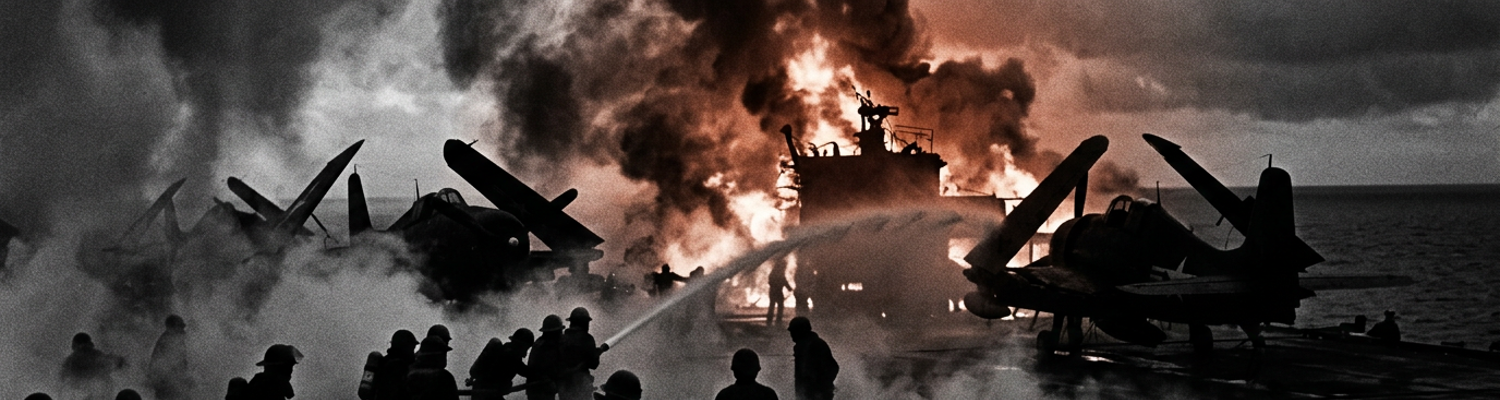
A massive fireball consumed the aft section of the hangar deck.
Striking the aft flight deck the second bomb ripped through a dense cluster of fueled Corsairs parked near the arresting wires. Detonating explosives pushed raw fuel across the wooden planks. Blast pressure knocked deck crews off their feet and threw them directly into the spreading flames. The secondary explosions caused the majority of the structural devastation and crew casualties. As the pool fires on both decks exceeded 1000 degrees Fahrenheit the 500-pound bombs and 1250-pound Tiny Tim rockets began to cook off. The solid-propellant rocket motors ignited from the external heat.
These massive projectiles ripped loose from the burning aircraft.
They accelerated blindly across the flight deck and tore through the steel bulkheads of the island superstructure. Warheads detonated randomly among the panicked crew. The blasts destroyed the forward radio room and severed interior communications. Millions of rounds of .50-caliber machine gun ammunition stored in the aircraft wings cooked off. Stray tracer rounds swept the open spaces. Down in the hangar bay the cascading detonations of general-purpose bombs blew the heavy steel aircraft elevators out of their tracks. The massive steel platforms crashed into the sea. Fire suppression systems failed instantly as the initial blasts severed the primary water mains running along the starboard side. Thick black smoke choked the engineering spaces below the waterline while secondary blasts continued to rock the ship for hours. Men trapped in the aft steering compartments suffocated as the ventilation intakes sucked in the heavy carbon monoxide off the burning flight deck. Internal temperatures inside the hangar bay climbed high enough to warp the structural steel I-beams supporting the flight deck above.